IDM NT202 (DT) Mitsubishi Elevator Digital Five-Party Intercom Optical Multiplexer
Five-Party Intercom
The IDM NT202 (DT) Mitsubishi elevator digital five-party intercom optical multiplexer provides a dedicated digital five-party intercom interface card that can match the signaling of five-party intercom units, enabling five-party communication between the central office and the machine room, car, car top, and pit. Five-party intercom optical multiplexers are available in 2-channel IDM NT202 (DT), 8-channel IDM ENT448 (DT), 30-channel IDM 30EN (DT), and other models. They meet the signal transmission needs from elevator group machine rooms of different capacities to the central office monitoring room, and are also suitable for fiber access transmission during monitoring room relocation and consolidation.
IDM NT202 (DT) 2-channel Mitsubishi elevator digital five-party intercom optical multiplexer is an elevator five-party intercom optical fiber transmission equipment developed by Beijing Ruiguang Jiyuan Digital Technology Co., Ltd. As a professional elevator terminal product showcase, this device is used to extend the voice and signaling of the Mitsubishi elevator digital five-party intercom from the elevator machine room over optical fiber to the central office monitoring room. As modern communities expand in scale, the distance between the elevator central office monitoring room duty equipment room and the elevator machine room often exceeds the transmission distance of five-party intercom twisted pair. One way to address this is to switch to GSM mobile network transmission, but this approach is constrained by the GSM charging model and is not economically reasonable for long-term operation. By installing one IDM NT202 (DT) at each end — the elevator machine room and the monitoring room — and using optical cable in between, optical fiber extension from the elevator machine room to the monitoring room can be achieved, upgrading this link from twisted pair to optical fiber while keeping the original call, answer and alarm modes of the intercom unchanged. As a representative product of the optical multiplexer manufacturer under Raytrans, this telephone optical multiplexer effectively solves the challenge of optical fiber access during elevator monitoring room relocation, providing a reliable optical multiplexer solution for elevator five-party intercom optical fiber transmission.
Key Specifications at a Glance: 2-channel five-party intercom voice channels · Mitsubishi elevator digital dedicated signaling interface card · Optical fiber replaces twisted pair · Independent Ethernet channel · Powered from the dedicated elevator power source · Paired point-to-point between equipment room and monitoring room
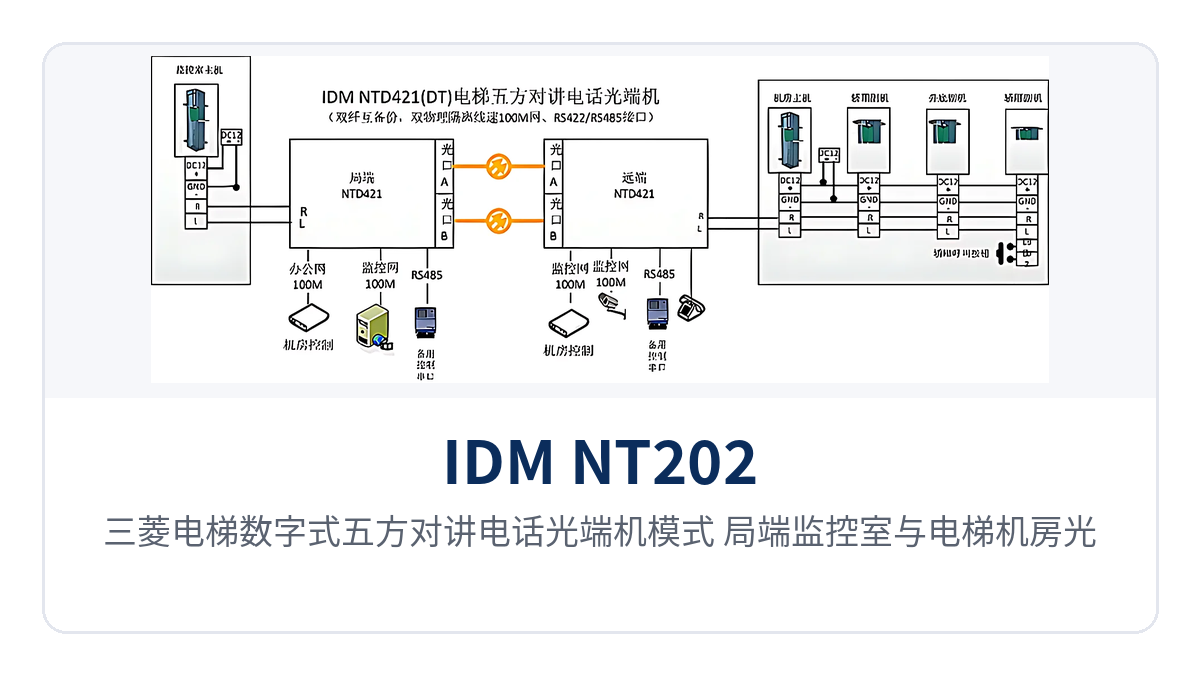
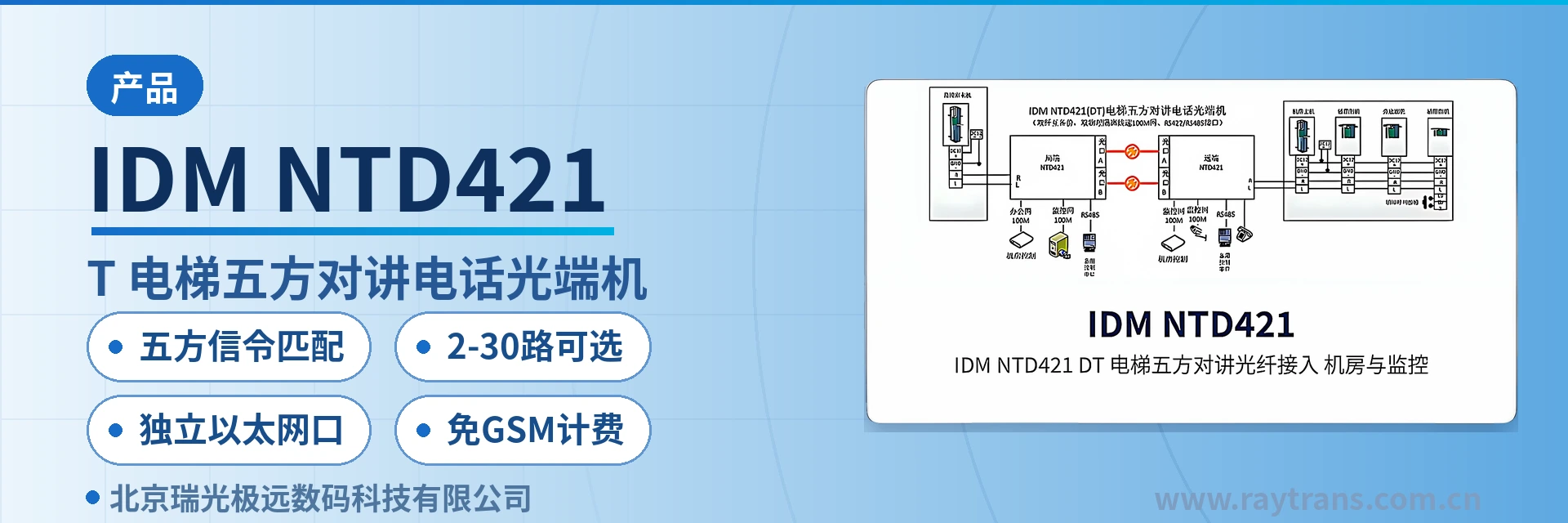
Figure 1: Mitsubishi elevator digital five-party intercom telephone optical multiplexer mode — schematic of optical fiber interconnection networking between the central office monitoring room and the elevator machine room
What Is a Mitsubishi Elevator Digital Five-Party Intercom Optical Multiplexer? How Does Five-Party Communication Run over Optical Fiber?
An elevator terminal five-party intercom optical multiplexer is a transmission device that replaces the twisted pair link between the equipment room side and the monitoring room side of an elevator five-party intercom system with an optical fiber link. Elevator five-party intercom covers five points: the duty room, the elevator machine room, inside the car, the car top and the pit. Among these, the car, car top and pit are aggregated via the elevator traveling cable to the machine room electrical control box, while the duty room side is cabled separately. On site, four-core bus wiring is commonly used, such as RVVP 4×0.75 cable. What truly needs to be sent across the equipment room to the duty room is only the voice and signaling link between the intercom master unit and the machine room.
When the distance between the equipment room and the duty room exceeds the transmittable range of twisted pair, the solution is to install optical multiplexers at both ends and use optical cable in between. Raytrans IDM NT202 (DT) is installed in pairs at the equipment room and monitoring room ends, with 2-channel intercom voice and signaling transmitted transparently over optical fiber. The optical fiber link isolates the voltage and current paths at both ends of the copper cable. The device detects voltage and current changes at the electrical interface and restores them at the other end over optical fiber. The monitoring room master unit uses this to identify the call, busy line and hang-up status of each extension, enabling normal communication between the duty room and the equipment room, car, car top and pit.
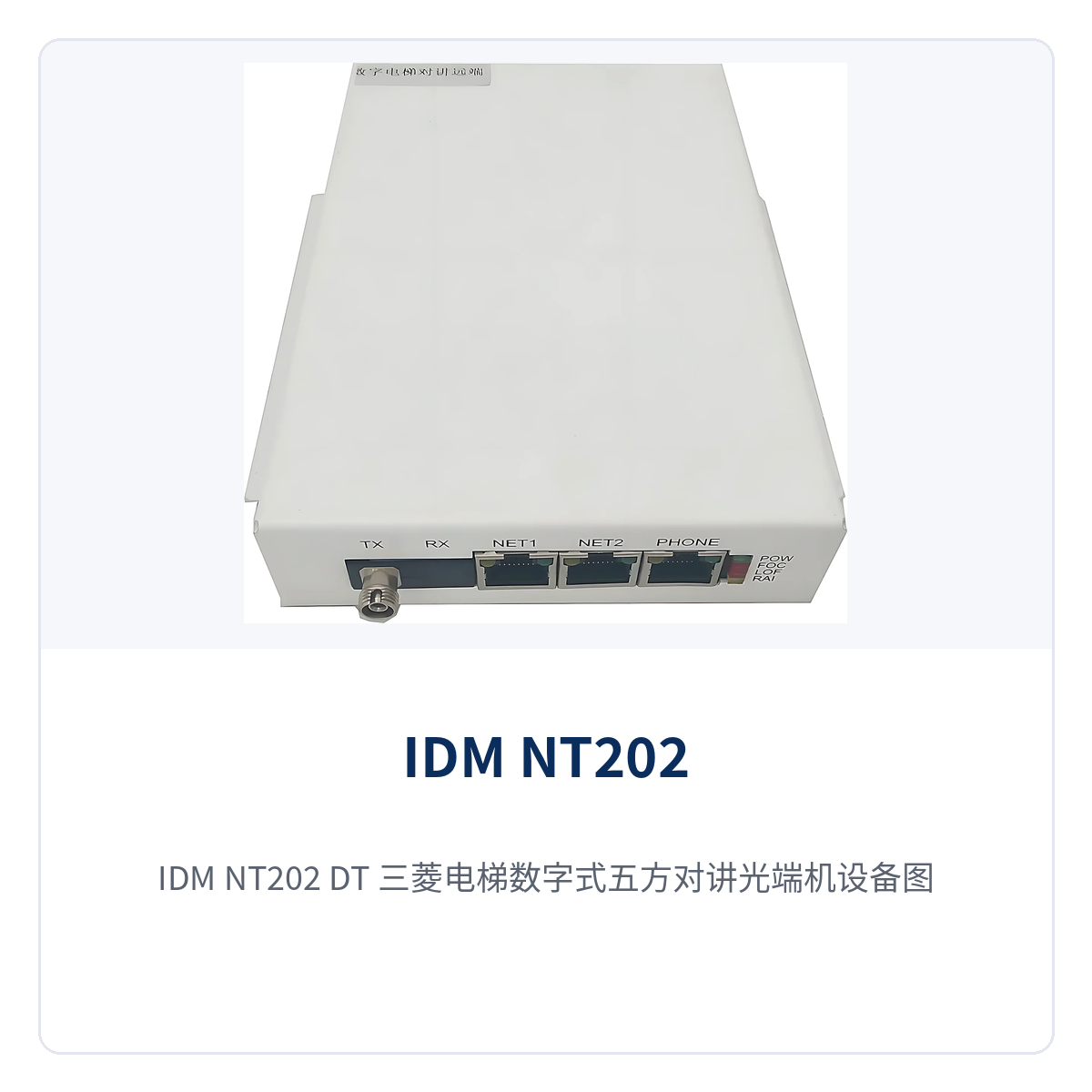
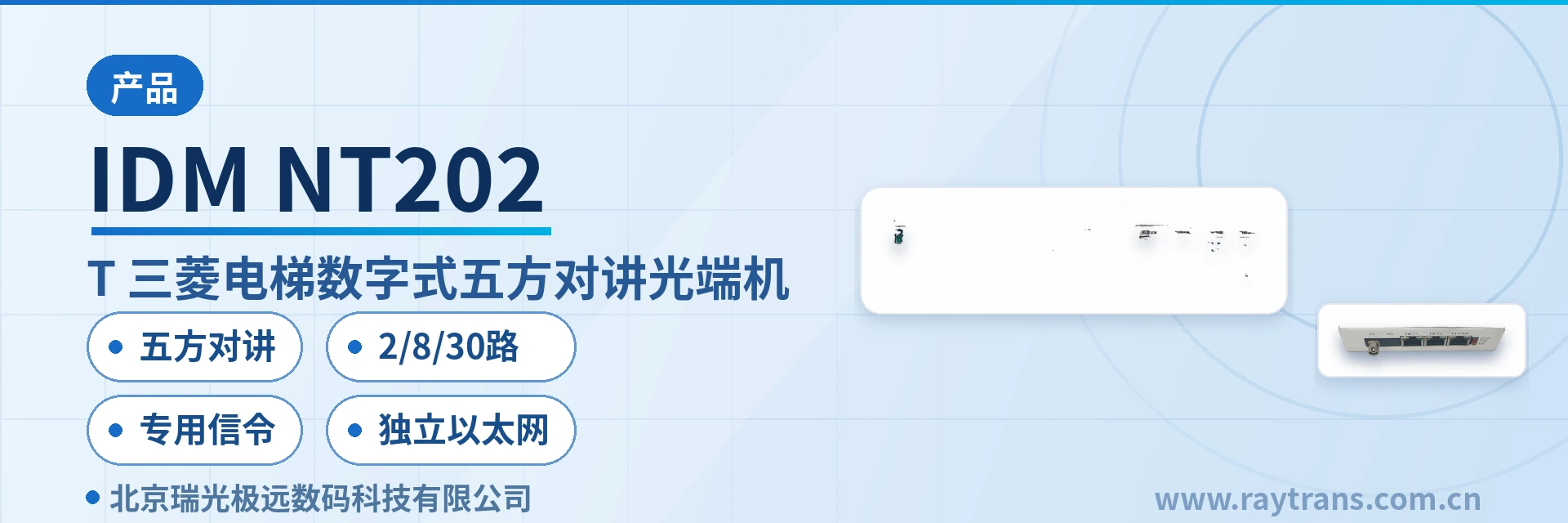
Figure 2: IDM NT202 (DT) Mitsubishi elevator digital five-party intercom optical multiplexer device image — close-up of the front panel intercom interface and optical port
Why Can't a Mitsubishi Elevator Digital Intercom Directly Use an Ordinary Telephone Optical Multiplexer?
Digital five-party intercom telephones work on a different principle from ordinary telephones. An ordinary telephone optical multiplexer is designed for telephone feeding, ringing and voice transmission, and cannot identify the signaling of a Mitsubishi elevator digital intercom, so it cannot be directly applied. Raytrans IDM NT202 (DT) is equipped with a dedicated five-party intercom interface card. The dedicated signaling interface card matches the signaling of the Mitsubishi elevator digital intercom and restores the call, answer and alarm states at both ends of the optical fiber, thereby achieving five-party communication between the central office and the equipment room, car, car top and pit.
Interface configuration is directly related to the brand and format of the on-site intercom. The Mitsubishi elevator digital system has interfaces that differ from older analog systems and systems of other brands. During project selection, the elevator brand, intercom model and format need to be provided, and the interface card configuration is subject to the manufacturer's technical documentation.
How to Choose Between the 2-Channel Mitsubishi Elevator Digital Five-Party Intercom Optical Multiplexer and the 8-Channel or 30-Channel Models?
Five-party intercom optical multiplexers are graded by intercom capacity, with 2/8/30-channel capacities available, matching transmission from elevator groups of different scales to the monitoring room. They are also suitable for optical fiber access transmission scenarios such as elevator monitoring room relocation and monitoring room consolidation. During selection, first count the number of elevator sites and the number of channels the monitoring room needs to access, then confirm the interface card model according to the brand and format of the elevator intercom.
Model | Intercom Capacity | Application |
|---|---|---|
IDM NT202 (DT) | 2-channel | Single or a small number of elevators; paired point-to-point optical fiber extension between equipment room and monitoring room |
IDM ENT448 (DT) | 8-channel | Medium-capacity elevator groups; intercom from multiple elevators aggregated in the equipment room and sent to the monitoring room over one optical fiber |
IDM 30EN (DT) | 30-channel | Large-capacity elevator groups, or aggregate at the central side during relocation or consolidation of an existing elevator management center |
Capacity and interface configuration are subject to the manufacturer's technical documentation. When multiple elevators are under centralized management, multiple intercom signals can first be tandem-connected at the equipment room side via the elevator intercom concentrator and splitter, then connected to the optical multiplexer or aggregation equipment, uniformly extending the elevator group intercom to the surveillance center.
IDM NT202 (DT) Core Functions
Raytrans IDM NT202 (DT) is designed around optical fiber transmission for the Mitsubishi elevator digital five-party intercom, with functions configured as shown in the table below.
Function | Description |
|---|---|
Dedicated signaling interface card matching | Built-in dedicated five-party intercom interface card matches the signaling of the Mitsubishi elevator digital intercom and restores the call, answer and alarm states at both ends of the optical fiber |
Voltage and current characteristic restoration | Detects voltage and current changes on the twisted pair side at the electrical interface, restores them at the other end after optical fiber transmission, and maintains the intercom master unit's identification of each extension status |
2-channel intercom voice channel access | A single device accesses 2-channel elevator intercom voice channels, covering the five-party intercom link of a single or a small number of elevators |
Long-distance extension over optical fiber | Optical fiber replaces twisted pair to carry voice and signaling; the link is no longer limited by the transmission range of twisted pair, adapting to deployment up and down the hoistway, across buildings and across parks |
Anti-interference and electrical isolation | The optical fiber link achieves electrical isolation, is immune to electromagnetic interference along the line, and eliminates communication anomalies caused by ground potential difference at both ends of the twisted pair |
Independent Ethernet channel | Provides an independent Ethernet channel that can carry Ethernet services such as car video surveillance along the same route; bandwidth specifications are subject to the manufacturer's technical documentation |
Coordination with centralized access | Can work with the elevator intercom concentrator and splitter to aggregate intercom signals from multiple elevators over optical fiber to the surveillance center for centralized management |
Powered from the dedicated elevator power source | Uses a dedicated power supply connected to the elevator power source, with nearby power supply access on the equipment room side, eliminating the need to lay separate power cabling during installation |
IDM NT202 (DT) Technical Specifications
The main technical specifications of the Raytrans IDM NT202 (DT) Mitsubishi elevator digital five-party intercom optical multiplexer are shown in the table below. The model is a 2-channel capacity elevator intercom optical fiber transmission device, and the specific configuration is subject to project confirmation.
Item | Parameter/Specification | Description/Applicable Conditions |
|---|---|---|
Product name | IDM NT202 (DT) Mitsubishi elevator digital five-party intercom optical multiplexer | Dedicated optical fiber transmission equipment for elevator digital five-party intercom systems, 2-channel capacity |
Application target | Mitsubishi elevator digital five-party intercom system | Used in pairs between the elevator machine room and the central office monitoring room |
Intercom channel | 2-channel | Matches Mitsubishi elevator digital intercom signaling; the number of channels and the interface format are subject to the manufacturer's technical documentation |
Capacity series | 2-channel IDM NT202 (DT), 8-channel IDM ENT448 (DT), 30-channel IDM 30EN (DT), etc. | Meets signal transmission from elevator group machine rooms to the central office monitoring room at different capacities |
Transmission medium | Optical fiber | Replaces twisted pair to extend five-party intercom voice and signaling; the optical transmission distance is determined by the optical module and line conditions, subject to the manufacturer's technical documentation |
Ethernet channel | Independent Ethernet channel | Can carry Ethernet services such as car video surveillance; bandwidth specifications are subject to the manufacturer's technical documentation |
Power supply mode | Dedicated power supply connected to the elevator power source | Power is taken nearby on the equipment room side; the voltage range is subject to the manufacturer's technical documentation |
Interface configuration | Intercom interface, optical interface | The intercom interface is configured with the corresponding interface card according to the on-site elevator brand and format; confirm with the manufacturer |
Operating environment | Elevator machine room, central office monitoring room | Indicators such as temperature and humidity are subject to the manufacturer's technical documentation |
The performance specifications on this page are subject to the manufacturer's technical documentation; when project selection involves intercom capacity, transmission distance and interface format, it is recommended that the optical multiplexer manufacturer provide a configuration list according to the on-site conditions.
Fiber Replacing Twisted Pair: How to Wire for Over-Distance and Monitoring Room Relocation?
Raytrans IDM NT202 (DT) adopts a point-to-point mode with two paired ends; the wiring consists of three parts: equipment room side access, monitoring room side access and the intermediate optical cable.
Equipment room side access: connect the audio and signaling lines from the five-party intercom master unit to the intercom interface of IDM NT202 (DT), and the device takes power from the elevator power source through a dedicated power supply; points such as the car, car top and pit have already been connected to the equipment room by the traveling cable, so no additional cabling is required.
Monitoring room side access: install the device at the other end in the central office monitoring room, connect the intercom interface to the duty master unit, and the duty operator can then call through and monitor each elevator point.
Intermediate optical cable: lay it along the weak-current shaft, cable tray or cable trunking, terminate both ends and connect them to the optical ports, and the link can be enabled.
Centralized access for multiple elevators: first aggregate multiple intercom signals on the equipment room side through the elevator intercom concentrator and splitter, then connect them to the optical multiplexer or aggregation equipment, so that the intercom of the elevator group is uniformly extended to the surveillance center.
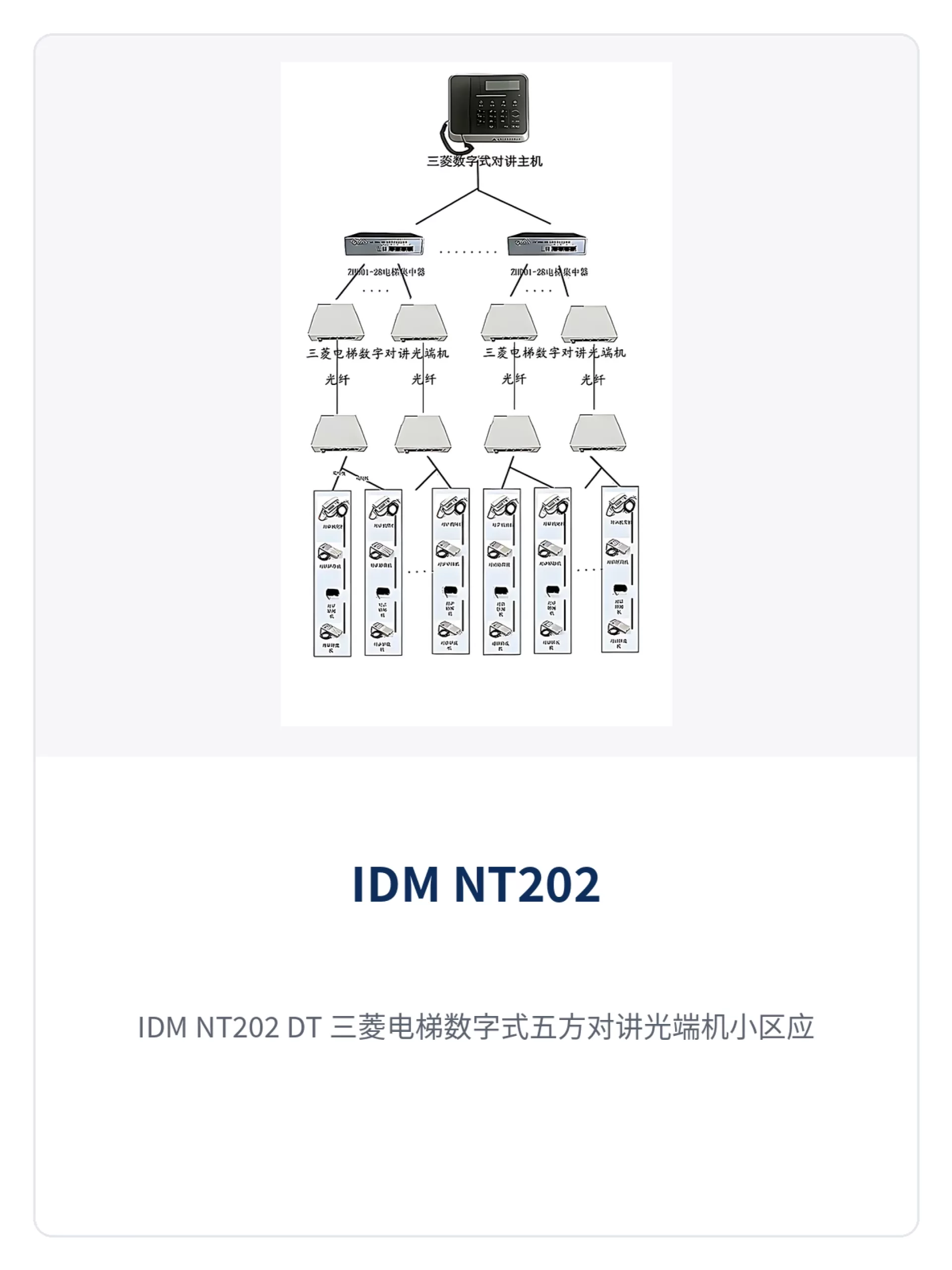
Figure 3: IDM NT202 (DT) Mitsubishi elevator digital five-party intercom optical multiplexer residential community application diagram — schematic of elevator group machine room aggregation access to the monitoring room
Optical fiber replaces twisted pair, breaking through the distance limit with no burden of the GSM charging model; one-time laying enables long-term use, with no need to pay per channel per month. Two points also need attention during installation.
When the brand and format of the intercom differ, the interfaces and wiring sequence vary; before installation, confirm the interface card and wiring definition with the manufacturer to avoid rework on site.
When the monitoring room is relocated or merged, simply reposition the monitoring room side equipment with the new equipment room and re-terminate both ends of the optical cable, and the intercom link can migrate along with the optical cable.
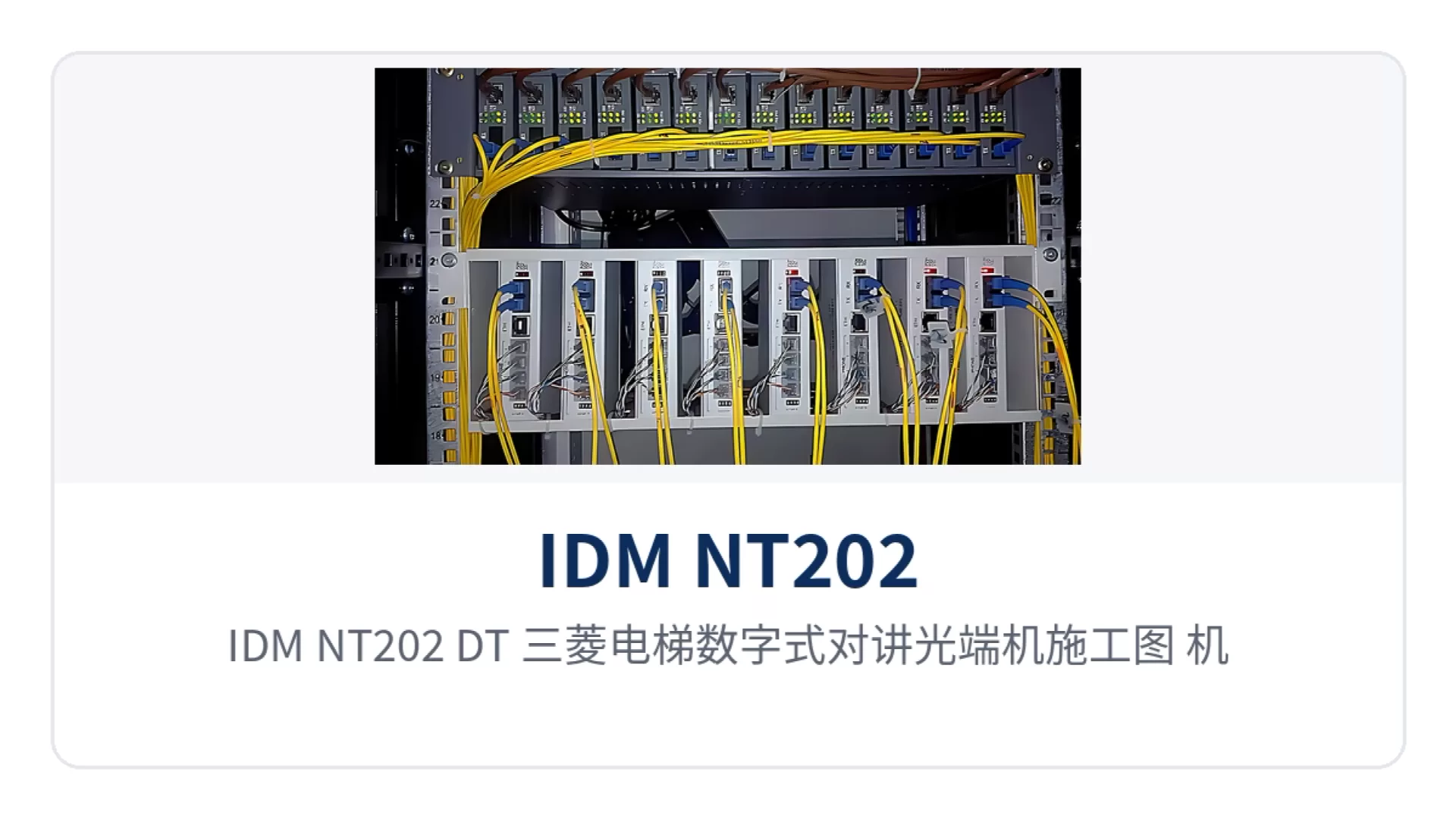
Figure 4: IDM NT202 (DT) Mitsubishi elevator digital intercom optical multiplexer installation diagram — equipment room side equipment positioning and intercom signal wiring
Typical Application Scenarios
Elevator IoT and Smart Community Integrators
The elevator machine rooms of residential communities are mostly located on the top floor or the equipment floor, while the monitoring room is often set up in the ground-floor lobby, the gatehouse of the park or the surveillance center, and the distance between them often exceeds the direct-connection range of twisted pair. In the link extending optical fiber from the elevator machine room to the monitoring room, after laying optical cable between the machine room and the monitoring room and installing IDM NT202 (DT) at both ends, when a trapped passenger in the car presses the alarm button, the duty operator can connect and keep reassuring them, and at the same time notify maintenance and rescue personnel, shortening the time to handle the trapped passenger. Elevator IoT projects can also use the independent Ethernet channel provided by this elevator terminal device to carry product showcase services such as car surveillance, incorporating intercom and video into the same optical cable resources and reducing repeated cabling and hoistway occupation.
Property Group Elevator Monitoring Center
Property groups need to centralize duty for elevator intercom scattered across multiple parks and multiple buildings. IDM NT202 (DT) aggregates the intercom voice of each machine room into the park elevator private network via optical fiber, and the surveillance center uniformly calls through each point of the car, car top and pit; maintenance personnel first contact and reassure the trapped passenger at the center, then dispatch the nearest team to the site, shortening the response time. This elevator five-party intercom optical fiber transmission solution does not need to rely on GSM monthly billing, nor does it need to lay extra-long twisted pair inside the building, making it suitable for link migration when the elevator monitoring room is relocated or merged with fiber access.
Industrial and Park Private Network Communication Integrators
The elevator machine rooms of industrial parks, plants and office parks are scattered at points such as workshops and auxiliary factory buildings, the central control room is far away, and some sites are unattended. IDM NT202 (DT) extends the intercom voice of scattered machine rooms to the central control room via optical cable, so that on-duty personnel can call through each elevator point without going to the site. For private network projects, the independent Ethernet channel of the device can carry data services such as monitoring and alarms along the way; the optical cable is laid once along the park pipe trench and cable tray, and voice extension across buildings and across parks requires no additional transmission channel.
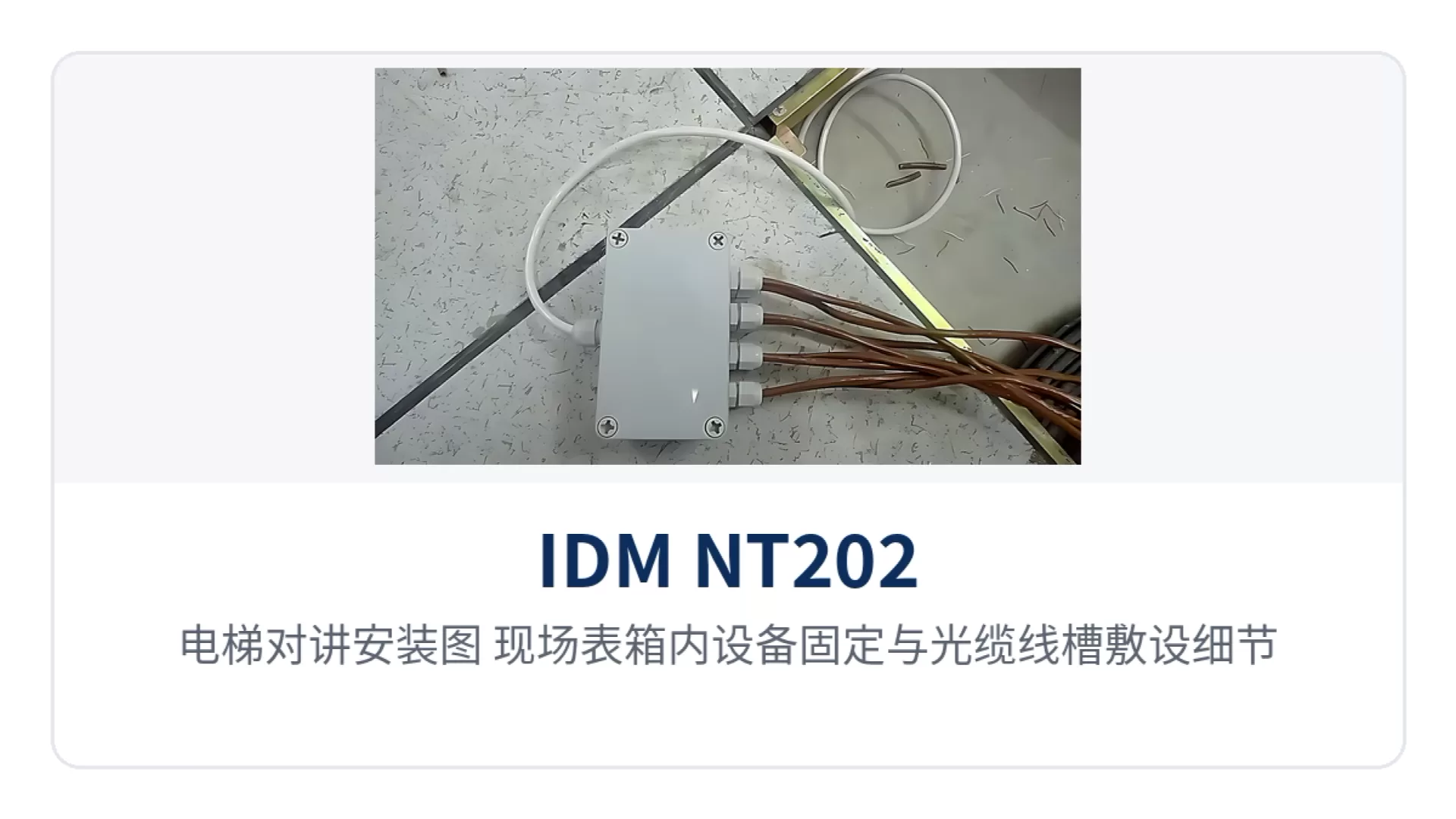
Figure 5: Elevator intercom installation diagram — details of equipment fixing in the on-site meter box and optical cable trunking laying