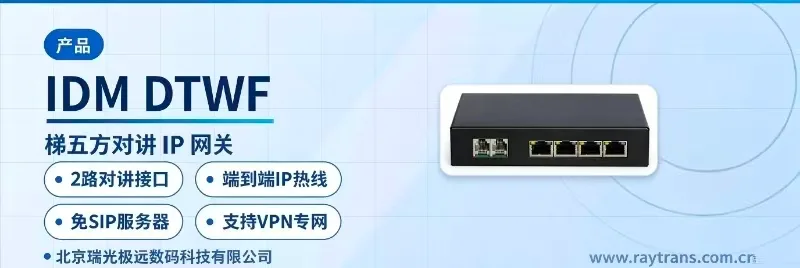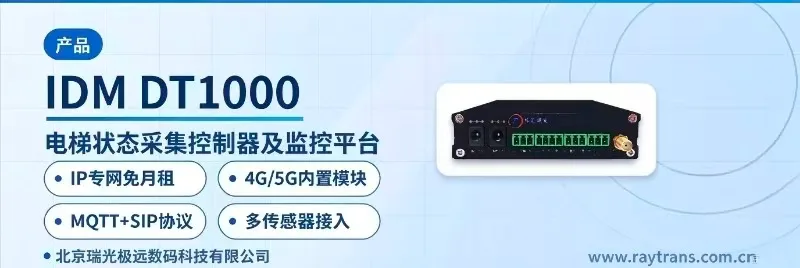
IDM DT1000 Elevator Status Acquisition Controller
Accelerometer and Barometer for Floor Detection, SIP Intercom Compatible with Existing Five-Party System, Dual-Mode Backhaul MQTT
The IDM DT1000 elevator status acquisition controller is available in a full-function access type and a standard-function access type. It is used for elevator operating status acquisition and reporting, remote control and management of elevators, and emergency call-for-help alarms inside the elevator car. It can be applied to all aspects of smart elevators.
IDM DT1000 elevator IoT status acquisition controller is an elevator terminal installed on the elevator car side. Developed by Beijing Ruiguang Jiyuan (Raytrans), it is used for elevator status acquisition and reporting, remote control and management of elevators, and in-car emergency call and alarm in emergency situations. It comes in two forms: full-function access-type and standard-function access-type, and can be applied to all aspects of smart elevators, providing reliable elevator terminal product showcase for command and dispatch system manufacturers and smart elevator IoT monitoring solutions.
Key Specifications at a Glance: 4G/5G + fixed IP dual-mode backhaul · MQTT standard protocol · SIP five-party intercom · AI e-bike recognition · full-function multi-sensor access · accelerometer + barometer acquisition
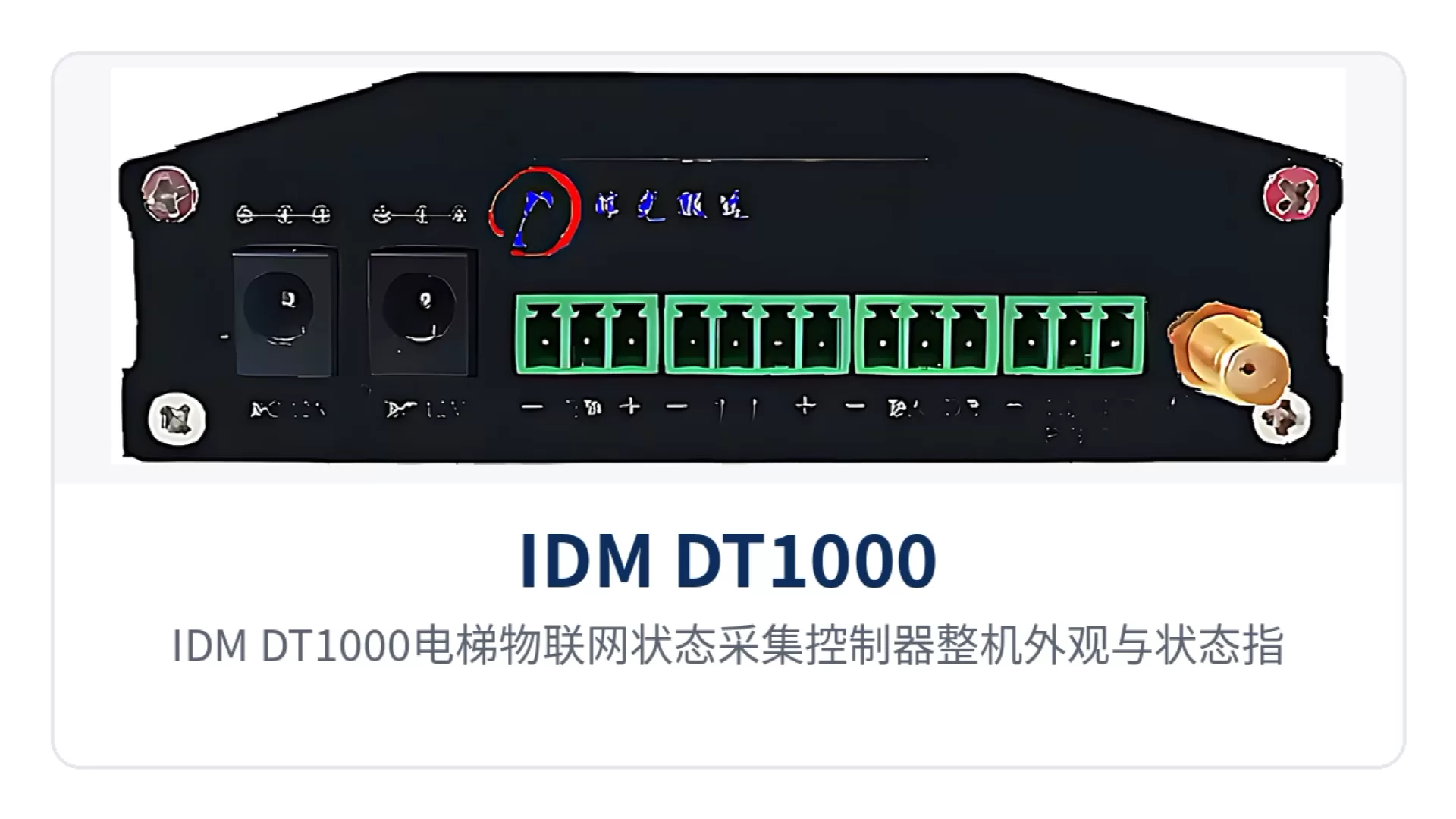
Figure 1: Overall appearance of the IDM DT1000 elevator IoT status acquisition controller and close-up of status indicator LED interfaces
What problems does the elevator IoT status acquisition controller solve
Elevators are highly dispersed, managed by numerous management units, and maintained by teams with varying levels of specialization — this is the realistic starting point of elevator safety management. Many local governments have therefore built elevator emergency response and IoT remote monitoring platforms, typically including a one-map (situational display) for elevator management, an emergency rescue and response system, an IoT remote monitoring system, a maintenance management system, an operation warning and alarm system, and an elevator big data analysis system. Without a unified status acquisition entry point at the front end, the back-end platform lacks a usable data source.
The IDM DT1000 elevator IoT status acquisition controller consolidates car-side acquisition, reporting, remote control and emergency call into one elevator terminal, forming a complete link of front-end acquisition, link backhaul and platform supervision. The device is available in two forms: full-function access-type and standard-function access-type. The standard type covers basic capabilities such as elevator status acquisition and reporting, voice broadcast, door control and card swiping; the full-function type, on top of all standard-type functions, can also connect to base station, leveling, door opening, overweight and human infrared sensors.
What access capabilities do the standard type and full-function type provide respectively
The difference between the standard type and the full-function type lies mainly in the sensor access scope. The standard type suits basic upgrades focused on status reporting, voice and door control; the full-function type suits smart deployments requiring multi-dimensional monitoring of leveling, door opening, overweight and human presence in the car. The functional composition of the two forms is shown in the following table:
Function | Description |
|---|---|
IP car status acquisition and reporting | Acquires car operating status and current floor via built-in accelerometer and barometer, and reports over the IP link |
TTS voice playback | Text-to-speech broadcast and prompts for passengers in the car |
HIFI voice broadcast | High-fidelity music and voice broadcast, capable of carrying notifications and emergency voice |
Door open/close button control | Supports button or remote command control of car door opening and closing |
Floor sensing and calibration | Senses and calibrates the floor at which the car stops, ensuring the reported floor matches the actual one |
Card swiping control | Identifies riding permissions by card swiping and completes floor selection, and can interwork with access control systems |
SIP voice intercom | Implements two-way voice call intercom inside and outside the car via standard SIP softswitch protocol |
Access to the elevator's existing five-party intercom system | Connects to the existing five-party intercom to enable remote calls with personnel in the car |
Base station, leveling, door opening, overweight and human infrared sensor access | Available on the full-function type for multi-dimensional elevator safety monitoring |
4G/5G or fixed IP network transmission | Dual-mode backhaul channel for status information reporting and control information delivery |
Standard MQTT IoT protocol | Establishes contact with the community elevator monitoring center for status reporting and command delivery |
AI smart camera linkage | When an e-bike is recognized being pushed into the car, the elevator does not close its doors or move up, and plays a safety warning voice |
Delivery robot cooperation | Works with delivery robots to enable robot entry into the elevator for upstairs delivery |
Mobile phone elevator reservation APP | Supports viewing elevator status and reserving floors on mobile phones |
Data statistics and analysis | Statistics of failures and complaints by region, production unit, maintenance unit and time |
Elevator big data analysis system | Provides information services around elevator safety, emergency rescue and elevator maintenance |
Visualized big data display platform | Displays the elevator supervision brain on a large display for elevator situation and supervision statistics |
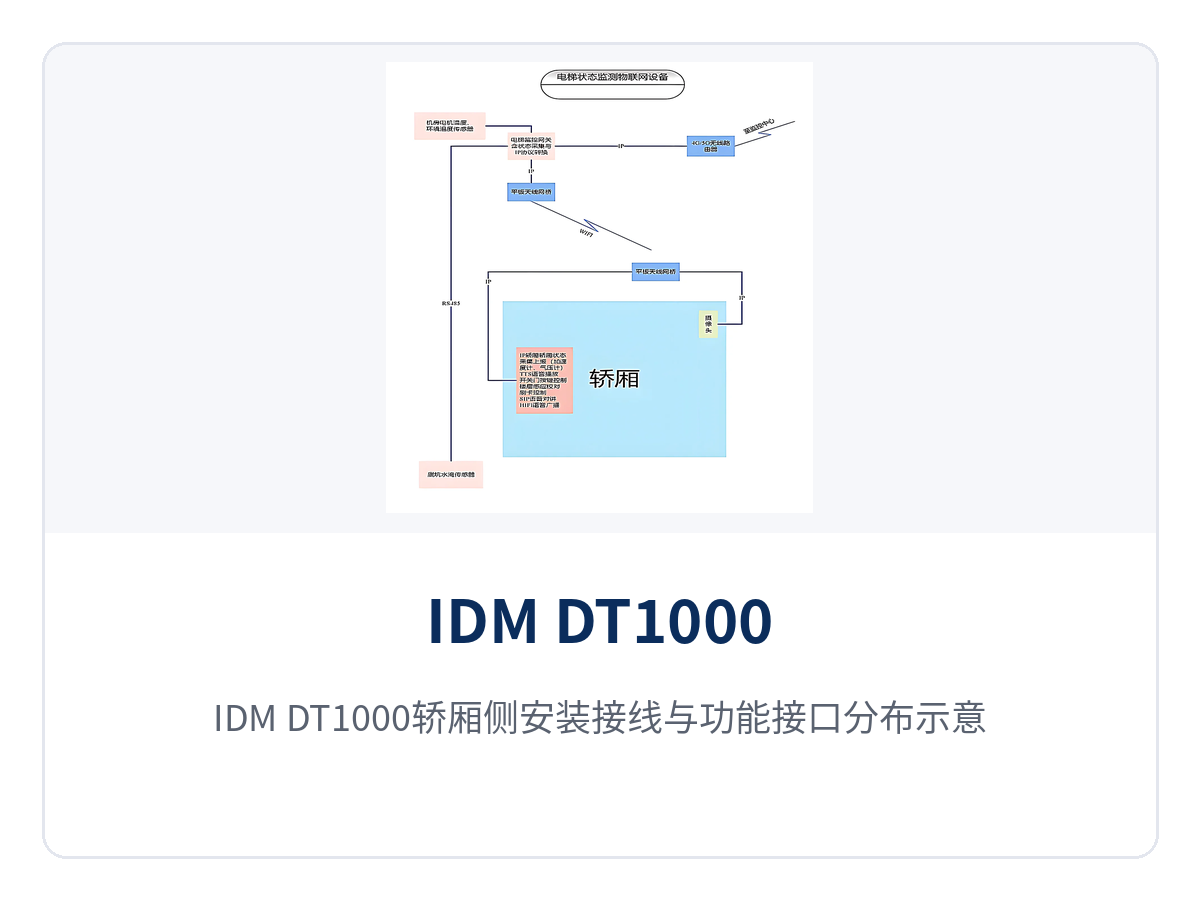
Figure 2: Schematic of car-side installation and wiring and functional interface layout of the IDM DT1000
How does 4G/5G or fixed IP dual-mode backhaul directly connect to the community elevator monitoring center
Elevator status data must be sent to the community or enterprise service center, which then connects to the government's unified monitoring platform. The backhaul channel is the prerequisite link that must be established first in this chain. The IDM DT1000 elevator IoT status acquisition controller provides two backhaul channels, mobile communication and fixed IP, both using the same set of standard protocols, so the back-end monitoring center needs no differentiated handling.
Fixed IP channel: the IDM DT1000-IP accesses the local IP transmission network, usually sharing the same optical fiber network with the industrial park monitoring system. No monthly rental fees apply, the transmission channel is stable, and the initial installation cost is slightly higher.
4G/5G channel: provided by the built-in 4G or 5G mobile communication module of the IDM DT1000-5G version. It can be enabled once installed in the car, is easy to install, and suits sites lacking fixed optical fiber that need rapid IoT service enablement.
Both channels connect directly to the community monitoring center via MQTT for status information reporting and control information delivery; on the voice side, the standard SIP softswitch protocol carries voice call intercom. One link carries both data and voice, enabling unified management of community elevator status over one network.
How does SIP softswitch voice intercom remain compatible with the elevator's existing five-party intercom system
Many regions require that elevator voice intercom should connect to the elevator's existing five-party intercom system to enable remote calls with personnel in the car — a common compliance requirement in existing elevator upgrades. The IDM DT1000 elevator IoT status acquisition controller handles two-way calls via SIP voice intercom: trapped passengers can call the monitoring center or duty room from the car, and on-duty personnel can also call the car in reverse to provide reassurance and rescue guidance.
Compatible with existing systems: the device supports access to the elevator's existing five-party intercom system, retaining passengers' existing alarm and call habits without installing a second intercom device in the car.
Standard protocol interfacing: SIP is an open standard protocol, facilitating interfacing with community and enterprise elevator monitoring centers, as well as access to unified monitoring platforms as required in many regions.
Voice hosted on one device: SIP voice intercom handles two-way calls, HIFI voice broadcast handles one-way announcements, and TTS voice playback automatically converts text into speech — all three voice types share one car terminal.
What car statuses can elevator multi-sensor access monitor
The value of the full-function type lies in extending elevator status acquisition from operating data to multi-dimensional safety data. In addition to the accelerometer and barometer built into the standard type, full-function elevator multi-sensor access can be extended to the following car sensors:
Base station sensor: determines the elevator's current base station position.
Leveling sensor: verifies leveling stop accuracy and identifies non-leveling stops.
Door opening sensor: records car door open/close status and door opening duration.
Elevator overweight sensor: reports an alarm when overloaded.
Human infrared monitoring sensor: determines whether anyone is in the car, used for trapped-person determination.
After these signals are aggregated, they can be used for operation warnings, entrapment determination, and on-demand maintenance decisions, and together with accelerometers and barometers they form the multi-source data sources of the elevator IoT status acquisition controller.
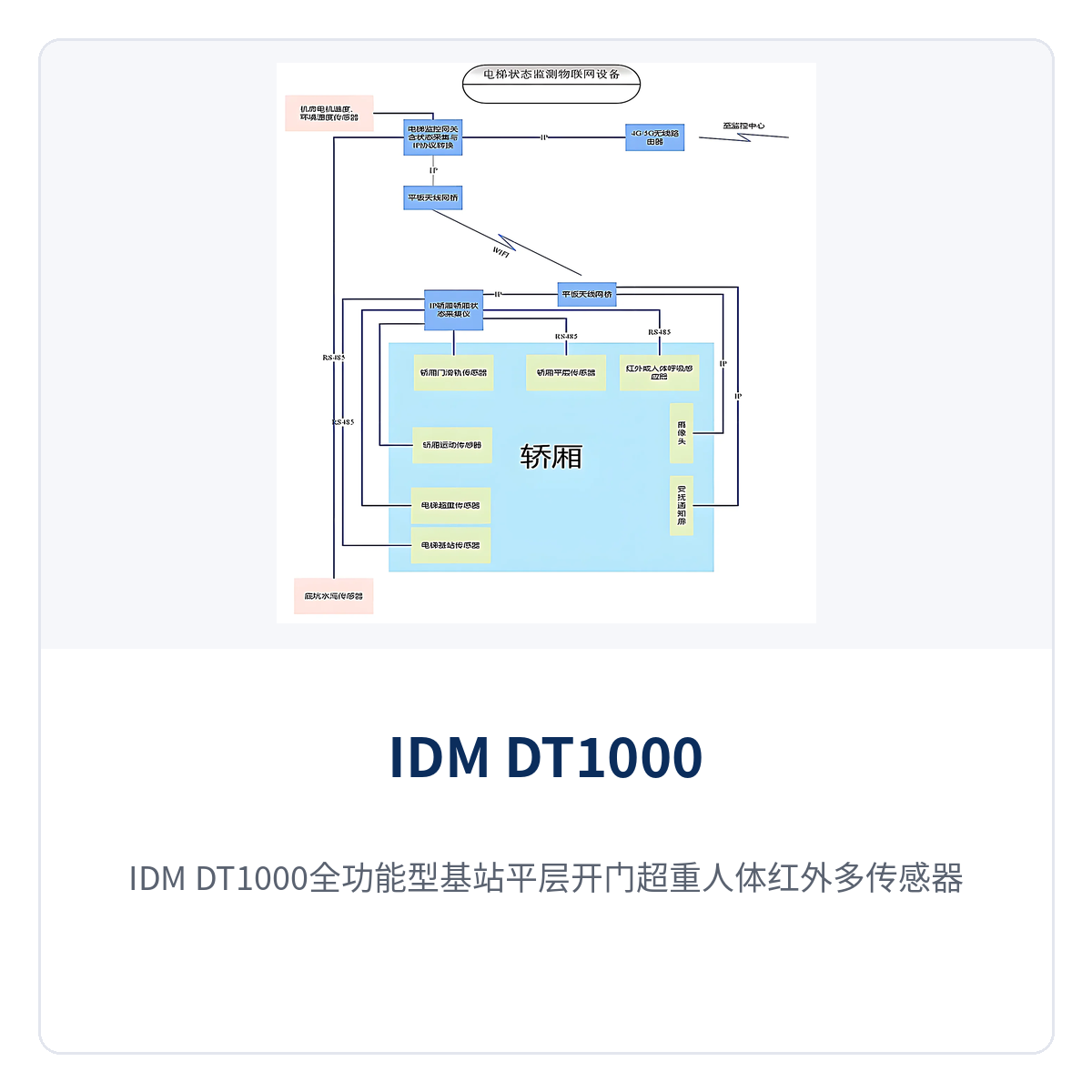
Figure 3: IDM DT1000 full-function base station, leveling, door opening, overload, and human infrared multi-sensor access schematic
How AI electric vehicle recognition and delivery robot linkage are implemented
Charging electric vehicles inside buildings is one of the safety hazards in high-rise residential buildings, and management methods used to rely on manual dissuasion. IDM DT1000 can connect to AI smart cameras: when a camera recognizes that an electric vehicle is being pushed into the cable car cabin, the elevator does not close its doors or move upward, and at the same time plays a safety warning voice to dissuade residents from pushing electric vehicles onto high floors, stringing recognition, door control, and voice into a single on-site response.
AI electric vehicle recognition: the camera is responsible for recognizing the electric vehicle, and the terminal is responsible for executing door control and voice actions.
Safety warning voice: carried by HIFI voice broadcast and TTS voice playback, with no need for manually recorded audio.
Delivery robot coordination: works with delivery robots to allow robots to enter the elevator and deliver goods upstairs, reserving elevator control interfaces for unmanned delivery.
What the elevator status monitoring platform and visualized big data display contain
Front-end acquisition is only the starting point; data must be aggregated in the surveillance center into usable operational and management information. In a community or enterprise service center, managers can view the status of all elevators, with real-time alarms, alarm logs, and site alarm management retained by event; data statistics and analysis can count elevator failures and complaints by area, production unit, maintenance unit, and time, and complaint records include complaint content and count but do not include the complainant's personal information.
The platform side also includes a mobile phone elevator reservation APP, an elevator big data analysis system, and a visualized big data display platform. The visualized big data display platform uses a large display to carry the elevator supervision brain, covering dimensions such as overview statistics, maintenance company statistics, elevator manufacturer statistics, operation statistics, complaint content statistics, maintenance content statistics, inspection statistics, and alarm statistics; the visualized interface is customized in layout according to user needs and habits, and can view the trajectories, map positioning, video, and case reports of emergency rescue and daily O&M personnel, making it convenient for the surveillance center to intervene immediately and issue instructions.
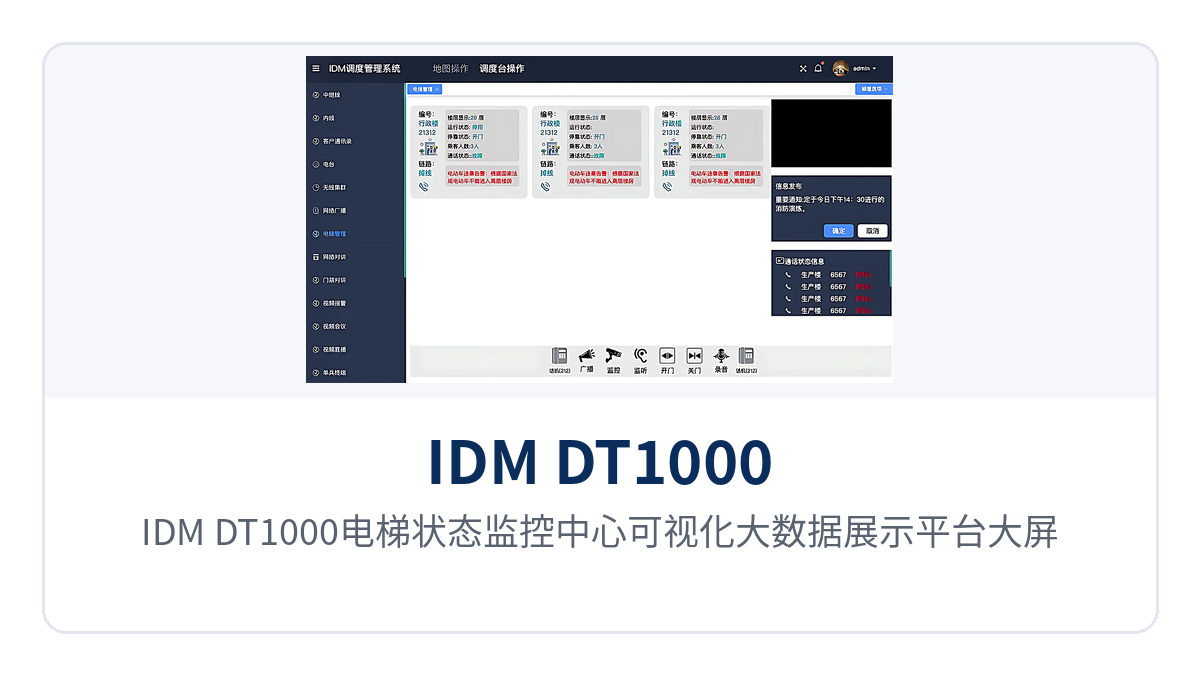
Figure 4: IDM DT1000 elevator status monitoring center visualized big data display platform large display interface
Technical Specifications and Performance Specifications
Item | Parameter/Specification | Description/Applicable Conditions |
|---|---|---|
Product form | Full-function access type, standard-function access type | The standard type covers basic acquisition, voice, and door control; the full-function type adds access for multiple types of sensors |
Acquisition method | Accelerometer, barometer | Built-in acquisition of cable car cabin operating status and floor location |
External sensors | Base station, leveling, door opening, overload, human infrared | Supported by the full-function type, used for multi-dimensional elevator safety monitoring |
Backhaul channel | 4G/5G mobile communication, fixed IP network | Dual-mode optional; fixed IP usually shares the optical fiber network with the industrial park monitoring system |
IoT protocol | Standard MQTT | Connects with the community elevator monitoring center, reporting status information and delivering control information |
Voice protocol | Standard SIP softswitch | Two-way voice call intercom inside and outside the cable car cabin, supporting access to the existing five-party intercom system |
Voice output | TTS voice playback, HIFI voice broadcast | Text-to-speech announcement and high-fidelity music and notification broadcast |
Access and door control | Card swipe control, door open/close button control, floor sensing verification | Supports access control linkage and remote door control |
Power supply, power consumption, operating temperature, ingress protection (IP) rating | Subject to the manufacturer's product documentation | Not yet recorded in the knowledge base |
Differentiated Value
Differentiated selling points | Value on Site |
|---|---|
4G/5G or fixed IP dual-mode backhaul, MQTT direct connection to the community monitoring center, monthly-fee-free stable channel | Sites with existing industrial park optical fiber use fixed IP access to save monthly fees, while sites lacking optical fiber use 4G/5G and can be enabled inside the cable car cabin; both types of sites share the same protocol and back end |
The full-function type can connect to multiple types of cable car cabin sensors such as leveling, door opening, overload, and human infrared | A single terminal covers operation, leveling, overload, and cable car cabin occupancy determination, providing fine-grained data for entrapment determination, operation warnings, and on-demand maintenance |
SIP softswitch voice intercom, compatible with the elevator's original five-party intercom system for remote calls | Uses the elevator's original five-party intercom link, extending cable car cabin calls for help to the remote duty room, and also facilitates access to a unified monitoring platform according to requirements in multiple locations |
Typical Application Scenarios
Smart community and property management elevator IoT operators
Property management groups focus on controllable cable car cabins and manageable elevator rides. Communities with existing industrial park optical fiber can choose fixed IP backhaul, and monthly-fee-free fixed IP backhaul enables unified management of community elevator status over one network; existing residential communities lacking optical fiber use 4G/5G channels for rapid enablement inside the cable car cabin. Card swipe control can share permission data with building access control, and door open/close button control and floor sensing verification keep orderly starting and stopping during unattended periods; SIP voice intercom and HIFI voice broadcast can both connect to the duty room in emergencies and broadcast daily notifications and prompts. As the core front end of a smart elevator IoT monitoring solution, the elevator terminal integrates product showcase with elevator status acquisition and reporting, providing property management operators with intuitive data support from the elevator IoT status acquisition controller.
Government elevator emergency response and supervision platform construction units
The supervision side requires elevator data to be connected to a unified platform in a standard format, with traceable events and verifiable data. IDM DT1000 reports status via the standard MQTT IoT protocol and uses the SIP softswitch protocol for call-for-help intercom, and can connect to government elevator emergency response and IoT remote monitoring platforms. During selection, construction parties can refer to the Technical Specifications for Internet of Things for Elevators, Escalators and Moving Walks (GB/T 24476-2017) and local standards such as SZDB/Z 116.1—2014 Technical Specifications for Elevator Operation Monitoring Systems regarding the layered requirements of the perception layer, transmission layer, and application layer. Raytrans, as a command and dispatch system manufacturer, provides mature elevator five-party intercom access solutions and technical support in this field.
Industrial park and commercial building low-voltage integrators
Low-voltage integrators usually have already laid optical fiber and IP networks in the park. Reusing the industrial park optical fiber IP network and connecting multiple types of cable car cabin sensors through one device is a common practice in such scenarios: the terminal can backhaul once connected to the local IP network, and the full-function type connects sensors such as leveling, door opening, overload, and human infrared all at once, reducing the cabling workload of adding acquisition devices point by point, and also reserving interfaces for the park's unified low-voltage management platform. The elevator five-party intercom access solution provided by Raytrans can work with the smart elevator IoT monitoring solution to help integrators quickly complete elevator terminal deployment and product showcase interfacing.
Conclusion
IDM DT1000 elevator IoT status acquisition controller integrates elevator data acquisition and reporting, remote control management, and emergency call for help into a single elevator terminal on the cable car cabin side: it uses 4G/5G or fixed IP dual-mode backhaul and the standard MQTT protocol to interface with the community elevator surveillance center, uses SIP softswitch voice intercom to remain compatible with the elevator's existing five-party intercom system, uses full-featured multi-sensor access to complete leveling, door opening, overload, and cable car cabin human presence monitoring, and can interwork with AI smart cameras and delivery robots. Aimed at smart community and property management elevator IoT operators, government elevator emergency handling and supervision platform builders, and industrial park and commercial building low-voltage integrators, the IDM DT1000 elevator IoT status acquisition controller can be deployed together with the matching elevator status monitoring platform to form a complete link from front-end acquisition to platform supervision. Raytrans, as a professional command and dispatch system manufacturer, can provide selection support for smart elevator IoT monitoring solutions and elevator five-party intercom access solutions for the above scenarios, helping elevator terminal product showcase and elevator status acquisition and reporting capabilities land quickly. Specific performance specifications such as power supply, power consumption, operating temperature, and ingress protection (IP) rating are subject to the manufacturer's product documentation and can be further confirmed based on the specific project.