IDM DTWF-2 Elevator Five-Party Intercom IP Gateway
2-channel intercom direct-to-IP, SIP-server-free end-to-end hotline, VPN overlay for non-private networks
When there is no optical fiber connection between the central office monitoring room and the elevator machine room, but an IP connection channel is available, a mode similar to VoIP telephony can be used, but without a SIP server; instead, an end-to-end IP hotline connection is used. In this case, the IDM DTWF-2 elevator five-party intercom gateway can be used. If it is not an IP private network, VPN virtual private network technology is required. The IDM DTWF-2 provides conversion of 2-channel elevator intercom interfaces to an IP transmission network.
The elevator five-party intercom IP gateway IDM DTWF-2 is an elevator intercom remote transmission device developed by Beijing Ruiguang Jiyuan Digital Technology Co., Ltd. (Raytrans). It consists of an elevator intercom interface conversion unit and an IP transmission unit, and is used to directly convert 2 elevator intercom interfaces to an IP transmission network when there is no optical fiber connection but an IP connection channel exists between the central office monitoring room and the elevator machine room, enabling end-to-end IP hotline direct-connect calls without a SIP server. As a professional IP access gateway, the device plays a key role in voice conversion and transmission in elevator intercom IP transmission solutions.
As modern communities expand, the distance between the elevator central office monitoring room main unit duty equipment room and the elevator machine room often exceeds the transmission distance of five-party intercom twisted pair. The transmission distance of traditional twisted-pair elevator five-party intercom is generally limited to 1~2km, beyond which another transmission means must be found. One approach is to use GSM transmission, but constrained by the GSM charging model, long-term operation is not economical; another is to lay new optical fiber, which involves high cost and extensive construction work. IDM DTWF-2 provides a solution based on an IP communication network: as long as an existing IP connection channel exists between the central office and the machine room, IDM DTWF-2 can convert elevator intercom voice into IP packets delivered directly to the duty room, with no SIP server required throughout, also eliminating the expense of adding software and hardware to the central platform. This VOIP telephone SIP-server-free solution effectively reduces system complexity while remaining compatible with the existing SIP telephone ecosystem, facilitating flexible deployment in the duty room.
Key specifications at a glance: 2-channel intercom to IP · SIP-server-free · end-to-end IP hotline · VPN private network encryption · reuse of existing IP channels with no cabling
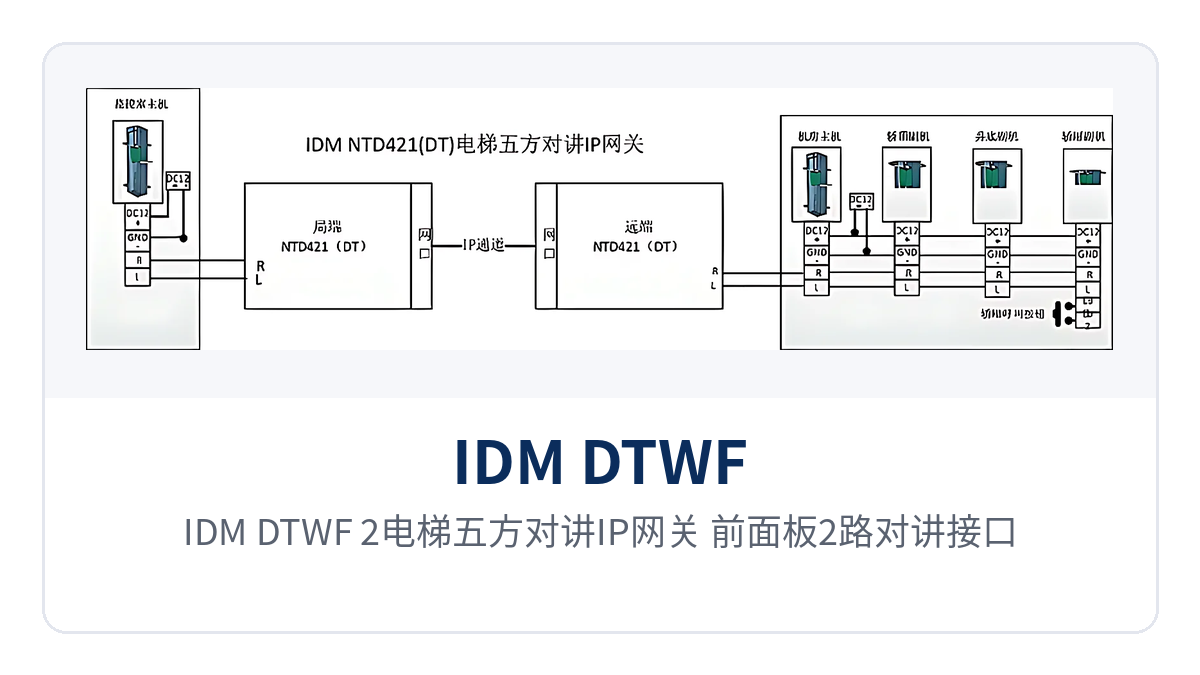
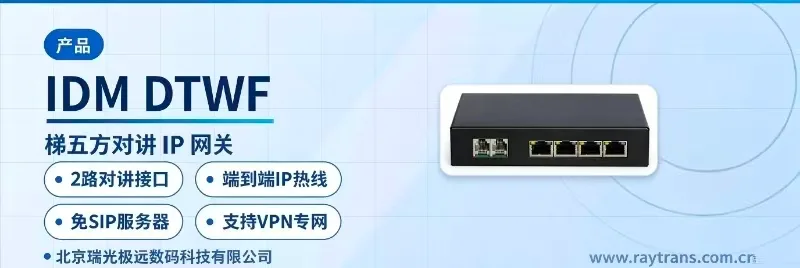
Figure 1: Close-up of the front panel 2-channel intercom interfaces and IP network ports of the IDM DTWF-2 elevator five-party intercom IP gateway
What Is an Elevator Five-Party Intercom IP Gateway: Five-Party Communication Without Fiber but with IP
IDM DTWF-2 is essentially an "intercom interface to IP converter": one end connects to the five-party intercom master unit in the elevator machine room, and the other end encapsulates voice into IP data packets that travel via LAN, industrial park network or MAN directly to the duty master unit in the central office monitoring room. It operates in a mode similar to a VOIP telephone, but unlike ordinary VoIP, which requires a SIP server for registration and addressing, DTWF-2 uses an end-to-end IP hotline connection to establish a call channel directly between a pair of fixed IP addresses, eliminating the purchase, configuration and maintenance of server software and hardware.
This end-to-end IP hotline design is a typical VOIP telephone SIP-server-free solution and a concise choice in elevator intercom IP transmission solutions, particularly suitable for scenarios where the central office and machine room sites are fixed: the addresses at both ends of the call are fixed, configured once for long-term use, with no need to introduce a server for centralized call control, thus removing a single point of failure and an investment. The device is connected only on the intercom system side of the elevator machine room, without changing the existing structure and usage habits of the elevator car, car top or car bottom, and is compatible with elevator five-party intercom master units of various existing formats.
IDM DTWF-2 Core Functions: 2-Channel Intercom Interfaces Directly Converted to IP Transmission Network
IDM DTWF-2 is designed around connecting elevator intercom to an IP network. Its functions and roles are shown in the table below.
Function | Description |
|---|---|
Elevator intercom interface conversion | Provides conversion of 2 elevator intercom interfaces to an IP transmission network, with one end connected to the machine room five-party intercom master unit and the other end to the IP network |
End-to-end IP hotline calls | Establishes a call channel directly between a pair of fixed IP addresses, eliminating SIP server registration and call control |
SIP-server-free networking | Eliminates the purchase, configuration and maintenance of central platform software and hardware, removing a node that must always be powered on and attended |
VPN private network encrypted bearer | In non-IP private network scenarios, a VPN virtual private network is overlaid to encapsulate intercom voice within the virtual private network for transmission across the public network |
Reuse of existing IP channels | Reuses the existing IP connection channel between the central office and the machine room, avoiding the laying of optical fiber and twisted pair extensions |
Transparent access on the machine room side | Connected only on the intercom system side of the machine room, without changing the existing structure and usage habits of the elevator car, car top or car bottom |
IDM DTWF-2 Technical Specifications and Networking Conditions
The main technical specifications and networking conditions of IDM DTWF-2 are shown in the table below; the specific configuration is subject to project confirmation.
Item | Parameter/Specification | Description/Applicable Conditions |
|---|---|---|
Number of intercom interfaces | 2-channel | 2 elevator intercom interfaces directly converted to an IP transmission network; a single standalone unit handles a dual-elevator machine room |
Call mode | End-to-end IP hotline | No SIP server required; a hotline call is established directly between fixed IP addresses |
Transmission channel | IP transmission network | An IP connection channel is required between the central office and the machine room; the channel bandwidth and IP port format are subject to the manufacturer's technical documentation |
Networking security | Supports VPN overlay | A VPN virtual private network can be configured for non-IP private networks, so intercom voice can be securely carried over public network channels |
Access location | Intercom system side of the elevator machine room | Does not change the existing structure of the elevator car, car top, car bottom or other sites |
Power supply and interface format | Subject to the manufacturer's technical documentation | The specific power supply specification, IP port format and intercom interface format are subject to the manufacturer's technical documentation |
Differentiated Value of the IDM DTWF-2 Elevator Five-Party Intercom IP Gateway
The value of IDM DTWF-2 centers on three points: server-free operation, a single standalone unit for dual elevators, and encrypted bearer.
Differentiation Point | Value on Site |
|---|---|
No SIP server required | End-to-end IP hotline direct connection saves central platform costs and removes a node that must be powered and maintained |
2-channel intercom to IP | 2 elevator intercom interfaces directly converted to an IP transmission network; a single standalone unit handles a dual-elevator machine room, reducing the number of devices and cabinet space usage |
Supports VPN overlay | A VPN virtual private network can be configured for non-IP private networks, so intercom voice can be securely carried over public network channels |
These three points translate into more economical long-term operating costs — calls run over the user's own IP channel with no per-minute billing; into farther coverage than short-distance twisted pair — the call distance is determined by the IP network topology, no longer limited by the 1~2km twisted pair limit; and into a lower construction threshold than building new optical fiber — communication works wherever an existing network is available, with no conduit laying or cabling.
How to Run IP When the Elevator Machine Room Has No Fiber: Typical Application Scenarios
How Elevator Intercom Is Transmitted Over Long Distances: Elevator IoT and Maintenance Service Providers
Elevator IoT and maintenance service providers often need to provide remote duty and intercom monitoring for elevators across multiple buildings and even multiple cities. The IDM DTWF-2 converts machine room intercom into IP and aggregates it to the O&M center. With a centralized management platform, it enables remote monitoring and answering of calls for help, delivering centralized elevator five-party intercom services across buildings and regions. Since there is no need to deploy a separate server for each machine room, maintenance platform access is simpler, and the cost of laying dedicated transmission facilities for each elevator is eliminated.
Smart Community and Property Low-Voltage System Integrators
Older residential communities usually do not have optical fiber running directly to the elevator machine room, but the industrial park often already has LAN or MAN channels for surveillance or office use. When integrators upgrade existing communities with networked five-party intercom, they install the IDM DTWF-2 in each elevator machine room and use the existing IP channels to backhaul the intercom voice of dispersed elevators to the duty room in a unified manner. One product showcase-grade IP access gateway covers 2-channel intercom, eliminating multiple sections of optical fiber laying and central server construction, and reducing upgrade costs and delivery cycles.
Industrial Plant and Park Private Network Communication Integrators
Elevators and freight elevators in industrial parks are distributed across different workshops and buildings, and a mature office or security IP private network is usually already in place. By connecting the IDM DTWF-2 to the private network, integrators can incorporate the intercom of dispersed elevators into unified duty, with point-to-point direct calls that do not rely on an external server. When cross-plant access within the park needs to go through the public network, an overlay VPN virtual private network can secure intercom voice over public network channels, making it suitable for integrated elevator duty management in plants.
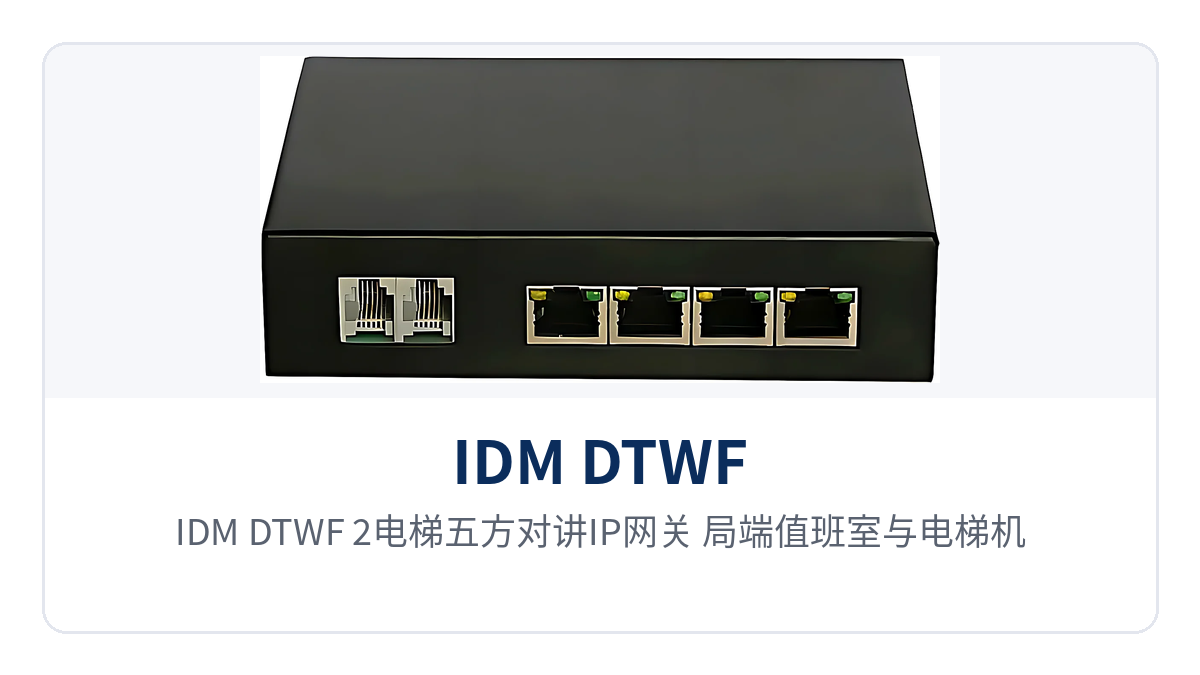
Figure 2: IDM DTWF-2 Elevator Five-Party Intercom IP Gateway — End-to-End IP Hotline Networking Diagram Between the Central Office Duty Room and the Elevator Machine Room