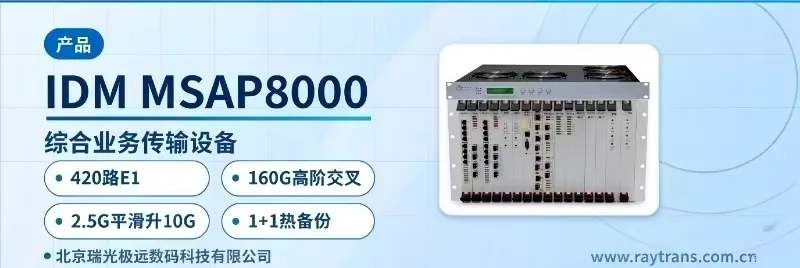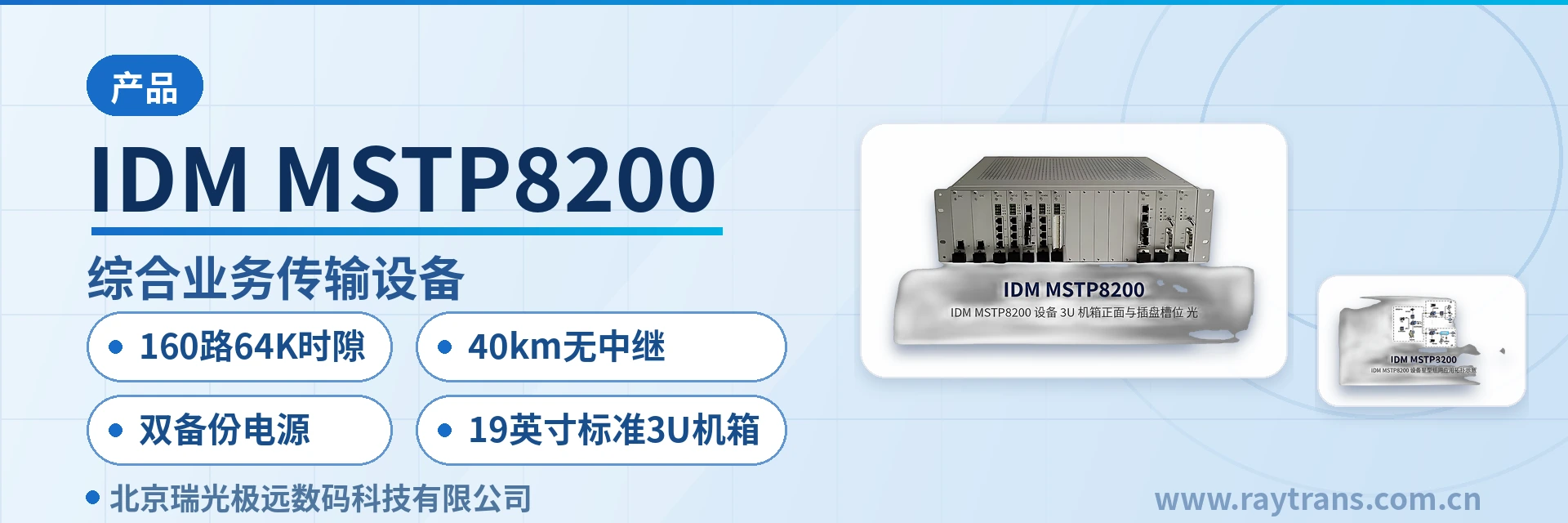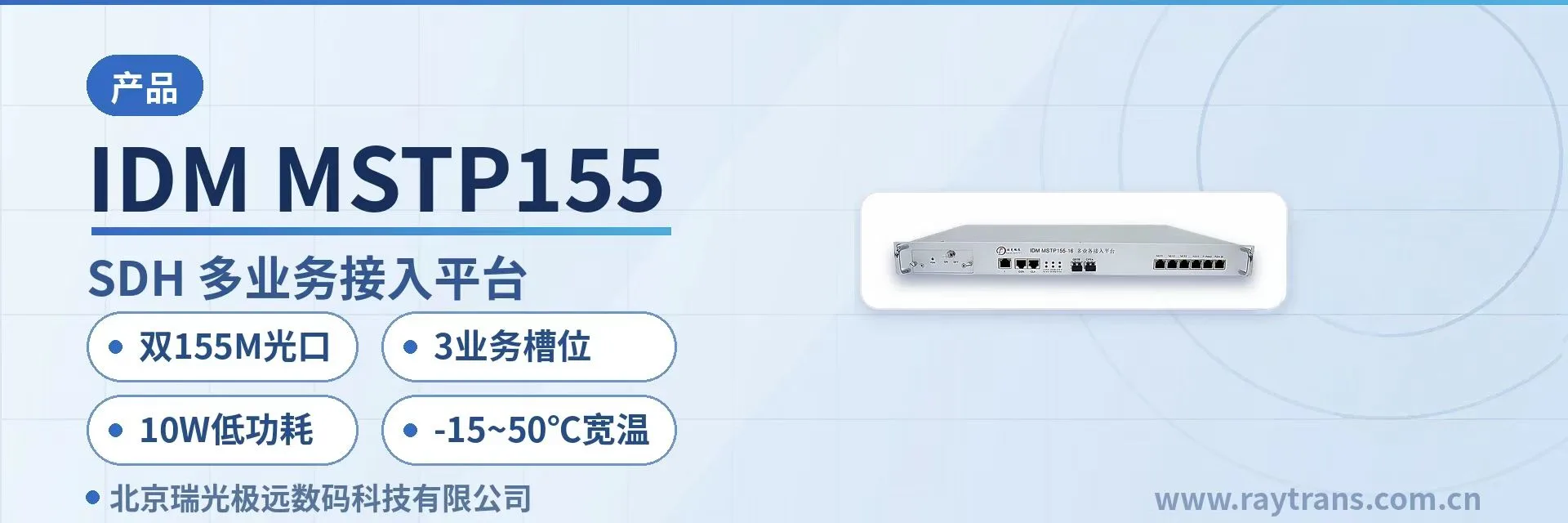
IDM MSTP155 -16 SDH Multi-Service Access Platform
Dual 155M optical ports, 2×STM-1, 4×FE interfaces
155M optical interface, 19-inch 1U standard chassis, provides 2×STM-1 interfaces, 4×FE interfaces, up to 16×E1 local termination, 3 universal slots supporting 3 service slots, can be inserted with E1 service cards, FXS/FXO cards, V.24/V.35 cards, Ethernet expansion cards, video cards, universal service cards, flexibly configured according to requirements; equipped with a TelecomBUS expansion bus, can be expanded with a gigabit Ethernet interface card, or 4 groups of physically isolated EOS Ethernet.
IDM MSTP155-16 multi-service access platform is an STM-1 level SDH multi-service access device developed by Beijing Ruiguang Jiyuan Digital Technology Co., Ltd. It is also a 3-slot mixed-insertion dual-optical-port SDH equipment for remote access. Centered on SDH and EOS technologies, its technical performance complies with relevant ITU-T standards, and it is used to access and transmit multiple services such as E1, voice, low-speed data, Ethernet, and video over an SDH transmission network. As a professional SDH equipment manufacturer, Raytrans has achieved unified multi-service carrying on this platform as part of its product showcase.
This 3-slot mixed-insertion dual-optical-port SDH equipment uses a 19-inch 1U standard chassis and provides two 155.52Mbps STM-1 optical interfaces, A and B. It can be used as an add-drop multiplexer (ADM) or terminal multiplexer (TM) to build point-to-point, chain, and ring transmission networks.
The common challenge at the private network access layer is mixed services, scattered sites, and limited investment: the remote end needs to deliver telephone and 2M data as well as Ethernet and surveillance video, and laying fiber separately for each service is neither economical nor easy to maintain. The positioning of IDM MSTP155-16 is exactly to collect these types of services into a pair of optical fibers, and it can be flexibly applied to government private network optical fiber communication solutions and military emergency communications vehicle solutions.
IDM MSTP155-16 integrates SDH transmission, PDH, and IP access into a single 1U device. A site inserts the corresponding service cards according to its service list, and 16-channel E1 termination and 4-channel FE Ethernet interfaces can work simultaneously; for capacity expansion, simply add or replace service cards while the chassis and optical path continue to be used.
Key specifications at a glance: dual 155M optical ports (A/B dual STM-1) · 3 service slots (universal slots, mixed insertion) · 16-channel E1 termination · 4-channel FE Ethernet · 128×128 VC-12 cross-connection · 19-inch 1U chassis · 10W low power consumption · -15~50℃ wide temperature
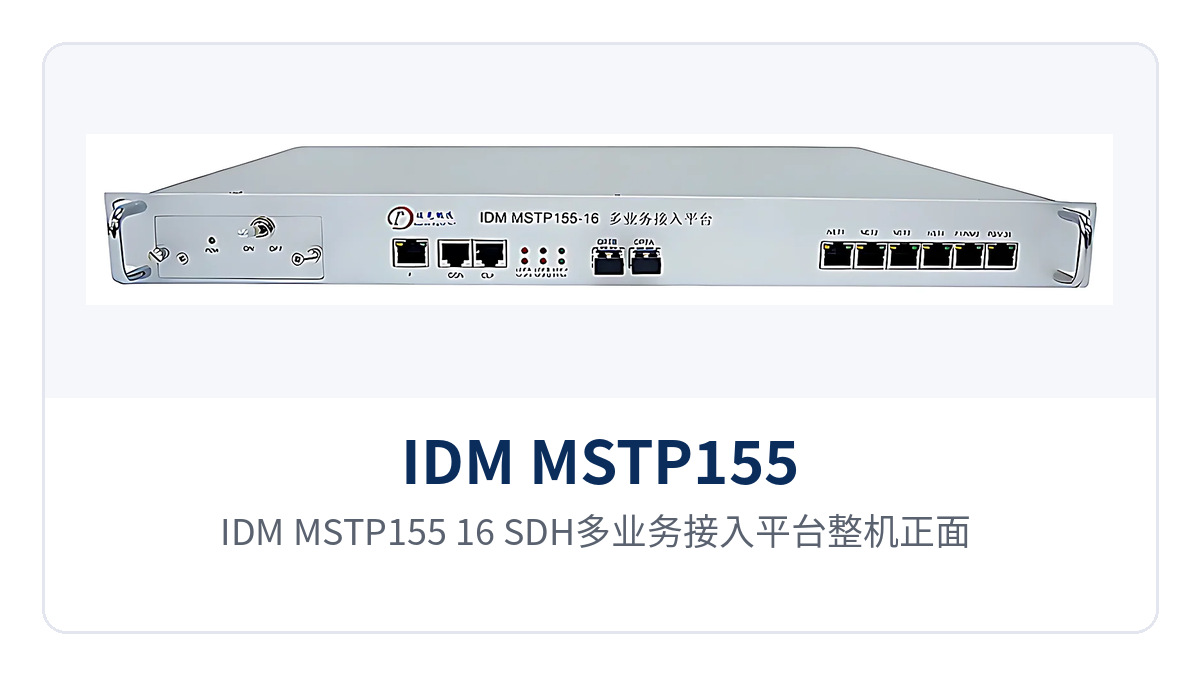
Figure 1: Front view of the IDM MSTP155-16 SDH multi-service access platform, showing the 19-inch 1U chassis appearance and panel indicator LEDs
What Is a 3-Slot Mixed-Insertion Dual-Optical-Port SDH Equipment? Which Services Can One 1U Device Carry?
A 3-slot mixed-insertion dual-optical-port SDH equipment refers to an access-type device that accesses the SDH transmission plane through two STM-1 optical ports on the trunk side and uses 3 universal slots for service cards on the tributary side. As a compact SDH equipment, IDM MSTP155-16 highlights high integration in its product showcase: the trunk side provides two 155.52Mbps optical interfaces, A and B, while the tributary side provides 3 service slots and fixed E1 and Ethernet interfaces.
Narrowband and broadband services at a site are therefore collected into the same transmission channel. At the central end, each remote station presents only one network element, and configuration, alarms, and service dispatching are handled in a centralized manner, making the O&M interface simpler than that of discrete devices. The variety of spare parts is also reduced along with the number of devices.
The 3 universal slots determine what services this SDH equipment can access: inserting an E1 service card enables 2M circuits, inserting an FXS/FXO card connects user telephones and SPC exchange trunks, inserting a V.24/V.35 card carries low-speed data and routing protocols, and inserting an Ethernet expansion card or video card connects the data network and video services. The same model therefore presents different interface combinations at different sites, and configuration flexibility comes from the slots rather than the model.
Universal slots: 3 service slots can accept E1 service cards, FXS/FXO cards, V.24/V.35 cards, Ethernet expansion cards, video cards, and universal service cards, configured flexibly as required.
E1 tributary: E1 service termination capacity is 16 channels, with a bit rate of 2048Kbps and HDB3 line coding, compliant with ITU-T G.703, with selectable 75Ω/120Ω impedance.
Ethernet tributary: the unit provides 4 FE interfaces, compliant with IEEE802.3, adaptive half-duplex/full-duplex, with a single-channel transmission rate of N×2.048Mbps (N≤50).
Expansion bus: equipped with a TelecomBUS expansion bus, which can expand a gigabit Ethernet interface card or 4 groups of physically isolated EOS Ethernet.
Total interfaces: varying with the Ethernet expansion card configuration, the unit can provide 18 10M/100M Ethernet interfaces.
How Are E1 and FE Services Transmitted Separately on One Device?
How E1 and FE services are transmitted separately on one device relies on the channelized cross-connection of SDH virtual containers (VC-12) and mutually independent tributary cards. E1 services are mapped into VC-12 at a 2.048Mbps granularity, while Ethernet services are carried by bundling bandwidth in N×VC-12 units. The two occupy different time slots on the same pair of STM-1 optical fibers and do not preempt each other's bandwidth.
The device has a cross-connect capacity of 128×128 VC-12 and supports VC-12 cross-connection, and can schedule service granules from different optical directions to the corresponding tributary cards or to local termination. E1 and Ethernet can therefore each use their own channel within the same device.
In engineering terms, E1 is used for services with strict timing requirements such as telecontrol, dispatching, and trunk circuits, while FE is used for packet services such as office networks and surveillance backhaul. The two types of services are inserted on separate cards and configured with separate bandwidths, so the impact of a failure does not spread. When Ethernet services require greater bandwidth, multiple VC-12 channels can be bundled to obtain a higher rate, and the bandwidth can simply be specified by granularity during configuration.
How Does 1+1 Path Protection with Dual 155M Optical Ports Build a Ring Network?
How 1+1 path protection with dual 155M optical ports builds a ring network depends on using the two STM-1 optical ports to connect to the two directions of the ring respectively, with switchover performed by the path protection mechanism. The main unit provides two 155.52Mbps optical interfaces, A and B, on the same SDH equipment, and the two form 1+1 path protection.
The working channel carries services while a backup channel is established simultaneously in the other direction. When the optical cable or optical module in one direction fails, services continue to be transmitted along the backup direction of the ring, thereby ensuring the real-time performance and accuracy of data and voice transmission within the ring network.
In terms of networking topology, the device can serve as a terminal multiplexer for point-to-point links, as an add-drop multiplexer to add and drop services at intermediate stations of chain and ring networks, and can also be networked jointly with a centralized MSTP system. The device provides network element timing compliant with ITU-T G.813, and its clock modes support local crystal clock, line-extracted clock, and external 2MBIT/2MHZ clock, giving inter-station timing a solid basis.
Star networking: multiple IDM MSTP155-16 units form a star network with a centralized SDH equipment over optical fibers, and remote services are aggregated at the central end, facilitating unified monitoring and management of the remote ends from the center.
Ring networking: multiple units form a ring network, and the 1+1 path protection mechanism ensures the real-time performance and accuracy of data and voice transmission within the ring network.
Interfacing capability: the optical ports use FC interfaces (SC and others can be customized), mainly single-mode with multi-mode optional, and can interconnect with the STM-1 optical interfaces of any standard SDH/MSTP equipment, protecting existing transmission investment.
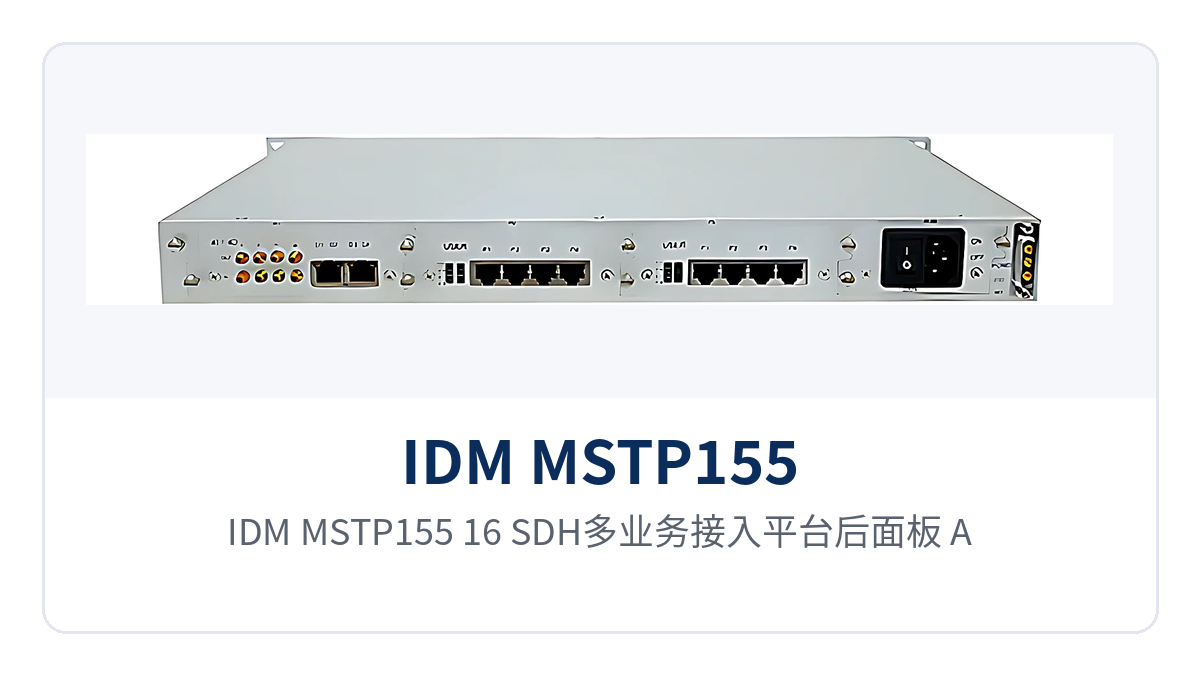
Figure 2: Rear panel of the IDM MSTP155-16 SDH multi-service access platform, showing the layout of the A/B dual STM-1 optical interfaces and service interface terminals
Core Functions: E1, Voice, Data, Ethernet, and Video Access in One Device
The functions of IDM MSTP155-16 can be understood along the lines of transmission, cross-connection, tributaries, expansion bus, clock timing, monitoring and alarms, and power supply. The table below lists each function item and its purpose, making it easy to compare and select according to a site service list. Interface capabilities not listed in the table are subject to the manufacturer's technical documentation and commercial confirmation of Raytrans.
Function | Description |
|---|---|
SDH optical transmission | Provides two STM-1 (155.52Mbps) optical interfaces, A and B, supports point-to-point, chain and ring networking, and can be jointly networked with a centralized MSTP system |
1+1 path protection | With dual optical port configuration, 1+1 path protection is formed; when one direction fails, services are transmitted along the other direction of the ring network |
VC-12 cross-connection | Cross-connect capacity 128×128 VC-12, with ITU-T G.813 network element timing, VC-12 cross-connection and path protection functions |
E1 service access | E1 termination capability 16 channels, bit rate 2048Kbps, line coding HDB3, compliant with ITU-T G.703, impedance 75Ω/120Ω |
Ethernet access | The unit provides 4 FE interfaces, compliant with IEEE802.3, full/half duplex adaptive, single channel N×2.048Mbps (N≤50) |
Voice service access | FXS/FXO boards are inserted into universal card slots to connect user telephones and SPC exchange trunks, enabling telephone services to be transmitted over the SDH network |
Low-speed data access | V.24/V.35 boards are inserted to carry low-speed data such as telecontrol and monitoring, as well as routing protocol services |
Video service access | Video cards are inserted to carry video services, sharing a pair of optical fibers with E1 and Ethernet services |
Expansion bus | The TelecomBUS expansion bus can be expanded with gigabit Ethernet interface cards, or with 4 groups of physically isolated EOS Ethernet |
Clock and timing | Supports local crystal oscillator clock, line-extracted clock and external 2MBIT/2MHZ clock, adapting to different synchronization environments |
Monitoring and alarms | Panel indicator LEDs display specific alarm status and output alarm information, facilitating fault identification at the central end |
Power supply mode | AC220V and DC-48V selectable, overall power consumption 10W, 19-inch 1U chassis |
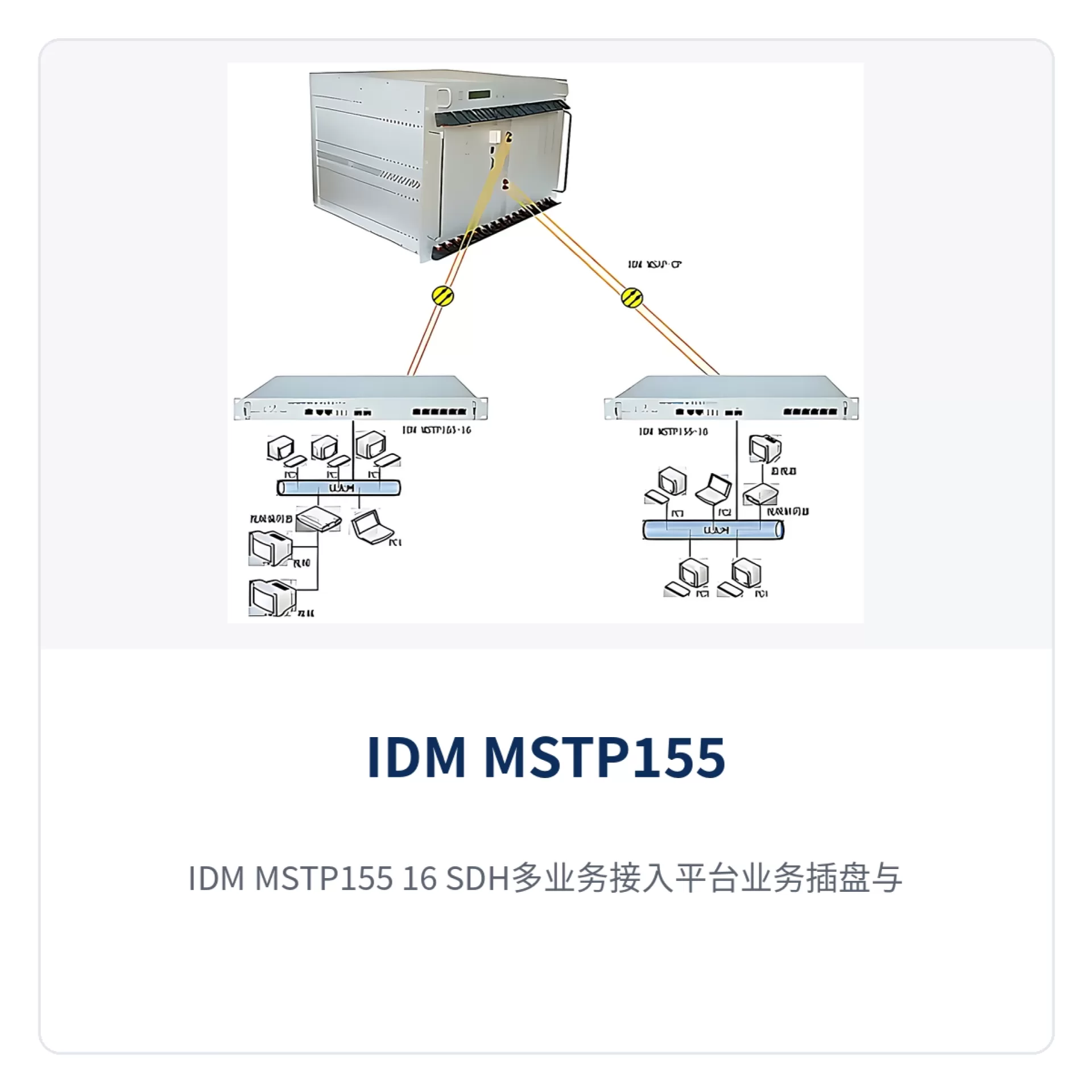
Figure 3: Close-up of the service boards and interface cards of the IDM MSTP155-16 SDH multi-service access platform, with mixed insertion of E1, voice, data and Ethernet card slots
As a professional SDH equipment manufacturer, Raytrans has developed mature solutions for multiple industries around this SDH equipment: in government private network optical fiber communication solutions, the equipment forms a ring with dual optical port 1+1 path protection, accessing E1 telecontrol, voice trunks and Ethernet office services in one unit, with unified monitoring at the central end; in military emergency communications vehicle solutions, the 1U chassis, 10W low power consumption and AC220V/DC-48V dual power supply options adapt to vehicle-mounted power supply environments, and 3-slot mixed insertion allows E1, voice, data and video interfaces to be configured as required at the emergency site, enabling rapid service provisioning.
Technical Specifications: Optical Interface, E1 and Ethernet Indicators
During selection and bidding, optical interface and tributary indicators are usually checked first. The following table lists the main technical specifications of the IDM MSTP155-16 item by item according to interface type; items not listed are subject to the manufacturer's technical documentation. The optical port, E1 and Ethernet items are the high-frequency items for engineering verification, and also the most commonly compared indicators when evaluating the performance of SDH equipment.
Item | Parameter/Specification | Description/Applicable Conditions |
|---|---|---|
Optical interface type | FC (SC and others can be customized) | FC/SFP optical modules are available in optical port mode |
Fiber mode | Single-mode (multi-mode optional) | Single-mode as standard, multi-mode customized as required |
Receive/transmit rate | 155M/155M | Corresponds to the STM-1 rate of 155.52Mbps |
Receive/transmit wavelength | 1310nm/1550nm | Determined by the optical module fitted |
Transmit optical power | -15~-8dBm | Standard single-mode configuration |
Receiver sensitivity | Better than -32dBm | Reserves margin for long-distance reception |
Transmission distance | 20Km | Long-distance optical modules can be fitted for longer optical fiber transmission |
E1 bit rate/line coding | 2048Kbps / HDB3 | Complies with ITU-T G.703, impedance 75Ω/120Ω |
E1 frame structure/signaling | PCM30/31, channel-associated signaling | Used for 2M circuits and trunk services |
Ethernet interface | RJ-45, N×2.048Mbps (N≤50) | Supports IEEE802.3, full/half duplex/adaptive |
Power supply mode | AC220V / DC-48V | AC or DC power supply selectable |
Overall power consumption | 10W | Low power consumption operation in a 1U chassis |
Operating temperature | -15℃~+50℃ | Wide-temperature design, suited to field and unattended sites |
Relative humidity | 0~95% (non-condensing) | For use in non-condensing environments |
Chassis dimensions | 440×230×45(mm) | 19-inch 1U standard chassis |
How Far Can an STM-1 Optical Port Transmit, and What Fiber Does It Use
How far an STM-1 optical port can transmit depends on the optical module fitted and the fiber conditions: the standard single-mode configuration of the IDM MSTP155-16 has a transmission distance of 20Km, a transmit optical power of -15~-8dBm and a receiver sensitivity better than -32dBm. When the inter-station distance exceeds 20Km, long-distance optical modules can be fitted for longer optical fiber transmission. The fiber mode is mainly single-mode with multi-mode optional, and the interface type is FC, with SC and other interface forms customizable.
In engineering, the optical power budget and connector loss also need attention: a receiver sensitivity better than -32dBm means the link allows a relatively large attenuation margin, but each additional fiber adapter or splice point consumes power budget, so for long-distance sections it is advisable to reserve margin according to the actual measured optical power. For long-distance sites, state the inter-station distance at the time of ordering, and the SDH equipment manufacturer will fit the optical module according to the distance.
Differentiated Value: What Problems the 3-Slot Mixed-Insertion Dual-Optical-Port SDH Equipment Solves in a Private Network
Differentiated capability | Value for private network users |
|---|---|
Dual 155M optical ports support 1+1 channel protection | Data and voice transmission within the ring network has a protection path; when the optical cable or optical module in one direction fails, services can be switched over to the other direction, ensuring link continuity |
3 universal service slots for flexible mixed insertion of E1/FXS/FXO/V.35/video cards | The same model is populated with boards according to the site service list, with voice, data and video configured as required, so there is no need to purchase a separate unit for each service type |
1U chassis with 10W overall power consumption | Low pressure on cabinet space and power load, suitable for installation in site cabinets with limited space |
-15℃~+50℃ wide temperature operation | Suited to the temperature conditions of field and unattended sites, reducing dependence on equipment room air conditioning and additional temperature control investment |
Typical Application Scenarios
The IDM MSTP155-16 is mostly used at the private network access layer, converging upward into the transmission plane through STM-1 optical ports and collecting site services downward into the same transmission channel. The typical deployment methods are described below according to site conditions and industry, and the actual configuration is subject to the site service list.
Where Is the SDH Equipment with a 1U Chassis and 10W Power Consumption Installed
Where is the SDH equipment with a 1U chassis and 10W power consumption installed? The answer is sites that require remote access but lack equipment room conditions. The 19-inch 1U standard chassis (440×230×45mm) can be mounted directly in a standard rack or installed in a small wall-mounted cabinet.
The overall power consumption is 10W, with AC220V and DC-48V power supply options, so when a site already has a DC power distribution panel, no additional AC conversion equipment is required. With an operating temperature of -15℃~+50℃ and a relative humidity of 0~95% (non-condensing), it can be deployed in places with limited space and ordinary temperature control, such as substation relay protection rooms, police station equipment cabinets and business outlet cabinets.
Electric Power Private Network: Remote E1 and Ethernet Access at Substations in One Unit
Substations and switching stations in the electric power private network are distributed sites, and their services include not only dispatch telephone and telecontrol data but also office and video surveillance Ethernet. The IDM MSTP155-16 uses 3 universal card slots for E1 service cards and Ethernet expansion cards, collecting 2M dispatch circuits and Ethernet services into the same pair of optical fibers.
When multiple devices form a ring network, 1+1 path protection allows services to be transmitted in the other direction when a section of optical cable is interrupted by excavation during construction. The -15℃ to +50℃ wide temperature range and 10W low power consumption suit the operating conditions of unattended sites, and the panel alarm indication enables the dispatch end to detect problems before manual inspection.
Public Security and Military Private Networks: 3-Slot Mixed Insertion of Voice, Data, and Video
Branch offices and duty posts of public security and military private networks have many service types, and voice, data, and video often need to be backhauled over the same cable. The 3-service-slot mixed insertion feature is directly reflected here: insert FXS/FXO boards to connect duty telephones and trunks, insert V.24/V.35 boards to carry data terminals, and insert video cards to backhaul images.
On the link side, a dual 155M optical port redundant ring network provides a protection channel. A single 1U device replaces multiple single-service devices, the cabling and number of devices in the site cabinet are reduced accordingly, and routine maintenance at duty posts is more centralized. Raytrans SDH equipment is equally applicable in such military emergency communications vehicle solutions. The device is small in size and flexible in power supply, and can be quickly deployed on an emergency communications vehicle and connected to the existing transmission network.
Banking and Financial Leased Lines: STM-1 Standard Optical Interface, Plug-and-Play
Leased lines from bank branches to the data center require reliable transmission of trunk circuits and service data, and seek to reuse existing SDH transmission resources as much as possible. The STM-1 optical interface of the IDM MSTP155-16 can interconnect with the STM-1 optical interface of any standard SDH/MSTP equipment, and access to the existing transmission network requires no modification at the opposite end.
1+1 path protection provides a backup channel for transaction-type leased lines. On the branch side, a 1U chassis is used for termination, and the power supply can be DC-48V to work with the DC system in the equipment room. In leased-line scenarios with many branches and small service volume at a single point, one device can carry the trunk circuit and service data, eliminating the need to deploy separately for each service type. For users requiring a government private network optical fiber communication solution, Raytrans can provide, based on this platform, a complete SDH networking design from the access layer to the aggregation layer, and verify the solution with actual cases in the product showcase.
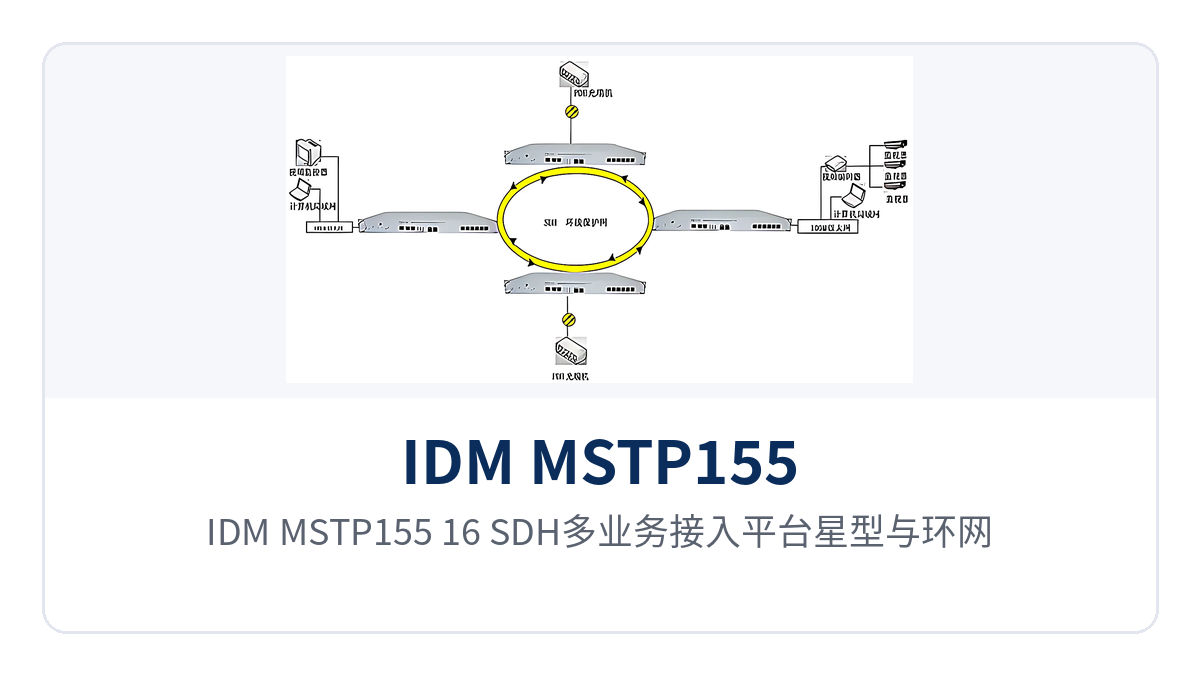
Figure 4: IDM MSTP155-16 SDH multi-service access platform star and ring network topology diagram, with remote site services aggregated at the central end