IDM MSAP622
IDM MSAP622
The IDM MSAP622/155 SDH equipment features a 19-inch (6+1)U plug-in card chassis structure. The MSAP equipment can be configured with different quantities and types of tributary service boards as required, providing multi-service access functions. The MSAP equipment provides uplink STM-1/STM-4 optical interfaces, with optical access board types including: STM-1 access boards and STM-4 aggregation boards; it provides downlink access for Gigabit Ethernet, Fast Ethernet, E1 services, telephone services, and various 64K services.
I. Overview
The IDM MSAP622&155 aggregation optical-electrical integrated transmission equipment is a new-generation SDH-based multi-service optical transmission/access equipment launched by Beijing Ruiguang Jiyuan Digital Technology Co., Ltd. It integrates SDH transmission, PBX/IP-PBX switching, and optical Ethernet switching technologies into one platform, incorporating audio/video command & dispatch functions. It is widely applicable in private networks such as public security, electric power, railway, and mining, as well as public networks including mobile, Unicom, and telecom operators.
The IDM MSAP622/155 equipment features a 19-inch (6+1)U plug-in card chassis structure. It can be configured with different quantities and types of tributary service boards as required, providing multi-service access functions. It provides uplink STM-1/STM-4 optical interfaces, with optical access board types including: STM-1 access boards and STM-4 aggregation boards; it provides downlink access for Gigabit Ethernet, Fast Ethernet, E1 services, telephone services, and various 64K services.
The IDM MSAP622/155 equipment is primarily used for service access, transmission, and aggregation at the access layer of data communication networks. It features complete synchronization timing functions, a powerful non-blocking cross-connect matrix at VC12 and 64K levels, and aggregation capabilities for voice, IP, and V24 Ethernet services.
The MSAP equipment network management platform can adopt the Netguard network management system from Beijing Ruiguang Jiyuan Digital Technology Co., Ltd., providing hierarchical, powerful management capabilities based on a server/client model, including configuration management, fault management, performance management, permission management, and log management functions.
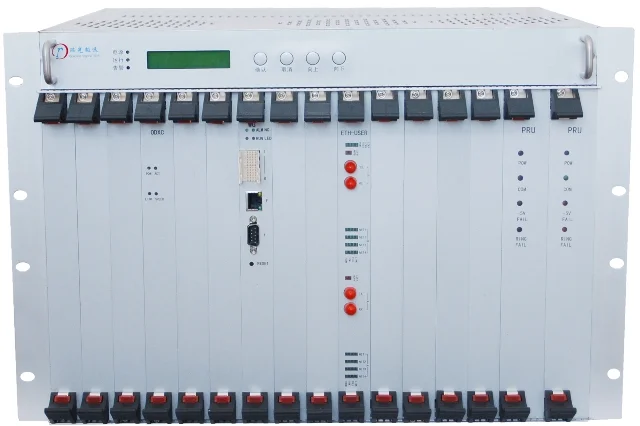
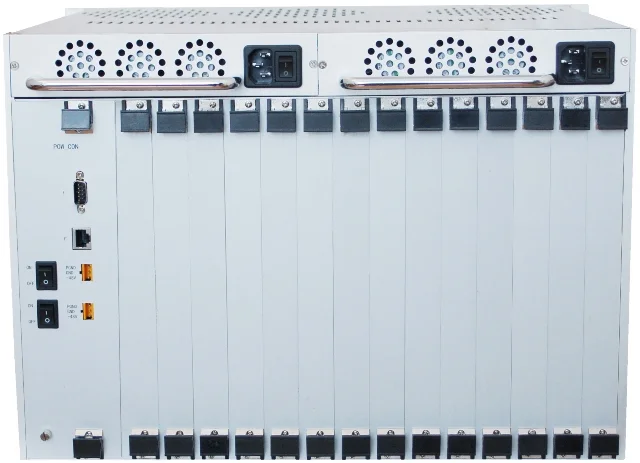
Figure 1 IDM MSAP622/155 Equipment Front and Rear Panel Diagram
II. Product Features
Chassis structure adopts (6+1)U plug-in card design; provides 16 front plug-in slots and 12 rear plug-in slots;
The equipment integrates multiple technologies including SDH transmission, PBX voice switching, and optical Ethernet switching;
Key functional modules provide mutual backup: STM-4 cross-connect aggregation board, main control board, and power supply board;
Flexible system design; the same equipment can be configured as TM, ADM, or MADM modes;
Provides multiple networking topologies: point-to-point, chain, ring, star, tree, ring-to-ring, ring intersection, etc.;
Maximum service interface capacity:
n STM-4 interfaces: 20; STM-1 interfaces: 56
n PDH optical interfaces: 44; E1 interfaces: 536
n FE interfaces: 104; maximum bandwidth per FE interface: 50 VC12;
n GE interfaces: 16; maximum bandwidth per GE interface: 63 VC12;
n FXS/FXO/Magneto interfaces: 210; EM24 interfaces: 100; V24 interfaces: 210
n Digital trunk interfaces: 8*N (N≤8)
Clock source can be selected from line clock, external clock (2Mbit/s or 2MHz), and free-running oscillation;
Standard model repeaterless transmission distance is 40 km; custom configurations are available for distances beyond this;
The MSAP equipment provides Ethernet management channels based on DCC, E1, N*64K, and TCP/IP, supporting SNMP simple network management protocol;
The MSAP equipment provides natural heat dissipation and forced fan cooling, with intelligent temperature-controlled fans and fan status detection to ensure stable operation;
The STM4 cross-connect aggregation board provides 4 STM-4 optical interfaces (optical ports can be configured online as STM-1 rates), supporting mutual backup between any two STM-4 optical ports. A single board provides 32×32 VC-4, 2016×2016 VC-12, and 512×512 64K timeslot non-blocking cross-connect, supporting unidirectional, bidirectional, and broadcast services;
The STM1 cross-connect aggregation board provides 2 STM-1 optical interfaces, supporting mutual backup between the two STM-1 optical ports. A single board provides 441×441 VC-12 and 1024×1024 64K timeslot non-blocking cross-connect, supporting unidirectional, bidirectional, and broadcast services;
The IDM MSAP622/155 IP access services support multiple access methods:
l G3-EOSEOP board based on EOS or EOPDH, providing 4 independent Ethernet aggregation interfaces; in EOP mode, each Ethernet interface group supports remote access of up to 63 single-E1 bridges; in EOS mode, each group supports up to 63 directions of EOS Ethernet service access;
l G3-2GE board based on EOS, providing 2 groups of Gigabit Ethernet service access, each group providing 1 optical and 1 electrical GE interface; bandwidth is N*VC12 (N≤63);
The MSAP622/155 can accommodate a signaling gateway board, supporting signaling protocols such as No.1, NO.7, PRI, and V5.2;
The MSAP622/155 can accommodate PCM service access boards, with over 20 types of PCM plug-in cards available for installation on the PCM user board, providing voice and data services.
III. Technical Specifications
Optical Interface
Interface Type | STM-4 SFP | Fiber Mode | Single-mode (Multi-mode optional) |
TX/RX Rate | 622.08Mbps/622.08Mbps | TX/RX Wavelength | 1310nm/1550nm |
Output Power | -12~-6dBm | Receiver Sensitivity | Better than-32dBm |
Transmission Distance | 20Km; long-distance optical modules can be optionally installed for extended fiber transmission | ||
Interface Type | STM-1 FC | Fiber Mode | Single-mode (Multi-mode optional) |
TX/RX Rate | 155.52Mbps/155.52Mbps | TX/RX Wavelength | 1310nm/1550nm |
Output Power | -12~-6dBm | Receiver Sensitivity | Better than-32dBm |
Transmission Distance | 20Km; long-distance optical modules can be optionally installed for extended fiber transmission | ||
E1 Interface
Line Rate | 2.048Mbps | Line Code | HDB3 |
Standard Protocol | SupportsITU-T G.703 | Impedance | 75Ω/120Ω |
Frame Structure | PCM30/32 | Signaling | Channel-Associated Signaling |
Ethernet (FE)
Interface Type | RJ-45 | Transmission Rate | N×VC12 (N≤50) |
Standard Protocol | Supports IEEE802.3 | Operating Mode | Full/Half Duplex/Auto-Negotiation |
Ethernet (GE)
Interface Type | RJ-45 | Transmission Rate | N×VC12(N≤63) |
Standard Protocol | SupportsIEEE802.3 | Operating Mode | Full/Half Duplex/Auto-Negotiation |
FXO, FXS Interfaces
Audio Range | 300Hz~3400Hz | Compression | A-law per ITU G.711 |
Impedance | Three-element complex impedance 200Ω+560Ω//0.1μF | Loop Current | 20mA/channel |
Co-directional 64K Interface
Line Code | G.703 Standard | Line Rate | 64Kbps |
Impedance | Balanced120Ω | Fully compliant withITU G.703 Recommendation | |
EM2/4-Wire Interface
Audio Frequency Range | 300Hz~3400Hz | Impedance | Balanced600Ω |
Companding | A-law per ITU G.711 | Return Loss | ≥18dB |
Magnetic Ring Interface
Audio Frequency Range | 300Hz~3400Hz | Impedance | Balanced600Ω |
Companding | A-law per ITU G.711 | Return Loss | Not less than18dB |
V.24 Interface
Transmission Rate | Asynchronous ≤9600bps; Synchronous 64Kbps | Electrical Characteristics | Compliant with CCITT V.28 protocol |
V.35 Interface
Interface Type | RJ-45 | Electrical Characteristics | Compliant withITU-T V.35Recommendation |
Transmission Rate | n×64Kbps(n=0~31) | Terminal Interface | Compliant withISO2593Specification |
Power Supply and Power Consumption
Power Supply | AC220V/DC-48V | Power Consumption | ≤150W |
Environmental Conditions
Operating Temperature | -10oC ~+50oC | Relative Humidity | 0~95% (non-condensing) |
Product Dimensions
Length×Depth×Height | 482×309×132(mm) |
IV. Application Example 1
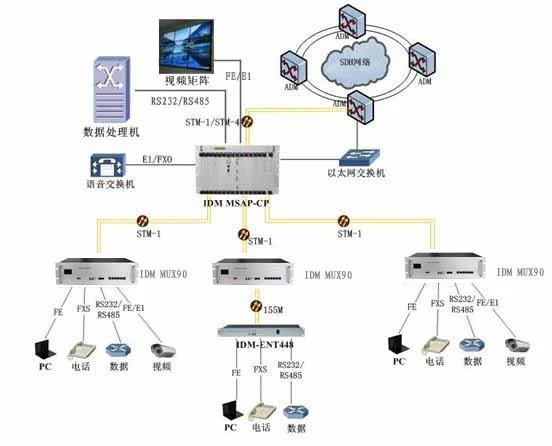
Figure 2 Star Network Application Diagram
The IDM MSAP622/155 can form a star network with other SDH devices to provide users with telephone, data, IP, and video services.
FAQs
What are the features of SDH technology and MSTP products?
I. Development Directions of Next-Generation SDH Technology and Products Regarding the development direction of…
View answerWhat is the difference between PDH and SDH?
I. PDH PDH is the Plesiochronous Digital Hierarchy, which is divided into the European standard and the…
View answerWhat is an E1 line? What are the core knowledge points?
E1 Basics Frame Structure of the E1 Channel In an E1 channel, 8 bits form one timeslot (TS)…
View answerLow-Cost SDH Is an Inevitable Choice for Access Network Construction in the Near to Medium Term
The current status of metropolitan optical networks is that SDH/MSTP (DWDM) optical networks have become the mainstream…
View answerIntroduction to Ethernet Over SDH Technology
Interface specifications: On the SDH side, provides 1 x 155.52Mbps LVDS interface, supporting STM-1.
View answer