IDM MSAP-CP Multi-Service Access Platform
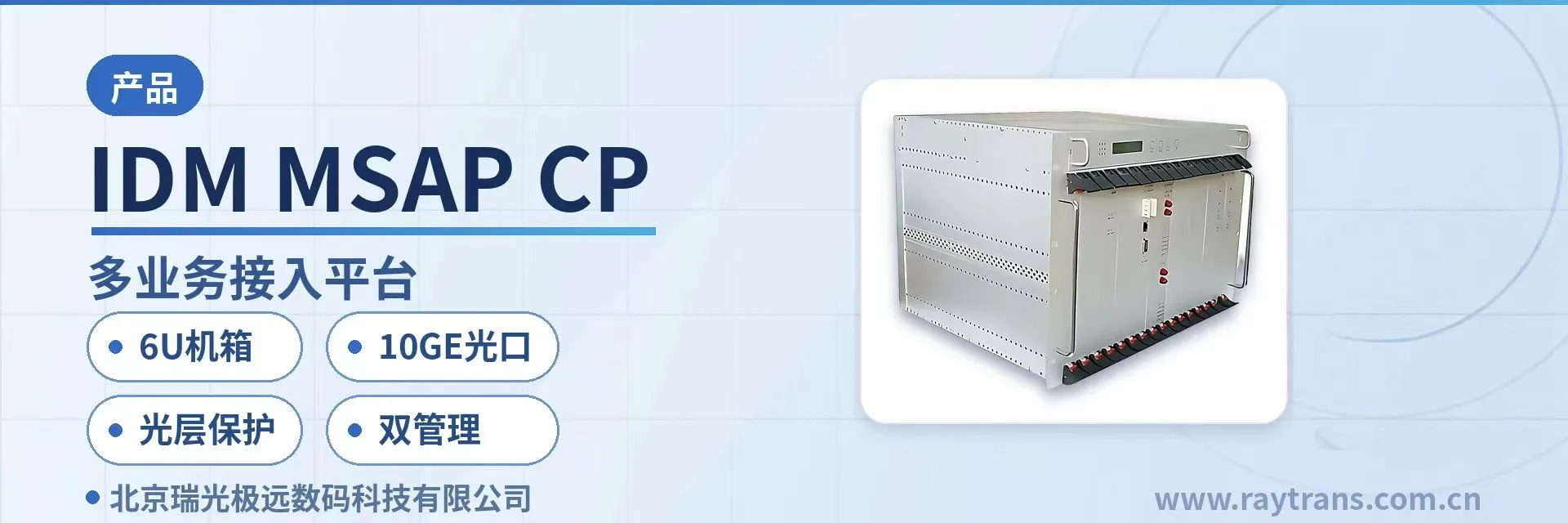
10 GE optical ports, 6U chassis, site-by-site expansion without replacing the chassis
The IDM all-optical Ethernet switch is a high-performance managed optical Ethernet access switch in a 19-inch 6U chassis structure that accepts Fast Ethernet/gigabit optical switching boards. The Fast Ethernet optical switching board provides 8 FE optical ports and 2 GE optical ports. The gigabit optical switching board provides 10 GE optical ports. The access fiber medium can be single-mode or multimode fiber, using SFP optical modules. The switch supports both network remote management and local management to monitor port operating status and configure the switch.
The IDM MSAP-CP 6U card-based all-optical Ethernet switch is a managed optical Ethernet access switch developed by Beijing Ruiguang Jiyuan Digital Technology Co., Ltd. As a professional media converter manufacturer and SDH equipment manufacturer, Raytrans adopts a 19-inch 6U chassis structure and a card-based design into which Fast Ethernet/gigabit optical switching boards can be inserted, for optical Ethernet access and aggregation in electric power private networks, rail transit communications, and unattended field sites. The access fiber medium of the IDM MSAP-CP can be single-mode or multimode fiber, and the optical modules are in SFP form; in addition to switching, authentication, and packet filtering, the device also provides an optical layer protection mechanism and multicast functions, and supports network remote management and local management, making it convenient to monitor port operating status and configure the switch. The device can be widely used in government private network optical fiber communication solutions and can coordinate networking with the products of industrial Ethernet switch manufacturers, and it is often presented as core aggregation equipment in a media converter product showcase.
Key Specifications at a Glance: 6U chassis · 10 GE optical ports · optical layer protection · dual management · Fast Ethernet board 8 FE + 2 GE · single-mode/multimode SFP
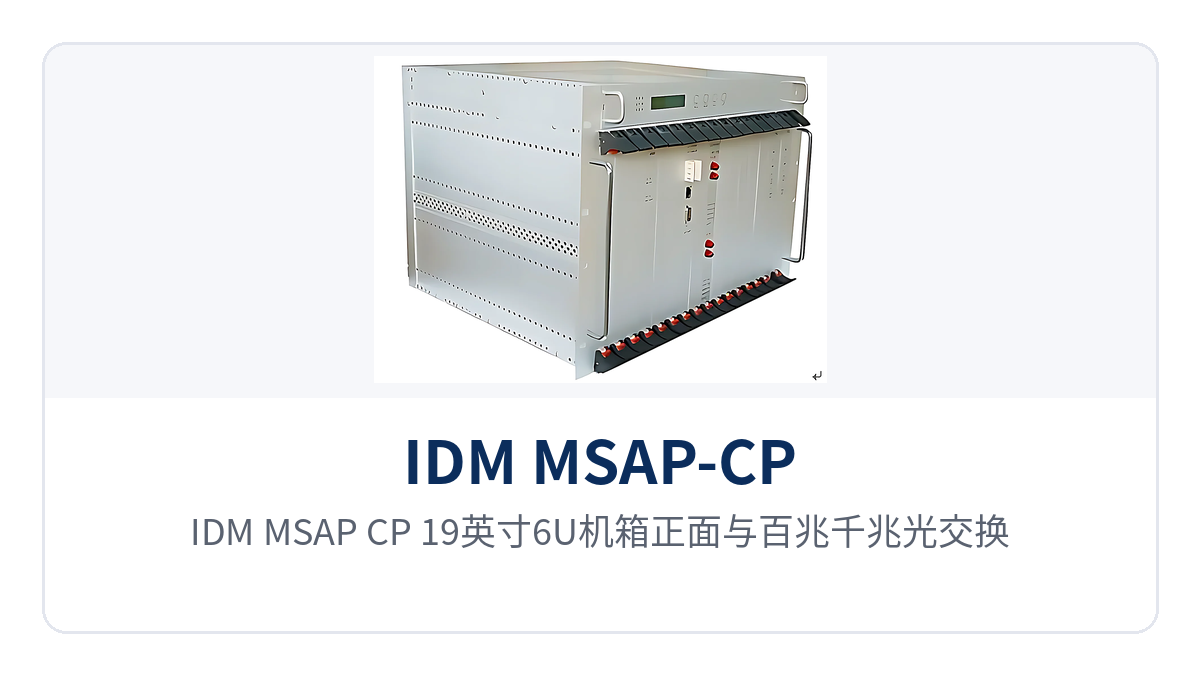
Figure 1: Front View of the IDM MSAP-CP 19-inch 6U Chassis and Card Slots for Fast Ethernet/Gigabit Optical Switching Boards
What Is an All-Optical Ethernet Switch? The IDM MSAP-CP Carries Optical Switching Boards in One 6U Chassis
An all-optical Ethernet switch is an Ethernet access switch whose access-side and uplink-side ports are all optical fiber ports and whose transmission medium is optical fiber, with service packets switched, authenticated, and filtered inside the device without relying on copper cable transmission. As a professional media converter manufacturer, Raytrans has turned this switching capability into a card-based form factor: the 19-inch 6U chassis of the IDM MSAP-CP provides multiple card slots for inserting Fast Ethernet or gigabit optical switching boards according to the site service scale, with both the devices on the user side and the uplink-side link connected through optical ports. The engineering significance of the card-based structure lies in configuration on demand — when an access point is expanded or bandwidth is upgraded, it is enough to add or replace optical switching boards while the chassis, backplane, and power supply continue in use. For integrators that need a media converter product showcase, this card-based form factor also makes it convenient to present port configurations and expansion paths visually.
The match between fiber medium and optical module is determined by the on-site optical cable: single-mode fiber suits links with a longer distance between sites, while multimode fiber suits connections inside an equipment room or over short distances; both media are connected through SFP optical modules, so a change of type requires only replacing the optical module rather than the whole board. The IDM MSAP-CP supports two maintenance paths, network remote management and local management: the central equipment room can view port operating status remotely, and on site the switch parameters can also be set through local login. As an experienced SDH equipment manufacturer and industrial Ethernet switch manufacturer, Raytrans adopts the same maintenance architecture in government private network optical fiber communication solutions.
How to Choose Between Fast Ethernet and Gigabit Optical Switching Boards?
The difference between the Fast Ethernet and gigabit optical switching boards lies in the number of optical ports and the per-port rate, and board selection is based on the port list of the site. The Fast Ethernet optical switching board provides 8 FE optical ports and 2 GE optical ports and suits access points where edge Fast Ethernet devices are concentrated: the 8 FE optical ports are used to connect Fast Ethernet terminals or front-end devices, while the 2 GE optical ports are used for uplinks or inter-site interconnection. The gigabit optical switching board provides 10 GE optical ports and suits gigabit access and aggregation scenarios: uplinks from multiple devices in an equipment room, gigabit access for a video private network, or gigabit interconnection between sites can all be completed within a single board.
Board selection proceeds in the order of first counting the port types and then calculating the number of boards: where Fast Ethernet devices dominate at a site, the Fast Ethernet optical switching board is the main choice, while dense gigabit ports or a need for gigabit aggregation call for the gigabit optical switching board; one and the same 6U chassis can take a mixed insertion of the two board types grouped by site, so there is no need to configure two kinds of chassis for sites of different rates. The single-mode/multimode choice of the optical ports is independent of the board type — simply select the corresponding SFP optical module according to the existing optical cable type.
Core Functions: Switching, Optical Layer Protection, and Port-Level Access Control
The functions of the IDM MSAP-CP revolve around access security and link continuity, and the table below summarizes the capabilities of the device and what they do.
Function | Description |
|---|---|
Switching, authentication, and packet filtering | Provides switching, authentication, and packet filtering, forwarding or discarding packets according to port and service policies |
Optical layer protection mechanism | Provides an optical layer protection mechanism, so that services can be switched over quickly when a private network link fails, reducing communication interruption time |
Multicast | Supports multicast, suitable for point-to-multipoint video service transmission |
Priority queues and quality of service guarantees | Supports priority queues to provide quality of service guarantees for control services |
IEEE 802.3x flow control | Supports IEEE 802.3x full-duplex flow control and half-duplex backpressure flow control to relieve port congestion |
Port-based network access control | Supports port-based network access control, so that unauthorized terminals cannot access the network through a port |
Port isolation | Provides port isolation, so that Layer 2 traffic between ports on the same board is invisible to each other, reducing the risk of lateral spread |
Head-of-line (HOL) blocking prevention | Provides a head-of-line blocking prevention mechanism to reduce packet loss caused by forwarding congestion |
Port-to-MAC address binding and MAC address filtering | Supports port-to-MAC address binding and MAC address filtering to block unauthorized terminals from accessing the network |
Port bandwidth control and broadcast storm control | Provides port bandwidth control and supports broadcast storm control to limit the link bandwidth occupied by abnormal traffic |
Dual management | Supports network remote management and local management, and can monitor port operating status and configure the switch |
Key Specifications
Item | Parameter/Specification | Description/Applicable Conditions |
|---|---|---|
Chassis structure | 19-inch 6U chassis, accepts Fast Ethernet/gigabit optical switching boards | Rack installation, with card slots configured according to the site service scale |
Optical switching board type | Fast Ethernet optical switching board, gigabit optical switching board | The two board types can be mixed in groups by site |
Fast Ethernet optical switching board optical ports | 8 FE optical ports + 2 GE optical ports | Edge Fast Ethernet access and the uplink gigabit channel are provided on the same board |
Gigabit optical switching board optical ports | 10 GE optical ports | Used in gigabit access and aggregation scenarios |
Fiber medium and optical module | Single-mode or multimode fiber available, SFP (small form-factor pluggable) module | The optical module is selected according to the on-site optical cable type and link distance |
Management mode | Network remote management + local management | Can monitor port operating status and set switch parameters |
Switching and packet processing | Supports switching, authentication, and packet filtering | Forwards or filters packets according to port policies |
Link protection | Provides an optical layer protection mechanism | Services are switched over quickly when a private network link fails |
Multicast and quality of service | Supports multicast and priority queues | Provides quality of service guarantees |
Flow control | IEEE 802.3x full-duplex flow control / half-duplex backpressure flow control | Reduces packet loss when a port is congested |
Access security | Port-based network access control, port isolation, port-to-MAC address binding, MAC address filtering | Prevents unauthorized terminals and lateral access on the access side |
Bandwidth and storm control | Port bandwidth control, broadcast storm control | Limits the impact of abnormal traffic on the link |
Congestion prevention | Head-of-line (HOL) blocking prevention mechanism | Reduces packet loss caused by head-of-line blocking |
Power supply mode and overall power consumption | not yet recorded in the knowledge base | The manufacturer's technical documentation and commercial confirmation shall prevail |
Operating temperature and optical port transmission distance | not yet recorded in the knowledge base | The manufacturer's technical documentation and commercial confirmation shall prevail |
The parameters in the table are taken from this product's technical documentation; for items not listed, such as power supply mode, overall power consumption, operating temperature, and optical port transmission distance, no information is yet recorded in the knowledge base, and for specific values the manufacturer's technical documentation and commercial confirmation shall prevail.
What Problems Does the 6U Card-Based All-Optical Ethernet Switch Solve in Private Networks?
Differentiated capability | Value for private network users |
|---|---|
The 19-inch 6U chassis accepts Fast Ethernet/gigabit optical switching boards, with 10 GE optical ports on a single board | One chassis takes a mixed insertion of optical switching boards of different rates according to the bandwidth requirements of each site: sites that need gigabit aggregation take the gigabit board, sites with pure Fast Ethernet access take the Fast Ethernet board, while the chassis and card slots continue in use, and later capacity expansion only adds boards without changing the chassis |
The Fast Ethernet board provides 8 FE optical ports + 2 GE optical ports, with flexible single-mode/multimode SFP access | Edge Fast Ethernet devices and the uplink gigabit channel are handled on the same board, the optical module is selected according to the on-site optical cable type, and both single-mode and multimode fiber can be connected, reducing the variety of equipment and the inventory of matching modules at access points |
Provides an optical layer protection mechanism, allowing fast switchover when a private network link fails | In scenarios with high requirements on link continuity, such as power dispatching and rail transit, services can be switched over to the standby optical path when the active optical path is interrupted, reducing communication interruption time |
Typical Application Scenarios
In private networks, the IDM MSAP-CP is usually deployed on the site side or the aggregation side, connecting downwards through optical ports to the terminals and front-end devices within the site and upwards through optical ports to the upper-level network; the card-based structure allows the same media converter device to match the port scale and rate requirements of different sites. The following three industry scenarios are the main uses of the 6U card-based all-optical Ethernet switch.
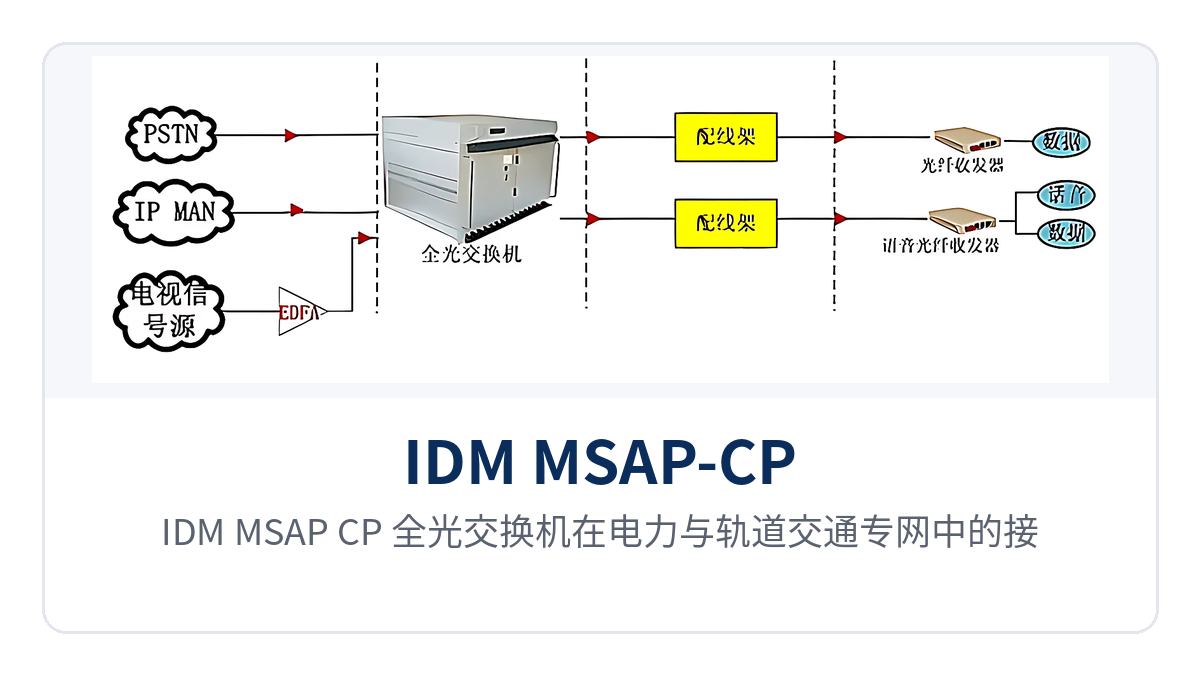
Figure 2: Access Networking Schematic of the IDM MSAP-CP All-Optical Ethernet Switch in Electric Power and Rail Transit Private Networks
Electric Power Private Networks: Ethernet Access Between Substations and Dispatch Centers
Electric power private networks are characterized by distributed sites and high requirements on link continuity, and a communication interruption may directly affect the delivery of dispatch commands and telecontrol data. On the substation side, the IDM MSAP-CP plays the access role: the 8 FE optical ports of the Fast Ethernet optical switching board connect terminal devices in the substation, and the 2 GE optical ports are used for the uplink; at the link level, the optical layer protection mechanism takes over, so that services can be switched over quickly when the active optical path fails. Access security is handled by port-to-MAC address binding, MAC address filtering, and port isolation, preventing terminals in the substation from connecting at will or accessing across ports. On the dispatch center side, network remote management provides a unified view of the port status of each site, reducing site-by-site inspection.
Rail Transit Communications: Optical Fiber Access and Aggregation for Sites Along the Line and Station Equipment Rooms
The station spacing along a rail transit line and the distribution of equipment rooms determine that access devices need to support Fast Ethernet access and gigabit aggregation at the same time. The 6U chassis of the IDM MSAP-CP allows boards to be inserted in groups by site: at small stations along the line, Fast Ethernet optical switching boards carry the access of front-end devices, while station equipment rooms use gigabit optical switching boards to complete access and aggregation on 10 GE optical ports; the access fiber is chosen as single-mode or multimode according to the on-site optical cable, and SFP optical modules are plugged directly into the board. When a section link interruption occurs, the optical layer protection mechanism switches over services, so that inter-station communication and monitoring data do not have to wait for manual intervention, and broadcast services are carried by the multicast function.
Unattended Field Sites: Remote Management Combined with Port Security Policies
The difficulty in operating and maintaining an unattended site is the high cost of reaching it, so the device must support remote configuration and status monitoring. The IDM MSAP-CP supports network remote management and local management: the central side remotely monitors port operating status and issues switch settings, and when attendance on site is necessary, maintenance can be performed through the local management port. On the access side, port-based network access control restricts terminal access, port bandwidth control and broadcast storm control suppress the impact of abnormal traffic on the link, and the head-of-line blocking prevention mechanism reduces packet loss caused by forwarding congestion, keeping the site available under conditions of sparse maintenance.
Item | Parameter/Specification | Description/Applicable Conditions |
|---|---|---|
Chassis structure | 19-inch 6U chassis, accepts Fast Ethernet/gigabit optical switching boards | Rack installation, with card slots configured according to the site service scale |
Optical switching board type | Fast Ethernet optical switching board, gigabit optical switching board | The two board types can be mixed in groups by site |
Fast Ethernet optical switching board optical ports | 8 FE optical ports + 2 GE optical ports | Edge Fast Ethernet access and the uplink gigabit channel are provided on the same board |
Gigabit optical switching board optical ports | 10 GE optical ports | Used in gigabit access and aggregation scenarios |
Fiber medium and optical module | Single-mode or multimode fiber available, SFP optical module | The optical module is selected according to the on-site optical cable type and link distance |
Management mode | Network remote management + local management | Can monitor port operating status and set switch parameters |
Switching and packet processing | Supports switching, authentication, and packet filtering | Forwards or filters packets according to port policies |
Link protection | Provides an optical layer protection mechanism | Services are switched over quickly when a private network link fails |
Multicast and quality of service | Supports multicast and priority queues | Provides quality of service guarantees |
Flow control | IEEE 802.3x full-duplex flow control / half-duplex backpressure flow control | Reduces packet loss when a port is congested |
Access security | Port-based network access control, port isolation, port-to-MAC address binding, MAC address filtering | Prevents unauthorized terminals and lateral access on the access side |
Bandwidth and storm control | Port bandwidth control, broadcast storm control | Limits the impact of abnormal traffic on the link |
Congestion prevention | Head-of-line (HOL) blocking prevention mechanism | Reduces packet loss caused by head-of-line blocking |
Power supply mode and overall power consumption | not yet recorded in the knowledge base | The manufacturer's technical documentation and commercial confirmation shall prevail |
Operating temperature and optical port transmission distance | not yet recorded in the knowledge base | The manufacturer's technical documentation and commercial confirmation shall prevail |
The parameters in the table are taken from this product's technical documentation; for items not listed, such as power supply mode, overall power consumption, operating temperature, and optical port transmission distance, no information is yet recorded in the knowledge base, and for specific values the manufacturer's technical documentation and commercial confirmation shall prevail.
What Problems Does the 6U Card-Based All-Optical Ethernet Switch Solve in Private Networks?
Differentiated capability | Value for private network users |
|---|---|
The 19-inch 6U chassis accepts Fast Ethernet/gigabit optical switching boards, with 10 GE optical ports on a single board | One chassis takes a mixed insertion of optical switching boards of different rates according to the bandwidth requirements of each site: sites that need gigabit aggregation take the gigabit board, sites with pure Fast Ethernet access take the Fast Ethernet board, while the chassis and card slots continue in use, and later capacity expansion only adds boards without changing the chassis |
The Fast Ethernet board provides 8 FE optical ports + 2 GE optical ports, with flexible single-mode/multimode SFP access | Edge Fast Ethernet devices and the uplink gigabit channel are handled on the same board, the optical module is selected according to the on-site optical cable type, and both single-mode and multimode fiber can be connected, reducing the variety of equipment and the inventory of matching modules at access points |
Provides an optical layer protection mechanism, allowing fast switchover when a private network link fails | In scenarios with high requirements on link continuity, such as power dispatching and rail transit, services can be switched over to the standby optical path when the active optical path is interrupted, reducing communication interruption time |
Typical Application Scenarios
In private networks, the IDM MSAP-CP is usually deployed on the site side or the aggregation side, connecting downwards through optical ports to the terminals and front-end devices within the site and upwards through optical ports to the upper-level network; the card-based structure allows the same media converter device to match the port scale and rate requirements of different sites. The following three industry scenarios are the main uses of the 6U card-based all-optical Ethernet switch.
Figure 2: Access Networking Schematic of the IDM MSAP-CP All-Optical Ethernet Switch in Electric Power and Rail Transit Private Networks
Electric Power Private Networks: Ethernet Access Between Substations and Dispatch Centers
Electric power private networks are characterized by distributed sites and high requirements on link continuity, and a communication interruption may directly affect the delivery of dispatch commands and telecontrol data. On the substation side, the IDM MSAP-CP plays the access role: the 8 FE optical ports of the Fast Ethernet optical switching board connect terminal devices in the substation, and the 2 GE optical ports are used for the uplink; at the link level, the optical layer protection mechanism takes over, so that services can be switched over quickly when the active optical path fails. Access security is handled by port-to-MAC address binding, MAC address filtering, and port isolation, preventing terminals in the substation from connecting at will or accessing across ports. On the dispatch center side, network remote management provides a unified view of the port status of each site, reducing site-by-site inspection.
Rail Transit Communications: Optical Fiber Access and Aggregation for Sites Along the Line and Station Equipment Rooms
The station spacing along a rail transit line and the distribution of equipment rooms determine that access devices need to support Fast Ethernet access and gigabit aggregation at the same time. The 6U chassis of the IDM MSAP-CP allows boards to be inserted in groups by site: at small stations along the line, Fast Ethernet optical switching boards carry the access of front-end devices, while station equipment rooms use gigabit optical switching boards to complete access and aggregation on 10 GE optical ports; the access fiber is chosen as single-mode or multimode according to the on-site optical cable, and SFP optical modules are plugged directly into the board. When a section link interruption occurs, the optical layer protection mechanism switches over services, so that inter-station communication and monitoring data do not have to wait for manual intervention, and broadcast services are carried by the multicast function.
Unattended Field Sites: Remote Management Combined with Port Security Policies
The difficulty in operating and maintaining an unattended site is the high cost of reaching it, so the device must support remote configuration and status monitoring. The IDM MSAP-CP supports network remote management and local management: the central side remotely monitors port operating status and issues switch settings, and when attendance on site is necessary, maintenance can be carried out through the local management port. On the access side, port-based network access control restricts terminal access, port bandwidth control and broadcast storm control suppress the impact of abnormal traffic on the link, and the head-of-line blocking prevention mechanism reduces packet loss caused by forwarding congestion, keeping the site available under conditions of sparse maintenance.
FAQs
What are the features of SDH technology and MSTP products?
I. Development Directions of Next-Generation SDH Technology and Products Regarding the development direction of…
View answerWhat is the difference between PDH and SDH?
I. PDH PDH is the Plesiochronous Digital Hierarchy, which is divided into the European standard and the…
View answerLow-Cost SDH Is an Inevitable Choice for Access Network Construction in the Near to Medium Term
The current status of metropolitan optical networks is that SDH/MSTP (DWDM) optical networks have become the mainstream…
View answerIntroduction to Ethernet Over SDH Technology
Interface specifications: On the SDH side, provides 1 x 155.52Mbps LVDS interface, supporting STM-1.
View answerEthernet Switch Board Principle
The Ethernet switch board launched by Raytrans on the IDM MSTP155-24 platform is based on the Spanning Tree Protocol…
View answer