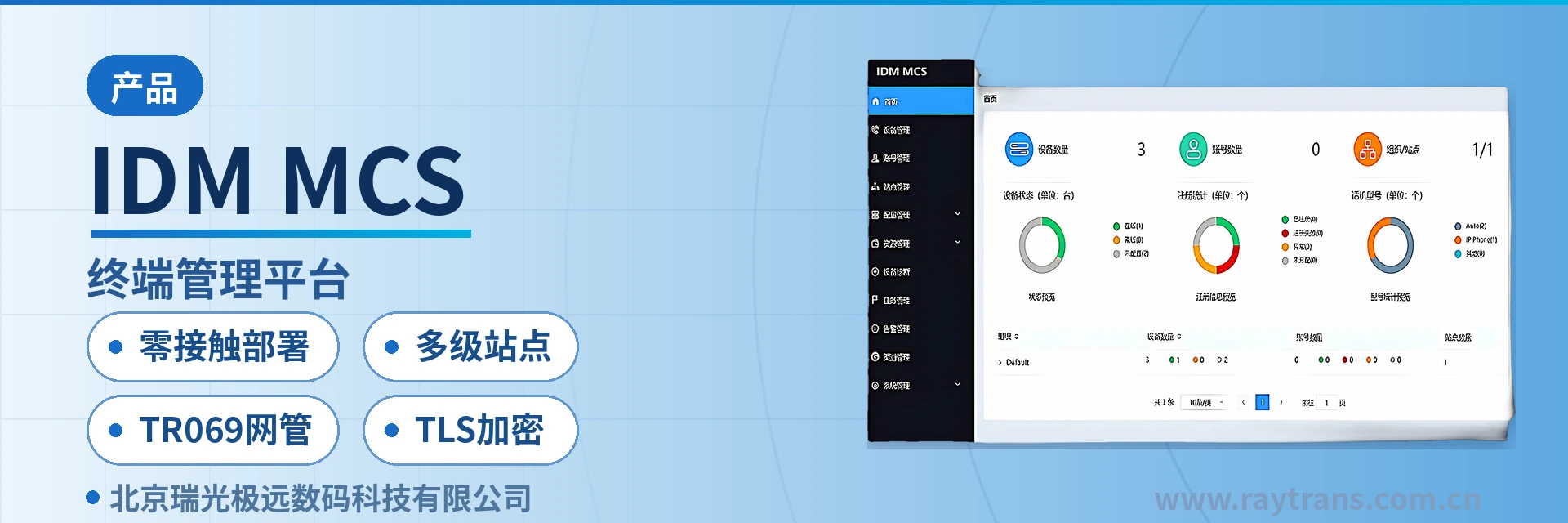
IDM MCS Terminal Management Platform
Zero-configuration automatic network access on power-up, batch centralized management of multi-level sites, remote diagnosis without site visits
The MCS terminal management platform is a maintenance and management platform for managing devices deployed in the network. The MCS is deployed at the top floor of the user network, and devices in same-level networks or subnets register with the MCS and come under its unified management. The MCS has a built-in ACS server and performs command-based management communication with devices through the TR069 protocol. The MCS provides users with a fast and easy-to-use tool for remote device deployment and management.
IDM MCS zero-touch deployment terminal management platform is a centralized terminal management platform developed by Beijing Ruiguang Jiyuan Digital Technology Co., Ltd. (Raytrans). Deployed at the top floor of the user network, it brings communication terminals in same-level networks and subnets under unified centralized management, providing terminal-side centralized management support for audio and video dispatching and command and dispatch system manufacturers. Once powered on and connected to the network, devices automatically register with the platform, so on-site personnel do not need to log in to devices for local configuration, and field sites can complete network access. This zero-touch deployment terminal management platform capability also applies to rapid terminal commissioning in government private network optical fiber communication solutions and military emergency communications vehicle solutions.
Key Specifications at a Glance: Deployed at the top floor of the user network · Built-in ACS server · Zero-touch deployment · Multi-level sites · TR069 NMS platform · TLS encryption
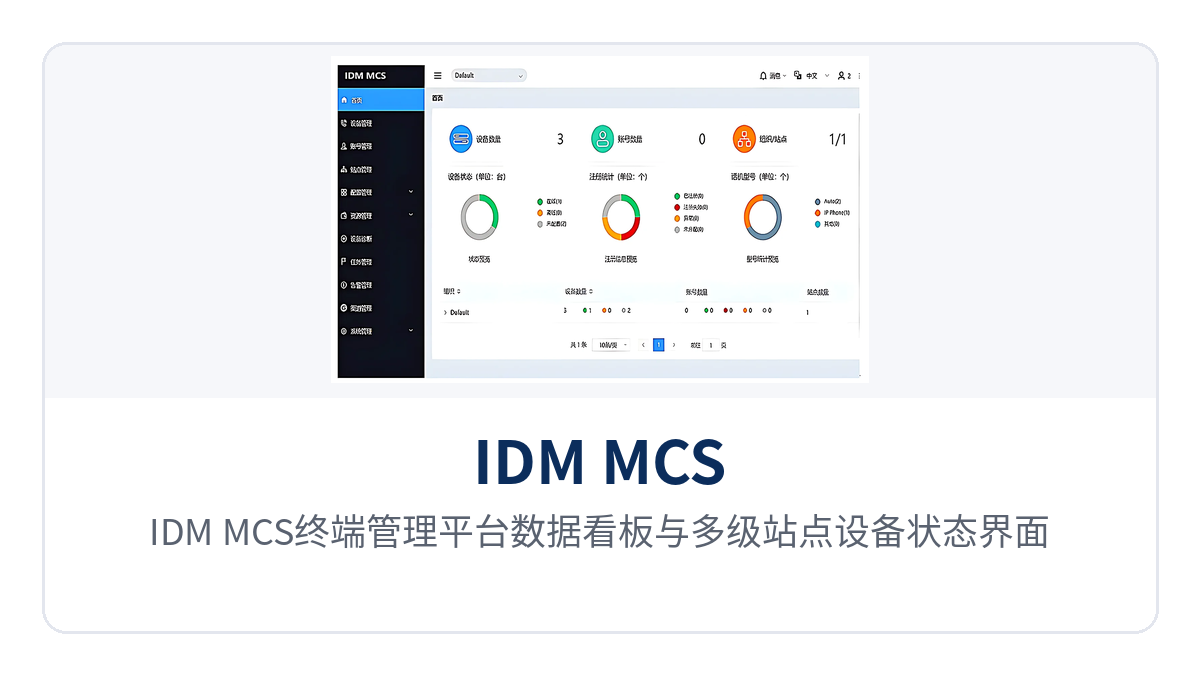
Figure 1: IDM MCS terminal management platform data dashboard and multi-level site device status interface
What is the zero-touch deployment private network terminal management platform, and at which layer of the network is it deployed?
The zero-touch deployment private network terminal management platform is a software platform that centrally manages all communication terminals in a private network and replaces site-by-site on-site configuration, and it is deployed at the top floor of the user network. After terminals register with the platform, device status, registered account status, site affiliation, and configuration version are all under the platform's unified control, and O&M personnel can complete operations in the central equipment room that previously required a site visit. For organizations building audio and video dispatching and command and dispatch systems, this platform is exactly the infrastructure for unified terminal-side centralized management.
The platform has a built-in ACS server and performs command management and communication with devices through the TR069 protocol, which is also where the TR069 NMS platform differs from ordinary NMS software: terminals are not passively queried but automatically execute configuration delivery, firmware upgrade, and reboot according to commands issued by the platform. Devices in a same-level network or subnet, once registered, are managed under the same set of rules.
For private network users with distributed sites and long distances to the equipment room, the value of the zero-touch deployment terminal management platform lies in turning O&M actions from people traveling to sites into commands issued by the platform. The more sites there are and the more scattered they are, the more obvious the benefit of centralized management, which is also why energy and electric power, rail transit, and military and government private networks prioritize building terminal management platforms. In government private network optical fiber communication solutions and military emergency communications vehicle solutions, unified terminal-side centralized management is likewise an indispensable part.
How do devices automatically join the network with zero configuration on power-up, and is on-site commissioning still needed?
The implementation path of zero-touch deployment is automatic deployment without user configuration after the device is powered on, and the terminal retrieves its own configuration from the platform the first time it comes online. An unconfigured device is identified by the platform and brought under management, and automatically registers after being powered on and connected to the network; the platform pushes the configuration down according to site affiliation, model, or MAC address, so no portable computer needs to be carried on site for local commissioning.
Account registration and configuration delivery are two linked actions. The platform supports batch management of SIP accounts; after adding a server, accounts can be added, exported, and deleted in bulk, and assigned to specified devices; after a device connects to the platform, accounts register automatically, and the registration result is shown in device registered account status monitoring as registered, registration failed, unregistered, or unknown.
Configuration is divided into two types: common configuration and MAC configuration. Common configuration targets general device parameters and supports immediate delivery and scheduled delivery; MAC configuration is named after the device MAC address and supports immediate push. Parameters can be modified in the GUI or edited in text form and then delivered, and configuration templates can be downloaded from the platform for unified maintenance.
How do multi-level sites and bulk import support hierarchical centralized management in private networks?
Multi-level site management addresses the question of who manages which terminal, and bulk import addresses how to quickly set up sites. The platform supports multi-level site management, bulk site import, and transferring devices in a site to another organization or site; site levels correspond to user organizations and can be divided by administrative region, voltage level, or line section, avoiding the difficulty of retrieving all devices piled in the same level.
Task management templates O&M actions, with task types of immediate, scheduled, and recurring. Task content covers rebooting devices, factory reset, firmware upgrade, upgrade by model, delivering configuration files, upgrading configuration files by site, and updating resource files; the execution scope can be all devices of a selected site, all devices of a certain model, specified devices, or precisely specified by entering MAC addresses.
After a task is delivered, the platform monitors task status and task results in real time; running tasks can be stopped or canceled, and tasks not yet executed can be edited and re-sent. Firmware and configurations for thousands of devices can be upgraded in bulk by site or model without scheduling site by site, which is the practical benefit of bringing devices under centralized management on one platform in large private networks, and it applies equally to the terminal networks that audio and video dispatching and product showcase services rely on.
Channel management leaves orders and devices on the distribution chain traceable in the platform as well. The platform supports viewing orders, importing orders, and import device management, assigning devices to sub-channels, binding sub-channels, and allowing upper-level channels to bind through channel authorization; the list of bound channels can be viewed on the platform.
How do the TR069 NMS and TLS encryption form a remote O&M closed loop?
The remote O&M closed loop consists of three steps: the TR069 NMS issues commands, TLS encryption protects the channel, and diagnostic data is sent back to the platform. The platform communicates with terminals through the TR069 protocol, and configuration delivery, firmware upgrade, reboot, factory reset, and packet capture diagnosis are all executed within the standard protocol framework; the administrator clicks once on the platform side, and the terminal executes the command and returns the result.
TLS encryption makes the management channel a controllable and manageable closed loop. The platform supports three types of protocols: TLS, HTTP/HTTPS, and TR069; TLS uses a mutual authentication mechanism and stores data in encrypted form, platform-side access goes over HTTP/HTTPS, the terminal command channel is carried by TR069, and the transport layer provides encryption and identity verification through TLS.
Remote diagnosis is the last link of the closed loop. The platform provides six means: viewing system and account status, exporting system logs, packet capture, exporting configuration files, detecting network status, and screenshots; network status detection includes Ping and route diagnosis. Once diagnostic results are retrieved on the platform side, it can be determined whether a site visit is needed, reducing round trips to the necessary minimum.
Permissions and auditing belong to the same security boundary. System management supports adding sub-accounts, adding roles, and adding organizations, and roles and permissions can be set for sub-accounts; agents, distributors, service providers, and end customers manage devices within their respective scopes according to their permissions; system logs can be viewed and exported, and key operations are recorded and traceable. As a command and dispatch system manufacturer, Raytrans pairs the capabilities of this TR069 NMS platform and zero-touch deployment terminal management platform into projects such as government private network optical fiber communication solutions and military emergency communications vehicle solutions, forming a complete closed loop from terminal centralized management to remote O&M.
Core Functions
The platform integrates device management, account management, configuration management, resource management, device diagnostics, alarms, channel management, and system management in a single interface. The functional modules and their purposes are listed in the table below. During selection, check row by row against the service list; which capabilities are needed and whether the platform has them built in can be seen at a glance.
| Function | Description |
|---|---|
| Data dashboard | Statistics on number of devices, number of accounts, and number of organizations and sites; statistics on device online/offline/unconfigured status, SIP account registered/abnormal/unassigned status, and number of devices of each model; statistics by organization on number of devices, device status, number of accounts, registration status, and number of sites |
| Device management | Zero-touch deployment: automatic deployment without user configuration after the device is powered on; add, export, and delete devices in bulk; real-time monitoring of device status as online/offline/abnormal; monitoring of device registered account status as registered/registration failed/unregistered/unknown; supports editing, deleting, and transferring the organization a device belongs to, assigning site, and setting parameters |
| Remote management | Perform remote reboot, firmware upgrade, configuration file update, resource file update, and factory reset on devices |
| Account management | Add, export, and delete SIP accounts in bulk; add servers and delete servers in bulk; assign accounts and unassign accounts; after an account is assigned to a device, the device registers automatically when it connects to the platform; supports editing and deleting accounts and changing the server an account belongs to |
| Task management | Task types are immediate, scheduled, and recurring; task content covers rebooting devices, factory reset, firmware upgrade, upgrade by model, configuration files, upgrading configuration files by site, and updating resource files; execution scope can be all devices of a site, all devices of a certain model, specified devices, or entered by MAC address; real-time monitoring of task status and task results, with support for immediate execution, canceling execution, stopping tasks, and editing tasks |
| Site management | Multi-level site management, bulk site import, transferring devices in a site |
| Configuration management | Common configuration supports immediate delivery and scheduled delivery; MAC configuration is named after the device MAC address and supports immediate push; parameter modification supports GUI modification and text modification; configuration template download is provided |
| Resource management | Firmware management distinguishes official firmware from my firmware, and supports uploading custom firmware, viewing official firmware release notes, pushing firmware updates, and downloading firmware; resource files cover images, phone books, certificates, and ring tones |
| Device diagnostics | Remote device diagnostics, with support for viewing system and account status, exporting system logs, packet capture, exporting configuration files, detecting network status, and screenshots; network status detection provides Ping and route diagnosis |
| Alarm management | View alarm details; alarms are sent by email or pushed as site messages; alarm content covers account registration failure, insufficient or full storage space, factory reset, device reboot, task execution failure, and device offline; supports deleting alarms |
| Channel management | View orders, import orders, import device management, assign to sub-channels, bind sub-channels, channel authorization (authorizing upper-level channel binding), and view the list of bound channels |
| System management | User management supports adding sub-accounts, adding roles, adding organizations, and setting sub-account roles and permissions; supports viewing system logs and exporting system logs |
Key Specifications and Technical Specifications
The platform's deployment mode, registration mechanism, and protocol support are summarized in the table below; selection and solution design can be checked item by item by protocol, task scope, and monitoring dimension. For platform hardware and operating environment parameters not listed in the table, the manufacturer's technical documentation and commercial confirmation shall prevail.
| Item | Parameter/Specification | Description/Applicable Conditions |
|---|---|---|
| Deployment position | Top floor of the user network | Devices in a same-level network or subnet are under unified management after registering with the platform |
| Terminal registration method | Built-in ACS server, command management and communication through the TR069 protocol | After an account is assigned to a device, the device registers the account automatically when it connects to the platform |
| Supported protocols | TLS, HTTP/HTTPS, TR069 | TLS supports a mutual authentication mechanism, and data is stored in encrypted form |
| Device status monitoring | Online / Offline / Abnormal | Real-time monitoring at the device level |
| Account registration status monitoring | Registered / Registration failed / Unregistered / Unknown | Real-time monitoring at the device registered account level |
| SIP account status statistics | Registered / Abnormal / Unassigned | Data dashboard statistics basis |
| Task types | Immediate / Scheduled / Recurring | Scheduled and recurring tasks execute automatically according to O&M windows |
| Task execution scope | All devices of a selected site / all devices of a certain model / specified devices / entered MAC address | The scope determines the number of terminals covered by one task |
| Task content | Reboot device, factory reset, firmware upgrade, upgrade by model, configuration files, upgrade configuration files by site, update resource files | Both configuration files and firmware support delivery by site |
| Configuration delivery method | Common configuration (immediate delivery / scheduled delivery), MAC configuration (immediate push) | Parameters support GUI modification and text modification |
| Remote diagnosis methods | View system and account status, export system logs, packet capture, export configuration files, detect network status (Ping / route diagnosis), screenshots | Diagnostic data can be collected without sending personnel to the site |
| Alarm notification methods | Email sending, site message push | Covers account registration failure, insufficient or full storage space, factory reset, device reboot, task execution failure, device offline |
| Users and permissions | Sub-accounts, roles, organizations | Supports setting roles and permissions for sub-accounts and dividing management scopes by role |
| Platform hardware and operating environment | Not yet recorded in the knowledge base | Subject to the manufacturer's technical documentation and commercial confirmation |
Differentiated Value: Zero-Touch Deployment, Multi-Level Sites, TR069 Network Management and TLS Encryption
The four capabilities address four types of on-site problems: whether deployment requires sending personnel, how to layer management as sites multiply, whether remote actions can be closed-loop, and whether the management channel is secure. The table below maps each capability to its implementation and value to the customer, for direct reference in solution reviews and bid responses.
| Capability | Implementation | Value to the Customer |
|---|---|---|
| Zero-touch deployment | Automatic deployment without user configuration once the device is powered on; the device registers automatically with the platform after an account is assigned | Zero-configuration automatic deployment on power-up; field sites join the network without on-site commissioning, shortening the delivery cycle |
| Multi-level sites | Multi-level site management, bulk site import, transfer of devices between sites, and tasks scoped by site or model | Multi-level sites plus bulk import suit layered private network organizations and centralized management of devices at scale |
| TR069 network management | Built-in ACS server; configuration delivery, upgrade and reboot triggers, and diagnostic data collection through the TR069 protocol | Remote reboot, upgrade, diagnosis and packet capture form a closed loop, with O&M actions executed within a standard protocol framework |
| TLS encryption | TLS mutual authentication; data stored in encrypted form; platform access over HTTP/HTTPS | The management channel combines encryption with identity verification, and system logs make operations auditable |
Typical Application Scenarios
Private networks share the traits of many sites, long distances and few duty personnel, so the benefits of a terminal management platform concentrate in the commissioning and O&M phases. The three scenarios below map directly to site hierarchy, task scope and diagnostic tool configuration, and can be selected by industry during solution design.
Energy and Electric Power Private Network: Unattended Terminal Management at Substations and Distribution Rooms
Electric power private networks have many, widely dispersed sites. Communication terminals at substations, distribution rooms and new energy stations often come from different batches and models, and many sites are unattended. The IDM MCS Terminal Management Platform organizes terminals at each site into multi-level sites by voltage level or supply area, and the data dashboard reports the number of devices and account registration status by organization, so O&M personnel at the dispatch center can check which type of terminal is offline or failed to register.
Batch device upgrade and configuration file delivery by site are used together, replacing site-by-site shutdown and device-by-device upgrades with one task covering all terminals at a site. Scheduled tasks can run during off-peak hours to reduce impact on dispatch telephones and automation channels; field sites no longer need a site visit for a single parameter change, and zero-touch deployment lets newly installed devices join the network on power-up.
Rail Transit Communication: Centralized O&M of Communication Terminals at Stations and Sections
Rail transit communication terminals are distributed across stations, sections and depots, and management permissions must be separated by line, section and job role. By adding organizations, roles and sub-accounts, the platform assigns devices on different lines or sections to the corresponding roles, with cross-level viewing and operations constrained by permissions, and bulk site import removes the need to register each device individually.
At the protocol level, TLS mutual authentication, HTTP/HTTPS and TR069 are used; data on the management channel is stored in encrypted form; system logs can be viewed and exported, so security audits are traceable to specific operations. Alarm management pushes messages or sends emails by site, delivering events such as device offline and task execution failure to the responsible person in time.
Military and Government Private Network: Multi-Level Organization Delegated Management and Remote Encrypted Management
Military and government private networks have deep organizational hierarchies and complex device ownership, with security requirements higher than those of ordinary industry private networks. The platform's multi-level sites and organization settings can be divided level by level into corps, detachments and sites, sub-accounts and roles limit operation permissions to each person's scope of responsibility, and system logs leave traces that meet post-event verification needs.
Field unattended sites are constrained by power supply and communication conditions, and both device commissioning and fault handling aim to reduce site visits. Zero-touch deployment lets newly installed terminals register automatically and retrieve their configuration on power-up; when a terminal is abnormal, remote diagnosis provides six tools—viewing system and account status, exporting system logs, packet capture, exporting configuration files, network status detection and screenshots—while Ping and route diagnosis determine which link segment the problem lies in.
Conclusion
The IDM MCS Zero-Touch Deployment Terminal Management Platform is built around a built-in ACS server deployed at the top floor of the user's network. It completes terminal registration, configuration delivery and remote O&M through the TR069 protocol (TR069 network management platform), and protects the entire management channel with TLS encryption. Zero-configuration automatic deployment on power-up lets field sites join the network without on-site commissioning; multi-level sites and bulk import make centralized management of devices at scale under layered organizations routine, and provide reliable support for unified terminal-side management of audio and video dispatching and command and dispatch systems.
The platform-side data dashboard, task management, remote diagnosis and alarm push move fault handling from the site to the center, while configuration management and resource management keep firmware, configuration files, phone books and certificates maintained uniformly by site. When planning terminal management solutions for energy and electric power private networks, rail transit communication, and military and government private networks, configurations can be checked against three items: site hierarchy, terminal model and task scope. Whether implementing a government private network optical fiber communication solution or rapidly commissioning a military emergency communications vehicle solution, you can combine business scenarios such as audio and video dispatching and product showcase, and refer to the technical documentation and commercial confirmation of command and dispatch system manufacturer Raytrans; specific parameters are subject to the manufacturer's technical documentation and commercial confirmation.