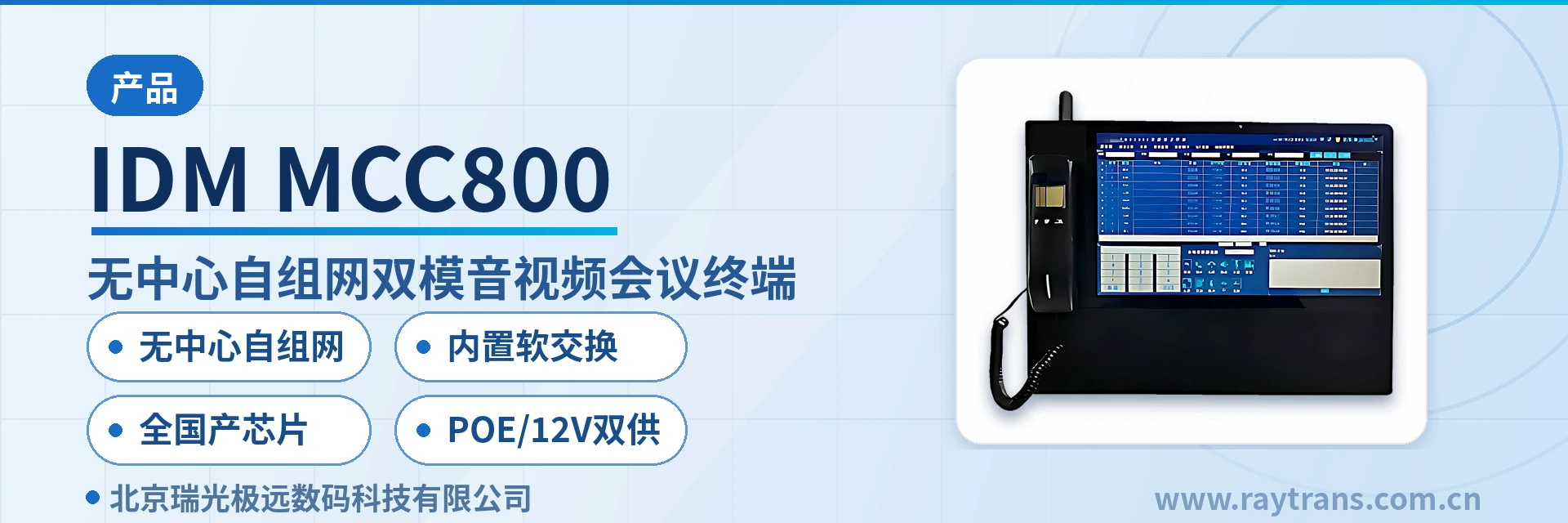
IDM MCC800 Centerless Ad-Hoc Network Audio and Video Dispatching Terminal
No-MCU Direct Conference Setup, Built-in Softswitch Doubles as Dispatch Host
The IDM MCC800 is a centerless ad-hoc network dual-mode audio and video conference terminal. It supports standard MCU compatibility, centerless ad-hoc networking, full-network access, and free switching between the two modes. It features AI speech recognition, video recognition, and transaction processing capabilities, and has a built-in softswitch server that allows it to serve as a dispatch host. It is suitable for emergency repair, field operations, energy and coal mine, government and enterprise offices, emergency command, rail transit, electric power, and other scenarios.
What Kind of Device Is This?
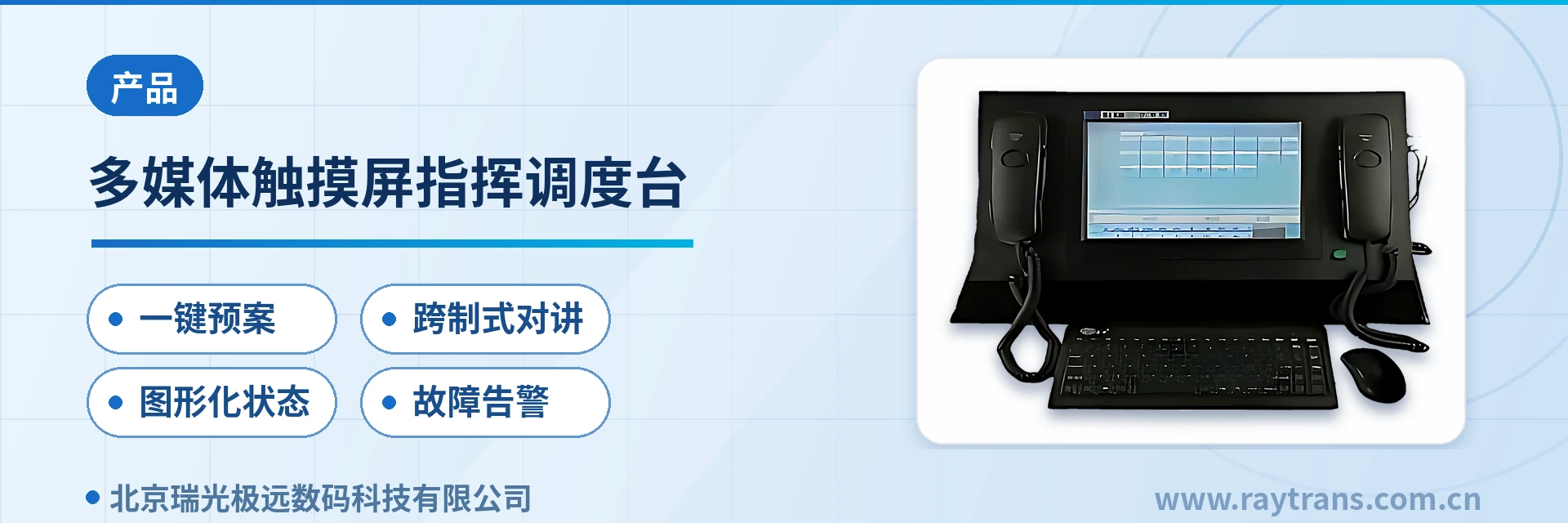
The IDM MCC800 industrial private network audio and video dispatching terminal is a desktop audio and video communication and dispatching integrated device developed by Beijing Ruiguang Jiyuan Digital Technology Co., Ltd. It comprises five capabilities: centerless ad-hoc network, built-in softswitch, dual-mode telephone intercommunication, offline AI recognition, and full-link encryption. It is used on sites without servers or public network coverage to directly connect multiple intelligent audio and video terminals into a communication network capable of holding audio and video conferences and issuing dispatch orders. The IDM MCC800 is built on fully domestic hardware, integrating a 15.6-inch capacitive multi-touch screen, a built-in softswitch service module, and dual 10 W full-range speakers into a single unit. It can serve as a conference terminal or as the main unit of a command and dispatch system.
Key specifications at a glance: 15.6-inch capacitive multi-touch screen · Fully domestic RK3568 quad-core Cortex-A55 · 2G+16G storage · 1000M adaptive Ethernet + WIFI-2.4G + BT-4.1 · POE/12V dual power supply · Built-in dual 10 W full-range speakers
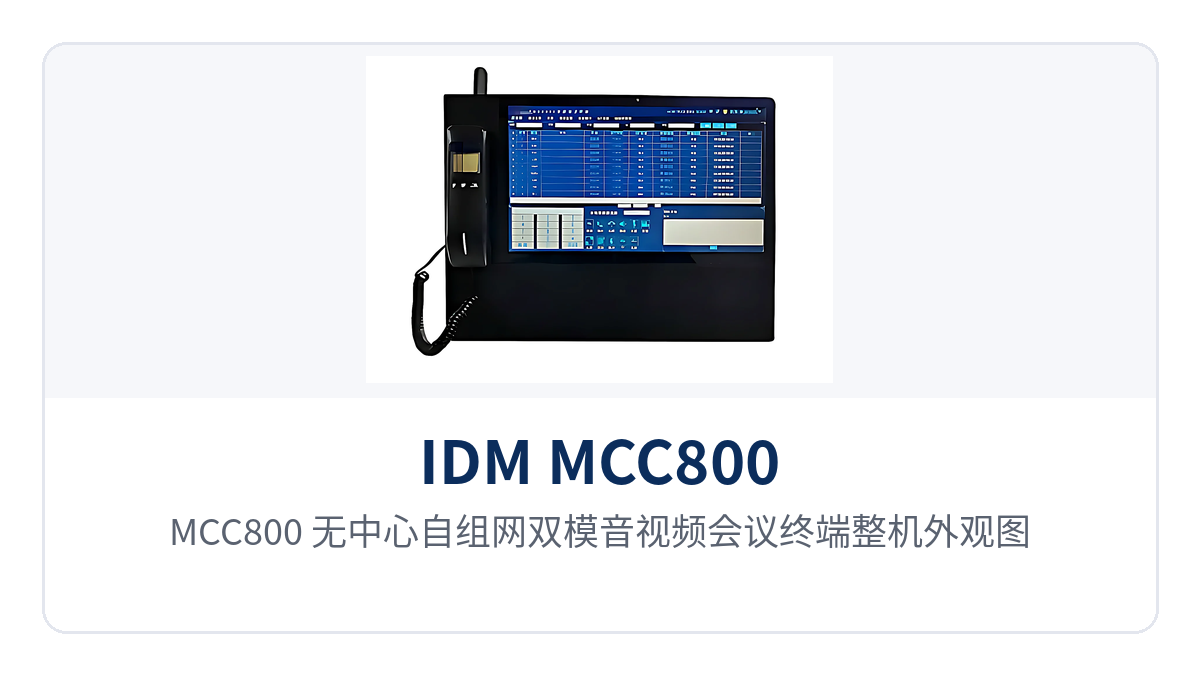
Figure 1: Overall appearance of the MCC800 centerless ad-hoc network dual-mode audio and video conference terminal
Centerless Ad-Hoc Network: Without a Server or Public Network, How Do Multiple MCC800 Units Start a Dispatch Conference?
A centerless ad-hoc network means multiple terminals connect to each other and form a conference network on their own, without going through a server, base station, or public network. In centerless mode, the IDM MCC800 industrial private network audio and video dispatching terminal requires no server support; multiple terminals can connect directly to hold an ad-hoc network conference. On site, simply deploy several MCC800 units and an audio and video dispatching conference can be set up on the spot, with no need to pre-build an equipment room, lay links, or configure a central platform.
This mode directly targets no-network scenarios such as emergency repair and field operations. Underground mine roadways, disaster sites, and uninhabited-area construction sites often have neither public network signals nor usable equipment room conditions, and the central MCU that conventional video conferencing systems rely on cannot be deployed in these places. The IDM MCC800 puts conference setup capability on the terminal side: multiple terminals connect directly to set up a conference, and voice, video, and audio and video dispatch orders remain within the on-site network.
Take 6 MCC800 units as an example: after the terminals arrive, links are established between each pair, any two terminals can initiate an audio and video call, and one of them can act as the host to organize a multi-party conference. With one unit each for on-site command, the repair crew, and logistics support, this is equivalent to moving a mobile conference and dispatch system to underground or a disaster area.
Built-In Softswitch: How Does One MCC800 Act as a Dispatch Host?
The IDM MCC800 industrial private network audio and video dispatching terminal has a built-in softswitch service module, so a single device can act as a dispatch host to coordinate communication among multiple terminals, with no need to connect an independent MCU or softswitch server on site. As a professional dispatch console, the MCC800 supports PTT intercom, audio and video forwarding, and permission control, making it suitable for dispatching scenarios such as emergency command and coal mine dispatch that require centralized calling and tiered authorization.
The IDM MCC800 also retains standardized compatibility: in conventional office environments with a central deployment, the device can seamlessly interface with a standard MCU to build a large-scale video conferencing system and meet daily office meeting needs. In other words, the same terminal can work under both "with center" and "centerless" conference architectures — connect to an MCU when a large-scale conference is needed, and switch to ad-hoc network mode when rapid commissioning on site is needed. Both architectures share the same set of terminals and the same operation method, so there is no need to purchase two types of devices for different scenarios.
Full-Network Access and Dual-Mode Communication: How Are SIP and PSTN Switched and Isolated?
The IDM MCC800 industrial private network audio and video dispatching terminal supports both SIP telephone system and PSTN public switched telephone network (PSTN) access, with free switching between the two modes. On site, calls can be carried over the IP network or made with external parties via the public telephone network. SIP signaling follows the RFC 3261 framework, facilitating intercommunication with existing call platforms.
The control method for dual-mode communication is selected by the user according to the confidentiality level: when cross-network collaboration is required, the two communication paths can intercommunicate and coordinate, bringing telephones and terminals within the private network and external telephones into the same dispatch session; when classified content is involved, the two communication paths can be physically isolated, with private network communication and the public telephone network not connected to each other, meeting communication needs at different confidentiality levels.
Encryption capabilities cover three layers: signaling, media stream, and management channel. Signaling supports SIP over TLS and explicit encryption specified by SIP URI; media streams support SRTP (SDES/DTLS, following RFC 3711) and ZRTP (following RFC 6189, negotiated with priority); the management channel supports SSH remote management, HTTPS web management, and ESL over TLS. Classified scenarios such as coal mines and energy can preferentially use ZRTP and DTLS-SRTP.
Offline AI: Speech Recognition, Video Recognition, and Transaction Processing Capabilities
The AI capabilities of the IDM MCC800 industrial private network audio and video dispatching terminal run locally without relying on cloud connectivity, and still work when the network is down. Speech recognition can transcribe meeting content in real time, supports multiple languages and multiple accents, and dispatch orders spoken on site can be directly turned into written records; video recognition can intelligently analyze image content to enable warning for personnel, object, and behavior recognition, and is used to indicate abnormal states in key underground areas and at disaster sites.
AI transaction processing targets the dispatch process itself: tasks such as automatic generation of meeting minutes, order issuance, and abnormal alarms can be handled automatically, reducing the dispatcher's manual operations in meeting records and information transfer, and letting on-site command focus on decision-making.
Functions and Performance Specifications
Function Overview
Function | Description |
|---|---|
Standardized compatibility | Seamless interfacing with standard MCUs to form a large-scale video conferencing system, meeting the needs of routine office meetings |
Centerless ad-hoc network | No server support is required; multiple terminals connect directly to hold an ad-hoc network conference, suitable for no-network scenarios such as emergency repair and field operations |
Full-network access | Simultaneously supports access to the SIP telephone system and the PSTN, with free switching between the two modes |
Flexible control | Dual-mode communication can either intercommunicate and collaborate or be physically isolated, meeting communication needs at different confidentiality levels |
Speech recognition | Real-time transcription of meeting content, supporting recognition of multiple languages and multiple accents |
Video recognition | Intelligent analysis of image content to enable recognition and warning of people, objects and behaviors |
AI transaction processing | Automated handling of meeting minutes, instruction delivery, abnormal alarms and other affairs, improving audio and video dispatching efficiency |
Audio and video call | Meets the needs of point-to-point and multipoint audio and video calls and visual conferences |
Softswitch server | Built-in softswitch service module, which can serve as a dispatch host to coordinate multi-terminal communication |
Professional dispatch console | Supports PTT intercom, audio and video forwarding and permission control, suitable for dispatching scenarios of concern to command and dispatch system manufacturers, such as emergency command and coal mine dispatching |
Signaling encryption | Supports SIP over TLS and explicit encryption specified by SIP URI |
Media stream encryption | Supports SRTP (SDES/DTLS) and ZRTP (negotiated with priority) |
Auxiliary encryption | Supports SSH remote management, HTTPS web management and ESL over TLS |
Smart speaker compatibility | Compatible with intelligent audio and video terminals such as Xiaodu, Xiao Ai and Tmall Genie, enabling voice-controlled terminal operation |
Enterprise service access | Interfaces with DingTalk enterprise services, supporting office functions such as check-in, logs and approvals |
Daily software compatibility | Can be pre-installed with office and social software such as Douyin and WeChat, meeting diversified office needs |
Ubiquitous terminal connectivity | Supports access of IoT devices such as cameras, sensors and alarm devices, integrating video surveillance, data acquisition and intelligent alarms |
System compatibility | Native Android system, with customizable HarmonyOS, adapting to domestic substitution needs |
Technical Specifications and Hardware Configuration
Item | Parameter/Specification | Description/Applicable Conditions |
|---|---|---|
Main control chip | Fully domestic RK3568, quad-core 64-bit Cortex-A55, 2.0GHz | Fully domestic hardware platform, adapted to private network domestic substitution requirements |
Storage configuration | 2G+16G | Low power consumption, meeting audio and video dispatching operation requirements |
GPU | ARM G52 2EE, 0.8TPS computing power, supporting OpenGL ES 1.1/2.0/3.2 and other protocols | Handles graphics rendering and video processing |
Display screen | 15.6-inch capacitive multi-point touch all-in-one, 1920*1080P high resolution | HDMI interface supports 4K video output |
Network interface | 1000M adaptive Ethernet, WIFI-2.4G, BT-4.1 | Ethernet complies with IEEE 802.3 series standards |
Power supply mode | POE / 12V dual power supply | Supports PoE power supply and 12V DC power supply access |
USB interface | 4 USB 2.0 + 2 USB 3.0 (1 USB3.0 is OTG) | For external cameras, headsets, handsets and other peripherals |
Audio system | Hardware echo cancellation technology, built-in dual 10W full-range speakers, 3.5mm headset/telephone handset/condenser microphone multi-interface | Hands-free calling, suitable for desktop and dispatch console deployment |
Camera system | 8-megapixel front camera, supports external multi-USB cameras | Multi-angle switching of video intercom and surveillance video |
Installation method | Ultra-slim chassis, standard display screen mounting holes on the back | Supports cabinet embedded mounting, wall-mounted, and desktop placement |
Differentiated Value: Three On-Site Benefits of the Industrial Private Network Audio and Video Dispatching Terminal
Differentiated capability | On-site problem addressed | User value |
|---|---|---|
Centerless ad-hoc network | Network outage, no server, no public network in underground and disaster sites | Multiple terminals directly connect for conference setup; audio and video dispatching conference can be enabled once terminals are in place |
Built-in softswitch | External MCU and independent dispatch console cannot be deployed on site | A single unit serves as the dispatch host, coordinating multi-terminal communication, reducing accompanying devices and deployment time |
Fully domestic chip and customizable HarmonyOS | Private network domestic substitution and confidentiality isolation requirements | Fully domestic RK3568 platform, native Android with customizable HarmonyOS, meeting domestic IT innovation and isolated deployment |
Typical Application Scenarios
Energy and Coal Mine: Underground Dispatch and Classified Communication
The underground mine roadway environment of coal mines is enclosed, public networks and conventional conferencing servers can hardly provide coverage, and dispatching calls involve production information security. The Raytrans IDM MCC800 industrial private network audio and video dispatching terminal uses a centerless ad-hoc network to set up conferences underground on the spot; multiple intelligent audio and video terminals directly connect to complete audio and video dispatching, speech recognition converts underground reports into text records in real time, and video recognition provides anomaly alerts for images of key areas. The physical isolation capability of dual-mode communication allows intrinsically safe mining communication underground to be separated from the external public telephone network as required, adapting to classified communication requirements and providing deployable terminal support for smart mining communication solutions.
Emergency Command: Ad-Hoc Networking and Multi-Terminal Dispatch at Disaster Sites
After earthquakes, flooding, landslides and other disasters, on-site communication infrastructure is often damaged at the same time, and emergency dispatching terminals brought in with the team need to quickly establish command channels without an equipment room or public network. After the Raytrans IDM MCC800 is brought in with the team, multiple units directly connect for conference setup; on-site command, rescue teams, medical and logistics personnel each hold one, PTT intercom is used for quick calls, audio and video forwarding sends front-line images back to the command point, and AI transaction processing automatically generates meeting minutes and instruction records. The IDM MCC800 supports POE and 12V dual power supply, and can be put into use under emergency power or vehicle-mounted power supply conditions, meeting the practical requirements of military emergency communications vehicle solutions for rapid deployment and flexible power supply.
Rail Transit and Electric Power: Equipment Monitoring, Remote O&M and Emergency Calls
Rail transit lines and electric power substations are distributed dispersedly, with long distances between sites and few duty personnel, requiring remote O&M and emergency call capabilities in daily operations. The Raytrans IDM MCC800 industrial private network audio and video dispatching terminal can connect to cameras, sensors, alarm devices and other IoT devices, centralizing video surveillance, data acquisition and intelligent alarms on the same terminal; when an anomaly occurs at a site, on-duty personnel confirm the on-site status face to face with the dispatch center through audio and video calls, shortening fault diagnosis time, and can coordinate networking with government private network optical fiber communication solutions, forming a communication system where the wired private network and terminal dispatching complement each other.
Deployment and Selection Recommendations
During selection, it is recommended to first clarify three points: whether the site requires independent conference setup during network outage, whether intercommunication with the external telephone network is needed, and whether domestic production and confidentiality isolation are required. The IDM MCC800 industrial private network audio and video dispatching terminal addresses these three points respectively through the centerless ad-hoc network, dual-mode telephone intercommunication and the fully domestic platform; users in energy and coal mine, emergency command, rail transit and electric power private networks can configure the main unit and subordinate terminals according to the number of on-site terminals and dispatching levels; in the practical implementation of audio and video dispatching and product showcase, Raytrans can provide overall capability support as a command and dispatch system manufacturer with intelligent audio and video terminals, and give matching recommendations for scenarios such as smart mining communication solutions, military emergency communications vehicle solutions, intrinsically safe mining communication and government private network optical fiber communication solutions; the specific networking solution and configuration quantity are subject to the on-site survey results and the manufacturer's technical documentation.