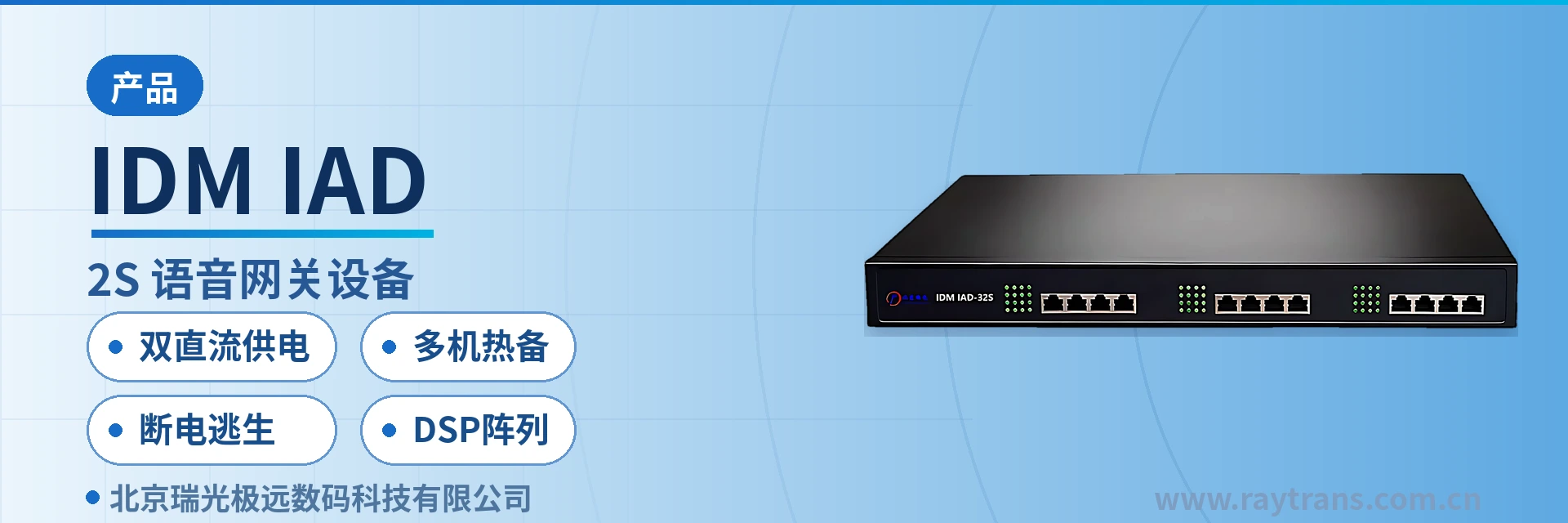
IDM IAD-32S Voice Gateway
Full-concurrency 32 channels, dual DC and dual AC power supplies, triple redundancy, dual escape, three protocol types on one device
The 32S voice gateway is a high-performance, high-reliability voice access gateway launched by our company. It uses the standard SIP protocol and is compatible with various IP PBX and VoIP voice platforms, providing flexible and diverse access methods. It is suitable for large-scale deployment in carrier projects and enterprise unified communications. Its full-concurrency call processing capability is also particularly suitable for IP contact center solutions, meeting the needs of high-traffic call handling.
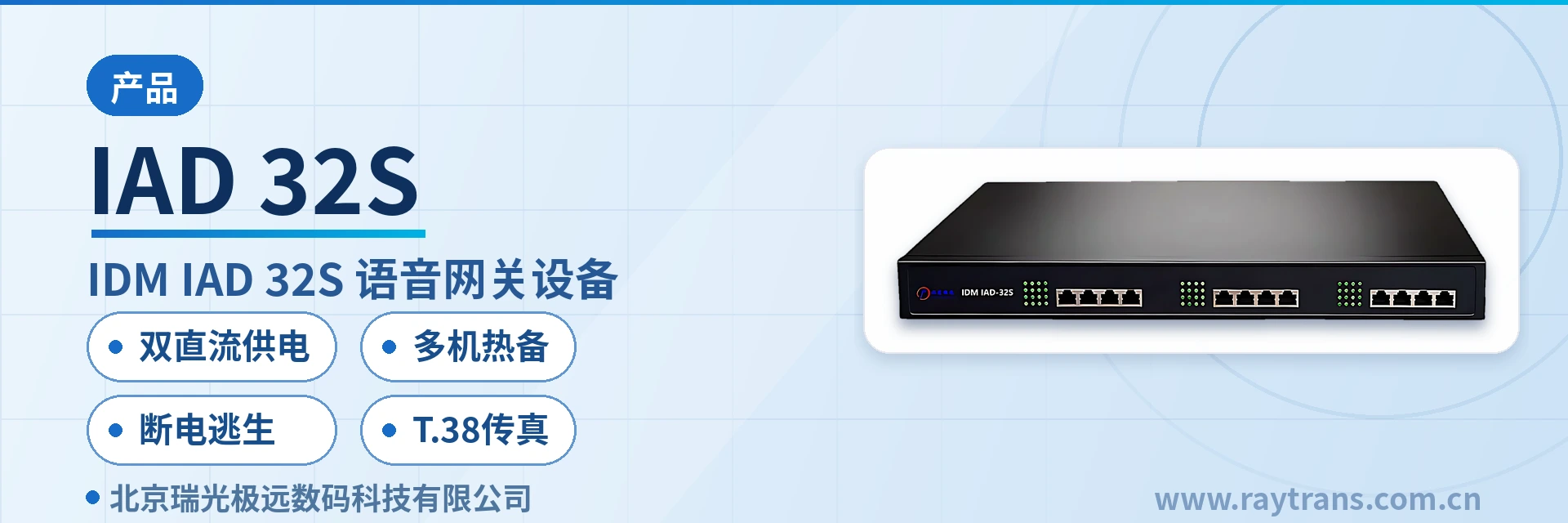
The IDM IAD-32S fully concurrent voice gateway is a 1U rack-mounted device that uses the standard SIP protocol and is designed for large-scale voice access in private networks. Developed by Raytrans, it connects ordinary telephones, computers, fax machines, and outside telephone lines to an IP voice network and bridges to the PSTN. It can also serve as an IP access gateway for the product showcase and unified access of SIP telephones and other terminals. The unit handles fully concurrent call processing with a 2–6 piece DSP array, supports dual DC power supply and dual AC power supply, and provides triple disaster recovery and dual escape capabilities. It is suitable for voice access scenarios built by government private network optical fiber communication solution providers and command and dispatch system manufacturers, and provides reliable gateway support for IP contact center voice access solutions.
Key Specifications at a Glance: 1 GHz processor · DSP array 200 MHz, configurable with 2–6 pieces · SIP/IMS/MGCP call control · single/dual DC -36~-72V · 128 MB DDR3 + 32 MB Flash · 1U rack 44×440×260 mm
What kind of device is a fully concurrent voice gateway?
A fully concurrent voice gateway is a voice access device that converts the voice and signaling of every voice channel into IP packets simultaneously and enables all channels to be connected at the same moment. Unlike proportional sharing of processing resources, fully concurrent means every channel gets an independent processing path during busy hours, so subsequent calls are not squeezed out because some channels are occupied. This is also the first specification to check when selecting for IP contact centers and high-traffic sites, and it directly affects the overall carrying capacity of an IP contact center voice access solution.
The IDM IAD-32S sits at the voice access layer: downward it connects ordinary telephones, computers, fax machines, broadband networks, and outside telephone lines; upward it registers over SIP, MGCP, or IMS to an IP-PBX, VoIP voice platform, or softswitch, completing the conversion of analog voice and fax services into IP voice streams. The unit is rack-mounted in 1U with dimensions of 44×440×260 mm and can be put into service once installed in a standard communications cabinet. As an IP access gateway, it bridges analog telephones and IP platforms, and can also be used in hybrid networking with SIP telephones.
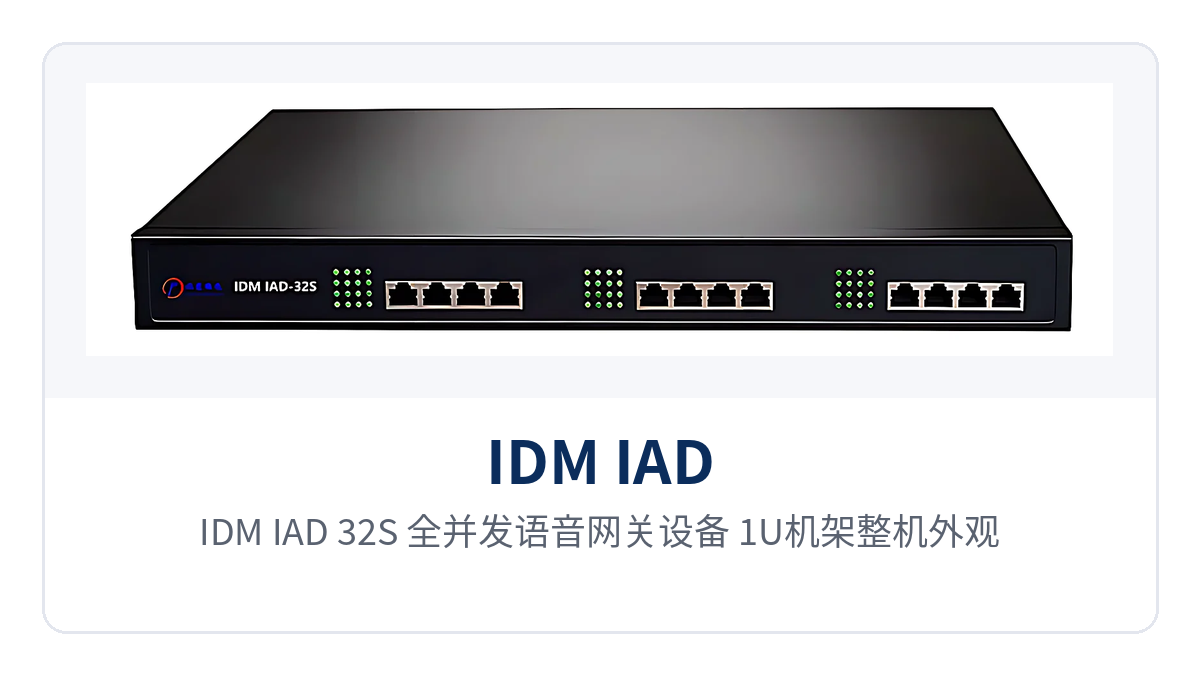
Figure 1: IDM IAD-32S fully concurrent voice gateway 1U rack overall appearance and interface layout close-up
Which call control protocols does the voice gateway support?
The IDM IAD-32S supports three types of call control protocol: SIP/UDP and SIP/TCP (RFC3261), IMS platform (3GPP), and MGCP (RFC3435). Newly built SIP softswitches and IP-PBXs use the SIP channel, service provisioning on carrier and government IMS networks uses the IMS channel, and early softswitches still use MGCP.
The three protocols can be connected separately on the same device, so when a private network platform is upgraded, the voice access device does not have to be replaced all at once; the transformation can proceed site by site, and the process of merging the existing voice network from MGCP into a SIP platform does not require a one-time downtime switchover.
On the network bearer side, it supports SSH, HTTP, HTTPS, DHCP client, PPPoE client, Radius, DNS, and STUN, adapting to fixed IP allocation, RADIUS authentication, and NAT traversal in private networks. Caller ID supports four formats—Bellcore/Teleordia, ETSI, BT, and DTMF—matching calling party number transparent transmission when connecting to PSTN outside lines.
Features at a glance: voice, fax, and office dispatch capabilities
The voice service functions of the IDM IAD-32S cover four categories: call control, media processing, supplementary services, and fax. The table below lists specific descriptions by function item, making it easy to check the provisioning scope item by item against the existing network platform. In the table, fax, DTMF, and line release directly determine compatibility with private network outside line access and should be confirmed carefully during selection.
| Function | Description |
|---|---|
| Call control | SIP/UDP and SIP/TCP (RFC3261), IMS platform (3GPP), MGCP (RFC3435) |
| Network protocols | SSH, HTTP, HTTPS, DHCP client, PPPoE client, Radius, DNS, STUN |
| Caller ID | Bellcore/Teleordia, ETSI, BT, DTMF (four formats) |
| Voice encoding and decoding | G.711, G.729A, G.723.1, GSM, iLBC |
| DTMF | In-band voice transparent transmission, RFC2833, SIP-INFO |
| Hook-flash reporting | Local processing, RFC2833, SIP-INFO |
| Fax | G.711 fax transparent transmission, T.38 fax automatic switchover, rate 9.6kbps, supporting V.21/V.27ter/V.29 protocols |
| Line release | Busy tone detection, reverse polarity detection, line release on power failure |
| QoS | DiffServ, TOS, 802.1P/Q VLAN |
| Audio quality enhancement technologies | Echo cancellation (G.168-2004), jitter buffer, silence suppression (VAD, CNG), PLC |
| Call transfer | Blind transfer, consultative transfer |
| Call forwarding | Unconditional call forwarding (CFU), call forwarding on no reply (CFNR), call forwarding on busy (CFB) |
| Recording storage | Remote recording |
| Office and dispatch functions | Programmable routing, number bitmap, three-party call, abbreviated dialing, do not disturb (DND), simultaneous ringing, ringback tone, hunt group, distinctive ringing, etc. |
| Routing and number conversion | Supports 500 routing and number conversion rules |
| Lightning protection | Provides 3.5kV lightning protection |
How are security policies and centralized O&M implemented on site?
The private network voice boundary has two risk points: signaling being eavesdropped or forged, and media streams being bypass-monitored. The IDM IAD-32S uses TLS and SRTP to protect signaling and media respectively, and then uses an access whitelist and malicious IP locking to restrict unauthorized terminal registration; on the O&M side, batch delivery and fault tracing are completed through the network management system (NMS), ACS automatic configuration, and 8-level logs, so large-scale deployment does not require on-site configuration device by device.
| Function | Description |
|---|---|
| Security protocols | HTTPS, SSH, TLS, SRTP |
| Encryption | SIP signaling encryption, configuration file encrypted import/export, password/PIN encryption |
| Anti-intrusion | Malicious IP locking, access whitelist, firewall (dynamic defense, static defense, Ping prohibition), SIP trusted address, alarms and notifications |
| VLAN | DHCP automatic discovery, manual configuration |
| VPN client | L2TP, OpenVPN |
| NMS platform | Network management system (NMS) |
| Automatic management | File download via TFTP, FTP, HTTP, or HTTPS; ACS address obtained via DHCP option 66 or redirection |
| Logs | 8-level log management, Syslog |
| Data capture | Port voice capture, packet capture |
| Status and statistics | Call status and statistics, system status monitoring and statistics |
| Version upgrade | Completed via the device Web interface or a configured remote automatic management system |
How do dual DC power supply and triple disaster recovery ensure uninterrupted calls?
Electric power private network equipment rooms generally use a -48V DC system, and AC distribution is not available everywhere. The IDM IAD-32S provides two formats: single/dual DC -36~-72V input (2 amperes) and single/dual AC 100~240V input (50/60 Hz, within 1.2 amperes). The dual power supplies are a redundant configuration, and the unit continues to run if either path fails. Dual DC power supply suits private network equipment rooms, so installing a voice gateway does not require additional inverter equipment.
Disaster recovery is organized in three layers: active/standby switchover handles device-level failures, multi-unit hot standby lets multiple devices form the same access resource pool, and load balancing distributes concurrent calls across devices. Dispatching seats and duty telephones do not need to redial and confirm during switchover, and maintenance downtime of a single device does not cut off voice channels in use.
Escape capabilities address extreme failures: network failure escape is used when the network link is interrupted, and power failure escape is used when mains power and DC power both fail, working with the line release on power failure mechanism to keep voice available. For unattended sites, dual DC power supply and dual escape combine into an independent fallback voice channel that does not depend on the availability of the upper-level network.
| Reliability item | Implementation | Applicable conditions |
|---|---|---|
| Power supply configuration | Single/dual DC -36~-72V, single/dual AC 100~240V | Dual power supply redundancy; failure of either path does not affect operation |
| Network port redundancy | Dual network port redundancy protection | Calls are not interrupted during partial network failure |
| Disaster recovery mechanism | Active/standby switchover, multi-unit hot standby, load balancing | Active/standby or cluster parameters must be configured on the dispatching platform |
| Escape mode | Network failure escape, power failure escape | Voice remains available when the network or power supply fails |
| Line release protection | Line release on power failure, busy tone detection, reverse polarity detection | Linked to the connection state of PSTN outside lines or telephones |
DSP array and hardware performance specifications
The capacity and power supply specifications on the hardware side determine the deployment method: the 1 GHz processor handles unit control and call processing, the DSP array is configured with 2–6 pieces according to traffic with 200 MHz per piece, and 128 MB DDR3 system memory and 32 MB flash memory carry the system and configuration. The parameters in the table below are taken from Raytrans product documentation; the number of subscriber interfaces is determined by the ordering configuration and must be checked item by item with the manufacturer before bidding.
| Item | Parameter/Specification | Description/Applicable Conditions |
|---|---|---|
| Processor (CPU) | 1 GHz | Unit control and call processing |
| Voice processor array (DSP) | 200 MHz, configurable with 2–6 pieces | Number of pieces configured by traffic; the DSP array determines concurrent processing capacity |
| System memory (RAM) | 128 MB, DDR3 | Call processing and system operation |
| Flash memory (Flash) | 32 MB | System and configuration file storage |
| Dimensions (H×W×D) | 44×440×260 mm | 1U, rack-mounted installation |
| Weight (net weight) | Within 3 kg | One person can complete rack installation |
| Single/dual AC power supply | 100~240 volts, 50/60 Hz, within 1.2 amperes | Direct power from AC equipment rooms |
| Single/dual DC power supply | -36~-72 volts, 2 amperes | Matches private network DC equipment rooms |
| Installation method | Rack-mounted | Standard communications cabinet |
| Number of subscriber interfaces | not yet recorded in the knowledge base | Determined by ordering configuration; the manufacturer's technical documentation shall prevail |
| Overall power consumption | not yet recorded in the knowledge base | Subject to the manufacturer's technical documentation and commercial confirmation |
| Operating environment | Temperature 0~40℃; relative humidity 10%~90% (non-condensing) | Equipment room environment |
| Storage environment | Temperature -40~70℃; relative humidity 5%~90% (non-condensing) | Warehousing and transportation |
Typical application scenarios
The three types of private network share one common point: distributed sites, few duty personnel, and reliance on voice as a fallback during failures. The following describes the positioning, power supply conditions, and disaster recovery configuration of the IDM IAD-32S by industry, making it easy to compare and select item by item according to on-site conditions.
Electric power private network: -48V DC direct supply, dual-machine hot standby safeguards substation voice
The communications equipment rooms of substations and switching stations mainly use -48V DC power supply, and AC sockets are not guaranteed to be available. The IDM IAD-32S draws power directly from the DC distribution panel in the equipment room, and the single/dual DC -36~-72V input matches this system; with two devices in multi-unit hot standby, when one is under maintenance or fails, the other takes over all calls. Dispatch telephones remain registered with the upper-level dispatching platform, and duty operators do not perceive the switchover process. As a commonly used access device of command and dispatch system manufacturers, this model handles the voice access and dispatch telephone termination in electric power private networks.
Rail transit communication: dual escape for network and power failure, dispatch telephones always online
Voice sites at stations, section equipment rooms, and depots are scattered, maintenance windows are short, and the fewer entries into the track area the better. The IDM IAD-32S is a 1U rack-mounted unit that can be installed in section equipment cabinets and station communications cabinets; when the network goes down, network failure escape takes over, and when the power supply fails, power failure escape takes over, so the connection between dispatch telephones and duty telephones is not interrupted by a single failure. On the O&M side, configurations are delivered through the network management system and TFTP or FTP, so version upgrades do not require sending personnel to the station. In a government private network optical fiber communication solution, access at such sites likewise relies on an IP access gateway to aggregate the voice side.
Emergency Command and Unattended Sites: One Gateway Carries Site Voice
Emergency command vehicles, temporary duty points, and unattended sites such as pumping stations and microwave stations usually have only one uplink channel and one cabinet. The IDM IAD-32S completes SIP telephone access, fax, and call processing within a single 1U enclosure, and DSP arrays are populated by traffic so that busy-hour calls are not squeezed out; single or dual DC and single or dual AC are selectable, so the site connects whatever power it has. The device supports ACS automatic configuration and centralized monitoring through the network management system, enabling O&M for multiple sites from one location, and is suitable for incorporation as a front-end access node of a command and dispatch system manufacturer into unified management.
How to Select a Full-Concurrency Voice Gateway?
Selection should be checked in the order of "protocol first, then power supply, then disaster recovery": the protocol determines whether the existing platform can be accessed, the power supply determines whether power can be taken directly in the private network equipment room, and disaster recovery and escape determine the fallback capability in the event of a failure. Only after these three items are confirmed should peripheral functions such as fax and O&M be compared. The table below lists the check items and judgment basis by dimension, and can be checked row by row.
| Selection Dimension | Suggested Check Items | Judgment Basis |
|---|---|---|
| Protocol interfacing | Whether the platform uses SIP, IMS, or MGCP | The IDM IAD-32S supports all three types of call control |
| Power supply format | Whether the equipment room uses an AC 220V or DC -48V system | Dual DC -36~-72V and dual AC 100~240V are both selectable |
| Disaster recovery level | Standalone unit, active/standby, or multi-unit hot standby | Triple capability of active/standby switchover, multi-unit hot standby, and load balancing |
| Escape requirements | Whether calls are still possible under network outage and power failure | Both network failure escape and power failure escape are provided |
| Concurrency and traffic | Busy-hour concurrent calls and traffic peaks | DSP arrays populated with 2~6 units according to traffic |
| Fax service | Whether T.38 fax is carried | G.711 transparent transmission with automatic switchover to T.38, at 9.6kbps |
| O&M approach | Whether centralized network management and batch configuration are required | Network management system, ACS automatic configuration, 8-level logs |
Concurrency capability must be delivered through the number of DSP units: for IP contact center voice access solutions and sites with concentrated traffic, the number of units is selected according to busy-hour concurrency, and insufficient units often first manifest as a drop in the connection rate during peak hours. The operating environment is 0~40℃ with relative humidity of 10%~90% (non-condensing); outdoor cabinets outside this range require separate confirmation of installation conditions. Raytrans can provide product showcase and selection comparison materials for item-by-item verification.
Conclusion
As a full-concurrency voice gateway, the IDM IAD-32S brings three things together in a single 1U device: DSP arrays configurable with 26 units handle full-concurrency call processing, single or dual DC -36-72V and single or dual AC adapt directly to the private network equipment room, and active/standby switchover, multi-unit hot standby, load balancing, and network failure and power failure escape combine into failure fallback. Raytrans provides a complete product showcase around IP access gateways and SIP telephone access, which can be incorporated into a government private network optical fiber communication solution for unified planning.
During selection, first confirm whether the protocol and power supply format match the site, then determine the number of DSP units according to busy-hour concurrency, and finally determine the hot standby level and escape configuration according to the importance of the site. For electric power, rail transit, and emergency command sites, checking against these three levels aligns the device configuration with on-site conditions; command and dispatch system manufacturers can also complete the implementation check of the IP contact center voice access solution in the same order during solution integration.