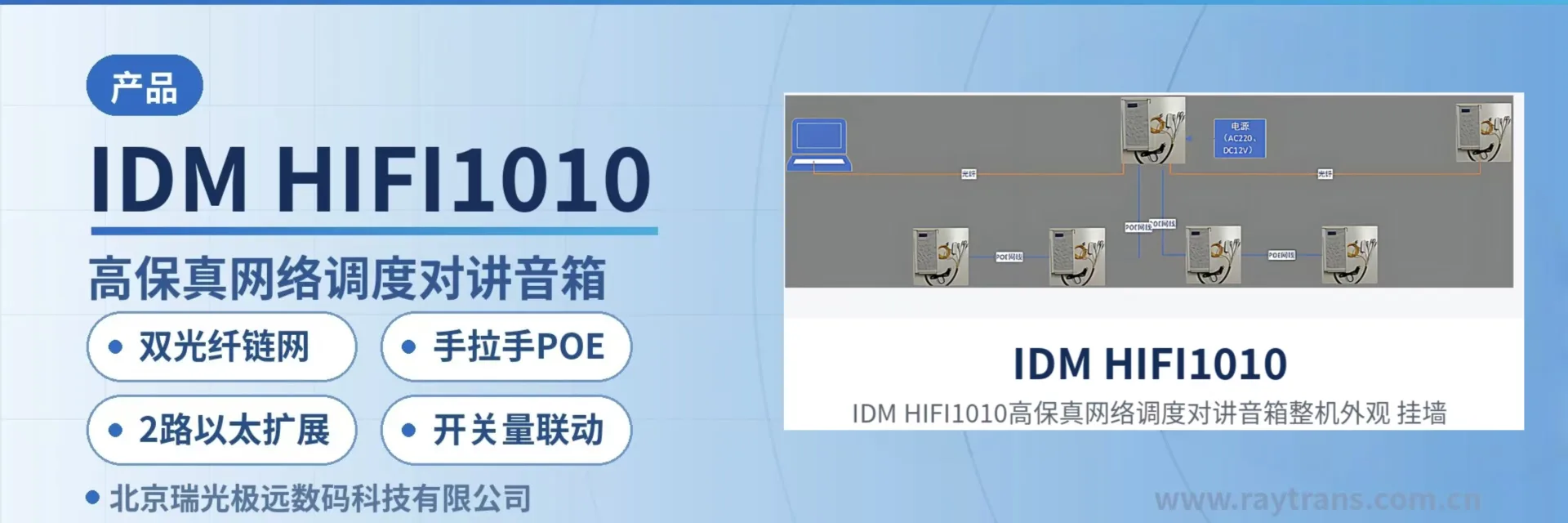
IDM HIFI1010 High-Fidelity Network Dispatch Intercom Speaker
Dual-fiber chain network saves two sets of transceivers, daisy-chain POE breaks the 100-meter limit, separate call microphone
HIFI1010 high-fidelity network intercom speaker 1. High-fidelity audio for PA and intercom; 2. Two optical fiber ports can form a chain network optical fiber transmission, saving two sets of media converters, or saving a set of dual-optical-port PoE Ethernet switches worth hundreds of yuan;
The IDM HIFI1010 high-fidelity network dispatch intercom speaker is a network audio terminal developed by Beijing Ruiguang Jiyuan. It combines high-fidelity sound reinforcement, a call button box and microphone, chain-network optical ports, and dispatch management into a single wall-mounted device for PA announcements and two-way intercom. As a professional audio and video dispatching and command and dispatch terminal, the high-fidelity network dispatch intercom speaker handles announcements, intercom, and alarm reception in smart parking lots, parks and scenic areas, expressways, and roadside emergency scenarios. One terminal performs sound playback, audio pickup, and linkage output at the same time, and can be seamlessly incorporated into converged communication and converged dispatching platforms.
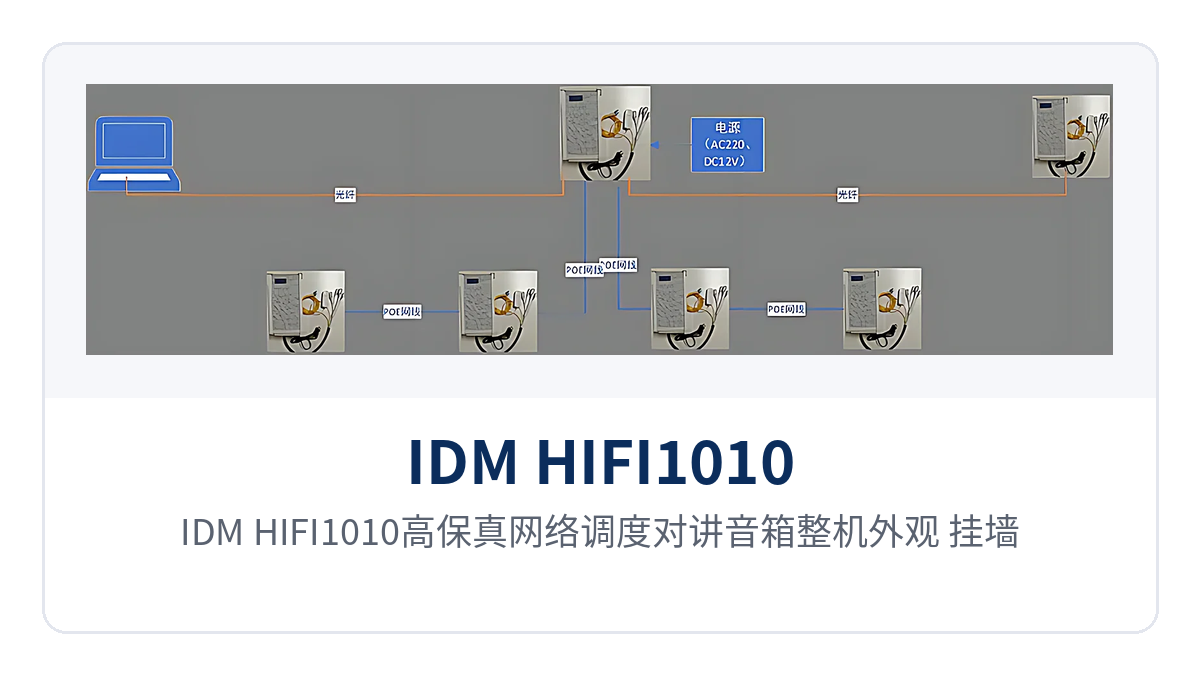
Figure 1: Overall appearance of the IDM HIFI1010 high-fidelity network dispatch intercom speaker — close-up of the wall-mounted speaker and the separate call button box and microphone
Key specifications at a glance: dual-fiber chain network · daisy-chain POE · 2-channel Ethernet expansion · on/off signal linkage · separate call button box and microphone · high-fidelity broadcast intercom
What functions does the IDM HIFI1010 high-fidelity network dispatch intercom speaker provide?
The functions of the IDM HIFI1010 high-fidelity network dispatch intercom speaker are organized around four main lines: broadcast sound reinforcement, two-way intercom, chain-network transmission, and linkage output. The table below lists capabilities and purposes by function item, making it easy for O&M personnel to check the configuration item by item against on-site requirements and to communicate interfacing plans with command and dispatch system manufacturers.
Function | Description |
|---|---|
High-fidelity broadcast and intercom | Performs zone paging, real-time announcements, and two-way intercom with high-fidelity sound quality; voice intelligibility meets listening requirements in outdoor and noisy environments |
Dual-fiber chain-network transmission | Two optical fiber ports can form chain-network optical fiber transmission, with adjacent speakers connected in series over optical fiber. This saves two sets of media converters or one dual-optical-port PoE Ethernet switch, and gives more flexibility in matching selection for media converter manufacturers |
Daisy-chain POE access | Provides daisy-chain POE Ethernet access service; multiple speakers are connected in series and share one link for transmission and power supply, solving the 100-meter limit of Category 5 network cable runs from a PoE switch |
Separate call button box and microphone | The speaker has a separate call button box and microphone and can receive call services; the microphone is used for intercom, monitoring, or automatic gain control (AGC) of the speaker |
2-channel Ethernet expansion | Two Ethernet interfaces can be expanded inside the device for adding a WiFi router module and a camera module, so no additional peripherals are needed on site |
On/off signal linkage output | Provides an on/off signal output interface for connecting an audible and visual alarm; provides a serial port expansion interface for connecting environmental trigger parameters |
Central-end management software | Provides flexible central-end management software; simple configuration and modification according to industry characteristics form a professional application platform, and secondary development is available |
Converged communication interfacing | Provides converged communication solutions with other audio and video systems for information platforms such as command and dispatch and emergency management, and can interconnect with a converged communication command and dispatch system |
Mobile phone APP access | After logging in, the user mobile phone APP supports remote calls, scanning the speaker QR code to play and upload broadcast documents, and PA announcements to multiple IP speakers |
How do the dual-fiber chain network and daisy-chain POE save on-site costs?
On-site costs for outdoor speakers center on three items: media converters, switches, and network cable runs. The dual-fiber chain network, daisy-chain POE, and 2-channel Ethernet expansion each address one of them. The table below maps each selling point to the step where savings are made, so it can be used directly when budgeting sites and compared item by item when requesting quotations from command and dispatch system manufacturers.
Selling Point | Value delivered on site |
|---|---|
Dual-fiber chain network: two optical fiber ports form chain-network transmission | Adjacent speakers are connected directly in series over optical fiber, saving two sets of media converters per node, or one dual-optical-port PoE Ethernet switch worth several hundred yuan |
Daisy-chain POE: series connection combines power supply and transmission | Multiple speakers share one link, breaking the 100-meter limit of Category 5 network cable runs from a PoE switch, and eliminating the need to deploy a separate switch for light pole installation |
2-channel Ethernet expansion: two Ethernet interfaces reserved internally | A WiFi router module and a camera module can be added, so wireless coverage and video are installed together with the speaker, eliminating extra peripherals and a second mounting pole |
On/off signal linkage: on/off signal output connects to an audible and visual alarm | Trigger signals such as intrusion, approach, smoke detector, and call for help can directly drive the audible and visual alarm, enabling security linkage, service linkage, and firefighting linkage |
What can the central-end dispatch console and the mobile phone APP each do?
The central end and the mobile phone have clear divisions of work: the PC dispatch console handles alarm reception, paging, group broadcast, and recording retrieval, while the mobile phone APP handles QR code access and mobile announcements by on-site personnel. Both entry points share the same set of speaker terminals, and their audio and video dispatching capabilities can be incorporated into the converged dispatching system. The table below lists the available operations separately.
PC dispatch console functions
Function | Description |
|---|---|
One-touch answer and one-touch call | Answer a terminal call with one touch while switching the display to the corresponding camera information; also make a one-touch call to a terminal for real-time announcements, conversations or intelligent inspection monitoring |
Video binding display | Bind a surveillance camera so that the on-site picture is displayed synchronously when a call is connected, providing an on-site basis for command and dispatch |
Grouping and paging broadcast | Support fixed groups and dynamic grouping, and paging broadcast by conditions such as location, IP address and user name |
Scheduled and temporary hold | Set scheduled calls for each terminal to play automatically when due; place a terminal on temporary hold with hold music for online consultation at the central end |
Alarm and sensor linkage | Light the alarm flag of the corresponding terminal when a sensor is triggered; a call alarm flag is cleared by the central end only after the problem is resolved and the record is written |
Multiple audio sources and broadcast files | Switch audio sources to play music, stories, notices, calls and microphone insertions; manage broadcast files in a list for scheduled, loop and event-triggered broadcasting |
Work orders and audio and video recording | A work order window pops up automatically when a call button alarm signal is received, for filling in alarm reception information; the audio and video recording software records all terminal calls for retrieval and review |
Volume and bandwidth adjustment | Set the volume, MIC gain and left/right channel for one speaker or a batch of speakers, and adjust the signal bandwidth of a single speaker |
Mobile APP Functions
Function | Description |
|---|---|
Remote call | Make a remote call to a speaker after logging in |
Scan-to-play | Scan the speaker QR code to select a playlist and play it in a loop |
Upload broadcast documents | Scan the speaker QR code to upload broadcast documents, which are stored long-term after review and can be played on demand later |
Real-name registration and mobile broadcasting | After real-name registration by scanning the speaker QR code, play files on the phone and make real-time announcement broadcasts |
Multi-speaker broadcast announcement | Registered users can make broadcast announcements to multiple IP speakers at the same time |
What Are the Key Specifications of the High-Fidelity Network Dispatch Intercom Speaker?
The specifications are listed in two categories, interfaces and components: optical ports, Ethernet ports and expansion interfaces determine the networking and capacity expansion approach, while audio components and linkage interfaces determine the on-site capabilities available; electrical and environmental indicators such as overall power consumption, dimensions and operating temperature are subject to the manufacturer's technical documentation and are confirmed together with the ordering configuration during selection. Raytrans can provide the corresponding technical documentation support.
Item | Parameter/Specification | Description/Applicable Conditions |
|---|---|---|
Optical fiber port | 2 optical fiber ports, supporting chain network optical fiber transmission | The optical module is selected according to the on-site distance and wavelength; when the optical port is not used, no SFP (small form-factor pluggable) module is required and it can be purchased later |
Ethernet access | Daisy-chain POE Ethernet access | Adjacent speakers are connected in series, breaking the 100-meter transmission limit of Category 5 network cable from a PoE switch; this power supply mode is available for light pole installation |
Expansion Ethernet interface | 2 Ethernet interfaces can be expanded inside the device | A WiFi router module and a camera module can be added, eliminating external devices |
Call and audio pickup components | Separate call button box and microphone | The microphone is used for intercom, monitoring or speaker automatic gain control (AGC), and the button box receives call services |
Digital I/O interface | Provides an on/off signal output interface | Can connect a sound and light alarm for security, service and firefighting linkage |
Serial port expansion | Provides a serial port expansion interface | Can connect environmental trigger parameters for triggering by external sensors |
Audio source | Supports switching between multiple audio sources | CD, MP3, tuner and other sources are connected through the broadcast gateway for music, stories, notices, intercom and microphone insertions |
Central end management | PC dispatch console software and user mobile APP | Supports configuration by industry characteristics and provides secondary development and converged communication interfacing |
Overall power consumption, dimensions, operating temperature, ingress protection (IP) rating | Not yet recorded in the knowledge base | Subject to the manufacturer's technical documentation and the configuration list confirmed commercially |
Typical Application Scenarios
Broadcast intercom sites differ mainly in three aspects: distance, power supply access and linkage. The site layout of network intercom speakers has different emphases in the three scenarios of parking lots, parks and scenic areas, and roadside emergency; the three scenarios below explain the configuration approach and the practices that can be directly adopted one by one.
Smart Parking Lot Operation: Parking Space Speakers Save Media Converters and Switches
Speakers in smart parking lots are distributed across entrances, lanes, and parking areas, where sites are dense, power access is difficult, and the demand for smart parking lot call intercom is concentrated. A dual-fiber chain network connects adjacent speakers with a single optical fiber, saving two media converters per node; daisy-chain POE lets each speaker draw power from the previous unit and forward data, so parking-space speakers do not need a dedicated switch for network connectivity. The separate call button box and microphone are used for vehicle-finding assistance and parking lot calls, and the central end can answer with one touch while viewing the camera feed at the same time.
Parks and Scenic Areas: Daisy-Chain POE on Light Poles for Plug-and-Play Installation
Most speakers in parks and scenic areas are mounted on light poles and walkway columns, and the distance from these positions to the equipment room often exceeds the 100-meter transmission limit of Category 5 network cable from a PoE switch. The daisy-chain POE power supply mode connects speakers on adjacent light poles in series, with each node supplying power and forwarding data to the next, so the next node can be enabled with just a short network cable; where the park spans a large area, a dual-fiber chain network is used instead, with only optical fiber between adjacent nodes. The microphone can be used for scenic area commentary and visitor calls for help.
Expressways and Roadside Emergency: Dual Optical Port Chain Network with On/Off Signal Linkage
Speakers at expressway and roadside emergency points are deployed along the roadside, where both power supply and transmission are constrained by distance, and alarms must also drive on-site audible and visual alarms, so expressway emergency intercom and broadcasting places higher demands on link reliability. Dual optical ports connect roadside speakers into a chain network, with only optical fiber between adjacent nodes, saving pairs of media converters; on/off signal linkage converts intrusion detection, proximity detection, and call-for-help signals into audible and visual alarm outputs. One-touch call at the central end enables real-time announcements to designated road sections, completing roadside alerts and traffic guidance before rescue vehicles arrive on site.
Conclusion
As a high-fidelity network dispatch intercom speaker designed for outdoor broadcasting and call scenarios, the IDM HIFI1010 combines a dual-fiber chain network, daisy-chain POE, 2-channel Ethernet expansion, and on/off signal linkage in a single wall-mounted device, so sites in parking lots, parks and scenic areas, and roadside emergency applications need fewer media converters and less network cabling. On site, selecting an optical port chain network or daisy-chain POE power supply according to site distance and power supply conditions enables broadcasting, intercom, and alarm linkage on the existing management platform. As a command and dispatch system manufacturer with deep expertise in audio and video dispatching and converged communications, Raytrans incorporates this terminal into its overall converged communication command and dispatch system solution, working with the dispatch console to achieve unified command and dispatch of front-end sites and product showcase-grade visualized presentation.