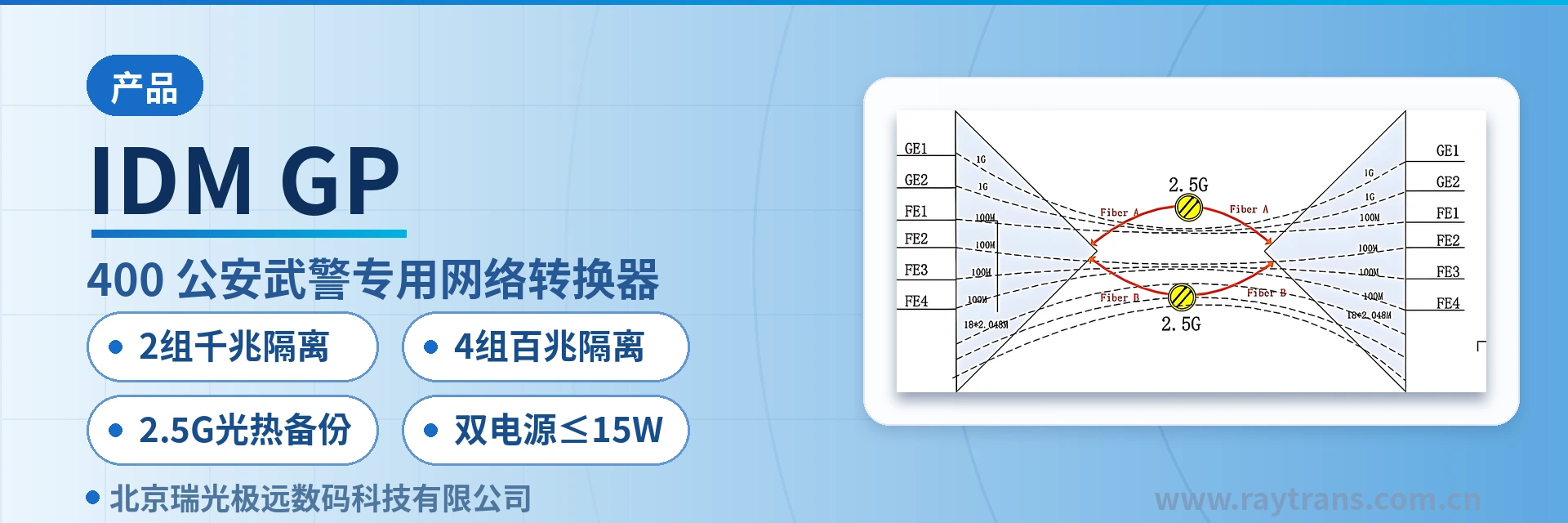
IDM GP-2400 Public Security and Armed Police Dedicated Network Converter
2 groups gigabit isolated
The Public Security and Armed Police Dedicated Network Converter can transmit 2 groups of physically isolated wire-speed gigabit Ethernet and 4 groups of wire-speed physically isolated 100M Ethernet over 2.5G optical fiber. It provides 2 groups of 2.5G optical fiber hot standby. It can simultaneously provide ~220V and -48V power supplies.
The IDM GP-2400 network converter for public security and armed police private networks is a physically isolated multi-channel network converter that simultaneously transmits 2 physically isolated wire-speed gigabit Ethernet channels and 4 wire-speed physically isolated 100M Ethernet channels over 2.5G optical fiber, and provides 2 groups of 2.5G optical fiber hot standby. Developed by Raytrans, the device targets public security and armed police private networks, industrial private networks such as electric power and rail transit, and unattended sites in the field, and can also serve as a bridge converter for multi-service channel aggregation scenarios.
A common situation at private network sites is that one optical cable must carry several networks—office, video surveillance, command and dispatch—that are not allowed to access each other, and the mixing of channels would invalidate the security boundary. Physical isolation places each network in an independent channel, packets are not forwarded across channels, and the security domain boundary is already defined on the device side without relying on the VLAN configuration of upper-layer switches. This feature makes the physically isolated multi-channel network converter a key node in physically isolated solutions for public security and armed police private networks, and it is also suitable for deployments with strict channel isolation requirements in government private network optical fiber communication solutions and military emergency communications vehicle solutions.
Key Specifications at a Glance: 2 gigabit and 4 100M physically isolated channels · 2 groups of 2.5G SFP optical port hot standby · AC220V/DC-48V dual power supply · overall power consumption ≤15W · 19-inch 1U chassis · -20℃~+50℃
As one of the representative products of an optical multiplexer manufacturer and an SDH equipment manufacturer, Raytrans continues its industrial-grade design and product showcase approach on the IDM GP-2400, making it easy for integrators to quickly select and deploy in government private network optical fiber communication solutions, military emergency communications vehicle solutions, and physically isolated solutions for public security and armed police private networks.
What Kind of Device Is a Physically Isolated Multi-Channel Network Converter?
A physically isolated multi-channel network converter separates multiple Ethernet channels from each other at the hardware level. Each channel independently occupies forwarding resources, and packets are not forwarded across channels. As a professional optical multiplexer manufacturer and SDH equipment manufacturer, Raytrans implements multiplexing of 6 groups of channels in the IDM GP-2400 bridge converter within a standard 19-inch 1U chassis using large-scale ASIC chips. The 2 gigabit and 4 100M channels all forward at wire speed, and the channels do not share bandwidth, providing reliable access equipment for government private network optical fiber communication solutions and physically isolated solutions for public security and armed police private networks.
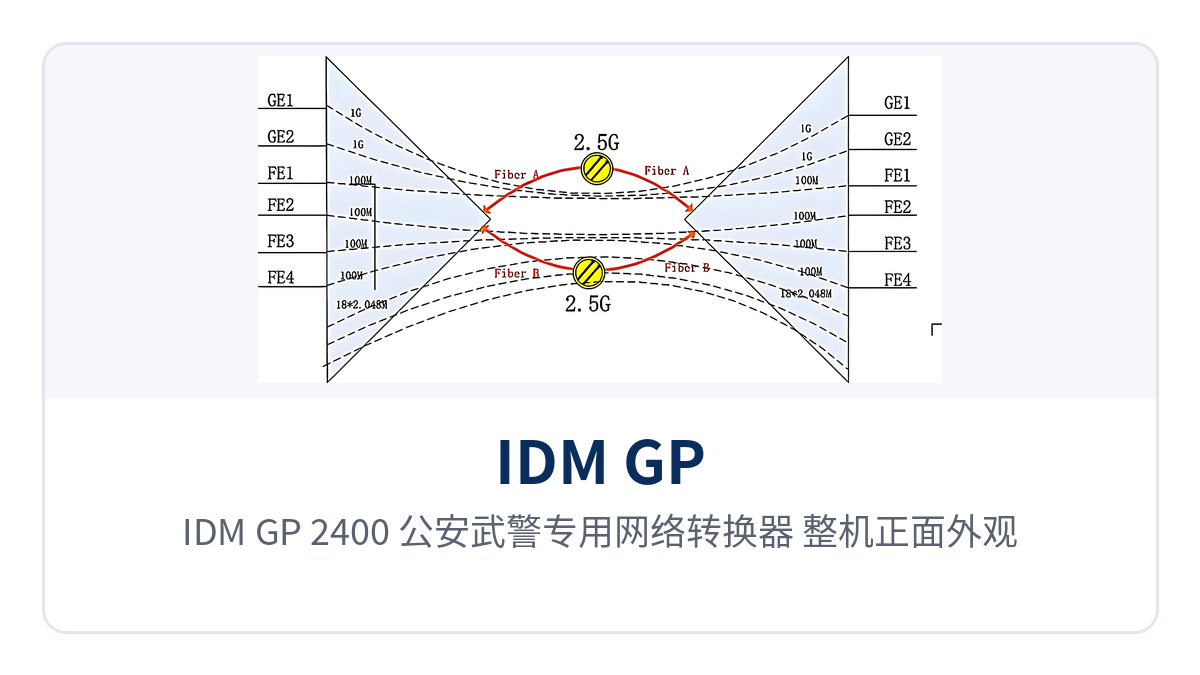
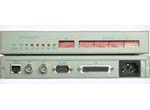
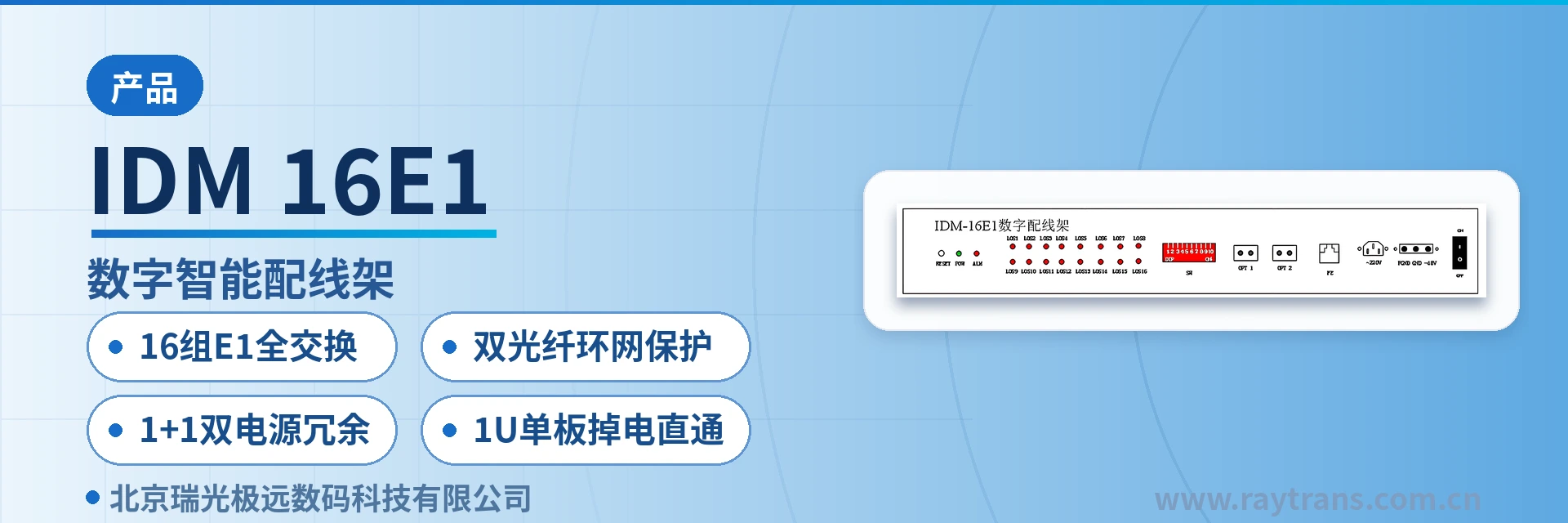
Figure 1: IDM GP-2400 network converter for public security and armed police private networks—close-up of the overall front appearance and the power and optical link indicator LEDs
The service side provides 2 gigabit Ethernet ports and 4 100M Ethernet ports, with rates supporting 10M, 100M, and 1000M adaptive, compliant with the IEEE 802.3 standard, and operating modes of full-duplex, half-duplex, and adaptive. The line side provides 2 SFP optical ports, single-mode as standard with optional multi-mode, wavelengths of 1310, 1490, and 1550nm selected by module, transmit optical power of -1~-10dB, and receiver sensitivity better than -24dBm.
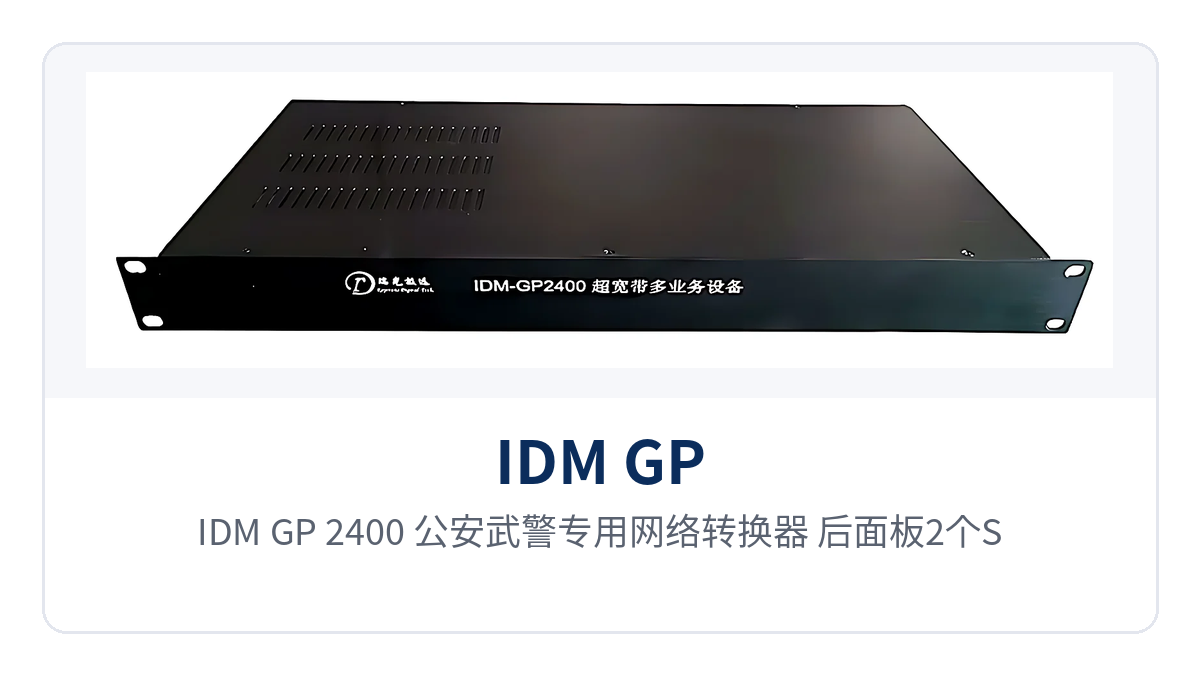
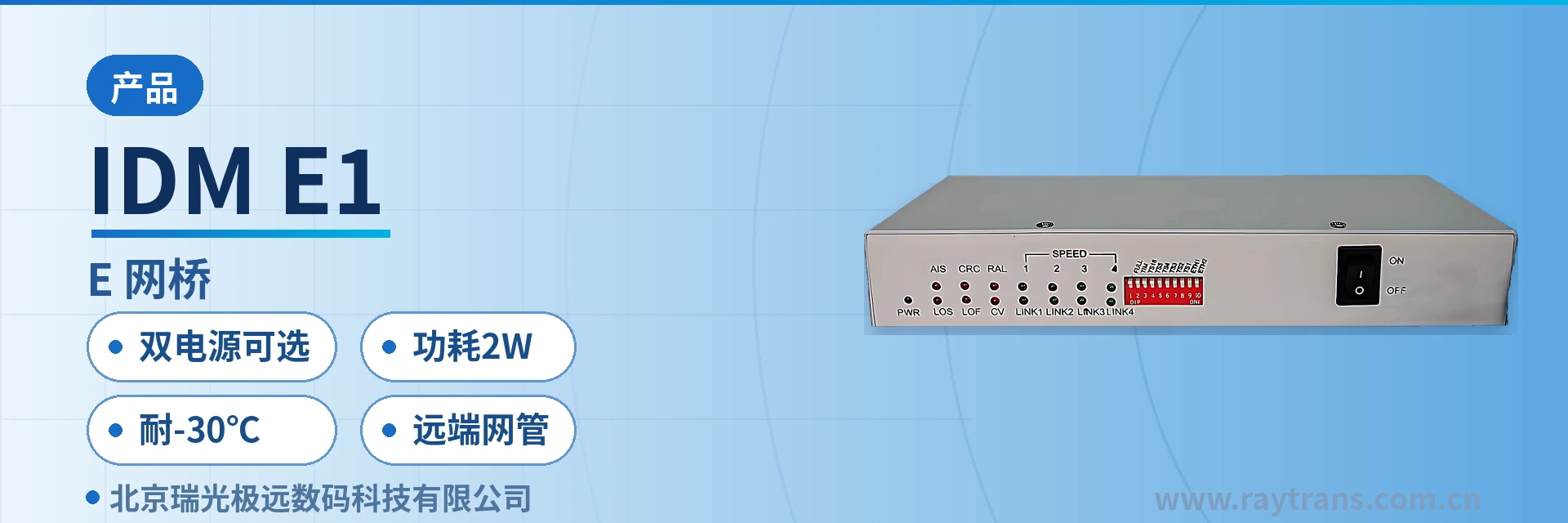
Figure 2: IDM GP-2400 network converter for public security and armed police private networks—layout of the 2 SFP optical ports and 6 groups of Ethernet ports on the rear panel
How Does One Device Simultaneously Carry 2 Gigabit and 4 100M Physically Isolated Channels?
The functions of the IDM GP-2400 bridge converter center on three parts: channel isolation, optical fiber transport, and power supply. The capabilities and applicable conditions of each function are listed in the table below. On site, they can be checked item by item against the service list to confirm whether the number of channels, number of optical ports, and power supply format match project requirements, facilitating quick product showcase and selection comparison in government private network optical fiber communication solutions and military emergency communications vehicle solutions.
| Function | Description |
|---|---|
| 2 gigabit isolated channels | Provides 2 physically isolated wire-speed gigabit Ethernet channels; a single channel forwards at 1000Mbps wire speed, and the two channels do not share bandwidth or packets |
| 4 100M isolated channels | Provides 4 physically isolated wire-speed 100M Ethernet channels, which can separately carry networks of different security domains such as video surveillance, office, and dispatch |
| 2.5G optical hot standby | 2 groups of 2.5G SFP optical ports work in active/standby mode; when the working link fails, the backup link carries the services, and a point-to-point or 1+1 protection network can be formed |
| Dual power supply ≤15W | AC220V and DC-48V power supply formats are available; overall power consumption ≤15W, suitable for unattended sites and communications equipment rooms |
| Optical fiber multiplexing | Independent channels are allocated to different services within the same optical fiber, so one optical cable carries multiple networks, reducing optical cable laying and leasing investment |
| Wire-speed forwarding | Each channel forwards at wire speed, compliant with the IEEE 802.3 standard, with operating modes supporting full-duplex, half-duplex, and adaptive |
| Port adaptive | Ethernet port rates support 10M, 100M, and 1000M adaptive; access terminals and uplink devices operate at the negotiated rate |
Key Specifications and Performance Specifications
The four categories of specifications—optical interface, Ethernet, power supply, and environment—are listed as stated in the original product documentation. The parameter table also explains the basis and applicable conditions of each specification, so that link length, equipment room temperature, and power supply mode can be checked directly on site without paging through manuals. As an optical multiplexer manufacturer and SDH equipment manufacturer, Raytrans provides a clear basis for each specification.
| Item | Parameter/Specification | Description/Applicable Conditions |
|---|---|---|
| Optical interface type | SFP | Optical modules selected by transmission distance and wavelength |
| Fiber mode | Single-mode (multi-mode optional) | Selected according to the on-site optical cable type |
| Optical port rate | 2.5Gbps | Total line-side bandwidth 2.5Gbps, carrying 2 gigabit and 4 100M channels |
| Optical wavelength | 1310/1490/1550nm | Determined by SFP module specification |
| Transmit optical power | -1~-10dB | As stated in the original product documentation |
| Receiver sensitivity | Better than -24dBm | As stated in the original product documentation |
| Transmission distance | 20KM, 40KM, 80KM | Selected by SFP optical module tier |
| Ethernet channel | 2 gigabit + 4 100M | All are physically isolated wire-speed channels |
| Ethernet rate | 10M/100M/1000M | Adaptive |
| Standard protocol | IEEE 802.3 | Ethernet access standard |
| Operating mode | Full-duplex/half-duplex/adaptive | Determined through negotiation with the peer device |
| Power supply mode | DC-48V/AC220V | Two formats available, configurable as dual power supply |
| Overall power consumption | ≤15W | Low power consumption, suitable for unattended sites |
| Chassis structure | 19-inch standard 1U | Modular design, rack installation |
| Operating temperature | -20℃~+50℃ | Equipment room and field enclosure environments |
| Relative humidity | 0~95% (non-condensing) | As stated in the original product documentation |
How Do 2.5G Optical Fiber Hot Standby and Dual Power Supply Keep Private Networks Uninterrupted?
2 groups of 2.5G optical fiber hot standby means the two SFP optical ports work in active/standby mode, so services have two available optical fiber paths at the same time. When the working path is interrupted, the backup path continues to carry the 2 gigabit and 4 100M channels. Switchover is completed on the device side, and on-site personnel do not need to plug or unplug patch cords manually. The two paths are usually laid on optical cables in different routes to prevent external damage in the same trench or manhole from affecting both active and standby paths at the same time. This design is particularly important in military emergency communications vehicle solutions and physically isolated solutions for public security and armed police private networks.
The power supply side provides AC220V and DC-48V formats. Communications equipment rooms mostly use -48V DC distribution panel power supply, while site equipment rooms often use 220V mains power. The two formats are selected according to equipment room conditions and can also be configured to operate as dual power supply. Overall power consumption ≤15W places very little demand on equipment room power supply capacity and UPS backup time, and a small solar and storage battery system can keep a field site running.
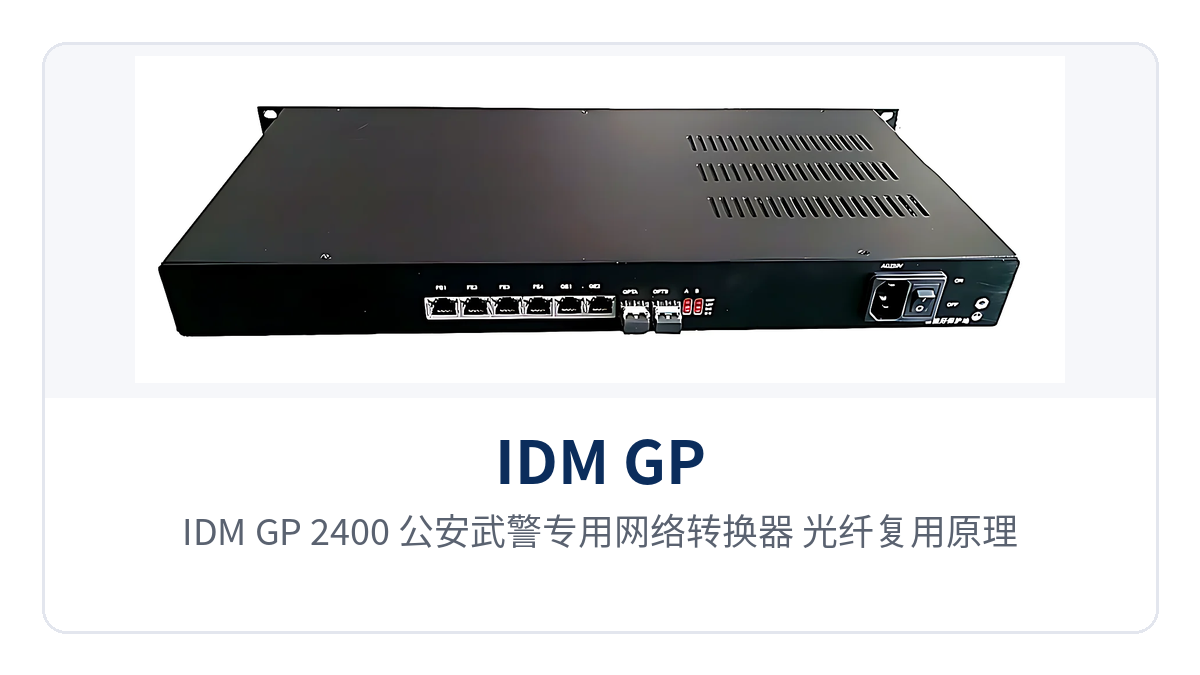
Figure 3: IDM GP-2400 network converter for public security and armed police private networks—optical fiber multiplexing schematic, with 2 gigabit and 4 100M channels multiplexed over 2.5G optical fiber
Typical Application Scenarios
The 6 isolated channels of the IDM GP-2400 bridge converter are used in private network projects according to security domain division, with one device simultaneously handling service access and channel boundary isolation. The three scenarios below differ in power supply access conditions, equipment room environment, and link resources. During deployment, check each item according to its respective basis. Raytrans can provide corresponding product showcase and technical support for different scenarios.
Public Security and Armed Police Private Networks: Multi-Security-Domain Services Carried Separately over One Optical Fiber
The office network, video surveillance network, and command and dispatch network of public security and armed police units usually must not access each other, while there is often only one spare fiber between the two locations. The IDM GP-2400 allocates 2 gigabit channels to office and video services and 4 100M channels to systems such as dispatch, access control, and voice. Channels are isolated at the hardware layer, so the security domain boundary does not depend on the VLAN configuration of upper-layer switches, fully meeting the construction requirements of physically isolated solutions for public security and armed police private networks.
The link length between checkpoints, camps, and higher-level authorities is determined on site, and SFP modules selected from the 20KM, 40KM, and 80KM tiers can cover most inter-station distances. 2 optical port hot standby keeps optical fiber transmission in public security and armed police private networks from stopping due to external damage to a single optical cable, while AC220V and DC-48V dual power supply accommodates both equipment room DC distribution panel and site mains power supply access conditions.
Electric Power and Rail Transit Industrial Private Networks: Separate Channel Backhaul for Production Control and Video Services
In the private networks of substations and rail transit stations, protection information, video surveillance, and office services belong to different networks, and mixing them makes it difficult to pass security assessment. The device assigns production control services and video and office services to different channels: 2 gigabit channels are used for video and data backhaul, and 4 100M channels are used for low-traffic control services, so increased traffic on a single channel does not affect other channels.
Substations and stations along the line are mostly unattended sites, where equipment room temperatures fluctuate with the seasons and power is mainly supplied from DC distribution panels. The -20℃+50℃ operating temperature, 095% relative humidity, and DC-48V power supply of the IDM GP-2400 correspond exactly to such conditions, and the 19-inch 1U chassis can be installed directly in communications cabinets alongside existing transmission equipment.
Unattended Sites in the Field: Dual Power Supply and Low Power Consumption Support Long-Term Operation
Common problems at field sites are difficult power supply access and large temperature differences, with equipment left unattended for long periods. Overall power consumption ≤15W allows a site to keep running on a small solar panel and storage battery. AC220V and DC-48V dual power supply are available; when a site has both mains power and a DC distribution panel, it can be connected in dual power supply mode, so power redundancy does not require a separate switching device.
The link from a site to the center often runs in only one direction, and after an interruption maintenance personnel need hours to arrive. 2 groups of 2.5G optical port hot standby lay the active and standby paths separately; when the active path fails, services are carried by the backup path, so services do not stall for long before O&M personnel arrive. This is a direct benefit for unattended sites and also safeguards the long-term stable operation of government private network optical fiber communication solutions and military emergency communications vehicle solutions.
How Are Point-to-Point and Centralized Point-to-Multipoint Networks Formed?
Point-to-point is a common deployment mode. Two IDM GP-2400 units are installed in pairs at both ends of the link. The 2 gigabit and 4 100M channels at end A are output at end B under the same channel numbers, and the service networks at both ends are interfaced channel by channel, with only one optical fiber link in between, so the switches at both ends do not need additional configuration for cross-site access. This point-to-point mode is also the most intuitive product showcase form of the bridge converter in private network projects. As an optical multiplexer manufacturer, Raytrans often uses such deployments as the basic networking unit in government private network optical fiber communication solutions.
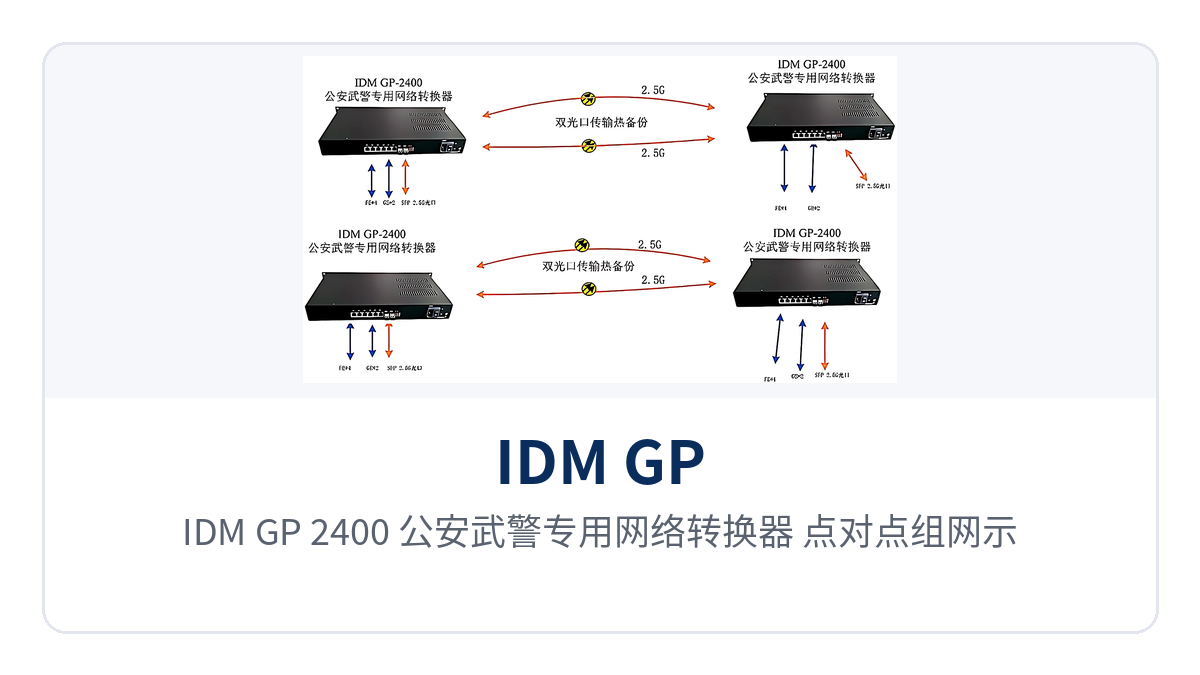
Figure 4: IDM GP-2400 network converter for public security and armed police private networks—point-to-point networking schematic, with the 6 isolated channels at both ends interfaced one-to-one by number
Centralized point-to-multipoint is used to aggregate multiple remote stations toward one center. The central-side device connects to each remote end over 2.5G optical fiber, one central node can connect 12 remote ends, and the 6 groups of channels at each remote station are terminated separately on the central side. For private networks with scattered sites such as checkpoints, substations, and toll stations, central aggregation saves more optical cable and equipment than pulling dedicated lines point by point. For military emergency communications vehicle solutions, this centralized aggregation structure likewise facilitates the rapid setup of temporary command nodes, and Raytrans products in its SDH equipment manufacturer portfolio are often used with this type of networking approach.
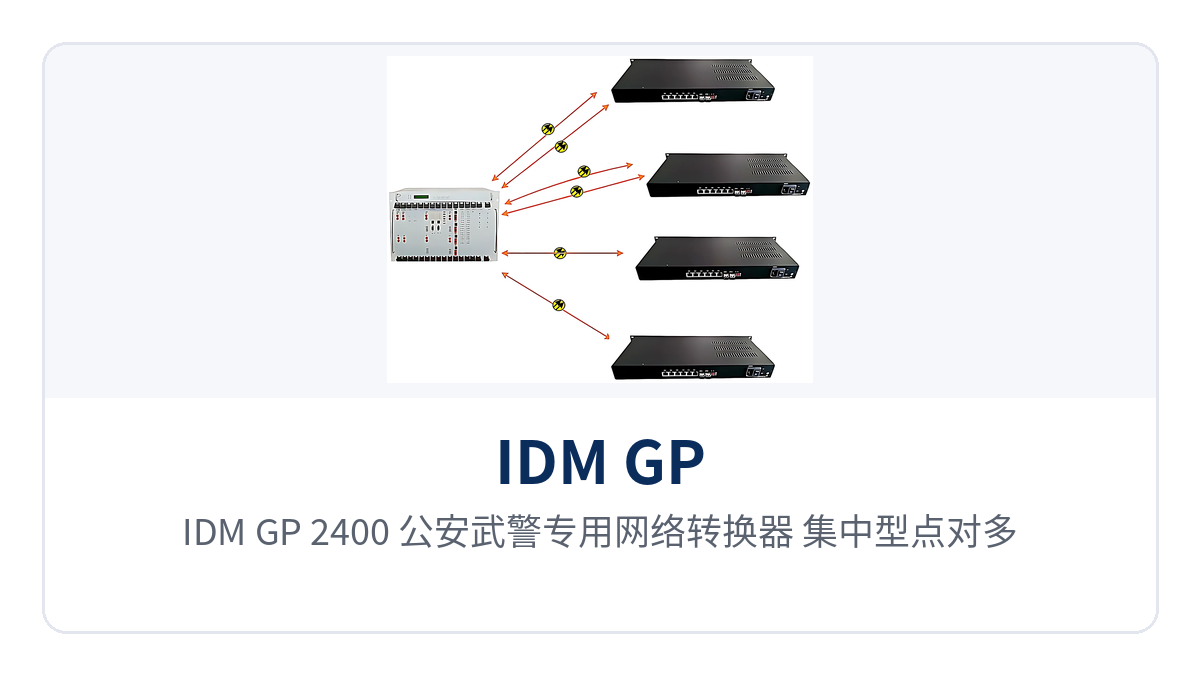
Figure 5: IDM GP-2400 Public Security and Armed Police Dedicated Network Converter — Centralized Point-to-Multipoint Networking Diagram, Central Node Aggregating Multiple Remote Stations
Selection and Deployment Highlights
Before putting the equipment into a project, check the five items one by one — number of channels, optical fiber resources, power supply format, environmental conditions, and channel mapping — to reduce rework on site and capacity expansion later; the check results also serve as the basis for the patch cord tables at both ends and the commercial configuration sheet, avoiding the discovery during installation that channels are insufficient or the optical module grade is wrong.
- Number of channels: first count the number of service networks that need isolation. Projects within 2 gigabit networks and 4 fast Ethernet networks can be carried by one device; beyond that, plan for multiple devices or a higher-capacity platform.
- Optical fiber resources: confirm the number of available optical cable cores and the link length at both ends, and select as required from the three SFP module grades of 20KM, 40KM, and 80KM. A hot standby solution requires two paths over different routes.
- Power supply format: choose DC-48V when the equipment room is powered by a DC distribution panel, choose AC220V when the site has only mains power, and configure dual power supply when both must be reliable.
- Environmental conditions: check whether the temperature and humidity of the equipment room or enclosure fall within -20℃
+50℃ and 095% non-condensing; if exceeded, temperature control measures must be added. - Channel mapping: record the channel numbers at both ends and their service correspondence, and check item by item against the table before patching, to avoid connecting different security domains to the same channel.