IDM DXC8E1
IDM DXC8E1
The IDM DXC8E1 Digital Cross-Connect Equipment is an integrated service platform that combines 64K narrowband service access, PCM multiplexing, and 64K timeslot cross-connection. The IDM DXC8E1 equipment is mainly used for service access and cross-connection at the access layer in data communication networks. It features complete synchronization and timing functions, providing non-blocking cross-connection at the 64K level across 8 E1 channels, and can also provide 30 channels of 64K services, including telephone, magneto telephone, common battery telephone, and V.24 data services.
1. Overview
The IDM DXC8E1 Digital Cross-Connect Equipment is an integrated service platform that combines 64K narrowband service access, PCM multiplexing, and 64K timeslot cross-connect in one unit.
The IDM DXC8E1 is primarily used for service access and cross-connect at the access layer of data communication networks. It features complete synchronization and timing functions, providing non-blocking 64K-level cross-connect across 8 E1 channels, while also supporting 30 channels of 64K services, including telephone, magneto telephone, common battery telephone, and V.24 data services.
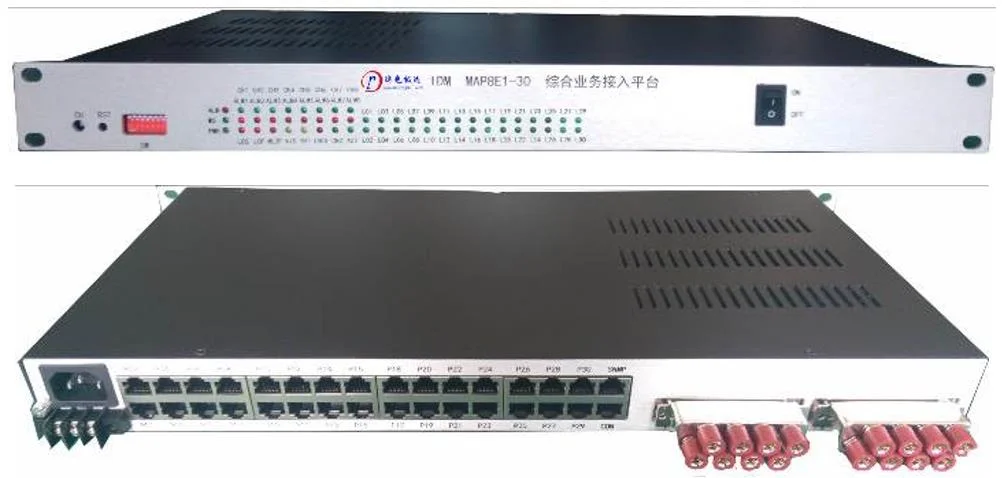
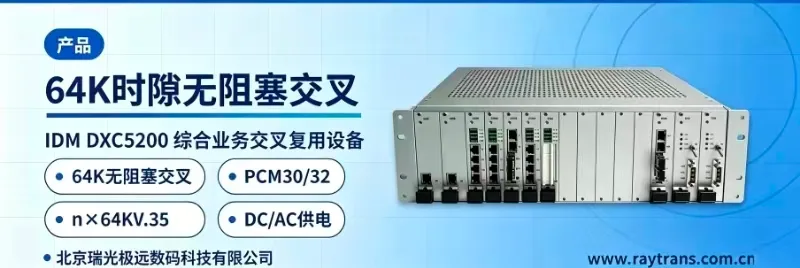
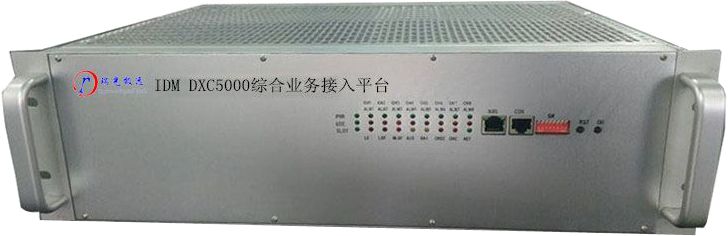
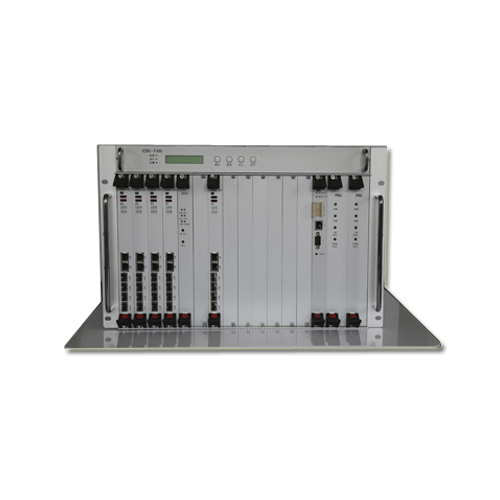
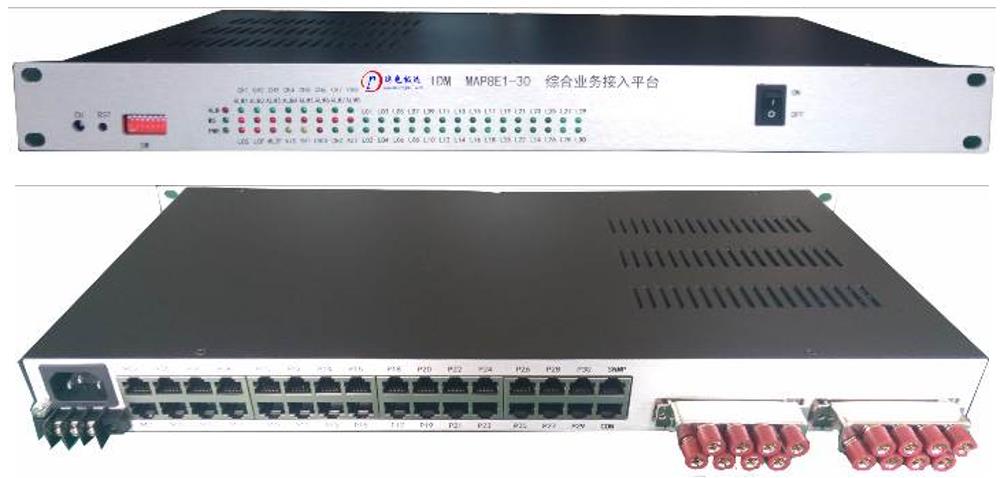
IDM DXC8E1 Digital Cross-Connect Equipment Image
2. Product Features
Non-blocking cross-connect across all timeslots of 8 E1 groups;
The host provides 30 channels of 64K (or Nx64K) user narrowband service access;
The main board provides 15 service card slots, with up to two services per card;
Voice interfaces can be FXO central office automatic telephone, FXS remote automatic telephone, or MAG magneto telephone; data services include V.24/RS232/RS485/RS422, X.50/X.58, co-directional 64K, V.35/V.36 with Nx64K bandwidth, and Ethernet bridge;
Supports serial port network management or Ethernet SNMP network management;
Supports AC 220V power supply or DC -48V power supply;
8 E1 groups can form point-to-point, chain network, star network, and other topologies.
3. Technical Specifications
1) E1 Interface
Bit Rate | 2.048Mbps | Line Code | HDB3 |
Standard Protocol | SupportsITU-T G.703 | Impedance | 75Ω/120Ω |
Frame Structure | PCM30/32 | Signaling | Channel-Associated Signaling |
2) Ethernet (FE)
Interface Type | RJ-45 | Transmission Rate | N×VC12(N≤50) |
Standard Protocol | SupportsIEEE802.3 | Operating Mode | Full/Half Duplex/Auto-Negotiation |
3) Ethernet (GE)
Interface Type | RJ-45 | Transmission Rate | N×VC12(N≤63) |
Standard Protocol | SupportsIEEE802.3 | Operating Mode | Full/Half Duplex/Auto-Negotiation |
4) FXO, FXS Interfaces
Audio Range | 300Hz~3400Hz | Compression | ITU G.711 A-law |
Impedance | Triple compound impedance200Ω+560Ω//0.1μF | Loop current | 20mA/channel |
5) Co-directional 64K interface
Line Code | G.703Standard | Line Rate | 64Kbps |
Impedance | Balanced120Ω | Fully compliant withITU G.703recommendation | |
6) EM2/4-wire interface
Audio Range | 300Hz~3400Hz | Impedance | Balanced600Ω |
Compression rate | A-law per ITU G.711 | Return loss | Not less than18dB |
7) Magnetic Ring Interface
Audio Range | 300Hz~3400Hz | Impedance | Balanced600Ω |
Compression Rate | A-law per ITU G.711 | Return Loss | Not less than18dB |
8) V.24 Interface
Transmission Rate | Asynchronous≤9600bps; Synchronous64Kbps | Electrical Characteristics | Compliant withCCITT V.28protocol |
9) V.35 Interface
Interface Type | RJ-45 | Electrical Characteristics | Complies withITU-T V.35Recommendation |
Transmission Rate | n×64Kbps(n=0~31) | Terminal Interface | Complies withISO2593specifications |
10) Power Supply and Power Consumption
Power Supply | AC220V/DC-48V | Total Power Consumption | ≤150W |
11) Environmental Conditions
Operating Temperature | -10oC ~+50oC | Relative Humidity | 0~95%(non-condensing) |
12) Product Dimensions
Length×Depth×Height | 482×309×44(mm) |
IV. Application Examples
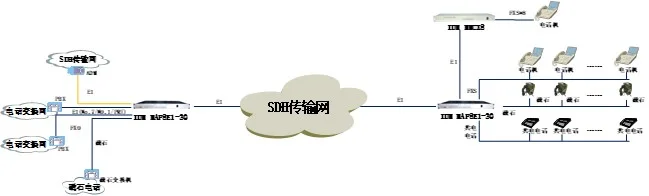
Typical Network Topology Diagram
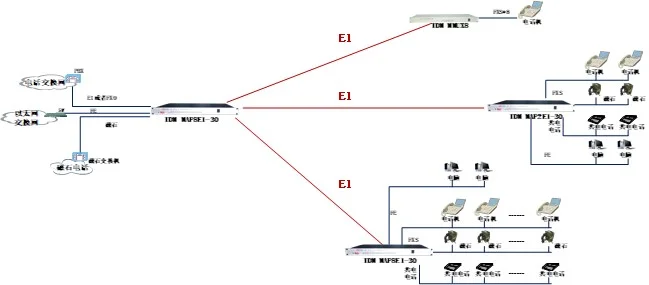
E1 Transmission Link Primary/Backup Protection Application
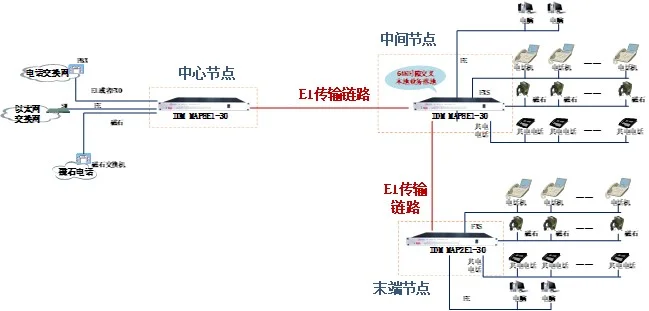
DXC Timeslot Cross-Connection Function Application
FAQs
What is E1? How to Use E1
What is E1 The European 30-channel pulse code modulation PCM is abbreviated as E1, with a rate of 2.048Mbit/s.
View answerFrame Structure of 30/32-Channel PCM Primary Group
A communication system consists of transmitting equipment, receiving equipment, and transmission equipment.
View answer63E1 and STM-1
The process of multiplexing 2Mbit/s signals into STM-1 can be described as follows…
View answerE1 Interface Converter, E1 Bridge
E1 Interface Converter Catalog IDM E1-ETH Single E1 Bridge IDM 4E-ETH 4E1 Bridge IDM 8E1-ETH 8E1 Bridge IDM E1-V.35…
View answerE1 Line Knowledge, Interface Protocols, and Usage Methods
"Currently in communications, many enterprises lease E1 (2M) lines and use PCM equipment to transmit voice calls, audio…
View answer