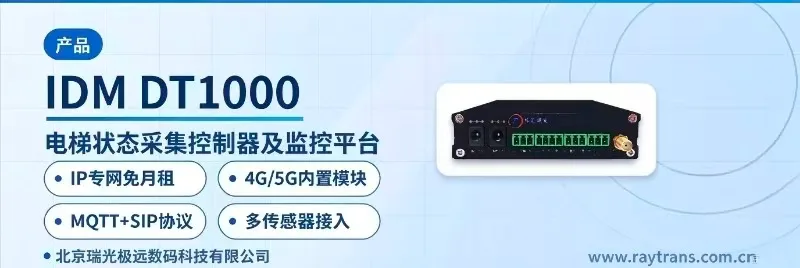
IDM DT1000 Elevator Status Acquisition Controller
Accelerometer Barometer Dual-Source Cross-Check SIP Intercom HIFI Broadcast Access Card Door Control Closed Loop in One Unit
IDM DT1000 Elevator Status Acquisition Controller, applied in the product showcase field, communication/transmission/dispatching equipment for industry customers (to be detailed and improved based on the product documentation)
The IDM DT1000 Elevator Car Status Acquisition Controller is an elevator terminal installed on the elevator car side; it is developed by Beijing Ruiguang Jiyuan and also marketed under the Raytrans brand, and is used for collecting and reporting car operating status, in-car voice dispatching and elevator ride door control management, and can be deployed together with the matching elevator status monitoring platform in smart elevator IoT projects, providing reliable elevator car status acquisition solution support for product showcase and smart elevator IoT solutions.
Key Specifications at a GlanceDual-source status acquisition · SIP voice intercom · HIFI voice broadcast · Elevator car closed-loop control · Accelerometer + barometer · TTS voice playback
What problem does the elevator car status acquisition controller solve?
The car data, voice and access management of elevators used to be shared among several unrelated sets of equipment: the status collector only reported operating data, intercom and public address each had their own set, and access card and door control went through the access control system. The IDM DT1000 Elevator Car Status Acquisition Controller launched by Raytrans brings these three categories of capabilities into one car-side terminal, so that status acquisition, voice dispatching and elevator ride control are completed on the same device, reducing the number of devices and the wiring workload inside the car and also laying a hardware foundation for subsequent connection to smart elevator IoT solutions.
For existing elevators already put into operation, the prerequisite for a retrofit is not to interfere with the original system. The IDM DT1000 Elevator Car Status Acquisition Controller connects to status, voice and control signals as an external unit on the car side, and the collected car operating status is reported to the monitoring platform over an IP link; the matching elevator status monitoring platform is responsible for data aggregation, visualized display and operational supervision, forming a complete chain from front end acquisition to back end management. As a command and dispatch system manufacturer, Raytrans provides on the elevator terminal side exactly such a product showcase that integrates acquisition and dispatching.
What car functions does the standard access type provide?
The standard type is the basic form of the IDM DT1000 Elevator Car Status Acquisition Controller, covering three categories of capabilities: car status acquisition, voice and door control. It is suitable for elevator terminal retrofits that focus mainly on status reporting and voice dispatching. The individual functions and their purposes are as follows:
| Function | Description |
|---|---|
| IP Elevator Car Status Acquisition and Reporting | Collects car operating status and the floor where the car is located with the built-in accelerometer and barometer, and reports them to the monitoring platform over an IP link |
| TTS Voice Playback | Voice announcements and prompts for passengers inside the car, able to play safety prompts and emergency guidance content |
| Door Opening and Closing Button Control | Supports button control of car door opening and closing, and completes door control actions together with remote commands |
| Floor Sensing Verification | Senses and verifies the floor where the car actually stops, ensuring that the reported floor is consistent with the actual floor |
| Access Card Control | Access card swiping identifies elevator ride authorization and completes floor selection, and supports linkage with the access control card system |
| SIP Voice Intercom | Two-way voice intercom inside and outside the car based on the Session Initiation Protocol, able to call the surveillance center |
| HIFI Voice Broadcast | High-fidelity broadcast output, carrying background music, notification announcements and emergency voice |
Dual-Source Status Acquisition: How Accelerometers and Barometers Improve Reporting Credibility
The credibility of car status acquisition depends on whether the sensors can continuously give valid readings under various operating conditions. The accelerometer senses the starting and stopping, the direction of travel and the ride smoothness of the car, while the barometer estimates the floor position through the change in air pressure corresponding to the height at which the car is located; the two data sources complement each other in physical principle and form the basis of dual-source status acquisition, which is also the core idea of the Raytrans elevator car status acquisition solution.
A single data source is easily limited under specific operating conditions: with the accelerometer alone, the accumulated error during long-distance travel makes the floor estimate drift gradually; with the barometer alone, the short-term pressure fluctuation caused by door opening and closing also causes interference in the judgment. After dual-source acquisition by the accelerometer and the barometer, the cross-verification of the two sources makes the judgment of the car in different stages such as running, stopping and leveling more stable, and together with floor sensing verification, the position and operating status reported to the platform are closer to the actual condition of the car.
SIP Voice Intercom and HIFI Broadcast: How One Device Carries Elevator Car Voice Dispatching
SIP voice intercom handles two-way calls, while HIFI voice broadcast handles one-way announcements; the two voice channels are carried by the same car terminal, which is the core design of the IDM DT1000 in elevator terminal scenarios. Trapped passengers can call the surveillance center or the duty room through the intercom channel inside the car, and on-duty personnel can also call the car in the opposite direction to provide reassurance and rescue guidance.
When announcements need to be made to passengers in batches, HIFI voice broadcast plays notifications, background music and safety prompts with high-fidelity output, while TTS voice playback can automatically convert text content into voice announcements without manual audio recording. Intercom and public address share the same voice hardware and link, which reduces the number of devices inside the car and also means that voice dispatching during rescue does not depend on amplification equipment temporarily installed on site. For a command and dispatch system manufacturer, this design of carrying voice dispatching in one device is exactly a key link of smart elevator IoT solutions on the car side.
Access Card, Door Opening and Closing, Floor Verification: How an Unattended Car Achieves Closed-Loop Control
For a car to keep running in an orderly way under unattended conditions, acquisition, judgment and control need to form a closed loop. Access card control is responsible for identifying the ride authorization and the target floor of passengers, door open/close button control is responsible for executing car door actions, and floor sensing verification is responsible for feeding the actual position of the car back to the control logic; combined, the three complete the whole process of access card release, floor selection and floor verification.
In access control integration scenarios, the building access control and the elevator card reader share the same authorization data, so personnel without authorization cannot select a floor by swiping a card; when remote intervention is needed, the surveillance center can first confirm the situation inside the car through the intercom channel and then issue door open/close commands. The results of door opening, door closing and floor verification are reported to the monitoring platform at the same time, forming traceable elevator ride records, so that car operation during unattended periods is equally controllable.
Technical Specifications and Functional Indicators
| Item | Parameter/Specification | Description/Applicable Conditions |
|---|---|---|
| Data Acquisition Method | Dual-Source Acquisition with Accelerometer + Barometer | The accelerometer senses starting and stopping and the direction of travel, the barometer estimates the floor, and dual-source cross-verification is applied |
| Uplink Transmission Link | IP Network | Car operating status is reported to the elevator status monitoring platform over an IP link |
| Voice Intercom | SIP Voice Intercom | Two-way calls inside and outside the car, able to connect to the surveillance center |
| Voice Broadcast | HIFI Voice Broadcast | High-fidelity broadcast output, carrying notifications and emergency voice |
| Voice Announcement | TTS Voice Playback | Text automatically converted to voice, announced to passengers inside the car |
| Access and Door Control | Access card control, door opening and closing button control, floor sensing verification | Supports access control integration and remote door control |
| Matching Platform | Elevator Status Monitoring Platform | Data aggregation, visualized display and operational supervision |
| Power Supply, Power Consumption, Operating Temperature and Ingress Protection (IP) Rating | Subject to the manufacturer's product documentation | Not yet recorded in the knowledge base |
Differentiated Value
| Differentiated Selling Points | Value on Site |
|---|---|
| Dual-source acquisition with accelerometer + barometer for accurate car status reporting | Dual-source cross-verification: even when a single source is limited under specific operating conditions, a credible car position and operating status can still be provided, reducing misjudgments |
| Integrated SIP intercom and HIFI broadcast, carrying voice dispatching in one device | Intercom and public address share one car terminal, eliminating the need to install an intercom and amplification equipment separately, and concentrating rescue calls and batch announcements in one entry point |
| Access card + door open/close + floor verification for closed-loop control of an unattended car | Authorization identification, door control execution and floor verification form a closed loop with records, so that elevator ride order during unattended periods is equally controllable |
Typical Application Scenarios
Elevator IoT Platform Operator
Platform operators need to roll out terminals across a large number of elevators and bring them under centralized management. The IDM DT1000 Elevator Car Status Acquisition Controller is installed as an external unit on the car side, and the collected status is reported over an IP link, so operators can manage the cars of different buildings with the same elevator status monitoring platform; the standard-type functional coverage spans acquisition, voice and door control, so a single terminal can meet basic terminal retrofit requirements, making it easy to scale up in batches according to the number of elevators and to replicate the whole smart elevator Internet of Things (IoT) solution to different projects.
Smart Buildings and Property Management Groups
Property management groups want the car to be controllable and elevator rides to be manageable. Access card control can share authorization data with the building access control, so that personnel without authorization cannot select a floor; door open/close button control and floor sensing verification keep the car starting and stopping in an orderly way during unattended periods; SIP voice intercom and HIFI voice broadcast can both reach the duty room in an emergency and play notifications and prompts in daily operation. One terminal concentrates acquisition, voice and door control, so the property management side does not have to purchase equipment separately for each function. As a command and dispatch system manufacturer, Raytrans can provide complete support from product showcase to on-site deployment around the elevator terminal.
Special Equipment Safety Supervision Authority
What supervision authorities care about is whether the reported data can be verified. Dual-source acquisition with the accelerometer and the barometer makes the car operating status and the floor position corroborate each other, and together with floor sensing verification, the data reported to the monitoring platform is traceable; access card, door open/close and verification actions are retained as events, making it easy to verify elevator usage and maintenance. After the data collected by the IDM DT1000 Elevator Car Status Acquisition Controller is connected to the unified elevator status monitoring platform, it can support safety operation analysis and emergency handling of elevators in the region, and also provides a data foundation for the supervision-side application of the smart elevator Internet of Things (IoT) solution.
Conclusion
The IDM DT1000 Elevator Car Status Acquisition Controller concentrates car status acquisition, voice dispatching and elevator ride door control in the same car-side terminal: dual-source acquisition with the accelerometer and the barometer improves the credibility of status reporting; SIP voice intercom and HIFI voice broadcast carry the voice channels inside and outside the car; and access card control, door open/close button control and floor sensing verification complete closed-loop control under unattended conditions. For elevator IoT platform operators, smart buildings and property management groups, and special equipment safety supervision authorities, the IDM DT1000 Elevator Car Status Acquisition Controller can be deployed together with the matching elevator status monitoring platform to form an elevator terminal solution from front end acquisition to platform management, and connects with the capabilities of command and dispatch system manufacturers such as Raytrans, constituting a deployable smart elevator IoT solution. The specific performance specifications such as power supply, power consumption, operating temperature and ingress protection rating are subject to the manufacturer's product documentation,and can be further confirmed in conjunction with the specific project.