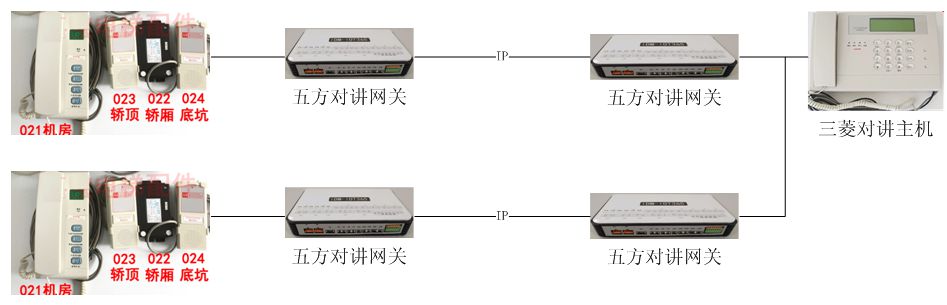
IDM DT02 Serverless Elevator Five-Party Intercom
No replacement of Deling two-wire or four-wire terminals, no dispatch server, a single point of failure does not affect other sites
IDM DT02 Serverless Elevator Five-Party Intercom, applied in the product showcase field, communication/transmission/dispatch equipment for industry customers (to be further detailed based on the product documentation)
IDM DT02 centerless-server elevator five-party intercom is a set of IP transmission-based elevator terminal equipment developed by Beijing Ruiguang Jiyuan Digital Technology Co., Ltd. (Raytrans). As a professional command and dispatch system manufacturer, this solution connects Deling-type two-wire and four-wire elevator intercom terminals to an IP network without adding a central dispatch server, and completes calls and dispatching at the central end, realizing a centerless-server elevator intercom dispatch solution. The core approach of IDM DT02 involves only two steps: transmitting a protocol similar to telephone signaling over the IP network, and reconstructing the signaling at the other end into the level signals required by the intercom terminals. This elevator five-party intercom IP transformation solution effectively simplifies the wiring structure of traditional elevator terminals.
Key Specifications at a Glance: centerless-server architecture · Deling two-wire/four-wire terminal compatibility · IP signaling reconstruction · direct signaling transmission over the IP network · decentralized five-party intercom · direct dispatching at the central end · elevator terminal product showcase
Why Traditional Elevator Five-Party Intercom Needs IP Transformation
Elevator five-party intercom covers five sites: the duty room, the elevator machine room, the cable car cabin, the car top, and the pit. Among them, the cable car cabin, car top, and pit are aggregated to the machine room via the elevator traveling cable, and only the voice link between main units is truly routed across the machine room to the duty room. This link has long relied on twisted pair. After the expansion of residential communities and the relocation and merging of monitoring rooms, the margin of twisted pair in transmission distance and anti-interference has become increasingly small.
Wireless and GSM methods can bypass cabling, but are limited by radio frequency band management and continuous charging models, making voice quality and long-term use cost difficult to control. Another path is to carry intercom over the IP network, but when building according to a softswitch centralized scheduling architecture, the central end must keep a dispatch server running, and one more device means one more power supply, maintenance, and point of failure.
IDM DT02 takes a third path: without replacing the original Deling intercom terminals inside the elevator and without adding a central dispatch server, it completes signaling and voice conversion only at both ends of the link, sends intercom signals onto the IP network, and lets the central end directly complete calls and dispatching. Elevator five-party intercom IP transformation can therefore be advanced site by site, without replacing the terminals of an entire building at once.
How Centerless-Server Elevator Five-Party Intercom Works
Centerless-server elevator five-party intercom splits signaling conversion across both ends of the link, so the central end no longer handles signaling forwarding. The Deling intercom terminals on the elevator side still work over the original lines, while IDM DT02 packages and sends telephone signaling on the IP network side, and after reaching the opposite end restores it into the levels the terminals can recognize, with calls, answers, and hang-ups completed directly by both ends.
This direct transmission brings two direct results. First, an abnormality in any intercom link will not affect other sites: dispatching does not depend on a central server for relay, a single point of failure does not affect five-party intercom, and the remaining floors and sites can call as usual.
Second, the central end can eliminate a dispatch server that is online year-round, and private network deployment cost and routine O&M nodes are reduced accordingly. For smart buildings and property management private network operators that need to manage hundreds or thousands of elevators, one less node that must be powered and maintained means one less category of duty failure. The national standard GB/T 24476-2017, Technical Specifications for the Internet of Things of Elevators, Escalators and Moving Walks, sets technical requirements for remote monitoring of elevator IoT, and five-party intercom, as the elevator voice emergency call link, is evolving toward being networkable and dispatchable.
How IP Signaling Reconstruction Is Compatible with Deling Two-Wire and Four-Wire Terminals
Reconstructing level signaling over the IP network is the key step for IDM DT02 to be compatible with Deling terminals. Deling-type elevator intercom uses dedicated-line interfaces, distinguished as two-wire or four-wire, and the call, busy line, and hang-up states on the line are all expressed by level changes; IDM DT02 transmits a protocol similar to telephone signaling over the IP network, and at the other end reconstructs these signals into the level timing corresponding to two-wire or four-wire.
Because the signaling is fully restored at both ends, the original Deling intercom terminals inside the elevator do not need to be replaced, and the wiring format does not need to be changed. The central end can then initiate calls, receive calls, and end conversations with Deling-type two-wire or four-wire elevator IP intercom in the original way. The value of two-wire/four-wire compatibility lies in the fact that elevators with the two wiring methods in the same community can be merged into the same IP transmission and dispatching system, and procurement and spare parts do not need to be split into two sets by format.
Core Functions and Parameters of IDM DT02
The functions of IDM DT02 revolve around signaling conversion, IP transmission, and central-end dispatching. The main function items are listed in the table below.
Function | Description |
|---|---|
IP signaling reconstruction | Transmits a protocol similar to telephone signaling over the IP network and reconstructs level signaling at the other end, completing remote signaling restoration |
Deling two-wire/four-wire access | Compatible with Deling-type two-wire and four-wire elevator intercom terminals; the original terminals inside the elevator need not be replaced |
Centerless-server dispatching | No central dispatch server is set up; the central end directly completes calls and dispatching for Deling-type two-wire or four-wire elevator IP intercom |
Five-party intercom link bearer | Carries intercom voice and signaling among the duty room, equipment room, cable car cabin, car top, and pit |
Decentralized operation | A single point of failure does not affect five-party intercom, the remaining sites can call as usual, and private network O&M nodes are reduced accordingly |
IP network bearer | Voice and signaling are transmitted over the IP network, reusing existing private network channels, without relying on wireless frequency bands or traffic cards |
The equipment parameters are subject to the product documentation. The table below lists the items already specified in the documentation; for the remaining performance specifications, not yet recorded in the knowledge base.
Item | Parameter/Specification | Description/Applicable Conditions |
|---|---|---|
Model | IDM DT02 | Centerless-server elevator five-party intercom equipment |
Applicable terminals | Deling-type two-wire / four-wire elevator intercom terminals | Deling elevator intercom two-wire and four-wire terminals are not replaced; confirm interfaces and wiring sequence according to the on-site format |
Signaling processing | Transmits telephone-type signaling over the IP network and reconstructs level signaling at the opposite end | Two-wire/four-wire compatible; call and hang-up states are restored by levels |
Scheduling method | Direct dispatching at the central end, without a central dispatch server | Decentralized architecture; a single point of failure does not affect five-party intercom |
Transmission bearer | IP network | Reuses existing IP private network channels; bandwidth and latency specifications are subject to the product documentation |
Power supply and environment | Not yet recorded in the knowledge base | Subject to the product documentation and the configuration confirmed for the project |
Performance specifications | Not yet recorded in the knowledge base | Number of channels, transmission latency, overall power consumption, etc. are subject to the product documentation |
Differentiated Value
Differentiation Point | Value on Site |
|---|---|
Centerless server architecture | Signaling is transmitted directly over the IP network, with no central dispatch server required to stay online year-round; a single point of failure does not affect five-party intercom |
Level signaling reconstructed over the IP network | Compatible with Deling two-wire/four-wire elevator intercom terminals; existing terminals and wiring can be connected to the IP network without modification |
Central dispatch server eliminated | Reduces private network deployment cost and operation and maintenance nodes; integrators deliver one less device, and operators maintain one less node |
How It Is Installed and Connected on Site
Elevator-side access: the existing five-party intercom twisted pair is reused between the cable car cabin, car top, and car bottom; on the equipment room side, intercom voice and signaling are connected to the intercom interface of the IDM DT02, with terminal and wiring formats kept unchanged.
Hoistway cabling: the elevator moves up and down continuously, so the traveling section must use elevator-specific tensile network cable and must not be replaced with ordinary network cable; otherwise, after long-term reciprocating motion, cores are prone to break and the intercom signal is affected.
Equipment room to center: this section runs over the IP network and reuses the existing private network channel; if a leased line is used, a VPN should first be established to form a virtual private network before carrying intercom signaling and voice.
Format verification: before construction, confirm whether the on-site Deling terminals are two-wire or four-wire, and configure interfaces and wiring sequence according to the corresponding format to avoid rework on site.
Activation verification: test calls channel by channel to confirm that the central end can initiate calls, receive calls, and hang up normally, and check that the status display of each channel matches the actual on-site conditions.
Typical Application Scenarios
Elevator IoT integrators: batch upgrades without replacing terminals
Elevator IoT integrators face a large installed base of elevators and worry during upgrades about long elevator downtime, terminal replacement, and adding another server at the center. The IDM DT02 is compatible with Deling two-wire/four-wire terminals, so existing terminals are not replaced and wiring is not changed; the elimination of the central server saves another device, and the delivery workload and number of devices for a single residential community drop accordingly; the same IDM DT02 covers both two-wire and four-wire formats, so spare parts and models can be unified.
Smart building and property private network operators: decentralized five-party intercom
Smart building and property private network operators must bear the long-term operation and maintenance of the intercom system. The decentralized architecture means a single point of failure does not paralyze the network, and an abnormal link on one channel will not bring down intercom for the entire building; the central end no longer needs a dispatch server that stays online year-round, private network operation and maintenance has one less node, and the pressure of night-shift and holiday duty decreases accordingly.
Industrial communications equipment channel distributors: a new selling point for private network dispatch
Channel distributors need differentiation they can clearly explain to customers. The centerless server architecture and Deling IP intercom compatibility are a rare combination of capabilities among products of the same class and map directly to two types of projects: elevator IoT and private network upgrades; for customers, the elimination of the central server means one less device in the solution and easier budget approval, making private network dispatch a new selling point for channels in the elevator industry.