IDM 60N Wired and Wireless Integrated Dispatch Gateway
Echo cancellation improves sensitivity; 6 km remote control over twisted pair; multi-band radio intercommunication
The IDM 60N wired/wireless integrated dispatch gateway is a dedicated communications device developed with digital technology to interconnect radio sets, wired terminal boxes, the wired telephone network, and GSM trunking equipment. This transfer system has complete functions and good wired/wireless transfer performance, and a wide range of applications. At the same time, the platform supports long-distance wireless communication and features low equipment cost. It plays a dispatching and command role in communications operations in railways, the military, public security, civil aviation airports, railways, ports and docks, and large and medium-sized enterprises, and has broad application prospects in communications and other fields.
The IDM 60N wired and wireless integrated dispatch gateway is a wired and wireless integrated dispatch gateway developed by Beijing Ruiguang Jiyuan. It interconnects radio sets, wired terminal boxes, wired telephone networks, and GSM trunking equipment to perform automatic transfer and unified command and dispatch between wired and wireless systems, providing underlying channel support for audio and video dispatching and command and dispatch services. The device adopts digital signal processing and microcontroller control technology, changing the traditional working mode in which radio sets rely on manual monitoring and on-duty standby.
Through an echo canceller, the device overcomes the interference with wired voice detection caused by radio signals during 2-wire/4-wire transfer, improving wired voice detection sensitivity and transfer reliability. Private network users such as railways, public security, and civil aviation airports can manage radio sets, wired terminals, and telephone networks simultaneously from a single dispatching seat, so command instructions no longer rely on manual call relay, and the converged dispatching capability in the product showcase is thus intuitively demonstrated. As a professional command and dispatch system manufacturer, Ruiguang Jiyuan has achieved stable transfer between radio sets and telephone networks on this model, and can provide networking support with the wired and wireless integrated dispatch gateway for military emergency communications vehicle solutions.
Key Specifications at a Glance: 6 km control distance over twisted pair · E1/optical fiber parallel operation for extended coverage · 2 radio set interfaces · 24 wired terminal interfaces · 2 telephone interfaces · 4 E1 channels · overall power consumption ≤50 W
The unit is a 19-inch 1U standard chassis with dimensions of 440×230×45 mm (length×depth×height), and can be installed directly in a standard cabinet. The front panel centrally locates the power and operating indicator LEDs, so O&M personnel standing in front of the cabinet can judge whether the device is running normally without first connecting a maintenance computer.
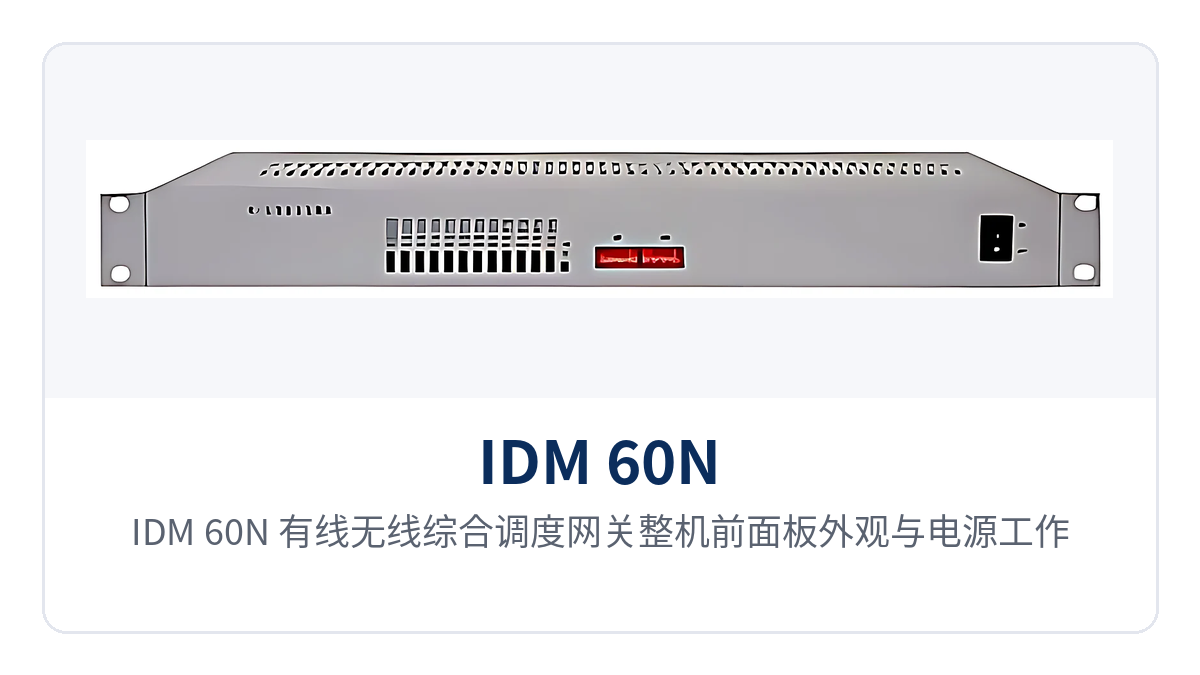
Figure 1: Front panel appearance and power/operating indicator LED layout of the IDM 60N wired and wireless integrated dispatch gateway
How does the wired and wireless integrated dispatch gateway connect radio sets and telephones?
Wired-to-wireless transfer is completed under microcontroller control: one side of the device connects to radio sets, and the other side connects to wired terminal boxes and the telephone network. Speech from either end is detected and automatically forwarded to the opposite end. Duty personnel no longer need to sit by the radio set listening; multiple control terminals can operate the same set of radio resources simultaneously, thus changing the listening and standby working mode and reducing the duty pressure of audio and video dispatching and command and dispatch.
The echo canceller handles a key link in 2-wire/4-wire transfer. When speech from the wireless side returns to the wired side through 2-wire to 4-wire conversion, it is easily treated as new input and suppresses voice detection sensitivity; after echo cancellation processing, wired voice detection sensitivity and transfer performance are both improved.
The device also provides telephone interfaces, so fixed-line telephones and mobile phones can dial in remotely for command and monitoring, and intercommunication between radio sets and the telephone network is completed within the same voice channel. After a GSM module card is configured, mobile terminals such as mobile phones can also access the same transfer system, so remote command is no longer limited by radio coverage.
Which terminals and interfaces can one device connect?
Functions are divided into three parts: the wireless side, the wired side, and the management side. The wireless side handles radio audio and keying, the wired side handles terminals and telephones, and the management side handles transfer control, recording, and status monitoring. The following table lists each capability and its on-site use by function item, and can serve as a checklist for acceptance on delivery and requirements lists.
| Function | Description |
|---|---|
| Echo cancellation | Adopts digital signal processing technology; the echo canceller suppresses 2-wire/4-wire transfer interference, improving wired voice detection sensitivity and transfer performance |
| Automatic transfer | Microcontroller control realizes automatic transfer between wired terminals and radio sets, replacing manual listening and standby for radio sets, and can provide multiple control terminals simultaneously |
| 6 km remote control over twisted pair | The transmission distance to the terminal controller can reach 6 km over twisted pair, so command terminals can be deployed at a distance |
| E1/optical fiber parallel operation | Parallel operation of multiple devices over a distance via E1 or optical fiber transmission, expanding wireless coverage |
| Telephone remote dial-in | Provides telephone interfaces; fixed-line telephones and mobile phones can dial in remotely for command and monitoring |
| Multi-band radio intercommunication | Supports real-time intercommunication among radio sets of different frequency bands, so cross-band announcements do not require manual relay |
| GSM module card | After a GSM module card is configured, the device can connect with mobile terminals such as mobile phones |
| Recording service | Provides recording service for all digital terminals, so the instruction issuance process can be reviewed afterwards |
| Expandable interfaces | Radio interfaces, telephone interfaces, and wired terminal interfaces are expandable and can be added according to the number of channels on site |
The rear panel arranges radio set interfaces, wired terminal interfaces, telephone interfaces, and E1 channels by area. The radio side carries two types of signals, audio and keying; the user side carries subscriber lines. During wiring, connect by interface label area to avoid mixing radio audio cables with subscriber lines; the product showcase and on-site acceptance can be checked item by item against the panel areas.
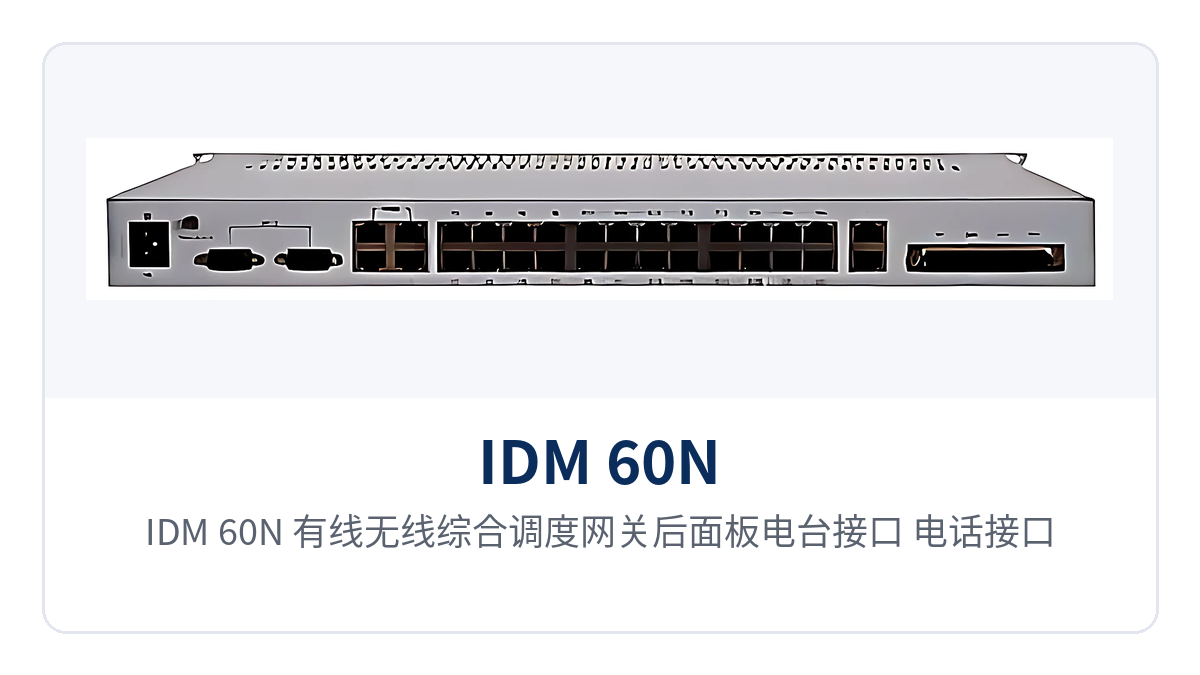
Figure 2: Rear panel layout of radio interfaces, telephone interfaces, and E1 channels of the IDM 60N wired and wireless integrated dispatch gateway
What are the core parameters and interface specifications?
Interface and electrical specifications are listed item by item in the following table according to the product documentation, for reference in selection and networking design. For the ingress protection rating, shock resistance, and packaging dimensions not listed in the table, not yet recorded in the knowledge base; confirm with the manufacturer before ordering. The number of interface channels is the standalone unit configuration; after parallel operation, they add up by the number of units.
| Item | Parameter/Specification | Description/Applicable Conditions |
|---|---|---|
| Equipment form factor | 19-inch 1U chassis, 440×230×45 mm | Standard cabinet installation, suitable for both equipment rooms and station buildings |
| Radio set interface | 2 channels, impedance 600 Ω (balanced or unbalanced) | Can connect base station radios of different frequency bands |
| Radio input level | -10 to +10 dBm | Adjust according to the output level of the opposite-end radio |
| Radio output level | -35 to +10 dBm | Verify receive/transmit gain against on-site voice |
| Keying output | Relay contact | Used for radio transmit keying |
| Wired terminal interface | 24 subscriber lines, output and input level -4.5 dBm (-10 to +6 dBm adjustable), off-hook loop current ≥20 mA | Supports DTMF dialing, adaptive adjustment of hybrid network, loss greater than 26 dB |
| Telephone interface | 2 FXO/FXS, audio range 300 Hz to 3400 Hz, G.711 A-law | Three-element complex impedance 200 Ω+560 Ω//0.1 μF, loop current 25 mA per channel |
| E1 channel | 4 | Used for parallel operation and long-distance extension |
| V.24 interface | Asynchronous ≤9600 bps, synchronous 64 Kbps | Complies with CCITT V.28 protocol |
| Power supply and power consumption | AC220V, overall power consumption ≤50 W | Conventional AC power supply in station buildings |
| Operating environment | -10℃ to +55℃, relative humidity 0 to 95% (non-condensing) | Equipment rooms and manned station buildings |
| Network management | Supports online real-time monitoring | Facilitates centralized viewing of device status |
How do the four capabilities apply on site: 6 km over twisted pair, E1/optical fiber parallel operation, echo cancellation, and expandable interfaces?
The four capabilities correspond to four types of on-site constraints: command seats far from the equipment room, insufficient coverage, unreliable voice detection, and insufficient interfaces. The following table maps capability labels to on-site problems item by item, and can be used directly as items to verify during selection. The four configurations are not mutually exclusive and can be enabled simultaneously on the same device.
| Differentiation Point | Description and Customer Value |
|---|---|
| 6 km over twisted pair | The transmission distance to the terminal controller can reach 6 km over twisted pair, so command terminals do not have to be squeezed next to the radio equipment room, and the duty room and dispatch room can be deployed separately |
| E1/optical fiber parallel operation | Multiple devices are operated in parallel via E1 or 4 E1 channels and optical fiber links, and the wireless areas covered by each device combine into one, so cross-station command no longer operates in isolation |
| Echo cancellation | Radio return crosstalk caused by 2-wire/4-wire transfer is suppressed, wired voice detection sensitivity is improved, and on-site announcements are less likely to be missed or falsely triggered |
| Expandable interfaces | Radio interfaces, telephone interfaces, and wired terminal interfaces are added according to the number of channels on site, so basic seats can be built first and subsequent capacity expansion does not require replacing the complete unit |
The 6 km remote control over twisted pair frees command seats from the equipment room. Radio equipment rooms are usually located near the rooftop or platform, while the duty room is in another building; connecting the terminal controller to the equipment room with a pair of twisted wires is sufficient, and no separate optical cable needs to be laid for the command terminal.
E1/optical fiber parallel operation connects multiple devices into one group via E1 or optical fiber links, with each device connected to local radios nearby, so coverage areas combine into one. During cross-region dispatching, the central seat can call radios at different sites simultaneously; coverage expands with the number of parallel units, and the coverage of converged dispatching expands accordingly.
Typical Application Scenarios
The following three industry scenarios are common uses of the wired and wireless integrated dispatch gateway, all sharing the goal of bringing existing radio sets and existing telephone networks together into one command point. Each scenario describes the access mode and configuration points according to on-site conditions; during site surveys, simply record the radio frequency band, number of seats, and inter-station links.
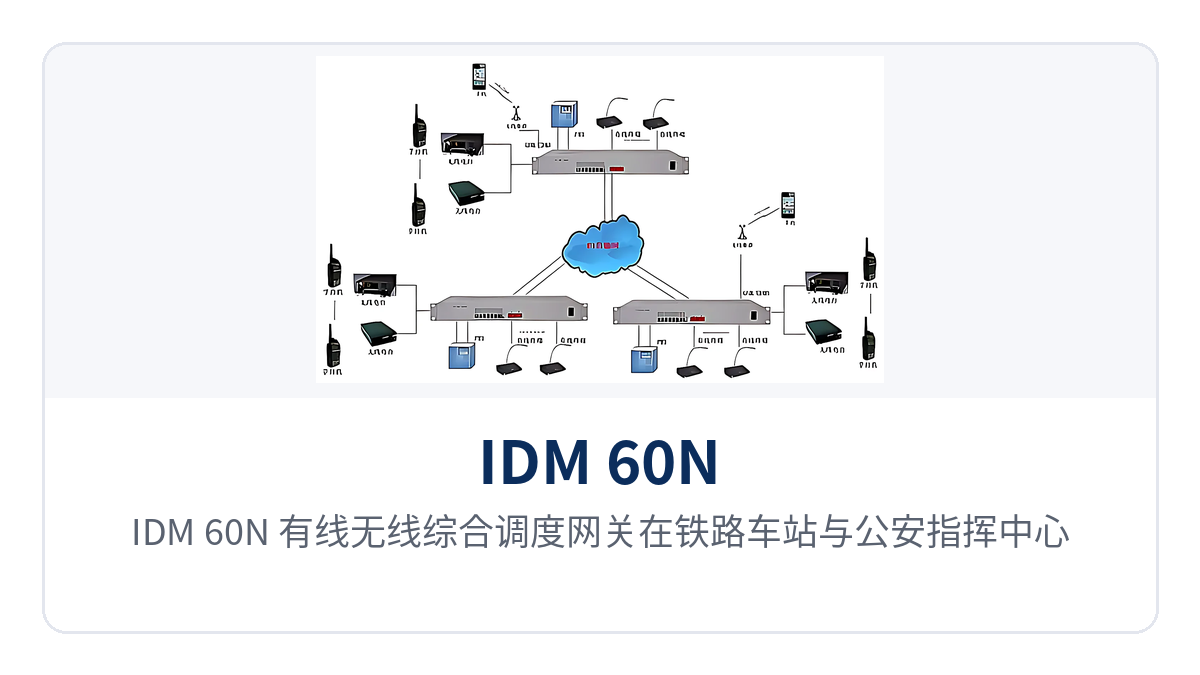
Figure 3: Parallel networking schematic of the IDM 60N wired and wireless integrated dispatch gateway at a railway station and a public security command center
Railway: station duty room and section radios brought together
The wired telephones in the station duty room and the radio sets used for section operations have long belonged to two separate systems, and train operation instructions rely on verbal relay by duty operators. The wired and wireless integrated dispatch gateway is installed in the station communications equipment room; the radio side connects to station radios, and the wired side connects to the duty console and telephone subscriber lines, so duty operators can talk directly with section workers from their seats.
When yards are dispersed, multiple devices operate in parallel via E1 channels, and the central station can call radios at adjacent yards simultaneously. The 6 km remote control over twisted pair allows dispatch seats to be placed in the duty building while only transfer equipment remains in the equipment room, so personnel do not need to travel between buildings.
Public security: police station radios connected to the command center telephone network
Police stations and street patrols use intercom and radio sets, while the command center issues instructions over the telephone network; manual call relay between the two systems is prone to delay. The wired and wireless integrated dispatch gateway connects police station radios to the command center telephone network, so commanders can call radios in their jurisdiction using ordinary telephones, and fixed-line telephones and mobile phones can also dial in remotely for monitoring.
Echo cancellation prevents announcements from the wired side from being suppressed by radio return crosstalk, keeping voice detection sensitive. The recording service records calls of digital terminals for later playback by seat, so verifying the instruction issuance process no longer requires separate recording equipment; calling, announcement, and recording are all completed at the same seat.
Civil aviation airport: unified dispatch of multi-band radios for ground support
Airport ground support involves multiple teams such as maintenance, apron service, shuttle, and cargo, each using radios of different frequency bands, and cross-team coordination often relies on telephone relay. The wired and wireless integrated dispatch gateway supports real-time intercommunication among radio sets of different frequency bands, and after parallel operation via E1 or optical fiber, radios in each area are brought into the same dispatch seat.
Duty operators at the seat can call radios of multiple frequency bands at once, and temporary adjustments for flight support are issued in one place. The expandable interface design means that when a new team is added, only the corresponding interfaces need to be added, without rebuilding the entire transfer system, so cross-team coordination is completed in one place.
What should be noted in on-site deployment and wiring?
Deployment starts with taking stock of on-site terminals: first count the number of radio channels, telephone channels, and wired terminal channels, then determine the device interface configuration, and then calculate the distance from the command seat to the equipment room. The wiring requirements for audio and video dispatching and product showcase sites also apply; check the following five items one by one so that wiring and commissioning are completed in one pass. Rework mostly occurs in the number of interface channels and the link route.
- Connect radio interfaces at 600 Ω impedance; choose balanced or unbalanced connection according to the output mode of the opposite-end radio, and verify receive/transmit gain against on-site voice during commissioning.
- Connect wired terminals as subscriber lines, with off-hook loop current not less than 20 mA, and DTMF dialing consistent with the terminal.
- Lay the control cable from the command terminal to the device as twisted pair, with distance controlled within 6 km; beyond that distance, switch to parallel operation via E1 or optical fiber links.
- When operating multiple devices in parallel, first plan the E1 channel and optical fiber link routes, and connect each device to local radios nearby to avoid interference introduced by long-distance audio cables.
- Connect power at AC220V, with overall power consumption not exceeding 50 W; control the equipment room environment at -10℃ to +55℃ and humidity 0 to 95% non-condensing.
Conclusion
The converged wired and wireless dispatch gateway brings radio sets, wired terminals, and the telephone network into one transfer system. Its three capabilities—6 km remote control over twisted pair, E1 optical fiber parallel operation for extended coverage, and echo cancellation for improved voice detection—address three on-site problems respectively: operator seat distance, coverage area, and transfer reliability. Duty rooms at railways, public security, and civil aviation airports can first configure the equipment according to the existing number of radio sets and telephone lines, then add interfaces as teams grow, without rebuilding the entire communication system. As a command and dispatch system manufacturer, Raytrans continues to provide reliable converged dispatching equipment support for scenarios such as audio and video dispatching, product showcase, and command and dispatch.