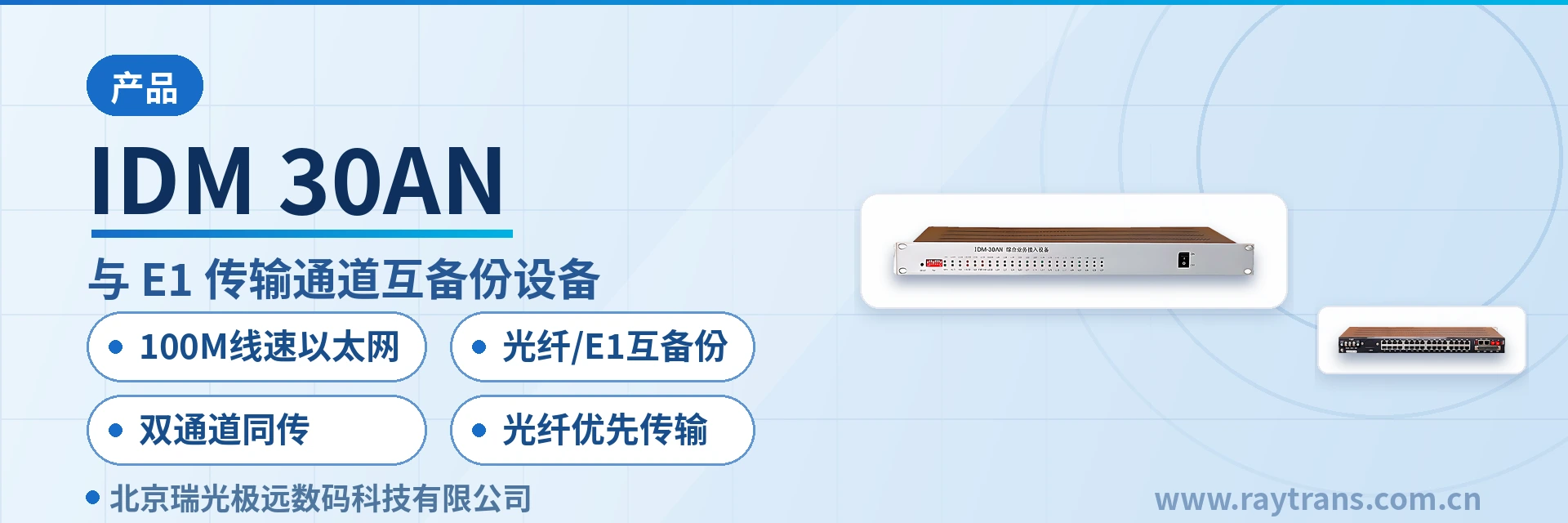
IDM 30AN Fiber and E1 Mutual Backup Device
Fiber-first with E1 fallback, narrowband dual-channel simultaneous transmission, wire-speed 100M or above guaranteed when fiber is normal
In some applications, both an optical fiber line and an E1 line are required to serve as mutual backup transmission channels. For example, a forest fire prevention lookout point normally uses optical fiber to communicate with the base of the mountain; to prevent mountain torrents during the flood season from breaking the cable, a microwave bridge plus reverse
IDM 30AN is an optical fiber and E1 transmission channel mutual backup device featuring an integrated multi-function design. Developed by Beijing Ruiguang Jiyuan (Raytrans) and launched as a representative product of a professional optical multiplexer manufacturer, it is commonly used in private network communication scenarios where optical fiber lines and E1 lines back each other up at the same site. In some applications, a site needs both optical fiber lines and E1 lines as mutual backup transmission channels: the optical fiber channel carries daily services and bandwidth, while the E1 channel takes over when the optical fiber is interrupted, thereby building a reliable optical fiber and E1 mutual backup transmission solution.
Key Specifications at a Glance: 100M wire-speed Ethernet · Optical fiber/E1 mutual backup · Dual-channel simultaneous transmission · Optical fiber priority transmission · Mutual backup model IDM 30AN-H
In government private network optical fiber communication solutions, the device can work with the telephone optical multiplexers and optical multiplexers shown in the product showcase to achieve stable transmission; in military emergency communications vehicle solutions, Raytrans optical multiplexer products can likewise leverage the advantages of optical fiber and E1 mutual backup to meet the stringent requirements for communication continuity in emergency scenarios.
What Is an Optical Fiber and E1 Transmission Channel Mutual Backup Device?
What is an optical fiber and E1 transmission channel mutual backup device? In one sentence: it is a type of transmission equipment that accesses both an optical fiber channel and an E1 channel at the same site and lets the two channels back each other up. When the optical fiber is normal, services run over the optical fiber channel; when the optical fiber fails, the E1 channel takes over, ensuring the basic transmission requirements of services. As a professional optical multiplexer manufacturer, Raytrans offers such equipment precisely as a supporting product for scenarios such as government private network optical fiber communication solutions and military emergency communications vehicle solutions.
IDM 30AN operates on the principle of "optical fiber first, E1 as fallback": under normal conditions, the optical fiber transmission channel is used preferentially; when optical fiber transmission is in use, 1 group of wire-speed 100M Ethernet channels is provided at the same time; when the optical fiber fails, the E1 transmission channel is enabled, so that services do not lose all bearing capacity due to an optical fiber interruption. The processing capabilities for optical fiber access and E1 access are integrated into one integrated enclosure, so no separate converter equipment needs to be added at the site for the backup link.
By convention, to distinguish it from the standard IDM 30AN, the model with optical fiber and E1 mutual backup is usually designated IDM 30AN-H.
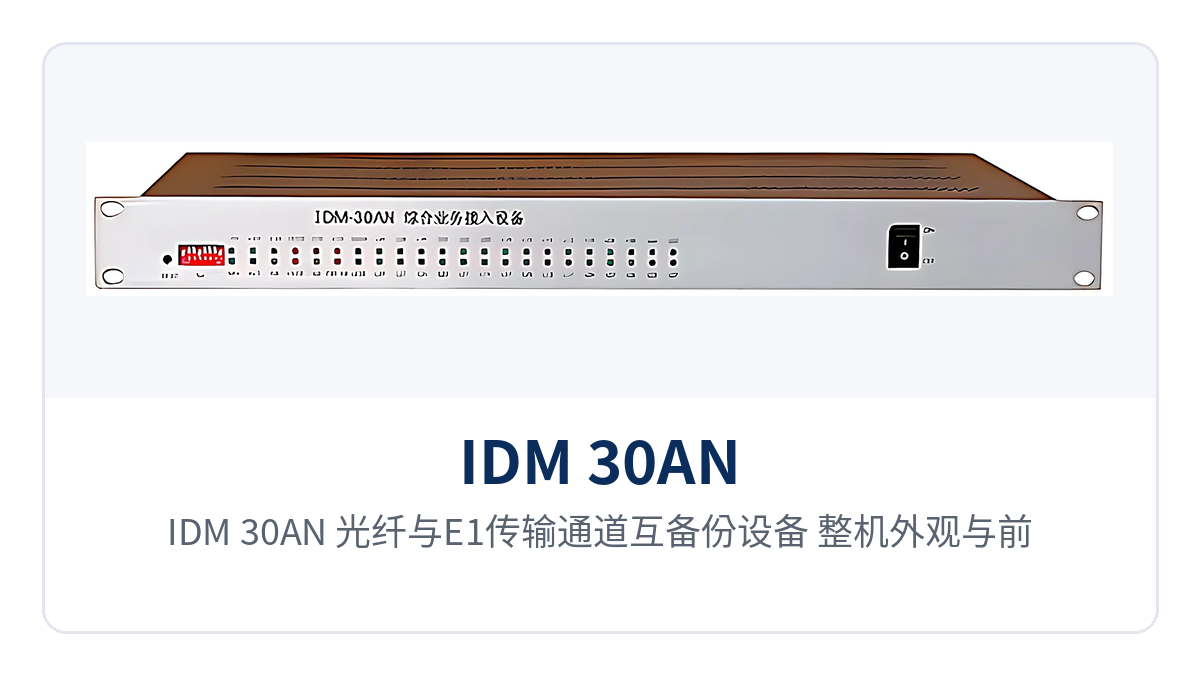
Figure 1: IDM 30AN Optical Fiber and E1 Transmission Channel Mutual Backup Device — Overall Appearance and Front Panel Indicator LEDs
Core Functions and Performance Specifications
The functions of IDM 30AN center on the main thread of "optical fiber primary, E1 backup." The table below lists each function and its purpose according to the product documentation. Functions and parameters are subject to the original product documentation; items not provided are marked according to the knowledge base convention.
Function | Description |
|---|---|
Optical fiber priority transmission | Under normal conditions, the optical fiber transmission channel is used preferentially to carry site services, with the optical fiber channel handling daily transmission |
1 group of wire-speed 100M Ethernet channels | When optical fiber transmission is in use, 1 group of wire-speed 100M Ethernet channels is provided at the same time, so daily service bandwidth is not reduced by the presence of a backup link |
E1 backup channel | When the optical fiber fails, the E1 transmission channel is enabled to ensure the basic transmission requirements of services |
Dual-channel simultaneous transmission | Narrowband services are transmitted simultaneously over the optical fiber and E1 channels, with the E1 channel always kept in a carrying state |
Automatic channel activation | When the optical fiber fails, the device automatically enables the E1 transmission channel to carry services |
Integrated multi-function design | Optical fiber access, E1 access and user service access capabilities are integrated into one integrated enclosure, reducing external equipment and on-site cabling |
The technical specifications of IDM 30AN are likewise subject to the original product documentation; items not provided in the documentation are marked directly in the table without estimation.
Item | Parameter/Specification | Description/Applicable Conditions |
|---|---|---|
Transmission channel configuration | Optical fiber channel (primary) + E1 channel (backup) | The two channels back each other up, and services preferentially run over the optical fiber channel |
Ethernet channel | 1 group of wire-speed 100M | Provided when optical fiber transmission is in use; service bandwidth is not reduced while the optical fiber is normal |
Dual-channel services | Narrowband services are transmitted simultaneously over the optical fiber and E1 channels | The optical fiber channel is used preferentially; when the optical fiber fails, the E1 channel ensures the basic transmission requirements of services |
Mutual backup model designation | IDM 30AN-H | To distinguish it from the standard IDM 30AN, the mutual backup model is usually written this way |
Source of the E1 backup channel | Microwave bridge + reverse bridge, or leased carrier E1 channel | Actual practice at sites such as forest fire lookout points and air traffic control radar/communication stations |
Optical port type and rate | Not yet recorded in the knowledge base | Subject to the product documentation and the manufacturer's technical documentation |
Optical wavelength and transmission distance | Not yet recorded in the knowledge base | Related to the on-site optical cable design; subject to the engineering design |
E1 interface line coding and frame structure | Not yet recorded in the knowledge base | Subject to the product documentation and the manufacturer's technical documentation |
Power supply mode and overall power consumption | Not yet recorded in the knowledge base | Subject to the product documentation and the manufacturer's technical documentation |
Operating temperature and enclosure dimensions | Not yet recorded in the knowledge base | Subject to the product documentation and the manufacturer's technical documentation |
How Are Services Automatically Switched Over to E1 When the Optical Cable Is Interrupted?
How are services automatically switched over to E1 when the optical cable is interrupted? The answer is: IDM 30AN preferentially uses the optical fiber transmission channel under normal conditions; when the optical fiber fails, the E1 transmission channel is enabled, and the E1 channel continues to carry narrowband services, ensuring the basic transmission requirements of services. The backup channel is not activated only after an interruption — narrowband services are transmitted simultaneously over the optical fiber and E1 channels, and the E1 channel is always in a carrying state.
From an engineering perspective, what needs to be distinguished before and after switchover is the difference between two types of services: while the optical fiber is normal, the site gains, in addition to narrowband services, one group of wire-speed 100M Ethernet channels; after the optical fiber is interrupted, this group of Ethernet channels is lost along with the optical fiber link, and the E1 channel carries narrowband services. Incorporating this difference into service tiering design in advance makes it clear, when the optical cable is interrupted, which services continue and which services wait for optical cable emergency repair. In government private network optical fiber communication solutions and military emergency communications vehicle solutions, Raytrans optical multiplexer products use exactly this optical fiber and E1 mutual backup transmission solution to improve link reliability.
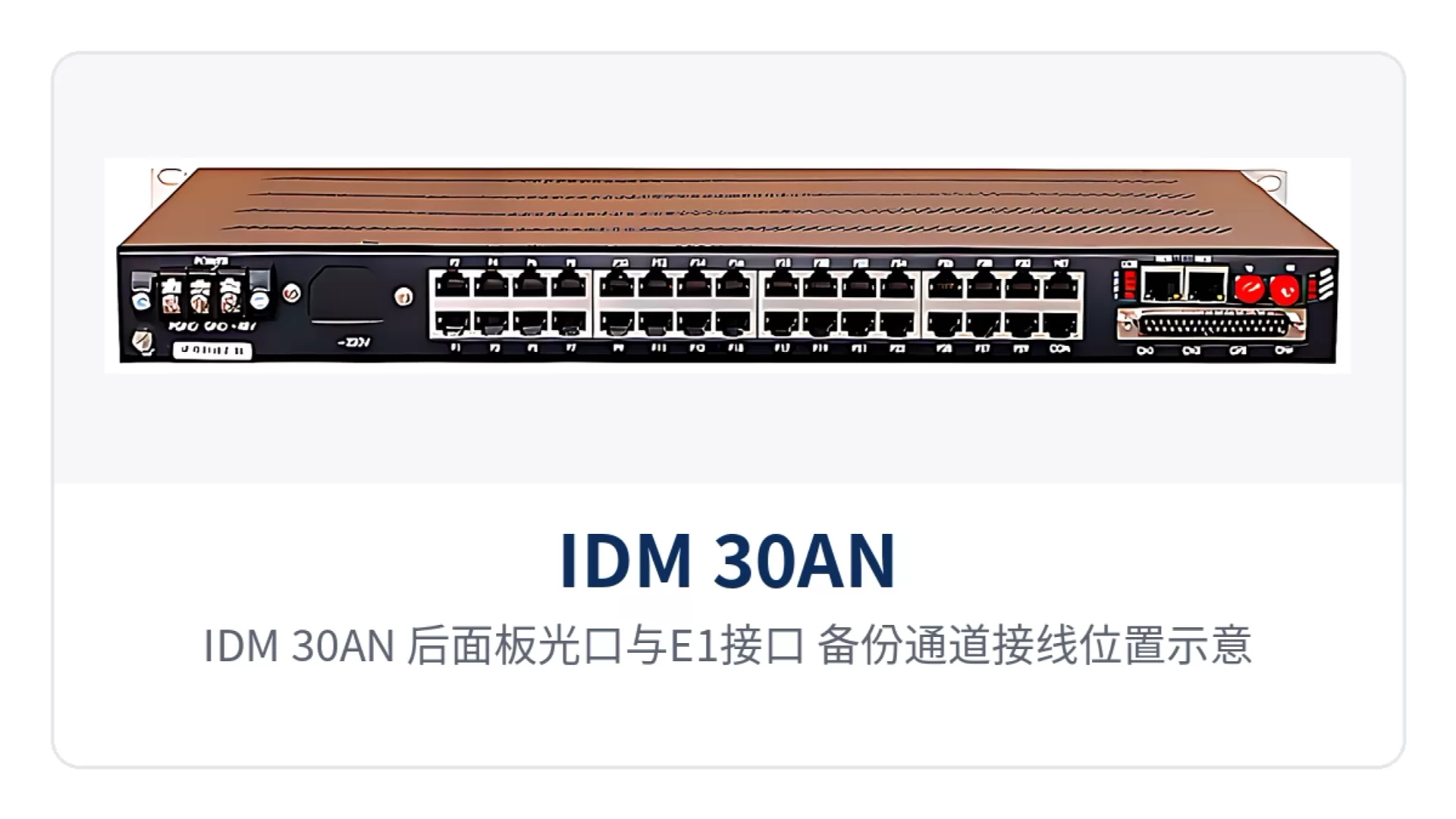
Figure 2: IDM 30AN rear panel optical port and E1 interface backup channel wiring position diagram
How is the wire-speed 100M Ethernet channel provided when the optical fiber is normal?
How the wire-speed 100M Ethernet channel is provided when the optical fiber is normal: the answer is that IDM 30AN, when using optical fiber transmission, simultaneously provides one group of wire-speed 100M Ethernet channels, and this bandwidth comes from the optical fiber link itself, so the existence of the backup channel does not slow down daily services.
This group of Ethernet channels is suitable for carrying Ethernet-type data services at the site and shares the same optical fiber channel with narrowband services, so the site does not need to arrange separate transmission equipment for data services. It should be noted that this group of 100M Ethernet channels depends on the optical fiber link and belongs to the bandwidth capability during normal optical fiber operation; after the optical fiber is interrupted, the E1 backup channel guarantees the basic transmission requirements of services. The two types of capabilities play different roles and should be treated separately according to this distinction during selection and service planning. As an optical multiplexer manufacturer, Raytrans also presents telephone optical multiplexers, optical multiplexers and other series together with the optical fiber and E1 mutual backup transmission solution in its product showcase, making it easier for users to select according to scenario.
Why are narrowband services transmitted simultaneously over optical fiber and E1?
Why narrowband services are transmitted simultaneously over optical fiber and E1: the answer is that IDM 30AN transmits narrowband services simultaneously over the optical fiber and E1 channels, and preferentially uses the optical fiber channel. The two channels carry the same set of narrowband services; when the optical fiber channel is normal, services run over the optical fiber, so the E1 backup channel remains in a carrying state synchronized with the optical fiber channel.
This approach directly corresponds to the operational reality of unattended sites: sites are distributed and the cost of a single site visit is high, and only when the backup channel is already in a carrying state during normal times can it truly "take over" when the optical fiber is interrupted. Transmitting narrowband services simultaneously over both the optical fiber and E1 channels and preferentially using the optical fiber is exactly the concrete practice that turns the backup channel from "standby" into "online." Around requirements such as government private network optical fiber communication solutions and military emergency communications vehicle solutions, Raytrans provides telephone optical multiplexers, optical multiplexers and other products together with the optical fiber and E1 mutual backup transmission solution, helping users strike a balance between link redundancy and service continuity.
Typical application scenarios
The target scenarios of IDM 30AN are concentrated on sites that "already have self-built optical fiber and also need an independent backup channel": the optical fiber carries daily services and bandwidth, the E1 channel guards against optical fiber interruption, and the practices at the three types of sites have different emphases. As a professional optical multiplexer manufacturer, Raytrans provides differentiated solutions for different industry requirements in its optical multiplexer product showcase.
Mountain forest fire lookout point: service channels remain available after cables are washed out during flood season
A lookout point of a mountain forest fire prevention unit normally uses optical fiber to communicate with the foot of the mountain. To prevent mountain torrents during flood season from breaking the cables, the site uses a microwave bridge plus a reverse bridge to provide an E1 channel as backup, and this microwave bridge E1 backup channel backs up the existing optical cable. IDM 30AN is deployed at the lookout point; when the optical fiber is normal, services run over the optical fiber, and one group of wire-speed 100M Ethernet channels is also provided; when cables are washed out during flood season, narrowband services continue to be carried by the E1 channel, so the foot of the mountain and the lookout point do not become completely disconnected. For such mountain forest sites with scattered sites and impassable roads, the value of the optical fiber and E1 mutual backup transmission solution is concentrated on communication assurance during flood season.
Air traffic control radar stations and communication stations: optical fiber as primary, leased E1 as auxiliary
Air traffic control organizations normally have their own optical fiber lines to radar stations/communication stations. To increase reliability, such organizations also lease E1 channels from carriers as backup channels, forming a dual-channel pattern with optical fiber as primary and carrier E1 as auxiliary. IDM 30AN at the site side connects both channels into the same device: when the optical fiber is normal, services run over the self-built optical cable and one group of wire-speed 100M Ethernet channels is provided; when the optical fiber line fails, the leased E1 channel takes over to guarantee the basic transmission requirements of services. For scenarios such as air traffic control, where communications are not allowed to lose their bearer for a long time, dual-channel mutual backup is a conventional reinforcement practice beyond a single optical fiber link, and it is also typical experience that Raytrans has accumulated in government private network optical fiber communication solutions.
Unattended private network sites in the field: an access mode with both channels in place
Unattended private network sites in the field usually have only one self-built optical cable to the site, and the optical cable repair cycle is affected by roads and weather. IDM 30AN provides such sites with an access mode using both optical fiber and E1 channels: the optical fiber channel carries daily services and one group of wire-speed 100M Ethernet channels, while the E1 channel serves as an independent backup path; narrowband services are transmitted simultaneously over both channels and preferentially use the optical fiber. The more remote the site and the higher the cost of a single site visit, the more obvious the benefit of incorporating the backup channel into the design in advance. Such telephone optical multiplexer product showcase scenarios are exactly the core requirements that Raytrans also focuses on in military emergency communications vehicle solutions.
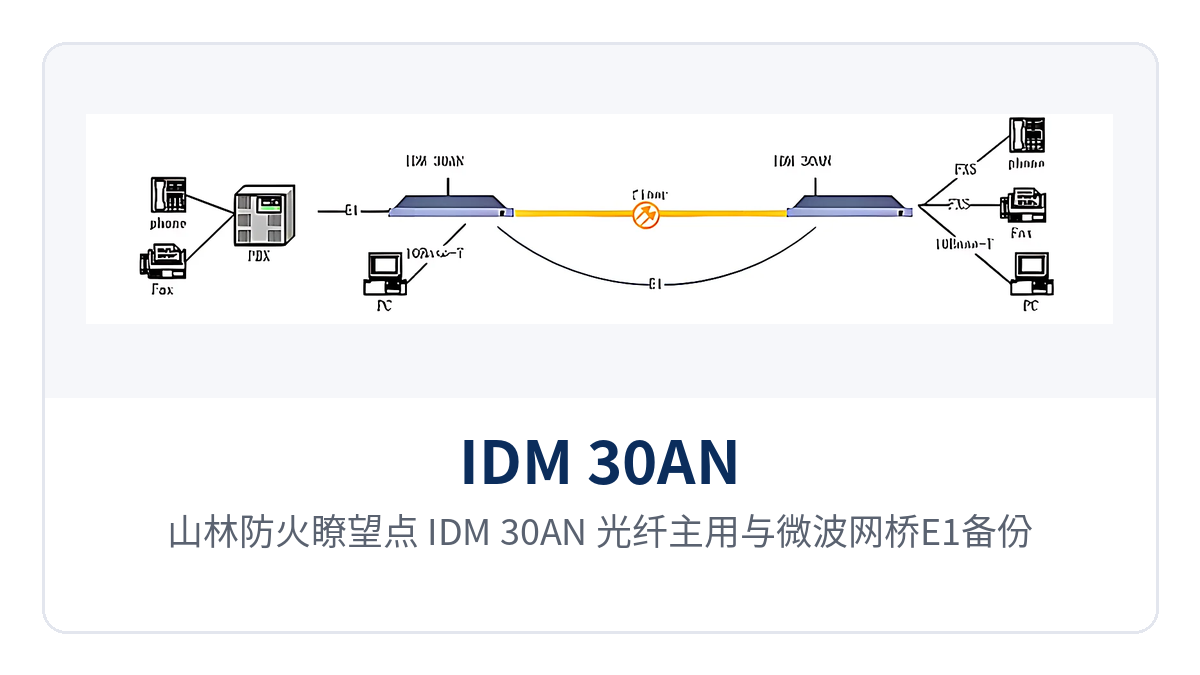
Figure 3: Mountain forest fire lookout point IDM 30AN optical fiber primary and microwave bridge E1 backup networking diagram
Differentiated value
The differentiated value of IDM 30AN is concentrated in three points: when the optical fiber is normal, it provides one group of wire-speed 100M Ethernet channels, so services do not need to slow down; when the optical fiber fails, E1 backup is automatically enabled to guarantee the basic transmission requirements of services; narrowband services are transmitted simultaneously over both the optical fiber and E1 channels and preferentially use the optical fiber. The three selling points and corresponding capabilities are shown in the table below.
Differentiated selling point | Corresponding capability | Customer value |
|---|---|---|
100M wire-speed Ethernet | When using optical fiber transmission, one group of wire-speed 100M Ethernet channels is also provided | When the optical fiber is normal, one group of wire-speed 100M Ethernet channels is provided, so services do not need to slow down |
Optical fiber/E1 mutual backup | The optical fiber channel and E1 channel back up each other, and the E1 transmission channel is enabled when the optical fiber fails | When the optical fiber fails, E1 backup is automatically enabled to guarantee the basic transmission requirements of services |
Dual-channel simultaneous transmission | Narrowband services are transmitted simultaneously over the optical fiber and E1 channels, and the optical fiber channel is preferentially used | Narrowband services are transmitted simultaneously over both the optical fiber and E1 channels, and preferentially use the optical fiber |
Conclusion
For the three types of sites—mountain forest fire lookout points, air traffic control radar stations/communication stations, and unattended private network sites in the field—IDM 30AN, as one optical fiber and E1 transmission channel mutual backup device, aggregates optical fiber primary and E1 backup into the same integrated device: when the optical fiber is normal, services do not need to slow down and one group of wire-speed 100M Ethernet channels is available; when the optical fiber fails, the E1 channel guarantees the basic transmission requirements of services; and narrowband services are transmitted simultaneously over both the optical fiber and E1 channels and preferentially use the optical fiber. As a professional optical multiplexer manufacturer, Raytrans continues to provide reliable optical multiplexer products and telephone optical multiplexer solutions for government private network optical fiber communication solutions and military emergency communications vehicle solutions.