IDM 300GP
IDM 300GP
The IDM-300GP Gigabit Network Telephone Optical Multiplexer provides 2 physically isolated wire-speed 1000M Ethernet interfaces and 8 groups of transparently transmitted E1 interfaces. The device features a plug-in card structure design, with each service card providing 30 telephone lines. The equipment is easy to install and maintain.
I. Overview
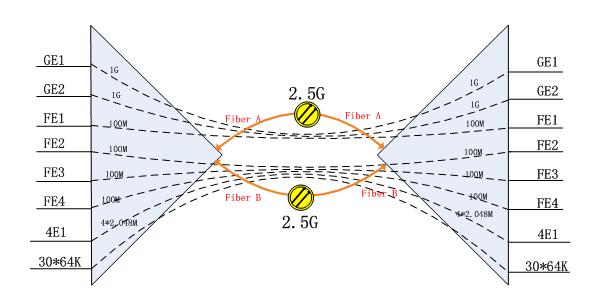
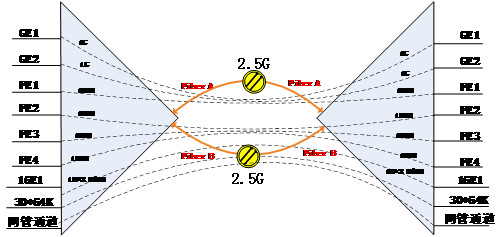
The IDM-300GP Telephone Optical Terminal provides 2 physically isolated wire-speed 1000M Ethernet interfaces and 8 groups of transparent E1 interfaces, while also offering FXO and FXS interfaces with Caller ID functionality, supporting a full configuration of 300 subscriber voice channels.
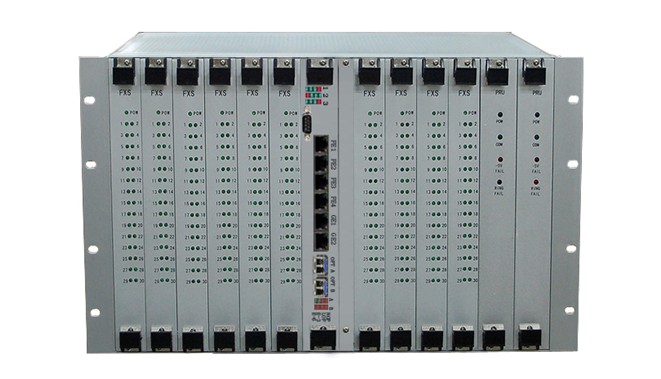
The IDM-300GP provides 14 card slots, with 1+1 redundant power supplies, 10 service cards, and 2 main control cards. All card slots support hot-swapping.
The IDM-300GP multiplexes narrowband and broadband services onto a 2.5G optical transmission channel, achieving both simplified transmission lines and cost savings. The equipment adopts a plug-in card structure design, with each service card providing 30 telephone channels. The equipment is easy to install and maintain.
It provides dual-fiber redundancy backup and can also be combined with other devices to form multiple physically isolated Ethernet chain-type Telephone Optical Terminal, ring-type Telephone Optical Terminal, and point-to-multipoint star-type Telephone Optical Terminal networks.
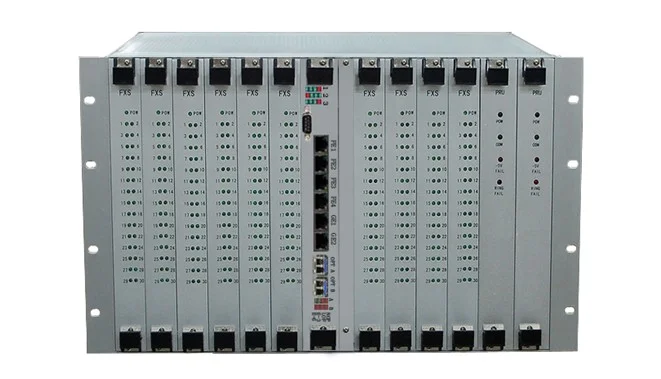
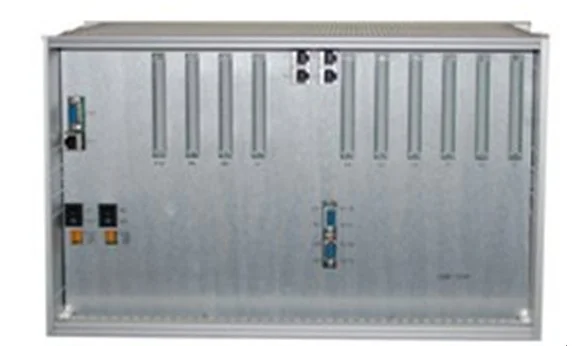
Figure 1 IDM 300GP front and rear panel diagram
II. Product Features
Ø Optical line rate of 2.5Gbps;
Ø 1 CMU central control management card, 10 user card slots, each user interface card supports 30 channels of 64K telephone audio services, with a maximum user interface capacity of 300 channels;
Ø 2 physically isolated wire-speed 1000M auto-negotiation Ethernet interfaces;
Ø 8 groups of transparent E1 interfaces, 4 groups in 75-ohm unbalanced mode and 4 groups in 120-ohm balanced mode, for customer selection based on environment;
Ø The entire unit features a centralized chassis design, standard 6U chassis, compliant with telecom and carrier standards;
Ø Easy equipment installation and convenient maintenance.
III. Technical Specifications
Optical Interface
Interface Type | SFP | Fiber Mode | Single-mode (Multi-mode optional) |
TX/RX Rate | 2.5Gbps | TX/RX Wavelength | 1310nm/1550nm |
Optical Output Power | -12~-6dBm | Receiver Sensitivity | Better than-32dBm |
Transmission Distance | 20Km, optional long-distance optical module available for extended fiber transmission | ||
E1 Interface
Line Rate | 2.048Mbps | Line Code | HDB3 |
Standard Protocol | SupportsITU-T G.703 | Impedance | 75Ω/120Ω |
Frame Structure | PCM30/32 | Signaling | Channel-Associated Signaling |
Ethernet
Interface Type | RJ-45 | Transmission Rate | 10M/100M/1000M |
Standard Protocol | SupportsIEEE802.3 | Operating Mode | Full/Half Duplex/Auto-Negotiation |
FXO, FXS Interfaces
Audio Range | 300Hz~3400Hz | Compression | A-law per ITU G.711 |
Impedance | Three-element complex impedance 200Ω+560Ω//0.1μF | Loop Current | 20mA/channel |
Co-directional 64K Interface
Line Code | G.703 Standard | Line Rate | 64Kbps |
Impedance | Balanced 120Ω | Fully compliant with ITU G.703 Recommendation | |
EM2/4****Wire Interface
Audio Frequency Range | 300Hz~3400Hz | Impedance | Balanced600Ω |
Companding Law | A-law per ITU G.711 | Return Loss | ≥18dB |
V.24 Interface
Transmission Rate | Asynchronous ≤9600bps; Synchronous 64Kbps | Electrical Characteristics | Compliant with CCITT V.28 Protocol |
V.35 Interface
Interface Type | RJ-45 | Electrical Characteristics | Compliant withITU-T V.35Recommendation |
Transmission Rate | n×64Kbps(n=0~31) | Terminal Interface | Compliant withISO2593Specification |
Power Supply and Power Consumption
Power Supply | AC220V/DC-48V | Power Consumption | ≤90W |
Environmental Conditions
Operating Temperature | -10oC ~+50oC | Relative Humidity | 0~95% (non-condensing) |
Product Dimensions
Length×Depth×Height | 482×266×270 (mm) |
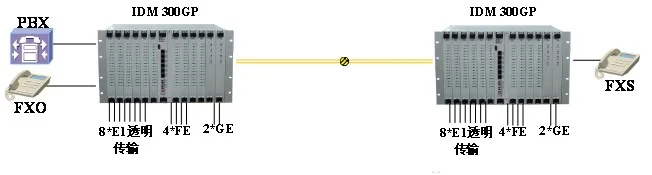
IV. Application Example 1
FAQs
What is the difference between PDH and SDH?
I. PDH PDH is the Plesiochronous Digital Hierarchy, which is divided into the European standard and the…
View answerWhat is an E1 line? What are the core knowledge points?
E1 Basics Frame Structure of the E1 Channel In an E1 channel, 8 bits form one timeslot (TS)…
View answerWhat is E1? How to Use E1
What is E1 The European 30-channel pulse code modulation PCM is abbreviated as E1, with a rate of 2.048Mbit/s.
View answerCommunication Transmission Products
PDH Equipment Physically Isolated Gigabit Multi-service Optical Terminal IDM GP2400 Series Optical Terminal IDM…
View answerIntroduction to EoPDH Technology
Ethernet-over-PDH is a set of technologies and standards used to transport local Ethernet frames over established…
View answer