IDM-120N
IDM-120N
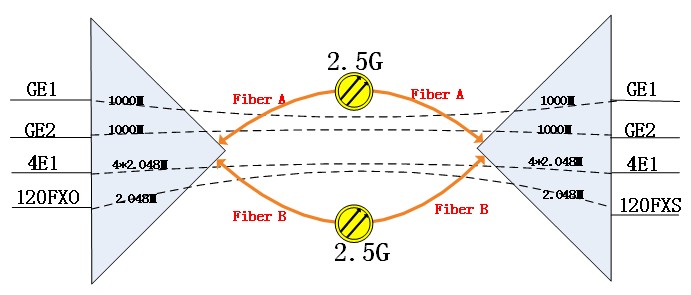
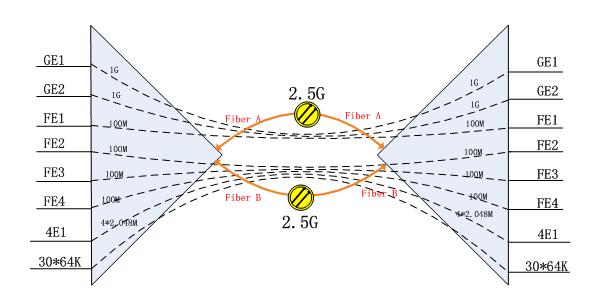
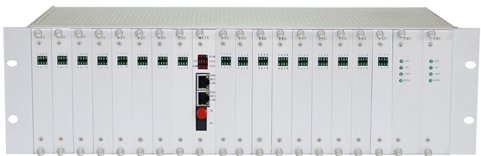
The IDM-120N 128-channel multi-service optical terminal is a PCM integrated service fiber optic transmission device designed with dedicated large-scale integrated circuits. Its total fiber optic transmission bandwidth is 155M, providing 2 shared wire-speed 100M Ethernet interfaces, 4 groups of E1 transparent transmission interfaces, and 128 telephone subscriber channels. The IDM-120N 128-channel multi-service optical terminal also features dual backup and hot-swappable power supply and ring generator units, greatly ensuring the reliability of service transmission.
Overview:
The IDM-120N integrated service cross-connect multiplexer is a PCM integrated service fiber optic transmission device designed by our company using dedicated large-scale integrated circuits. Its total fiber optic transmission bandwidth is 155M, providing 2 shared wire-speed 100M Ethernet interfaces, 4 groups of E1 transparent transmission interfaces, and 128 telephone subscriber channels. The E1 transmission channels comply with the G.703 standard and adopt the PCM30/31 format; FXO and FXS support polarity reversal and caller ID functions. The 128-channel telephone optical terminal also features dual backup and hot-swappable power supply and ring generator units, greatly ensuring the reliability of service transmission. The 128-channel telephone optical terminal can be widely applied in telecom and Netcom public telephone network services, as well as private line information and data services for power, banking, public security, and military sectors.
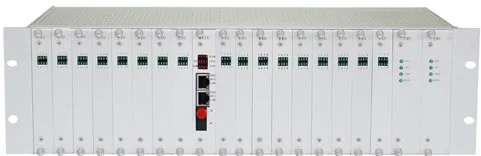
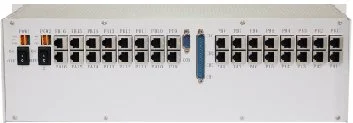
Product Features:
- 4 groups of E1 transmission interfaces;
- 2 shared wire-speed 100M Ethernet ports;
- Provides 16 subscriber interface slots;
- Reserved multi-function card slots for flexible expansion, supporting any network topology;
- Complete function control switches and alarm indication features;
- Comprehensive and concise network management functions, enabling online real-time configuration, query, and fault statistics management of the device;
Configuration Table:
No. | Name | Model | Description | Qty |
1 | Equipment Chassis Backplane | IDM-120 | 19-inch 3U chassis, providing 19 card slots | 1 |
2 | E1 Interface Main Control Card | CMU-E1-120 | Provides E1 interface access | 1 |
3 | Optical Interface Main Control Card | CMU-120 | Provides 1 optical interface access. 2 line-rate 100M Ethernet interfaces, 4 E1 interfaces | 1 |
4 | Power Supply Card | PRU-120 | Provides 1+1 power supply for the entire unit. Used on the FXO side, -48V input | 2 |
5 | Power Supply and Ringing Card | RPRU-120 | Provides 1+1 power supply, power for the entire unit, and ringing voltage. Used on the FXS side, -48V input | 2 |
6 | FXO service card | 8FXO-120 | 8 FXO interfaces, switch side | 16 |
7 | FXS service card | 8FXS-120 | 8 FXO interfaces, subscriber side | 16 |
In a single device configuration, only one of Items 2 and 3 can be selected;
Technical Specifications:
Optical Interface
Interface Type | FC (customizable to SC, etc.) | Fiber Mode | Single-mode (multi-mode optional) |
Fiber Rate | 155bps±50ppm | Wavelength | 1310nm |
Transmit Power | -2 to -11dBm | Receiver Sensitivity | Better than-36dBm |
E1 Interface
Bit Rate | 2048Kbps | Line Code | HDB3 |
Standard Protocol | Supports ITU-T G.703 | Impedance | 75Ω/120Ω |
Frame Structure | PCM30/31 | Signaling | Channel-Associated Signaling |
Ethernet
Interface Type | RJ-45 | Transmission Rate | 10/100Base-T 10M/100M |
Standard Protocol | Supports IEEE802.3 | Operating Mode | Full/Half Duplex/Auto-Negotiation |
FXO/FXS Interface
Audio Range | 300Hz~3400Hz | Impedance | Three-element complex impedance 200Ω+560Ω//0.1μF |
Compression Rate | ITU G.711 A-law | Loop Current | 25mA/channel |
Power Supply and Consumption
Power Supply | DC- 48V orAC 220V | Power Consumption | ≤250W |
Environmental Conditions
Operating Temperature | 0°C ~+40oC | Humidity | 95%non-condensing |
Product Dimensions
Length×Depth×Height | 480×200×132(mm) |
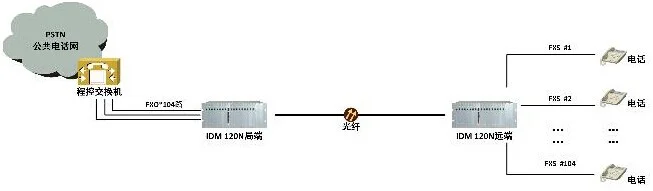
Application Example:
FAQs
Top 10 Common Questions About Telephone Optical Terminals
Based on years of experience in the production and R&D of telephone optical terminals…
View answerHow to Troubleshoot Common Faults of Telephone Optical Terminal?
Device cannot be powered on Check whether the power cable is connected correctly.
View answerWhat is an Optical Terminal?
Many people are unfamiliar with the optical terminal, but in essence, it is a dedicated device for optical-electrical…
View answer