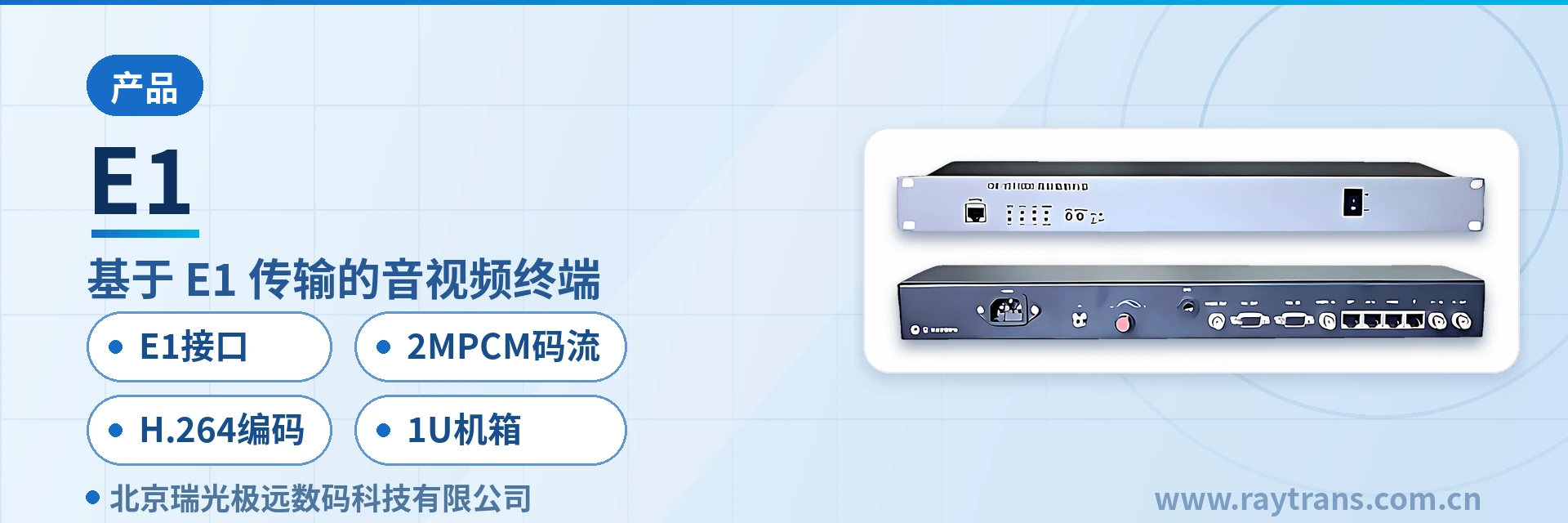
E1 Audio and Video Terminal
Video, audio, and data compressed into a single 2M PCM stream; no dedicated line required
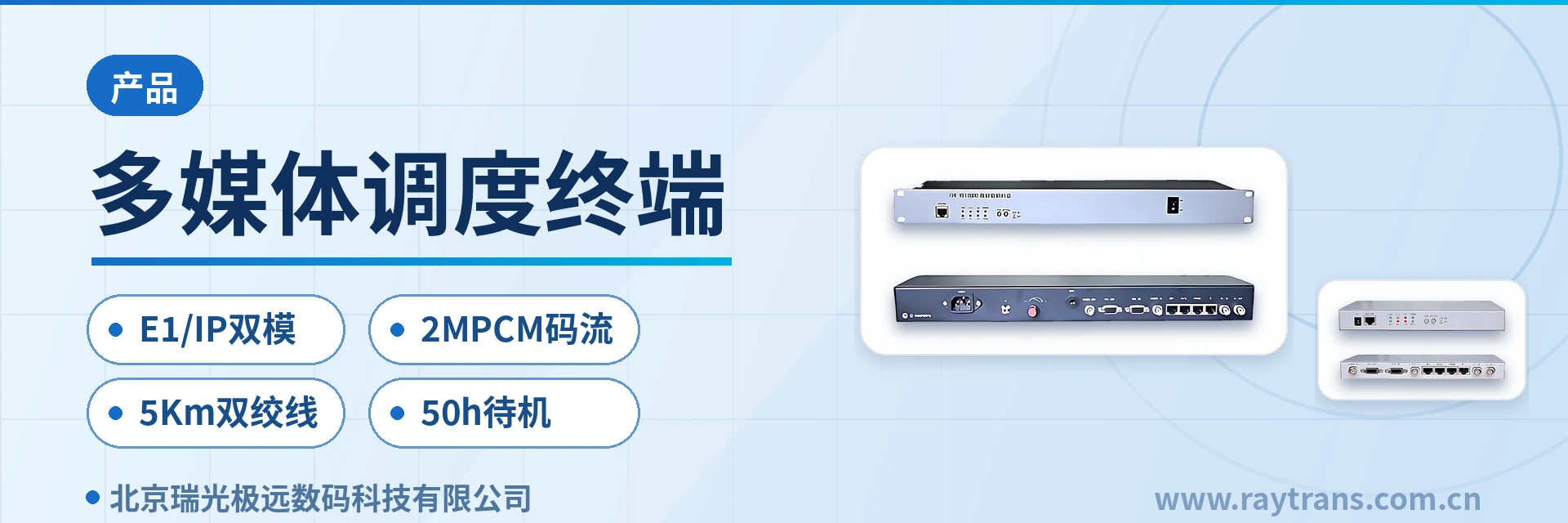
The IP-based audio and video intercom terminal over E1 transmission is housed in a 19-inch 1U chassis, is designed around an E1 transmission channel, and uses H.264 encoding, providing powerful real-time image capture and image compression. It compresses and mixes input video, audio, and data into a 2M-rate
What Kind of Device Is an E1-Based Audio and Video Terminal?
An E1-based audio and video terminal is an integrated intelligent audio and video terminal that compresses and multiplexes video, audio, and data into a single 2M PCM stream and sends it out through an E1 interface. Developed by Beijing Ruiguang Jiyuan Digital Technology Co., Ltd. (Raytrans), it is used for long-distance audio and video dispatching and transmission in systems such as remote video surveillance and video conferencing. The device uses a 19-inch 1U chassis, is designed around an E1 transmission channel, and adopts H.264 encoding, with real-time image capture and image compression capabilities.
Key Specifications at a Glance: E1 interface · 2M PCM stream · H.264 encoding · 19-inch 1U chassis · video, audio, and data in one · private network/SDH resource reuse
H.264 video encoding and compression is the key to fitting on-site images into a single 2M channel: video, audio, and data are first compressed and multiplexed to form a 2M-rate PCM stream, which is then handed to the transmission device through the E1 interface. This stream directly occupies an existing E1 channel, so no separate line needs to be laid for video, and the line resources of private networks and SDH networks are fully used.
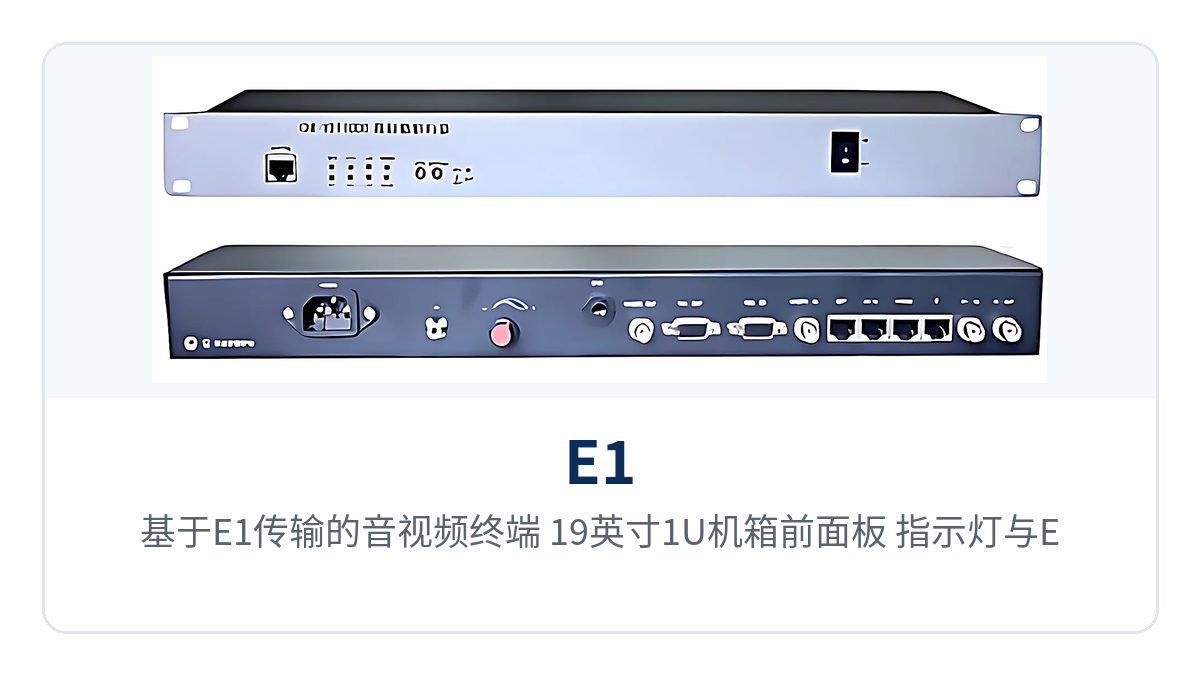
Figure 1: Close-up of the front panel, indicator LEDs, and E1 interface of the 19-inch 1U chassis of the E1-based audio and video terminal
Why H.264 Encoding Needs to Work with Real-Time Image Capture
Real-time image capture and image compression are two integrated steps. The device first captures the on-site image, then compresses it with H.264 encoding, and the compressed data is multiplexed together with audio and data into the 2M stream. For bandwidth-constrained private network E1 channels, encoding efficiency determines the picture quality that the same E1 channel can carry, and also determines whether the audio and video dispatching picture is clearly discernible under low-bandwidth conditions.
What Deployment Convenience Does the 19-inch 1U Chassis Bring
The integrated design packs video acquisition, encoding and compression, multiplexing and framing, and the E1 interface into a single 1U intelligent audio and video terminal. The device can be pushed directly into a standard 19-inch rack, takes up no additional cabinet space, and eliminates the need to separately equip an encoder plus a multiplexer for video in the equipment room. For electric power and rail transit private network equipment rooms with distributed sites and tight cabinet space, one less device means one less point of failure and one less O&M burden.
What the Three Differentiated Selling Points Mean on a Private Network Site
Differentiated Selling Point | What It Means on a Private Network Site |
|---|---|
Direct 2M PCM stream transmission over an E1 channel, high private network/SDH resource utilization | Video, audio, and data are compressed into a 2M PCM stream and run directly on existing E1 channels, so private network and SDH resources need not be rebuilt, and line utilization improves accordingly |
H.264 compression + real-time image capture, clear video under low bandwidth | H.264 preserves picture details within a limited bit rate, and on-site images can still be compressed and transmitted back at 2M bandwidth, which suits private network environments with fixed E1 channel bandwidth |
19-inch 1U chassis, integrated design, space-saving deployment | One 1U device completes acquisition, compression, multiplexing, and E1 interface output, with standard rack installation, so the equipment room does not need to free up extra space for video upgrades |
Functions and Performance Specifications
Function List
Function | Description |
|---|---|
Video acquisition and compression | Adopts H.264 encoding to capture and compress images in real time, reducing the bandwidth occupied per service |
Audio and video data hybrid multiplexing | Compresses and multiplexes input video, audio, and data to form a 2M-rate PCM stream |
E1 interface long-distance transmission | Sends the 2M PCM stream to the transmission device through the E1 interface for long-distance transmission |
Private network/SDH resource reuse | Directly occupies existing E1 channels to carry services, improving the utilization of E1 line resources in private network/SDH networks |
Integrated rack deployment | Integrated design in a 19-inch 1U chassis, standard rack installation, space-saving deployment |
Technical Specifications
Item | Parameter/Specification | Description/Applicable Conditions |
|---|---|---|
Chassis structure | 19-inch 1U chassis | Standard rack installation, integrated design |
Transmission channel | E1 transmission channel | Interfaces with the transmission device through the E1 interface for long-distance transmission |
Video encoding format | H.264 | Real-time image capture and image compression capabilities |
Multiplexed output stream | 2M-rate PCM stream | Video, audio, and data are compressed and multiplexed, then sent out through the E1 interface |
E1 interface | 2048Kbps interface compliant with ITU-T G.703 | The interface format is subject to the manufacturer's technical documentation and commercial confirmation |
Carried services | Video, audio, data | Meets the needs of systems such as remote video surveillance and video conferencing |
Line resource utilization | Improves the utilization of E1 line resources in private network/SDH networks | Existing private network/SDH resources need not be rebuilt |
Transmission distance, power supply, and environment | Not yet recorded in the knowledge base | Subject to the manufacturer's technical documentation and commercial confirmation |
Which Scenarios Suit E1 Channel Audio and Video Long-Distance Transmission
Electric Power/Energy Private Network
Substations and sites along transmission lines are distributed and far apart, and dispatch telephones and video surveillance run year-round on the electric power industry's self-built E1/SDH private network. The E1-based audio and video terminal compresses on-site video, audio, and data into a 2M PCM stream and directly occupies existing E1 channels for backhaul, with no need to lay new lines for video, so private network resource utilization improves accordingly. On the equipment room side, it only needs a 1U slot in a standard 19-inch rack, and the upgrade is concentrated on the terminal side. As a professional SDH equipment manufacturer and command and dispatch system manufacturer, Raytrans can provide electric power private networks with an overall solution from transmission to audio and video dispatching.
Rail Transit Private Network
Rail transit platforms, depots, and sections along the line require stable and available communication means, and E1 transmission channels have often already been built along the railway. The IP-based audio and video intercom terminal uses H.264 compression to compress on-site video from platforms and sections into a 2M stream, which is sent back to the control center over existing E1 channels, keeping images clearly discernible at low bandwidth. The 1U chassis is suitable for rack deployment in station equipment rooms and communications equipment rooms, and video conferencing and platform surveillance can share the same E1 resources, enabling efficient audio and video dispatching and product showcase.
Military and Government Private Networks
Military and government private networks usually build their own E1/SDH transmission systems, with line resources allocated as required and manageable and controllable. The 19-inch 1U chassis integrated intelligent audio and video terminal connects to the E1 private network with plug-and-play transmission, compressing on-site video, audio, and data into a single 2M PCM stream, delivering video services to remote command posts without changing the existing structure of the private network, for remote video surveillance and video conferencing. The terminal is ready for use once rack-mounted, suitable for rapid deployment in military emergency communications vehicle solutions, command posts, and fixed sites; in government private network optical fiber communication solutions, it can likewise serve as an audio and video access node on E1/SDH channels, working in coordination with platforms from command and dispatch system manufacturers.
Selection and Deployment Recommendations
Confirm four things before deciding whether to use the IP-based audio and video intercom terminal.
Whether there are available E1 channels or SDH private network resources on site: if yes, use the IP-based audio and video intercom terminal to make full use of existing channels, with dedicated transmission resources and stable performance; if there are only IP links and no E1 resources, choose the IP-based Audio and Video Intercom Terminal instead.
Whether cabinet space is sufficient: the device is a 19-inch 1U chassis occupying 1U of height in a standard rack; before rack-mounting, confirm that the cabinet has a 1U slot and a power position available.
Whether voice and data need to be transmitted simultaneously: the device compresses and multiplexes video, audio, and data into a single 2M stream, with all three service types carried over the same E1 channel, and cabling configured only for the E1 interface.
Items to confirm before purchase: the E1 interface format, power supply mode, operating temperature, and ingress protection (IP) rating are not given in this documentation; please refer to the manufacturer's technical documentation and commercial confirmation.
Conclusion
The IP-based audio and video intercom terminal compresses video, audio, and data into a single 2M PCM stream, directly multiplexing existing private network/SDH channels through the E1 interface, while the 19-inch 1U chassis integrated design lets equipment room deployment occupy only one rack position. For users of electric power and energy private networks, rail transit private networks, and military and government private networks, the value of this intelligent audio and video terminal lies in carrying remote video surveillance and video conferencing over existing E1 line resources, without building a new transmission network for video services. Raytrans, as an SDH equipment manufacturer and command and dispatch system manufacturer, can provide overall product and solution support from E1/SDH transmission to audio and video dispatching for requirements such as government private network optical fiber communication solutions and military emergency communications vehicle solutions.