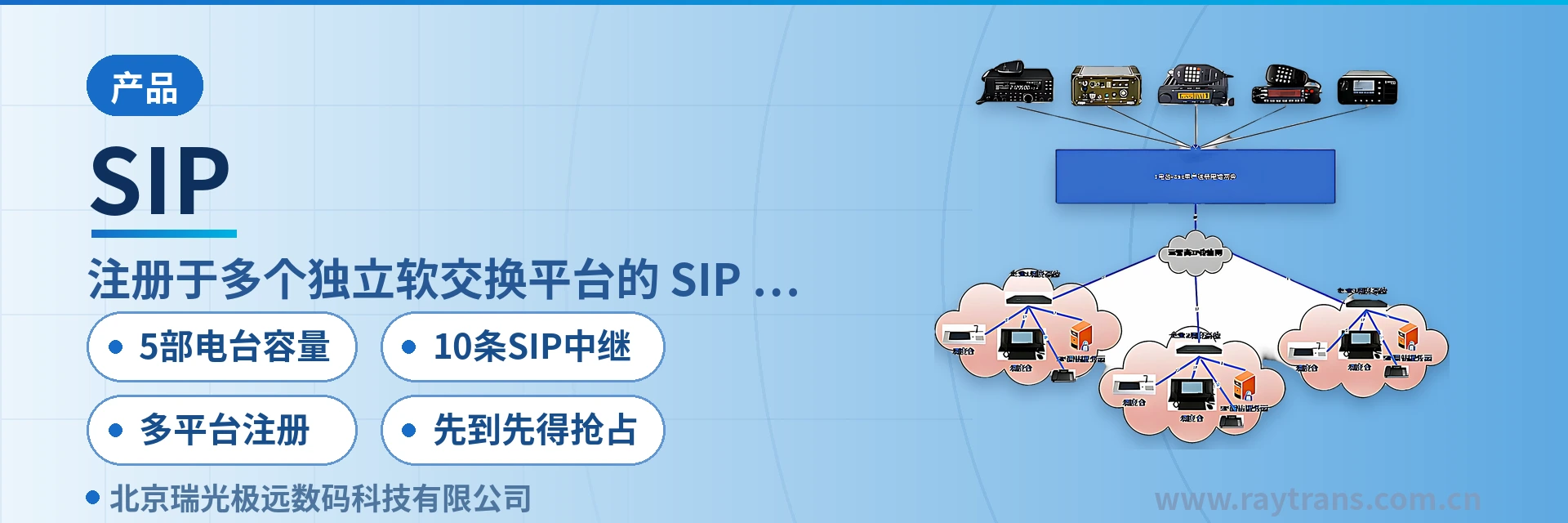
SIP Shared Radio Gateway
One gateway registers with multiple softswitches; 5 radios mixed and marked as sources; first-come, first-served preemption
SIP shared radio gateway registered on multiple independent softswitch platforms. SIP softswitch applications are increasingly widespread, with 4G/5G IP channels. Radio stations at the seaside usually have multiple radios of different frequency bands, each undertaking different tasks for different
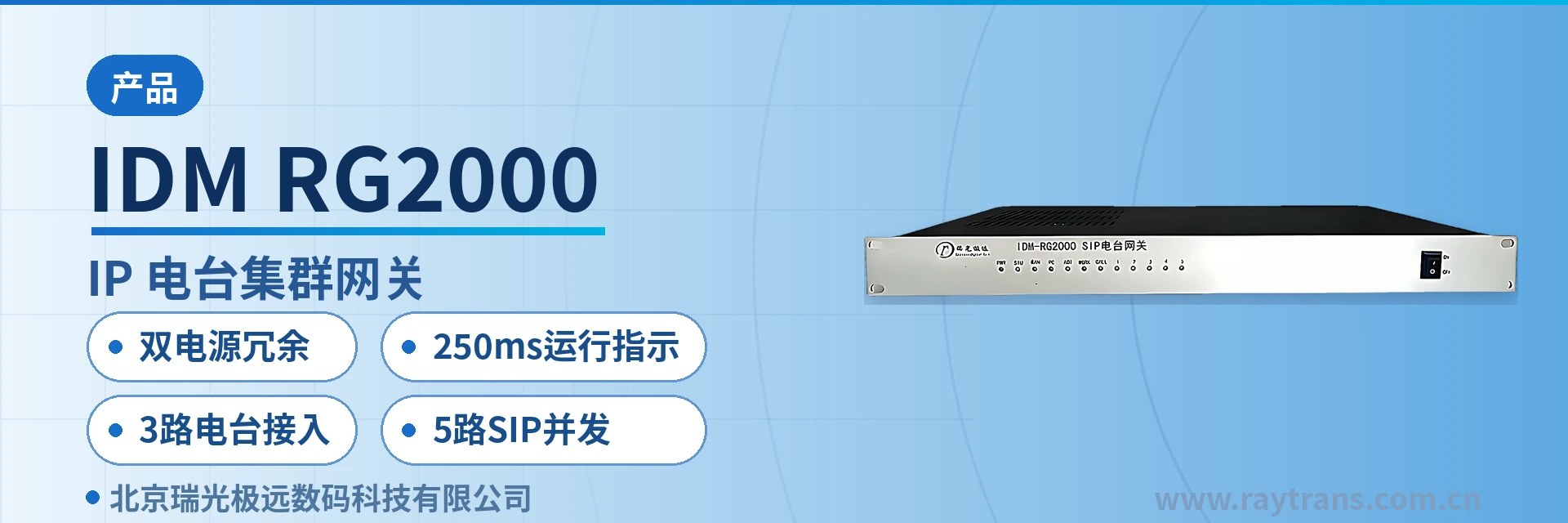
The multi-platform registration radio gateway is a SIP dispatch gateway device developed by Beijing Ruiguang Jiyuan Digital Technology Co., Ltd. (Raytrans), used to open multiple radio sets at the same radio station site to multiple independent softswitch dispatch systems at the same time. The IDM RG2000-5 SIP shared radio gateway registers independently with multiple softswitch dispatch systems through SIP trunks, and remote configuration can also be used to specify which softphone interfaces a given system may use.
Such requirements are concentrated in scenarios where a single radio station site is shared. A seaside radio station site usually has multiple radio sets on different frequency bands, each serving a different task for vessels in different environments, including radio broadcasting for electronic fences. These radio sets are often shared by maritime safety administrations, maritime surveillance, and enterprises in marine aquaculture, wind power generation, and transportation. With one IP access gateway registering with multiple softswitch platforms, there is no need to build a separate radio station site for each organization.
For projects that require multiple organizations to share radio sets while each organization keeps its existing dispatch system, the configuration can be checked against a capacity of 5 radio sets and 10 SIP trunks. The 10 SIP trunks are allocated by organization; each user organization may occupy 3 SIP trunks to connect to the radio gateway, and the device capacity is 5 radio sets. The device can be used in three types of scenarios: maritime and air traffic control radio station sites, emergency command communications, and private networks of offshore wind power and aquaculture enterprises.
Key Specifications at a Glance: 5 radio sets capacity · 10 SIP trunks · multi-platform registration · first-come, first-served preemption · 5-radio-set voice conference room mixing · open SIP protocol
What is a multi-platform registration radio gateway? Why should one radio station site connect to multiple platforms?
A multi-platform registration radio gateway is an access device between radio sets and the IP softswitch network, addressing the problem of the same group of radio sets being shared by multiple independent systems. A conventional radio gateway registers with only one dispatch platform, and more important systems are configured with dual servers for backup, but applications in which the same radio gateway registers with multiple platforms are uncommon, and solutions that can simultaneously control multiple radio sets and provide gateway interfaces to multiple independent users are even rarer. For command and dispatch system manufacturers undertaking product showcase and selection tasks, such devices are exactly the key link for multi-organization sharing of a radio station site.
By handling registration relationships on the gateway side, multiple platforms do not constrain one another. Each organization keeps its existing softswitch dispatch system and dispatch console, while the gateway allocates the receive and transmit voice channels of the radio sets to different systems by trunk line. When one system adds or removes trunks or adjusts softphone interfaces, the normal calls of other systems are unaffected.
How many softswitch platforms can one gateway register with, and how are SIP trunks allocated among organizations?
As an IP access gateway, the IDM RG2000-5 can register independently with multiple softswitch dispatch systems at the same time, with registration and interface allocation for each system independent of the others. SIP trunks are used to connect to the radio gateway; the device capacity is 5 radio sets with a total of 10 SIP trunks, each user organization may occupy 3, and remote configuration can specify which softphone interfaces a given system uses.
Taking the practical application of a seaside radio station site as an example, 3 radio sets on different frequency bands are connected on site (device capacity is 5), used respectively by several independent users such as maritime safety, aquaculture, and power generation. Each user must be able to monitor all radio sets and also to make announcements through any radio set via the dispatch console; the 10 SIP trunks map the receive and transmit voice channels of the radio sets to each organization's softswitch system.
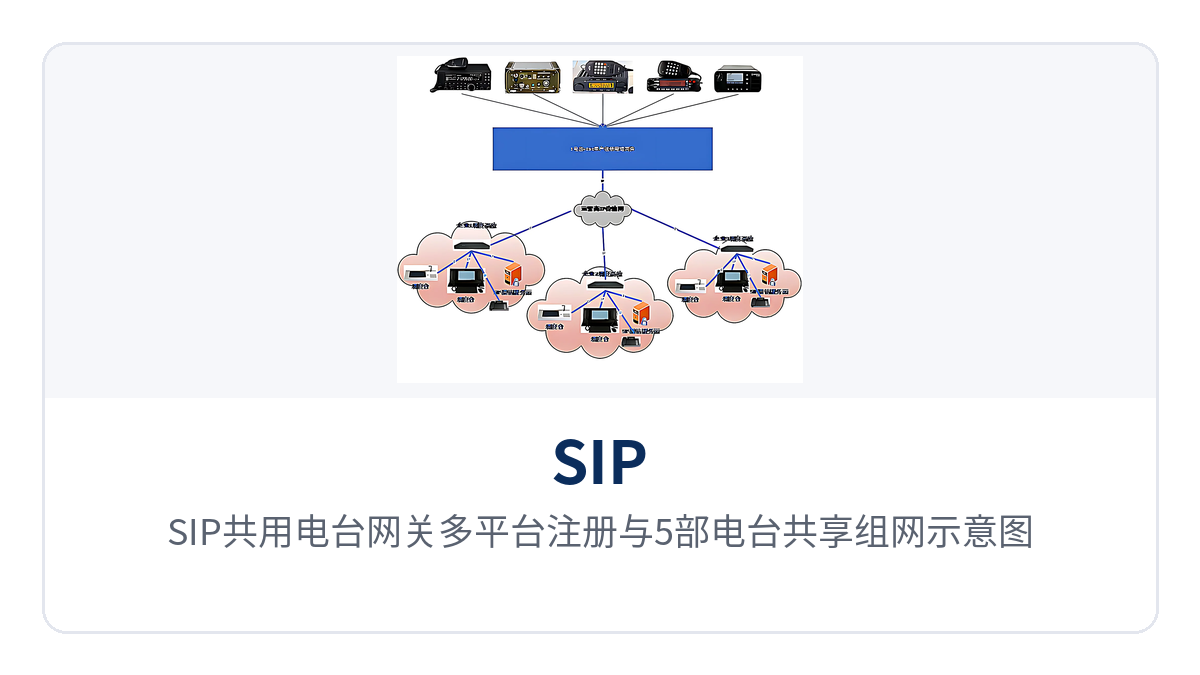
Figure 1: Schematic diagram of multi-platform registration and 5-radio-set sharing networking for the SIP shared radio gateway
When multiple systems need the same radio set at the same time, how is the right of use arbitrated?
When multiple systems share the same radio set, only the system that arrives first has the right of use; this is the first-come, first-served preemption rule adopted by the multi-platform registration radio gateway. When voice needs to be transmitted through a designated radio set, the system sends the radio selection information to the gateway, and the gateway switches the call to the transmit channel of the designated radio set.
First-come, first-served preemption converges the right of use into unified arbitration at the gateway, preventing multiple organizations from contending for the same frequency band in the same period. Dispatch systems of maritime safety, aquaculture, and wind power organizations may need to make announcements at the same time; without a clear order of occupancy, frequency conflicts and out-of-order voice would result. With unified arbitration, later systems can queue and wait or switch to another radio set.
How is the voice of 5 radio sets mixed, and how do you know which radio set is speaking?
5-radio-set voice conference room mixing places the voice received from the 5 radio sets into the same conference room for mixing and then delivers it to each user, while identifying which radio set the current voice comes from. By monitoring a single mixed voice stream, the dispatcher can grasp the call content of all radio sets and, by the source identifier, determine which frequency band and which radio set is speaking.
When voice traffic is busy, the conference room can include fewer radio sets, leaving conference resources for current call handling. Each user can still monitor all frequency bands: when speaking is required, the radio selection information is sent to the gateway, which switches to the designated radio set for transmission, while the mixing and source identification in the conference room on the receiving side remain unchanged.
Function and interface list: what work can one gateway handle?
The functions of the IDM RG2000-5 are organized around multi-platform registration, radio sharing, and voice mixing; all capabilities are available simultaneously on the same device, and configuration items can be set separately for each user organization. The table below lists specific capabilities and applicable notes by function item, for item-by-item checking against the on-site configuration.
Function | Description |
|---|---|
Independent multi-platform registration | Registers independently with multiple softswitch dispatch systems through SIP trunks, with registration for each system independent of the others |
Softphone interface allocation | Remote configuration specifies which softphone interfaces a given system uses, dividing subsets by user organization |
Trunk sharing | 5 radio sets correspond to 10 SIP trunks; each user organization may occupy 3 to connect to the radio gateway |
Radio conference room mixing | Voice received by the 5 radio sets is mixed in the conference room and distributed to each user; when voice traffic is busy, the number of radio sets in the conference room can be reduced |
Voice source identification | After mixing, identifies which radio set the current voice comes from, so the dispatcher can determine the frequency band and radio set |
Radio selection for transmission | Before speaking, the radio selection information is sent to the gateway, which switches to the designated radio set for transmission |
First-come, first-served occupancy | When multiple systems share the same radio set, the system that initiates first obtains the right of use; other systems queue or switch to another radio set |
Trunking gateway intercommunication | Converts intercom channels into SIP numbers under the IPPBX, so a desktop phone can call an intercom channel by dialing |
Dialing and digit collection rules | Supports configuration of multiple dialing and digit collection rules, which can be set separately according to each system's numbering habits |
Multi-channel telephone access | Provides access and processing capability for multiple SIP and PSTN telephone lines |
Voice activation and level | Adaptive VOX voice activation with adjustable sensitivity, and adjustable input and output volume |
Signaling and protocols | COR and PTT valid signals can be set by the user, and an open SIP protocol is provided externally |
Differentiated value: what is saved by multiple organizations sharing one radio station site?
The differentiated capabilities of the IDM RG2000-5 are concentrated in three areas: multi-platform registration, trunk allocation, and the voice conference room. All three capabilities reside in the same gateway, so there is no need to build a separate radio station site for each organization. The table below lists the differentiation points and the corresponding customer value item by item, for evaluating against requirements.
Differentiation Point | Customer Value |
|---|---|
A single gateway registers with multiple independent softswitch platforms; 10 SIP trunks for 5 radio sets are allocated by unit | Maritime, aquaculture and wind power units each occupy 3 SIP trunks to connect to the radio gateway and share the same radio sets without building duplicate stations, making fuller use of frequency band resources |
When multiple systems share the same radio set, first come, first served, preventing multiple units from preempting the same frequency band resources | Systems requesting the same radio set at the same time obtain the right of use in the order of initiation, while the others queue or switch to another radio set, so frequency conflicts and voice disorder are controlled |
Voice from 5 radio sets is mixed in the conference room with source identification, and each user can monitor all frequency bands | Received voice from all channels is mixed into one stream and distributed to each unit, indicating which radio set the current voice comes from, so the dispatcher can grasp all frequency band calls by monitoring one channel |
Key Specifications and Performance Indicators
The interface and capacity parameters of IDM RG2000-5 are subject to the manufacturer's product documentation. The table below summarizes the items explicitly stated in the product documentation for selection and networking design verification. Items not listed in the table are not yet recorded in the knowledge base and need to be confirmed with the manufacturer Raytrans.
Item | Parameter/Specification | Description/Applicable Conditions |
|---|---|---|
Product form | SIP dispatch gateway | Independently registers with multiple softswitch dispatch systems through SIP trunks |
Registration platforms | Multiple softswitch dispatch systems | Remote configuration can specify which softphone interfaces a given system uses |
Radio access capacity | 5 radio sets | In practice, 3 radio sets of different frequency bands are commonly connected |
SIP trunks | 10 | Each user unit can occupy 3 trunks to connect to the radio gateway |
Voice conference room | Voice mixing for 5 radio sets | The voice source is identified after mixing; when voice traffic is busy, the number of radio sets in the conference room can be reduced |
Radio right of use | First come, first served | When multiple systems share the same radio set, the system that initiates first obtains the occupation |
Dialing and digit collection | Multiple dialing and digit collection rules configurable | Specific rule entries are not yet recorded in the knowledge base |
Telephone access | Multi-channel SIP and PSTN access processing | Specific number of channels and interface forms are not yet recorded in the knowledge base |
Voice activation | Adaptive VOX with adjustable sensitivity | Adjust sensitivity according to the on-site voice environment |
Volume control | Input and output volume adjustable | Adjust separately according to the radio side and telephone side levels |
Signaling control | COR and PTT active signals user-configurable | Adapts to the receive/transmit control levels of different radio sets |
Protocol | Open SIP protocol | Facilitates integration with existing softswitch, IP PBX and converged communication systems |
Power supply, enclosure, operating environment | Not yet recorded in the knowledge base | Subject to the manufacturer's technical documentation and commercial confirmation |
Typical Application Scenarios
The typical networking of IDM RG2000-5 is to open multiple radio sets in a radio station simultaneously to multiple independent softswitch dispatch systems through SIP trunks, realizing cross-system sharing as a multi-platform registration radio gateway. Each unit monitors all radio sets on its existing dispatch console and transmits through any radio set; voice is mixed in the conference room and distributed with source identification. This product showcase form has been deployed in multiple industries.
Maritime and Air Traffic Control Radio Stations
Maritime bureaus, maritime surveillance, offshore aquaculture, wind power and transport enterprises often share multiple radio sets of different frequency bands in the same seaside radio station. As an IP access gateway, IDM RG2000-5 reserves independent softswitch registration and SIP trunks for each unit, so dispatchers of each unit can monitor all radio sets and transmit through any radio set; radio broadcasting for electronic fences is accessed in the same way.
The same applies to ground-to-air radio sets in air traffic control scenarios: the number of radio sets is limited while there are many operator seats. After the radio sets are registered with multiple service systems, each seat calls the corresponding radio set using a SIP number or speed-dial key, and when multiple systems share the same radio set, the transmit right is preempted and allocated on a first come, first served basis.
Emergency Command Communications and Command Vehicles
The pain point of emergency on-site projects is that the command center can reach the command vehicle but cannot reach on-site intercom personnel. When the remote command center talks to the command vehicle over 4G networks, satellite networks and satellite phones, it cannot communicate directly with on-site intercom personnel. Deploying the RG2000 series converged dispatching gateway inside the command vehicle and connecting the on-site vehicle-mounted radio to the gateway enables intercommunication with the command center over SIP. This military emergency communications vehicle solution has been verified in multiple emergency projects.
The command center accesses on-site intercoms over the IP network and talks directly with on-site intercom personnel. When multiple radio sets need to be on duty simultaneously on site, the voice of these radio sets is mixed in the conference room and delivered to each command operator seat with source identification, so the commander can grasp all on-site calls without switching channels one by one.
Private Networks of Offshore Wind Power and Aquaculture Enterprises
Offshore wind power and aquaculture enterprises have built their own softswitch or IP PBX but lack access means on the radio side. IDM RG2000-5 can convert intercom channels into SIP numbers under the IP PBX, so a desktop phone can call an intercom channel by dialing, or channel numbers can be programmed as speed-dial keys for one-touch communication with intercoms on an IP phone terminal.
When multiple enterprises share the same radio station, each unit keeps its own IP PBX and dispatch console and occupies SIP trunks by unit; when transmitting through the same radio set, the transmit channel is preempted on a first come, first served basis. Intercoms and desktop phones thus intercommunicate, and duty operator seats no longer need a separate radio console.
How to Select and Deploy a Multi-Platform Registration Radio Gateway?
Before deployment, first take stock of the number of radio sets to be shared in the radio station, the frequency bands and the number of user units, then plan SIP trunks by unit. IDM RG2000-5 has a capacity of 5 radio sets and 10 SIP trunks, with each unit occupying 3, from which the scale of units that can be supported can be estimated; when all units need to monitor all frequency bands, the radio voice conference room handles mixing and source identification.
The differentiation of the multi-platform registration radio gateway lies in: one gateway registers with multiple softswitch platforms, with 5 radio sets and 10 SIP trunks allocated by unit; multiple systems share the same radio set on a first-come, first-served preemption basis, avoiding multiple units competing for the same frequency band resources; the voice of 5 radio sets is mixed in a conference room with sources identified, and each user can monitor across the full frequency band.
When more radio channels or SIP trunks are required, it is recommended to confirm the model and configuration with the manufacturer Raytrans. As a professional command and dispatch system manufacturer, Raytrans provides full support from product showcase to solution implementation. Engineering parameters such as power supply, enclosure and operating environment are not yet recorded in the knowledge base and are subject to the manufacturer's technical documentation and commercial confirmation; before on-site implementation, check item by item against the radio-side interfaces and control signals, then proceed to commissioning.