PCM
PCM
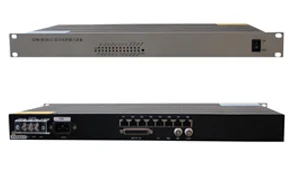
The IDM-MINI Integrated Service Multiplexer adopts an independent structure, capable of simultaneously transmitting 8+1 channels of 64K or n×64K voice and data services over one E1 or optical fiber transmission channel. By converting 10Base-T Ethernet, voice channels, V.35, V.24 and other services into E1 data streams for transmission over E1 or fiber channels.
Overview:
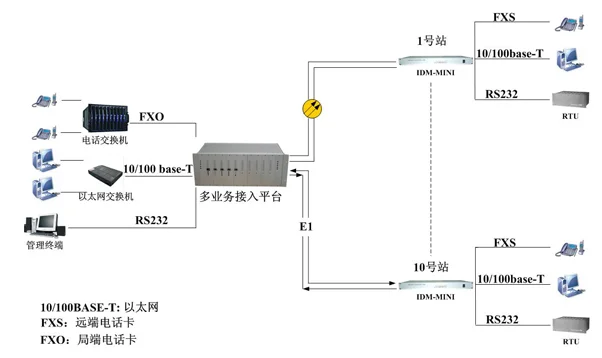
The IDM-MINI Integrated Service Multiplexer adopts an independent structure, capable of simultaneously transmitting 8+1 channels of 64K or n×64K voice and data services over one E1 or optical fiber transmission channel. By converting 10Base-T Ethernet, voice channels, V.35, V.24 and other services into E1 data streams, it enables transmission over E1 channels or fiber optic channels. It is suitable for extending the working distance of interfaces via channels such as fiber optics, microwave, and DDN private networks, and can also serve as a telephone optical terminal. It can be combined with other series of multiplexers to form various network topologies, such as chain networks, star networks, tree networks, and other integrated networks.
The IDM-MINIO, based on the IDM-MINI, converts E1 transmission to fiber optic transmission, making it suitable for voice and data access over self-provided fiber optic line channels in private networks. The IDM-MINI centralized version can be configured with 10 user interface cards, each supporting services corresponding to the IDM-MINI single-board version.
Product Features:
- E1 transmission and optical transmission options available;
- Over 20 types of service interface cards for flexible configuration;
- Can be networked with IDM series products for combined applications;
- Provides powerful audible and visual alarm indication for line operation status;
- Rich user interfaces, providing 8 channels of 64K voice, data, and 1 channel of N*64K service access;
Technical Specifications:
Interface Type | FC (SC and others customizable) | Fiber Mode | Single-mode (Multi-mode optional) |
Transmit/Receive Rate | 155M/155M | Transmit/Receive Wavelength | 1310nm/1550nm |
Optical Output Power | -3~-11dBm | Receiver Sensitivity | Better than -36dBm |
Transmission Distance | 20Km, optional long-distance optical module for extended fiber transmission. | ||
E1 Interface
Line Code Rate | 2048Kbps | Line Code | HDB3 |
Standard Protocol | Supports ITU-T G.703 | Impedance | 75Ω/120Ω |
Frame Structure | PCM30/31 | Signaling | Channel Associated Signaling |
Ethernet
Interface Type | RJ-45 | Transmission Rate | N×2.048Mbps (N≤50) |
Standard Protocol | Supports IEEE802.3 | Operating Mode | Full/Half Duplex/Auto-negotiation |
FXO, FXS Interfaces
Audio Range | 300Hz~3400Hz | Compression Rate | ITU G.711 A-law |
Impedance | Three-element complex impedance 200Ω+560Ω//0.1μF | Loop Current | 25mA/channel |
EM2/4-Wire Interface
Audio Range | 300Hz~3400Hz | Impedance | Balanced 600Ω |
Compression Rate | ITU G.711 A-law | Return Loss | ≥18dB |
V.24 Interface
Transmission Rate | Asynchronous ≤9600bps; Synchronous 64Kbps | Electrical Characteristics | Complies with CCITT V.28 protocol |
V.35 Interface
Interface Type | RJ-45 | Electrical Characteristics | Complies with ITU-T V.35 recommendation |
Transmission Rate | n×64Kbps (n=0~31) | Terminal Interface | Complies with ISO2593 specification |
Power Supply and Power Consumption
Power Supply Mode | AC220V/DC-48V | Total Power Consumption | ≤50W |
Environmental Conditions
Operating Temperature | 0ºC~40ºC | Relative Humidity | ≤90% (non-condensing) |
Product Dimensions
Length*Depth*Height | 495*307*47(mm) |
Application Example:
FAQs
What is the working principle of Pulse Code Modulation (PCM)?
Working Principle Pulse Code Modulation is the process of converting a time-continuous…
View answerPCM30 Working Principle: What Is PCM30/32
PCM30 Equipment Working Principle The 30-channel PCM equipment refers to equipment that provides 30 user interfaces and…
View answerWhat are the common problems of PCM equipment in enterprise applications?
At present, PCM equipment has become basically ubiquitous in enterprise network applications.
View answerWhat is E1? How to Use E1
What is E1 The European 30-channel pulse code modulation PCM is abbreviated as E1, with a rate of 2.048Mbit/s.
View answerFrame Structure of 30/32-Channel PCM Primary Group
A communication system consists of transmitting equipment, receiving equipment, and transmission equipment.
View answer