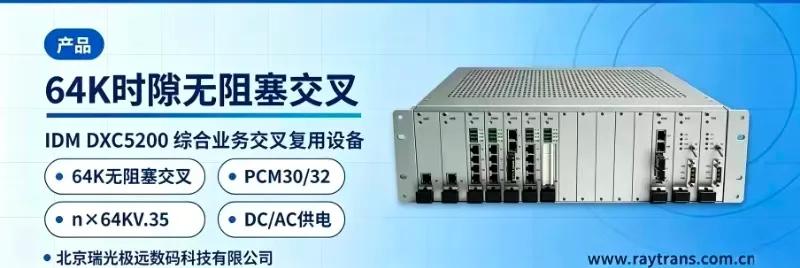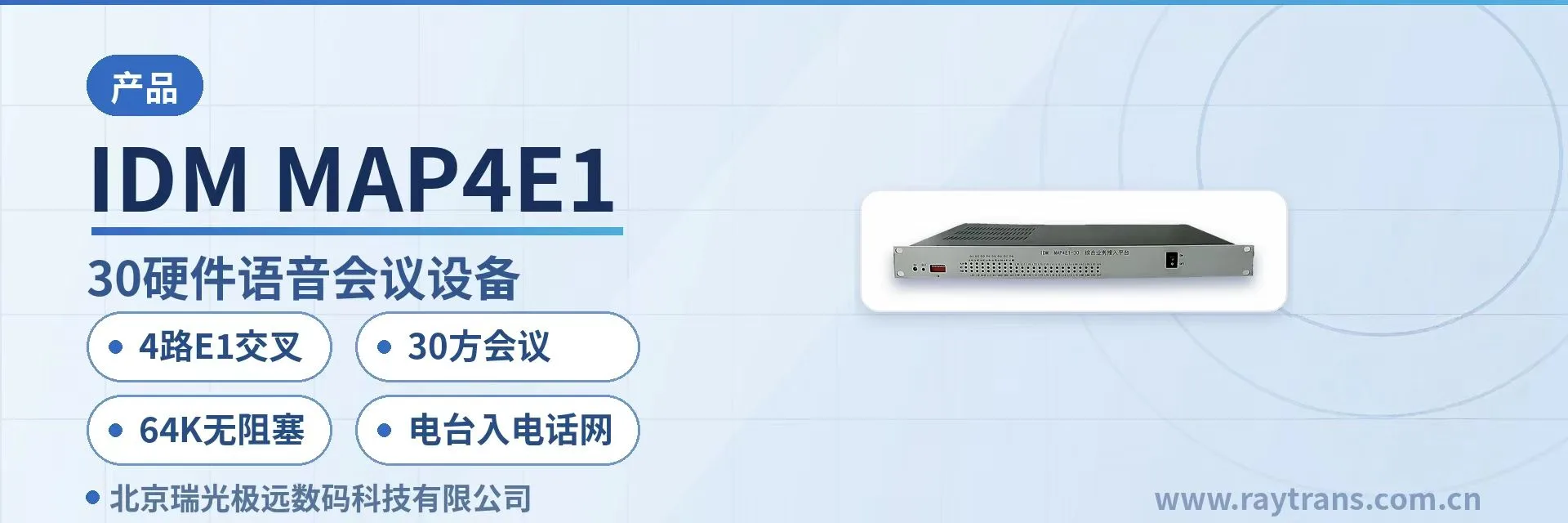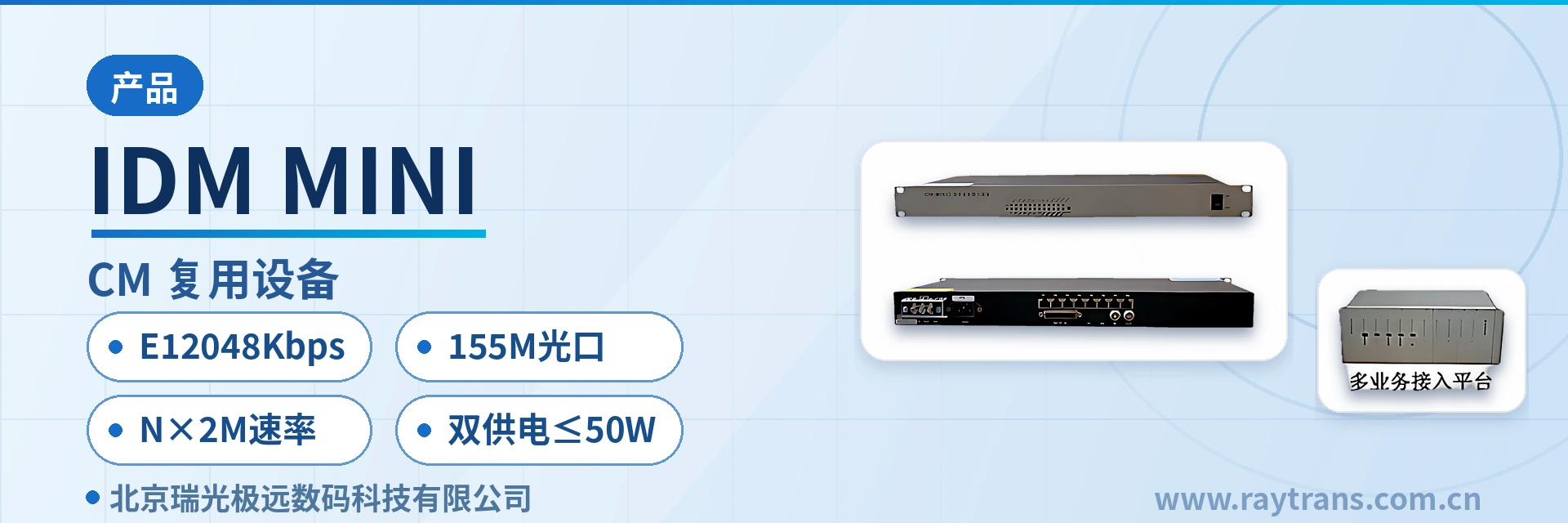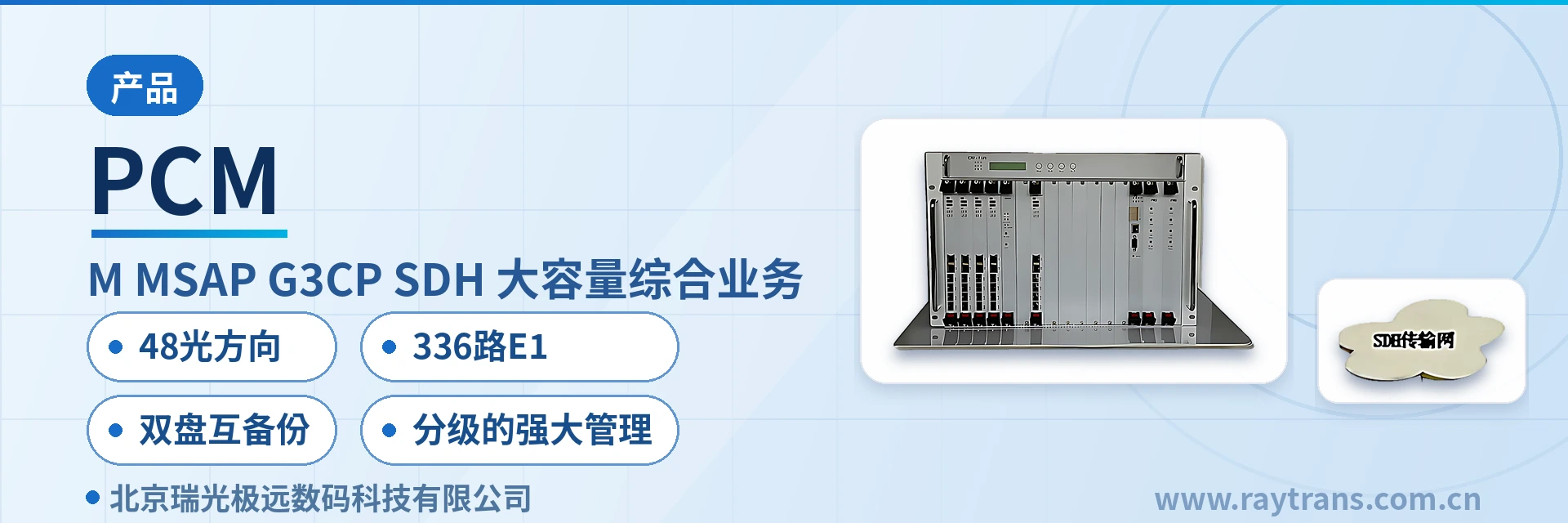
PCM PCM Equipment IDM MAP8E1-30 Integrated Service Cross-Connect Multiplexing Equipment
['8 E1 channels', '64K cross-connection', '30 services', 'dual power
The IDM MAP8E1-30 Integrated Service Cross-Connect Multiplexing Equipment is an integrated service platform that combines 64K narrowband service access, PCM multiplexing, and 64K time-slot cross-connection. The IDM MAP8E1-30 is mainly used for service access and cross-connection at the access layer of a data communication network. It provides complete synchronous timing functions and non-blocking cross-connections at the 64K level among 8 E1 channels, and can also provide 30 channels of 64K services, including telephone, magneto telephone, common battery telephone, and V.24 data services.
IDM MAP8E1-30 Integrated Service Cross-Connect Multiplexing Equipment is an integrated service platform developed by Beijing Ruiguang Jiyuan Digital Technology Co., Ltd. (Raytrans), combining 64K narrowband service access, PCM multiplexing, and 64K time-slot cross-connection. It is used for service access and cross-connection at the access layer of data communication networks. As a time-slot cross-connect equipment designed for the access layer, this product has significant advantages in PCM multiplexing and cross-connection scheduling. This 8-channel E1 integrated service cross-connect multiplexing equipment provides complete synchronous timing functions, can perform 64K non-blocking cross-connections across 8 E1 channels, and simultaneously provides 30 channels of 64K services, covering telephone, magneto telephone, common battery telephone, and V.24 data services. It is suitable for access nodes of electric power private networks, rail transit, and military and government private networks. In government private network optical fiber communication solutions, this integrated service access device can serve as a core node at the access layer and work with optical multiplexing equipment to achieve unified multi-service carrying; in military emergency communications vehicle solutions, its compact structure and dual power supply design also meet the requirements of rapid deployment and high-reliability communications. With its technical accumulation in PCM and optical multiplexing equipment, Raytrans provides stable and reliable product showcase and solution support for users of various private networks.
Key Specifications at a Glance: 8-channel E1 · 64K non-blocking cross-connection · 30 channels of 64K services · 15 service card slots · AC 220 V/DC -48 V dual power supply · overall power consumption ≤150 W · 482×309×44 (mm)
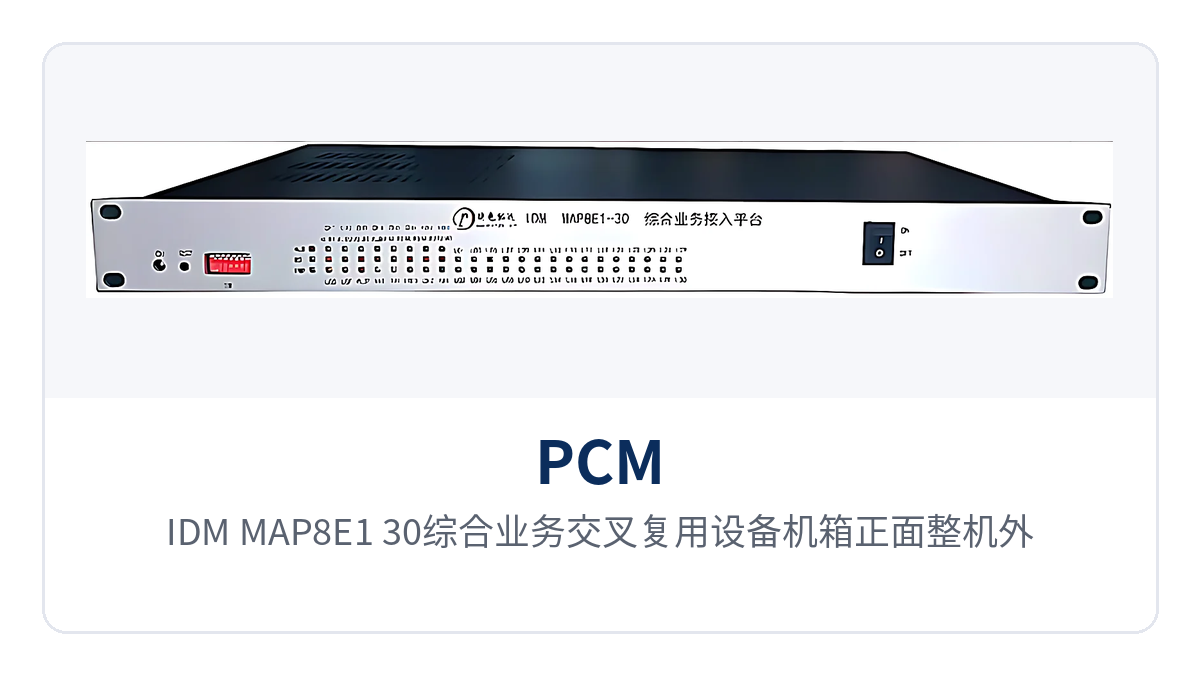
Figure 1: Overall appearance and operating indicator LEDs of the front chassis of IDM MAP8E1-30 Integrated Service Cross-Connect Multiplexing Equipment
What Kind of Device Is an 8-Channel E1 Integrated Service Cross-Connect Multiplexing Equipment?
IDM MAP8E1-30 Integrated Service Cross-Connect Multiplexing Equipment is an integrated access and cross-connect device that uses 64K time slots as the scheduling granularity: one side accesses 8 E1 channels, and the other side provides voice channel and data interfaces. After services enter the device, they are uniformly divided into 64K time slots and then allocated to designated time slots of the target E1 channel according to the configuration. 8-channel E1, 64K cross-connection, and 30 channels of services are concentrated in the same chassis, and access and scheduling are completed by a standalone unit, so an access node no longer needs two machines—a multiplexing equipment and a cross-connect equipment—connected in series.
The core value of the integrated service cross-connect multiplexing equipment lies in pushing cross-connection scheduling capability down to the access layer. Services on the site side do not need to be aggregated to the central equipment room first and then queued for scheduling; time slot allocation can be completed locally. For network management, serial port network management or Ethernet SNMP network management is provided, allowing remote viewing of link and service status. The 8 E1 groups can form point-to-point, chain network, star network, and other structures, and the networking approach is adjusted as the site distribution changes. Raytrans has accumulated mature engineering experience in PCM scheduling and product showcase for this type of integrated service access device, and can provide matching time-slot cross-connect equipment and optical multiplexing equipment combinations for government private network optical fiber communication solutions and military emergency communications vehicle solutions.
What Can This Device Do: Core Functions at a Glance
IDM MAP8E1-30 Integrated Service Cross-Connect Multiplexing Equipment concentrates narrowband service access, PCM multiplexing, and time-slot cross-connection on the same platform. The function items and their descriptions are shown in the table below.
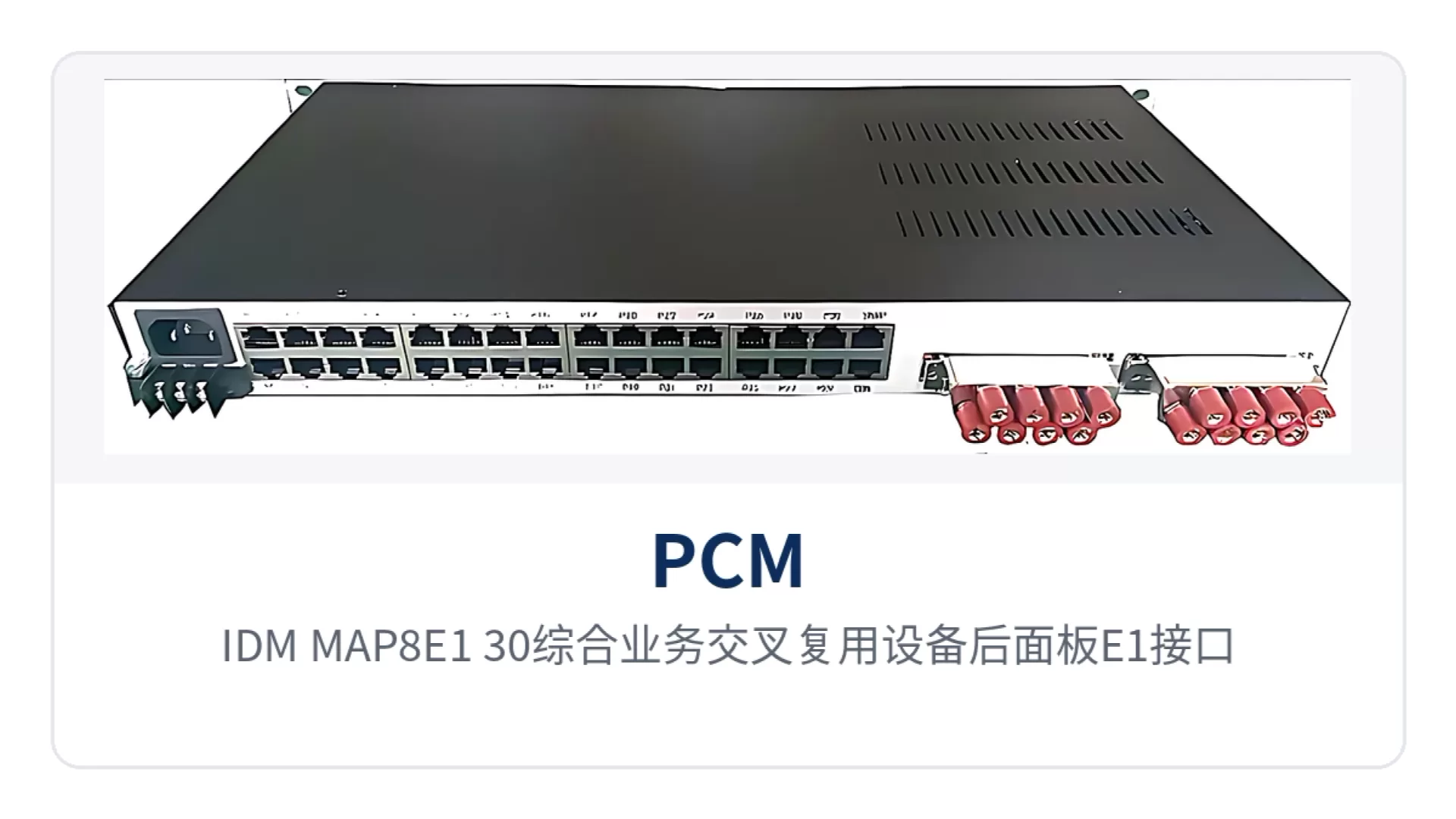
Figure 2: Close-up of the E1 interfaces and service wiring terminals on the rear panel of IDM MAP8E1-30 Integrated Service Cross-Connect Multiplexing Equipment
| Function | Description |
|---|---|
| 8-channel E1 access and cross-connection | Provides 8 E1 directions for access and performs non-blocking cross-connections between channels at the 64K time slot level |
| 64K time-slot cross-connection | Non-blocking cross-connection of all time slots across 8 E1 groups; any time slot can be scheduled to any time slot, and cross-connection relationships are configured according to circuit planning |
| 30 channels of 64K service access | The main unit provides 30 channels of 64K (or N×64K) user narrowband service access, carrying voice and data in a mixed manner |
| Service card expansion | The main board provides 15 service card slots, each card supports up to two services, and cards are flexibly configured according to on-site service types |
| Synchronous timing | Provides complete synchronous timing functions and supplies a unified clock reference for E1 links and service time slots |
| Network management | Provides serial port network management or Ethernet SNMP network management, supporting remote status monitoring and configuration delivery |
| Networking topology | The 8 E1 groups can form point-to-point, chain network, star network, and other structures, adapting to different site layouts |
| Link protection | Supports active/standby protection applications for E1 transmission links; during link switchover, existing voice and data services continue to be carried |
Technical Specifications
| Item | Parameter/Specification | Description/Applicable Conditions |
|---|---|---|
| E1 bit rate | 2.048 Mbps | Standard rate of the E1 line |
| E1 line coding | HDB3 | Line coding compliant with the ITU-T G.703 standard |
| E1 standard protocol | Supports ITU-T G.703 | International standard followed by the E1 interface |
| E1 impedance | 75 Ω/120 Ω | Two interface forms: 75 Ω coaxial or 120 Ω balanced |
| E1 frame structure | PCM30/32 | 32 time slots per frame, of which 30 time slots carry services |
| E1 signaling | Channel-associated signaling | Line and voice channel status are transmitted together with voice time slots |
| Ethernet (FE) interface | RJ-45, transmission rate N×VC12 (N≤50) | Standard protocol supports IEEE802.3, operating mode full/half duplex/adaptive |
| Ethernet (GE) interface | RJ-45, transmission rate N×VC12 (N≤63) | Standard protocol supports IEEE802.3, operating mode full/half duplex/adaptive |
| FXO, FXS interfaces | Audio range 300 Hz~3400 Hz, compression ITU G.711 A-law | Impedance three-element complex impedance 200 Ω+560 Ω//0.1 μF, loop current 20 mA/channel |
| Codirectional 64K interface | Line coding G.703 standard, bit rate 64 Kbps | Impedance balanced 120 Ω, fully compliant with ITU G.703 recommendation |
| E&M 2/4-wire interface | Audio range 300 Hz~3400 Hz, impedance balanced 600 Ω | Compression ITU G.711 A-law, return loss no less than 18 dB |
| Magneto interface | Audio range 300 Hz~3400 Hz, impedance balanced 600 Ω | Compression ITU G.711 A-law, return loss no less than 18 dB |
| V.24 interface | Transmission rate asynchronous ≤9600 bps; synchronous 64 Kbps | Electrical characteristics compliant with CCITT V.28 protocol |
| V.35 interface | Interface type RJ-45, transmission rate n×64 Kbps (n=0~31) | Electrical characteristics compliant with ITU-T V.35 recommendation, terminal interface compliant with ISO2593 |
| Power supply mode | AC 220 V/DC -48 V | Two power supply modes: AC and DC |
| Overall power consumption | ≤150 W | Upper limit of overall power consumption |
| Operating temperature | -10℃~+50℃ | Communications equipment room and outdoor cabinet environments |
| Relative humidity | 0~95% (non-condensing) | Normal operation under non-condensing conditions |
| Product dimensions | 482×309×44 (mm) | Dimensions of the rack-mounted chassis, length × depth × height |
How Is the 64K Non-Blocking Cross-Connection of 8-Channel E1 Implemented?
The 64K non-blocking cross-connection of 8-channel E1 depends on two conditions: the cross-connect granularity must reach the 64K time slot, and cross-connect matrix resources must not be occupied by other connections. IDM MAP8E1-30 Integrated Service Cross-Connect Multiplexing Equipment establishes connection relationships in units of 64K time slots. All time slots of the 8 E1 groups can participate in cross-connection, any input time slot can be scheduled to any output time slot, and connections do not squeeze each other's matrix resources. Therefore, existing services are not affected when circuits are added or adjusted.
Knowledge block: PCM30/32 frame structure and E1 interface standards. PCM30/32 is the frame structure standard of the E1 base group. Each frame is divided into 32 time slots, of which TS0 is used for frame alignment and alarms, TS16 is used for channel-associated signaling, and the remaining 30 time slots are used to carry 64K services. The E1 interface of IDM MAP8E1-30 Integrated Service Cross-Connect Multiplexing Equipment has a bit rate of 2.048 Mbps and HDB3 line coding, follows the ITU-T G.703 standard, and has an impedance of 75 Ω/120 Ω. Cross-connect configuration is performed at 64K time-slot granularity, so circuit adjustment at access nodes does not rely on manual patch cords.
Cross-connection relationships are delivered by configuration, specifying the input E1 channel and time slot and the output E1 channel and time slot one by one according to service planning. When a site is expanded or services are migrated, only the cross-connect configuration needs to be adjusted, while external lines and peer devices remain unchanged, reducing on-site workload. The time-slot cross-connect equipment and optical multiplexing equipment provided by Raytrans adopt the same type of cross-connection mechanism in government private network optical fiber communication solutions and military emergency communications vehicle solutions. In the product showcase, the entire process of time-slot scheduling and PCM service configuration can be seen intuitively.
How Are 30 Channels of 64K Services Mixed: Telephone, Magneto, Common Battery, and V.24 Data
The mixed access of 30 channels of 64K services relies on service cards configured as required. The main board provides 15 service card slots, each card supports up to two services. Voice channel interfaces can be FXO central office automatic telephones, FXS remote automatic telephones, and MAG magneto telephones. Data services cover V.24, codirectional 64K, and other interfaces. Voice and data are accessed in a mixed manner within the same integrated service cross-connect multiplexing equipment and then allocated by the 64K cross-connect matrix to target E1 time slots. Voice services such as common battery telephones and magneto telephones that do not rely on SPC switching power supply are also carried within these 30 channels.
Voice services are compression-encoded according to ITU G.711 A-law, with an audio range of 300 Hz3400 Hz. The V.24 interface has an asynchronous transmission rate ≤9600 bps and synchronous 64 Kbps, and its electrical characteristics comply with the CCITT V.28 protocol. The V.35 interface has a transmission rate of n×64 Kbps (n=031) and is suitable for carrying synchronous data with N×64K bandwidth. Different service cards can be mixed in the same chassis, and sites only need to configure cards according to the on-site service list. In military emergency communications vehicle solutions, this type of PCM integrated service access device can quickly complete mixed access of voice and data; in government private network optical fiber communication solutions, combined with optical multiplexing equipment, it can achieve integrated service access and product showcase demonstrations at remote stations.
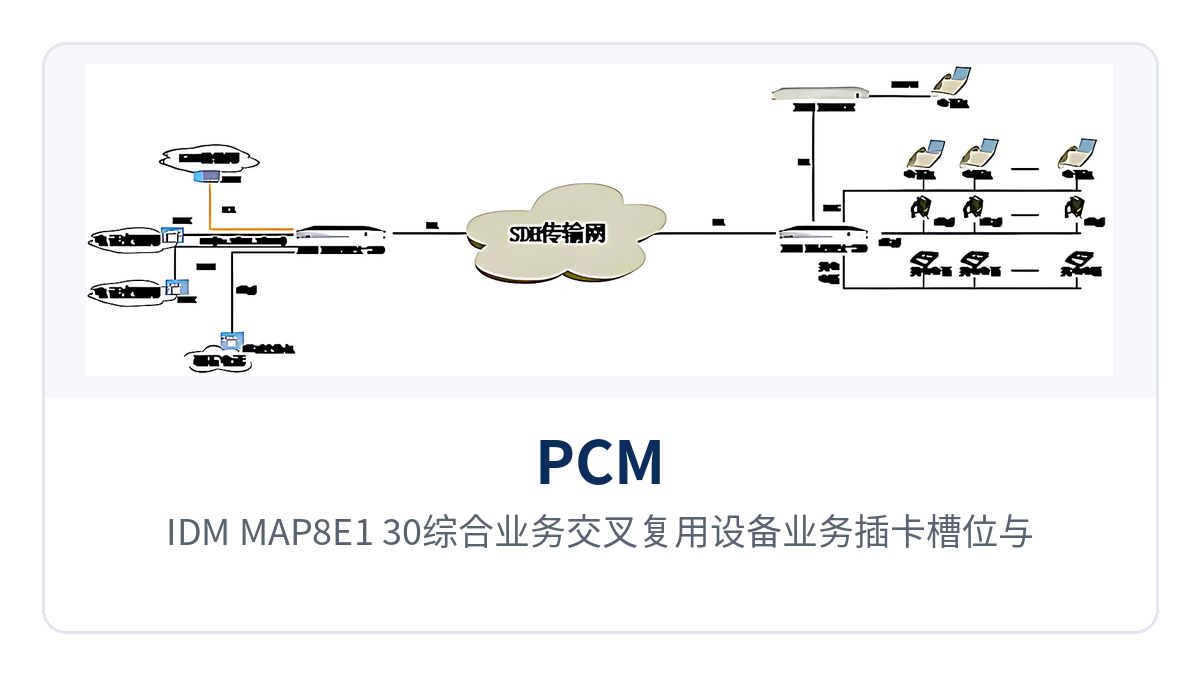
Figure 3: Close-up of service card slots and alarm indicator LEDs of IDM MAP8E1-30 Integrated Service Cross-Connect Multiplexing Equipment
Power Supply, Structure, and Network Management: How to Use AC 220 V/DC -48 V Dual Power Supply
AC 220 V/DC -48 V dual power supply means the same device can be connected to an AC 220 V power supply or a DC -48 V power supply, and sites can choose either one according to existing power conditions, with overall power consumption ≤150 W. Substations and communications equipment rooms usually have both mains power and DC power systems, while field sites mostly use -48 V storage battery banks. The same model can cover both scenarios, unifying spare parts and O&M practices.
IDM MAP8E1-30 Integrated Service Cross-Connect Multiplexing Equipment has an operating temperature of -10℃+50℃, relative humidity of 095% (non-condensing), and dimensions of 482×309×44 (mm). It can be installed in a standard cabinet or vehicle-mounted rack. On the service side, it provides access capacity for 30 channels of 64K and 15 service card slots. When a site is expanded, interfaces are added by inserting service cards without replacing the complete unit.
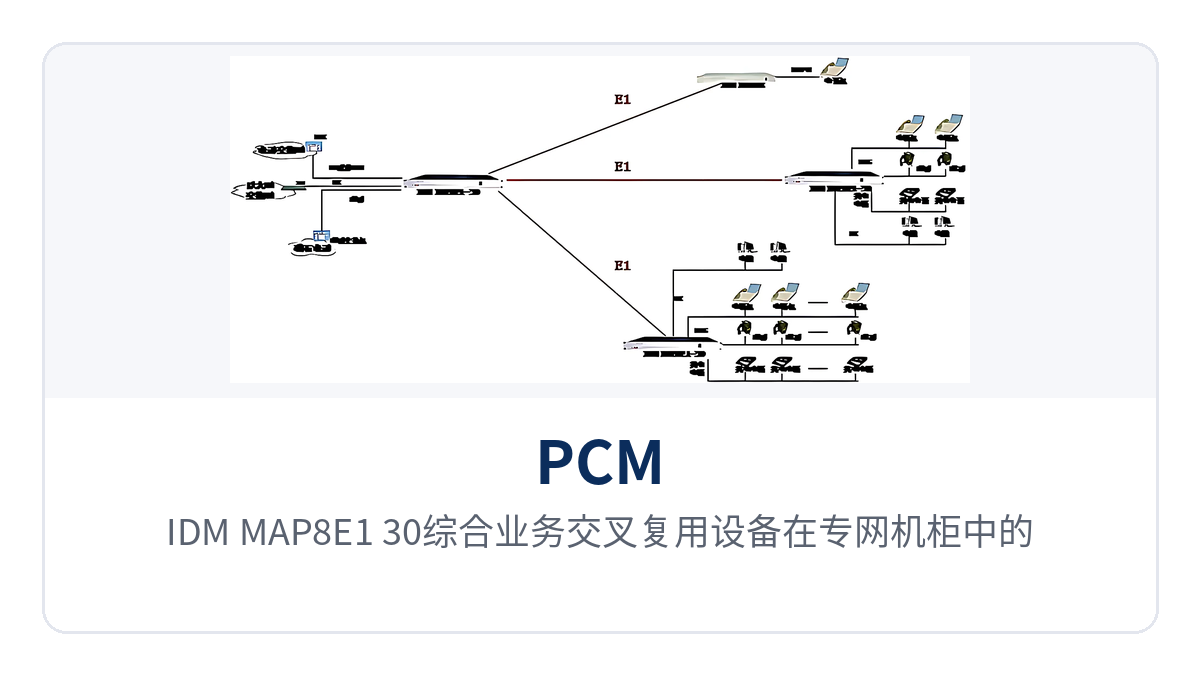
Figure 4: Installation and power supply wiring diagram of IDM MAP8E1-30 Integrated Service Cross-Connect Multiplexing Equipment in a private network cabinet
Differentiated Value: 8-Channel E1, 64K Cross-Connection, 30 Channels of Services, Dual Power Supply
| Value | Corresponding Capability | Value to the Customer |
|---|---|---|
| 8-channel E1, 64K non-blocking cross-connection | Full-time-slot non-blocking cross-connection of 8 E1 channels; access and dispatching completed in a standalone unit | Circuit routing can be adjusted at the access layer; capacity expansion requires no downtime for rearranging existing circuits |
| Integrated 30-channel 64K service | Mixed connection of 30-channel 64K services; mixed access of telephone and V.24 data | One device handles both voice and data services, reducing the number of site devices and cabinet space |
| AC220V/DC-48V dual power supply | AC and DC power supply modes; overall power consumption ≤150W | The same model suits both equipment rooms and field sites, unifying spare parts and O&M practices |
Typical Application Scenarios
The IDM MAP8E1-30 Integrated Service Cross-Connect Multiplexing Equipment targets private network scenarios that use E1 as the transmission medium and need to aggregate telephone and data services into the same channel. The 8 E1 groups can form point-to-point, chain network, and star network topologies, making it easy to select a networking topology according to site distribution.
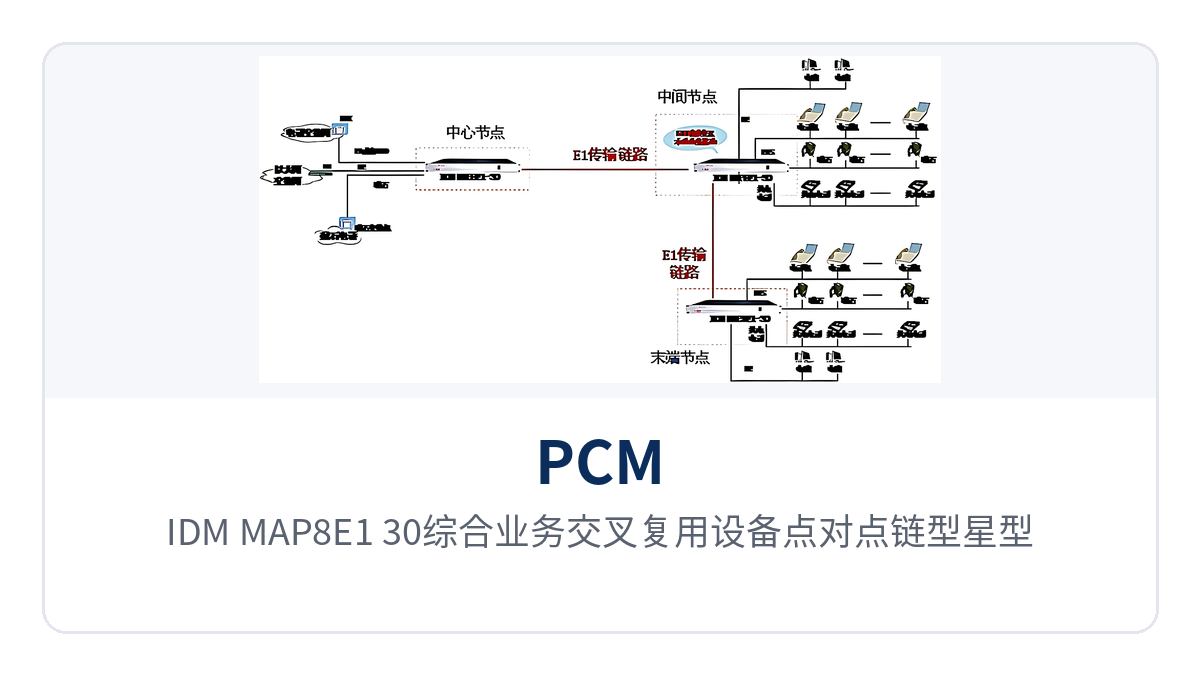
Figure 5: Point-to-point, chain, and star networking topology diagram of the IDM MAP8E1-30 Integrated Service Cross-Connect Multiplexing Equipment
Electric Power Private Network: 8-Channel E1 Non-Blocking Cross-Connection, Substation Services Dispatched by One Device
In an electric power private network, substations, switching stations, and the dispatch center carry both dispatch telephone services and low-speed telecontrol and monitoring data. The IDM MAP8E1-30 Integrated Service Cross-Connect Multiplexing Equipment aggregates the E1 channels from all directions, cross-connects voice channels and data to the corresponding channels at the 64K time-slot level, and carries voice and data simultaneously over one E1, reducing the number of private network lines. When a new bay is added or service assignment is adjusted, only the cross-connect configuration is changed, while the cabling remains untouched.
Rail Transit: Mixed Connection of 30-Channel 64K Services, Saving Equipment and Space for Inter-Station Communication
Rail transit sites along the line are distributed, and inter-station liaison telephone and monitoring data need to be aggregated at the central side. The IDM MAP8E1-30 Integrated Service Cross-Connect Multiplexing Equipment accesses telephone, magneto telephone, and V.24 data in one device through mixed connection of 30-channel 64K services, and then sends them upstream over E1 channels. The 15 service card slots are configured with cards according to site service types, eliminating the need to set up a separate transmission device for each service type, and reducing cabinet space and supporting power supply accordingly.
Military and Government Private Networks: AC/DC Dual Power Supply, ≤150W Low Consumption, Stable Operation at Field Sites
Field sites of military and government private networks face power supply conditions that vary with the site, and both AC power in equipment rooms and DC power in vehicles and at sites may be encountered. The IDM MAP8E1-30 Integrated Service Cross-Connect Multiplexing Equipment supports AC220V/DC-48V dual power supply, with overall power consumption ≤150W and an operating temperature of -10℃~+50℃, and can be installed in a cabinet or a vehicle-mounted rack. Field sites can stay online over the long term with -48V DC power supply, and when services change, the time-slot cross-connection configuration is adjusted from the central side without rewiring on site. In military emergency communications vehicle solutions, the device can be quickly enabled via vehicle-mounted DC power and work with optical multiplexing equipment for efficient backhaul of on-site services; in government private network optical fiber communication solutions, the device can serve as an access layer node, aggregating voice and data services onto optical fiber transmission channels and simplifying the private network architecture.
FAQs
What is the working principle of Pulse Code Modulation (PCM)?
Working Principle Pulse Code Modulation is the process of converting a time-continuous…
View answerPCM30 Working Principle: What Is PCM30/32
PCM30 Equipment Working Principle The 30-channel PCM equipment refers to equipment that provides 30 user interfaces and…
View answerWhat are the common problems of PCM equipment in enterprise applications?
At present, PCM equipment has become basically ubiquitous in enterprise network applications.
View answerWhat is E1? How to Use E1
What is E1 The European 30-channel pulse code modulation PCM is abbreviated as E1, with a rate of 2.048Mbit/s.
View answerFrame Structure of 30/32-Channel PCM Primary Group
A communication system consists of transmitting equipment, receiving equipment, and transmission equipment.
View answer