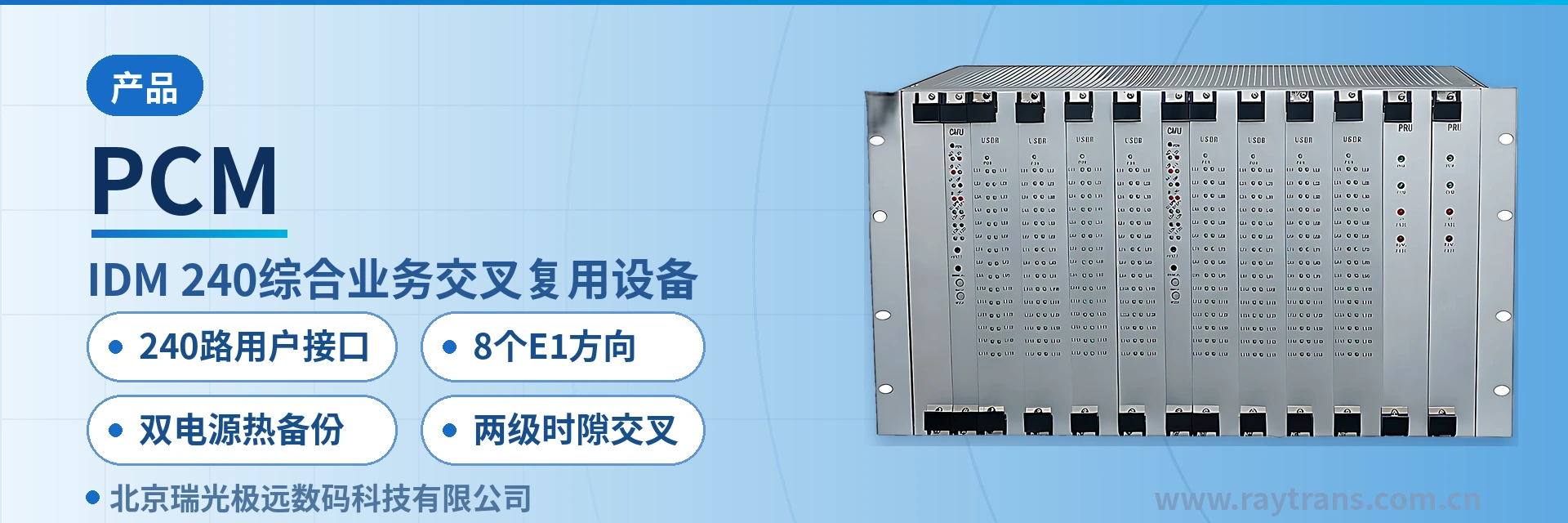
IDM-240 Integrated Service Cross-Connect Multiplexing Equipment
240 subscriber interfaces, two-stage time-slot cross-connection, dual CMU, dual hot-standby power supplies, 8E1
The IDM-240 Integrated Service Cross-Connect Multiplexing Equipment is a PCM multiplexer built with dedicated large-scale integrated circuits that handles up to 8 E1 signals. It uses a 19-inch 6U standard chassis with 13 slots (2 CMU slots, 8 USER slots, 2 PRU slots, and 1 expansion slot). It can provide 240 subscriber interfaces, and the user cards can be flexibly configured with more than 20 types of interface cards as required.
IDM-240 240-channel PCM integrated service multiplexer is a PCM multiplexer developed by Beijing Ruiguang Jiyuan Digital Technology Co., Ltd. using dedicated large-scale integrated circuits. It performs cross-connect multiplexing of 8 E1 signals and subscriber service access. A single 19-inch 6U chassis provides 240 subscriber interfaces and 8 E1 directions, making it an integrated service access device for multi-service scenarios.
IDM-240 organizes capacity through modular slots. User cards are populated with voice, data, and signaling interface cards as required by the project, aggregating voice, data, and video surveillance services from electric power, public security, finance, and education systems onto E1 dedicated lines or optical fiber channels. The unit has built-in time-slot cross-connect equipment and optical multiplexing equipment capabilities, flexibly adapting to the dedicated line access requirements in government private network optical fiber communication solutions and military emergency communications vehicle solutions. The various interface configurations in the product showcase also intuitively reflect Raytrans's mature design in the integrated service access field.
Key Specifications at a Glance: 240 subscriber interfaces · 8 E1 directions · 19-inch 6U with 13 slots · two-stage time-slot cross-connection 1024×1024 · dual power supply and dual CMU hot standby · NetGuard network management
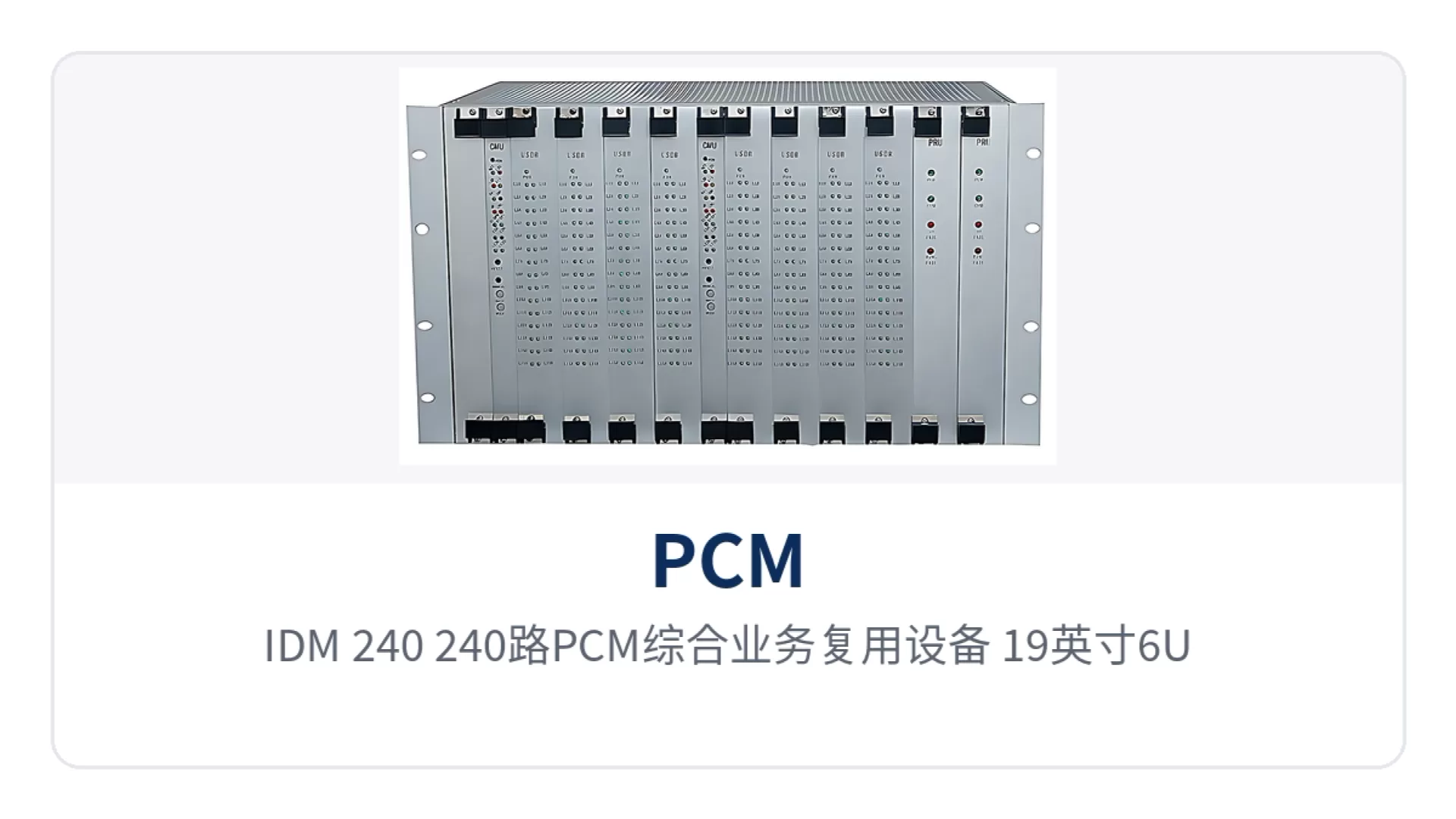
Figure 1: IDM-240 240-channel PCM integrated service multiplexer, 19-inch 6U chassis front view and 13-slot layout
What Kind of Device Is a 240-Channel PCM Integrated Service Multiplexer?
IDM-240 is a 240-channel PCM integrated service access device in a standard 19-inch 6U chassis with 13 slots in total: 2 CMU slots, 8 USER slots, 2 PRU slots, and 1 expansion slot. The 2 CMU slots carry E1 interface multiplexing processing boards, responsible for multiplexing and cross-connection processing of 8 E1 directions. Each of the 8 USER slots carries one user card, and each user card contains 15 subscriber interface card slots.
Calculated on the basis that each subscriber interface card typically contains 2 channels of 64K service, a fully configured unit provides 8 boards × 15 card slots × 2 channels = 240 subscriber interfaces, while processing 8 2M services simultaneously. The multi-function slots can also accept PDH optical interface modules, allowing broadband IP services and narrowband E1 services to be multiplexed in the same chassis. The device thus combines PCM multiplexing with Ethernet access capability, making it an integrated service access device that also has the attributes of optical multiplexing equipment.
What Functions Can a Single 6U Chassis Provide?
The capabilities of IDM-240 unfold along three lines: high-capacity access, two-stage time-slot cross-connection, and operational reliability. The functions and their descriptions are summarized in the table below. The items are listed on a fully configured basis; the actual interface types and number of channels depend on the project's card configuration, and the number of cards directly determines networking cost.
Function | Description |
|---|---|
Two-stage time-slot cross-connection | The first stage contains two groups of 256×256 full cross-connect matrices, completing full cross-connection of two groups of 4 2M, i.e. 120 64K time slots; the second stage is a 1024×1024 (i.e. 32 2M) matrix, with service connection modes flexibly configured according to user requirements |
Modular mixed insertion | The same chassis can accept E1 interface-based cross-connect multiplexing boards, optical fiber-based broadband (IP interface) and narrowband (E1 interface) multiplexing boards, and E1 interface-based time-slot cross-connect boards; the number of multiplexing boards is selected according to the number of interfaces |
240 subscriber interfaces | 8 user cards × 15 subscriber interface card slots per card; a single card typically provides 2 channels of 64K access service, for 240 channels at full configuration |
8 E1 directions | The 240 subscriber interface services can be distributed across 8 E1 directions for transmission; a single unit processes 8 2M services simultaneously |
Clock and interface modes | Can be set to master clock, external clock, line clock, or user clock, and to exchange interface or subscriber interface, compatible with both central office and remote end |
NetGuard network management | NetGuard network management software provides intelligent configuration management of service networking, flexible time slot allocation at each station, and real-time monitoring of equipment operating status |
Dual power supply and dual CMU hot standby | 2 PRU power card slots and 2 CMU card slots form dual power supply and dual CMU hot standby; when an active board fails, the standby board takes over the services |
Structure and protection | The chassis heat dissipation system together with the electromagnetic interference shielded chassis ensures normal operation in complex equipment room and outdoor cabinet environments |
How Does Two-Stage Time-Slot Cross-Connection Support Time Slot Allocation from a Central Station to Multiple Substations?
Two-stage time-slot cross-connection is the core capability that distinguishes IDM-240 as time-slot cross-connect equipment from ordinary PCM multiplexers: the first stage completes full cross-connection of two groups of 4 2M, i.e. 120 64K time slots, inside the device, while the second stage uses a 1024×1024 (32 2M) matrix for larger-scale time slot scheduling, with service connection modes flexibly configured according to user requirements.
A network structure in which a central station corresponds to multiple sub-centers is the main application of this architecture. IDM-240 accesses 8 E1 lines, while the second-stage cross-connect matrix has a capacity of 32 2M, leaving margin in cross-connect resources relative to the access scale. When substations are added or removed or services are redirected, time slots are reallocated within the matrix first, so in-service traffic is not blocked by a shortage of internal matrix resources.
Time slot allocation is issued through NetGuard network management software: the voice channels of a given substation are assigned to specified 64K time slots of a specified E1 at the central station, and monitoring data is assigned to another time slot, so that one E1 can carry voice and data simultaneously. When a substation is expanded, only the time slot configuration is changed, while the external transmission line and the opposite end equipment remain untouched, and on-site work is concentrated on card configuration and wiring. This characteristic also makes the device easy to commission and adjust rapidly in dedicated line access scenarios.
How to Configure 240 Subscriber Interfaces: More Than 20 Interface Cards Cover Three Service Categories
User cards adopt an independent subscriber module design. Voice, data, and signaling interface cards can be mixed in the same chassis, with more than 30 interface types available and freely interchangeable according to user needs. The interfaces below are grouped by service type; the specific configuration is subject to the project's card configuration list and the manufacturer's technical documentation.
Voice interfaces: FXO, FXS, polarity reversal and caller ID telephone, magneto, 2100Hz carrier magneto, hotline, carrier, EM2/4-wire audio, high-fidelity audio;
Data interfaces: 64K codirectional, V.24/V.28 (RS232/RS485), V.35 (n×64K), 10Base-T;
Signaling and trunk interfaces: baseband trunk interface card, Signaling System No. 1 card, telephone switching card.
Card configuration proceeds in the order of "first count services, then check time slots." First, count the number of telephone, magneto, audio, and data channels required at the site and convert them into the number of each type of interface card; then check the time slot occupation of the 8 E1 directions and distribute the 240 channels of service across each E1 by direction; finally, use NetGuard network management to verify that the configuration matches the actual services. For capacity expansion, simply add cards without replacing the chassis.
How Do Dual Power Supply and Dual CMU Hot Standby and 240-Channel Capacity Keep Private Networks Uninterrupted?
Dual power supply and dual CMU hot standby address the problem of a single board failure bringing down all services at a station. The IDM-240 chassis reserves 2 PRU power card slots and 2 CMU card slots; while the active board works, the standby board is synchronized in hot standby, and when a power card or multiplexing processing board fails, the standby board takes over the services, so the services of 240 subscriber interfaces and 8 E1 directions are not interrupted by the loss of one board.
Reliability also rests on clocking and structure. The device can be set to master clock, external clock, line clock, and user clock, and to exchange interface or subscriber interface, compatible with both central office and remote end; during networking, simply select one mode according to the existing network's clock source without adding separate clock equipment. The chassis heat dissipation system and the electromagnetic interference shielded chassis keep the impact of temperature and interference on long-term online operation within a controllable range. For this reason, the government private network optical fiber communication solutions and military emergency communications vehicle solutions that Raytrans builds on this platform can maintain service continuity in unattended equipment rooms and in vehicle-mounted environments subject to vibration.
IDM-240 Technical Specifications
The following parameters are taken from the IDM-240 technical documentation. Capacity indicators are given on a fully configured basis, and interface types and card quantities are subject to the project configuration and commercial confirmation. When checking, it is recommended to review slot occupation, number of E1 directions, and number of subscriber interfaces together, as the three jointly determine the unit configuration.
Item | Parameter/Specification | Description/Applicable Conditions |
|---|---|---|
Chassis structure | 19-inch 6U standard chassis | Centralized card-based structure, installable in a standard 19-inch rack |
Total slots | 13 | 2 CMU slots, 8 USER slots, 2 PRU slots, 1 expansion slot |
CMU slots | 2 | Host the E1 interface multiplexing processing cards, supporting dual-CMU hot standby |
USER slots | 8 | Each slot takes 1 user card, and each card provides 15 user interface card slots |
User interface card slots | 15 per card | Each user interface card typically carries 2 channels of 64K access services |
User interface capacity | 240 channels | 8 cards × 15 card slots × 2 channels, full configuration |
E1 processing capacity | 8 E1 (8 × 2M) | 240 channels of user services can be distributed across 8 E1 directions for transmission |
Cross-connection | Level 1: 2 groups of 256×256; Level 2: 1024×1024 | Level 1 performs full cross-connection of two groups of 4 × 2M, i.e. 120 × 64K; Level 2 is a 32 × 2M matrix |
Clock mode | Master clock / external clock / line clock / user clock | Can be set as exchange interface or user interface, compatible with both central office and remote end |
User interface types | More than 20 interface cards, more than 30 interfaces | Three categories: voice, data, and signaling and trunk; cards configured per project |
Optical interface expansion | Multifunction slots can take PDH optical interface modules | Broadband IP and narrowband E1 services are multiplexed over optical fiber |
Network management | NetGuard network management software | Real-time monitoring of time slot provisioning and operating status at each site |
Power supply and backup | 2 PRU power card slots, dual hot-standby power supplies | When a single card fails, the standby card takes over the services |
Structural protection | Chassis heat dissipation system + EMI-shielded chassis | Suitable for complex equipment room and outdoor cabinet environments |
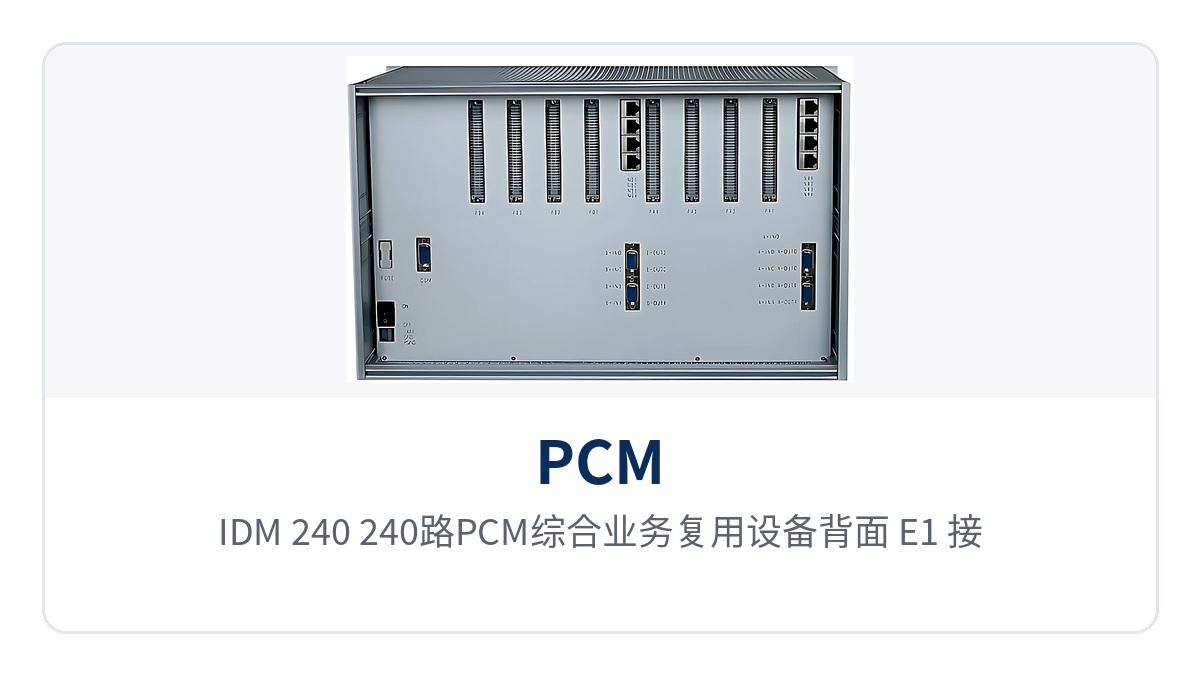
Figure 2: Close-up of the E1 interfaces and service wiring terminals on the rear panel of the IDM-240 240-channel PCM integrated service multiplexer
Value comparison of 240 user interfaces, 8 E1 directions, dual hot-standby power supplies, and two-level time-slot cross-connection
What exactly does a 6U chassis buy you? You can compare it capability by capability across three items. The left column of the table below gives the original short selling-point labels, and the right column translates capacity, time slot scheduling, and power supply backup into benefits you can perceive on site, making it easy to calculate together with the substation list during the solution stage and judge whether the configuration is sufficient.
Differentiation Point | Corresponding Capability and Customer Value |
|---|---|
240 user interfaces, 8 E1 directions | A single chassis can handle the high-capacity product showcase aggregation at the central station: 240 channels of voice, data, and video surveillance services are distributed across 8 E1 directions, so substation services need not be spread over multiple low-capacity optical multiplexing equipment |
Dual hot-standby power supplies | Dual power supplies and dual-CMU hot standby keep private network services uninterrupted: 2 PRU slots and 2 CMU slots back each other up, and when a single card fails the standby card takes over, so unattended equipment rooms need no overnight site visits |
Two-level time-slot cross-connection | Flexible provisioning from the central station to multiple substations: the Level 2 1024×1024 cross-connect matrix is configured according to the service connection pattern; adding or removing substations or redirecting services only requires adjusting time slots, while the transmission line and the time-slot cross-connect equipment at the opposite end remain unchanged |
Typical application scenarios
IDM-240 targets industry private networks that use E1 dedicated lines as the transmission backbone and need to aggregate voice and data at the central station. User cards are configured according to the service list, multifunction slots take optical interface modules according to line conditions, and a single 6U chassis covers the uplink requirements of narrowband voice, low-speed data, and video surveillance services at the same time.
Electric power private network: dispatch telephone and telecontrol data aggregated in the same chassis
In an electric power private network, dispatch telephone as well as low-speed data such as telecontrol and protection signals run between substations, switching stations, and the dispatch center. As an integrated service access device, IDM-240 aggregates the E1 links of all directions and cross-connects voice channels and data to the corresponding channels at the 64K time slot level, so one E1 carries voice and data simultaneously and the number of private network lines is reduced accordingly.
When a new bay is added or service assignment is adjusted, the central station changes the time slot configuration through NetGuard network management, and no wiring is touched at the substation site; dual power supplies, dual-CMU hot standby, and the shielded chassis meet the requirements of long-term online operation in unattended substations.
Public security and military private networks: high-capacity access and multi-substation dispatching
The command center of a public security or military private network needs to aggregate the telephone, data, and video surveillance services of subordinate units at the same node, with many substations and frequent changes in service assignment. The 240 user interfaces of IDM-240 let the central station access a large number of voice channels and data ports at one time, and the two-level time-slot cross-connection rearranges services by substation, meeting the high requirements of the military emergency communications vehicle solution for rapid deployment and flexible dispatching.
The device can be set as an exchange interface or a user interface and is compatible with both central office and remote end, so the opposite end need not be replaced when connecting to existing SPC switching equipment; with PDH optical interface modules inserted in the multifunction slots, services can be extended to remote stations over optical fiber, and chain, star, and tree topologies can all be built. Dual power supplies, dual-CMU hot standby, and the shielded chassis give the central equipment room and subordinate sites the same spare parts standard.
Financial and school dedicated line access: low-capacity remote stations aggregating upward
Dedicated line access for financial branches and campuses is dominated by voice channels, low-speed data, and surveillance, with distributed sites and modest service volume per site. IDM-240 is deployed in the branch equipment room or the campus central equipment room; a small number of interface cards is enough to handle the dedicated line access services of the subordinate branches, and the remaining card slots are reserved for future capacity expansion, so there is no need to rack a separate device for each type of service.
Remote stations can be connected using IDM-120 series, IDM-30 series, and IDM-mini series devices, and then uplinked to IDM-240 over E1 or optical fiber. Users can choose freely based on capacity requirements and cost-effectiveness, with unified spare parts and O&M practices across the network.