MA5680T
MA5680T
The Huawei MA5680T optical access device serves as the OLT equipment in GPON/EPON systems. Used in conjunction with terminal ONU devices, it provides GPON/EPON access services to meet networking requirements such as FTTH (Fiber to the Home), FTTB (Fiber to the Building), micro base station transmission, IP leased line interconnection, and bandwidth wholesale.
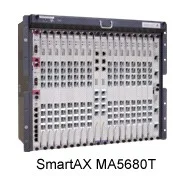
The Huawei MA5680T optical access device serves as the OLT equipment in GPON/EPON systems. Used in conjunction with terminal ONU devices, it provides GPON/EPON access services to meet networking requirements such as FTTH (Fiber to the Home), FTTB (Fiber to the Building), micro base station transmission, IP leased line interconnection, and bandwidth wholesale.
The Huawei MA5680T service frame features 23 slots with a fan frame configured at the top. The service frame is secured in the cabinet via mounting brackets.
The Huawei MA5680T service frame provides 16 service board slots and 2 main control board slots. The service frame offers 23 slot numbers, where the first slot from the left can accommodate 2 power interface boards and 1 clock processing board, and the last slot can accommodate 2 uplink interface boards.
Supported boards for the Huawei MA5680T:
Board Type | Board Name and Function Description | Slot Restriction |
Main Control Board | SCUN: System main control board, providing 4GE optical uplink | 9, 10 |
SCUL: System main control board | ||
Service Board | OPFA: Provides 16 channels of P2P FE optical access | 1–8, 11–18 |
GPBC: Provides 4 channels of GPON access | ||
GPBD: Provides 8 channels of GPON access | ||
EPBC: Provides 4 channels of EPON access | ||
EPBD: Provides 8 channels of EPON access | ||
TOPA: TDM interface board; with daughter board, supports 16E1 or 2*STM-1 | ||
CSPA: Converts Native TDM to CESOP; no front-panel interface | ||
SPUB: MPLS service enhancement processing board; no front-panel interface | ||
Ethernet Cascade and Uplink Board | ETHB: Provides 8*GE optical interfaces | 1–8, 11–18 |
SPUA: Provides 8*GE+2*10GE optical interfaces, supporting hierarchical QoS | ||
Uplink Board | GICF: Provides 2*GE optical interfaces | 19, 20 |
GICG: Provides 2*GE/FE electrical interfaces | ||
X1CA: Provides 1*10GE optical interface | ||
X2CA: Provides 2*10GE optical interfaces | ||
X2CS: Provides 2*10GE optical interfaces, supporting Synchronous Ethernet | ||
Power Access Board | PRTE: Power interface board | 21, 22 |
Clock Board | BIUA: BITS interface board, providing clock processing functions | 0 |
Huawei MA5680T Service Frame Parameter Table
Model | Dimensions (W×D×H) | Max Power Consumption (Fully Loaded, Single Shelf) | Empty Shelf Weight |
ETSI service shelf dimensions (with mounting brackets) | 530mm×275.8mm×447.2mm | 1420W | 7kg |
ETSI service shelf dimensions (without mounting brackets) | 490mm×275.8mm×447.2mm | ||
19-inch service shelf dimensions (with mounting brackets) | 482.6mm×275.8mm×441.7mm | 1420W | 7kg |
19-inch service shelf dimensions (without mounting brackets) | 442mm×275.8mm×441.7mm |
Huawei MA5680T Operating Environment Parameters
Environment Parameter | Parameter Value |
Operating Ambient Temperature | -30℃~+60℃ |
Operating Ambient Humidity | 5%RH~95%RH |
Atmospheric Pressure Environment | 54kPa~106kPa |
Huawei MA5680T Power Supply Parameters
Specification | Parameter Value |
Power Supply Mode | DC Power Supply |
Rated Voltage | -48V DC |
Operating Voltage Range | DC Power Supply: -72V ~-35.4V DC(-48V DCpower supply) |
Huawei MA5680T Parameter Details
Others | Other Features | Converged aggregation and access in one: ultra-high aggregation switching capability with 3.2T backplane capacity, 960G switching capacity, and 512K MAC address capacity; ultra-high-density cascading capability supporting up to 768 GE ports per chassis without additional investment in aggregation switches; ultra-reliable networking capability with direct BRAS connectivity, supporting OLT dual-machine hot standby, remote disaster recovery, and service upgrade. Full-service access: non-blocking access for IPTV users, supporting 8000 multicast users and 4000 multicast channels per chassis. The proprietary video enhancement engine greatly improves user service experience; hierarchical high QoS assurance with H-QoS functionality meets SLA requirements of diverse commercial customers; supports Native TDM or CESoP functions for multiple E1 leased line access; supports intra-VLAN traffic interworking to meet enterprise and campus networking applications. Green and energy-efficient: proprietary chip technology with power consumption of high-density 8-port GPON line cards not exceeding 55W; proprietary energy-saving bus technology for deep power saving. |
Environment | Operating temperature: 0-45°C Operating humidity: 20%-85% (non-condensing) Storage humidity: 5%-95% (non-condensing) |
FAQs
What is the working principle and function of a media converter?
The rapid advancement of informatization has led to growing demand for multimedia communications such as data, voice…
View answerWhat is the difference between an Optical Terminal and a Media Converter?
Optical Terminal is a device that converts multiple E1 (a data transmission standard for trunk lines…
View answerWhat are the characteristics and principles of fiber-optic transmission?
I. Background of Optical Communication In today's world, optical fiber communication has become the primary means of…
View answer