MA5680T Optical Access Device
768 GE ports per frame, eliminating aggregation switches; dual-machine hot standby and remote disaster recovery; unattended at 30°C
The Huawei MA5680T optical access device is used in the product showcase field, targeting industry customers' communication/transmission/dispatching equipment (to be further detailed based on documentation).
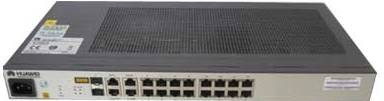
MA5680T is a high-capacity OLT optical access device launched by Huawei. It consists of a service frame, main control board, service board, and uplink board. In GPON/EPON systems, it works as an optical line terminal (OLT) together with terminal ONU devices to provide GPON/EPON access services, meeting networking requirements such as FTTH, FTTB, micro base station transmission, IP leased line interconnection, and bandwidth wholesale. As a benchmark product often compared by media converter manufacturers and optical multiplexer manufacturers, it is frequently used in product showcases to illustrate the access capacity of a high-capacity OLT.
In private network scenarios such as electric power and energy, rail transit, and industrial parks, the value of the MA5680T centers on three points: the scale of 768 GE ports per frame means site cascading requires no additional aggregation switches, saving investment and space; it supports OLT dual-machine hot standby and remote disaster recovery, ensuring highly reliable private network communications without interruption; and the service frame can operate at -30℃~+60℃ and 95%RH high humidity, adapting to unattended sites in the field. These features make it a common access layer choice in government private network optical fiber communication solutions, military emergency communications vehicle solutions, and smart mining communication solutions, and it can work with intrinsically safe mining communication equipment, fiber optic switches, and media converters to complete last-mile networking.
Key specifications at a glance: 3.2T backplane · 960G switching capacity · 768 GE ports per frame · dual-machine hot standby · 55W low power consumption for the 8-port GPON board · 23 slots
What Is an OLT Optical Access Device
An OLT optical access device is the central office equipment in a PON system, located on the central equipment room side. It connects upward to aggregation and service networks, and downward forms a point-to-multipoint structure with terminal ONUs through passive optical splitters, handling the establishment, control, and management of access services. In GPON/EPON systems, the MA5680T takes the role of the optical line terminal. Its service frame can be mixed with GPON, EPON, P2P FE optical access, TDM, and Ethernet-type boards, so a single device carries broadband, voice leased line, and video services at the same time. As a core central office device in product showcases, it is also a type of network element frequently benchmarked by media converter manufacturers and optical multiplexer manufacturers in access network solutions.
GPON and EPON are defined by the ITU-T G.984 series of recommendations and IEEE 802.3ah respectively, and the two standards differ in frame structure and bearer mode. The MA5680T supports both formats by selecting and inserting GPBC, GPBD (GPON access) or EPBC, EPBD (EPON access) boards in service slots. The same service frame can decide its format according to the existing on-site network, or use mixed insertion when a site is expanded in batches. In government private network optical fiber communication solutions, military emergency communications vehicle solutions, and smart mining communication solutions, the device can serve as a unified access platform on the OLT side, and work with fiber optic switches and media converters to complete uplink aggregation and last-mile extension; for intrinsically safe mining communication scenarios, it can carry leased-line services through TDM and Ethernet-type boards, while in FTTH construction it takes the role of the PON central office.
What Slots Does the Service Frame Have? How Are the 23 Slots Allocated
The MA5680T service frame has 23 slots in total, with a fan frame configured at the top, and the service frame is fixed in the cabinet through mounting brackets. The service frame provides 16 service board slots and 2 main control board slots; among the 23 slot numbers, the first slot from the left can hold 2 power interface boards and 1 clock processing board, and the last slot can hold 2 uplink interface boards. Reasonable slot planning is also an important part of demonstrating device expansion capability in product showcases. For media converter manufacturers and optical multiplexer manufacturers, this type of 23-slot service frame can serve as an equipment room side access node in government private network optical fiber communication solutions and military emergency communications vehicle solutions.

Allocation follows the slot restrictions in the board table: main control boards occupy slots 9 and 10, service boards and Ethernet cascade boards occupy slots 1–8 and 11–18, uplink boards occupy slots 19 and 20, power interface boards occupy slots 21 and 22, and the BITS interface board providing clock processing functions occupies slot 0. Board slot planning directly determines the capacity expansion margin. New sites usually fill uplink boards and main control boards first, then add GPON/EPON service boards according to user scale. For smart mining communication solutions and intrinsically safe mining communication scenarios, service slots can be reserved in the early stage and gradually expanded later by mining zone; in FTTH projects, last-mile user access can be completed together with fiber optic switches and media converters.
Key Specifications and Operating Environment
The MA5680T chassis comes in ETSI and 19-inch specifications, both supporting installation with and without mounting brackets; the power consumption at full configuration (per frame) and empty chassis weight are the same for both specifications, while environmental and power supply parameters are listed in two columns: frame-level and device-level. For on-site verification, it is recommended to use the stricter of the two, for example checking equipment room and cabinet conditions against the overall operating temperature. As a key specifications page in product showcases, these indicators directly relate to the selection and deployment of government private network optical fiber communication solutions, military emergency communications vehicle solutions, and smart mining communication solutions.
| Item | Parameter/Specification | Description/Applicable Conditions |
|---|---|---|
| ETSI service frame dimensions (with mounting brackets) | 530mm×275.8mm×447.2mm | Width×depth×height, including mounting brackets |
| ETSI service frame dimensions (without mounting brackets) | 490mm×275.8mm×447.2mm | Width×depth×height |
| 19-inch service frame dimensions (with mounting brackets) | 482.6mm×275.8mm×441.7mm | Width×depth×height, including mounting brackets |
| 19-inch service frame dimensions (without mounting brackets) | 442mm×275.8mm×441.7mm | Width×depth×height |
| Power consumption at full configuration (per frame) | 1420W | Same specification value for ETSI and 19-inch service frames |
| Empty chassis weight | 7kg | Excluding boards and power supply |
| Operating environment temperature (service frame) | -30℃~+60℃ | Frame-level operating environment parameter, adapting to unattended sites in the field |
| Operating environment humidity (service frame) | 5%RH~95%RH | Frame-level operating environment parameter |
| Atmospheric pressure environment | 54kPa~106kPa | Check high-altitude sites against this |
| Operating temperature (the unit) | 0℃~45℃ | Device-level operating temperature specification |
| Operating humidity (the unit) | 20%~85% (non-condensing) | Device-level operating humidity specification |
| Storage humidity | 5%~95% (non-condensing) | Warehousing and transportation conditions |
| Power supply mode | DC power supply | DC power distribution system of communications equipment rooms |
| Rated voltage | -48V DC | Standard DC voltage for equipment rooms |
| Operating voltage range | -72V~-35.4V DC | At -48V DC power supply |
Which Boards Are Supported?
MA5680T boards are divided into six categories: main control boards, service boards, Ethernet cascade and uplink boards, uplink boards, power access boards, and clock boards. Each category has fixed slot restrictions, and planning by slot number before inserting boards avoids board slot conflicts. For media converter manufacturers and optical multiplexer manufacturers, this board list is also an important basis in product showcases for judging whether a device can connect to existing fiber optic switches, government private network optical fiber communication solutions, and FTTH networks.
| Board Type | Board Name and Function Description | Slot Restriction |
|---|---|---|
| Main control board | SCUN: system main control board, also providing 4GE optical uplink | 9, 10 |
| Main control board | SCUL: system main control board | 9, 10 |
| Service board | OPFA: provides 16-channel P2P FE optical access | 1–8, 11–18 |
| Service board | GPBC: provides 4-channel GPON access | 1–8, 11–18 |
| Service board | GPBD: provides 8-channel GPON access | 1–8, 11–18 |
| Service board | EPBC: provides 4-channel EPON access | 1–8, 11–18 |
| Service board | EPBD: provides 8-channel EPON access | 1–8, 11–18 |
| Service board | TOPA: TDM interface board, supporting 16E1 or 2×STM-1 with daughter board | 1–8, 11–18 |
| Service board | CSPA: Native TDM to CESoP, no front-panel interface | 1–8, 11–18 |
| Service board | SPUB: MPLS service enhancement processing board, no front-panel interface | 1–8, 11–18 |
| Ethernet cascade and uplink board | ETHB: provides 8×GE optical interfaces | 1–8, 11–18 |
| Ethernet cascade and uplink board | SPUA: provides 8×GE+2×10GE optical interfaces, supporting hierarchical QoS | 1–8, 11–18 |
| Uplink board | GICF: provides 2×GE optical interfaces | 19, 20 |
| Uplink board | GICG: provides 2×GE/FE electrical interfaces | 19, 20 |
| Uplink board | X1CA: provides 1×10GE optical interface | 19, 20 |
| Uplink board | X2CA: provides 2×10GE optical interfaces | 19, 20 |
| Uplink board | X2CS: provides 2×10GE optical interfaces, supporting synchronous Ethernet | 19, 20 |
| Power access board | PRTE: power interface board | 21, 22 |
| Clock board | BIUA: BITS interface board, providing clock processing functions | 0 |
GE and 10GE ports are provided by boards such as ETHB, SPUA, GICF, GICG, X1CA, X2CA, and X2CS, with a product specification of 768 GE ports per frame; 10GE uplink boards are used for high-bandwidth egress on the uplink side, and 8×GE optical interface boards are used for cascading and aggregation between sites. The combination of the two determines the port scale of the entire frame. In military emergency communications vehicle solutions and smart mining communication solutions, TDM-type boards can be selected according to intrinsically safe mining communication requirements; in government private network optical fiber communication solutions and FTTH scenarios, networking can be coordinated with fiber optic switches and media converters.
Function and Performance Specifications Summary
MA5680T functions are organized around four groups of capabilities: aggregation, access, reliability, and energy efficiency. The specification values of each capability are shown in the table below. For media converter manufacturers and optical multiplexer manufacturers, these capabilities can serve as a reference in product showcases for comparing fiber optic switch and OLT solutions, and facilitate unified planning in government private network optical fiber communication solutions, military emergency communications vehicle solutions, smart mining communication solutions, and FTTH projects.
| Function | Description |
|---|---|
| Aggregation and aggregate access in one | 3.2T backplane capacity, 960G switching capacity, 512K MAC address capacity; switching and aggregation are completed within the same service frame |
| High-density cascading | 768 GE ports per frame; the scale of 768 GE ports per frame means site cascading requires no additional investment in aggregation switches |
| Reliable networking | Direct connection to BRAS, supporting OLT dual-machine hot standby, remote disaster recovery, and service upgrade |
| Full-service access | Non-blocking access for IPTV users; a single frame supports 8000 multicast users and 4000 multicast channels |
| Video enhancement | Built-in video enhancement engine, used to improve the viewing experience of IPTV and video services |
| Hierarchical QoS | H-QoS performs hierarchical dispatching by service, meeting the SLA requirements of diverse commercial customers |
| TDM leased line | Supports Native TDM or CESoP functions, enabling various E1 leased line access |
| VLAN intercommunication | Supports VLAN-based internal traffic intercommunication, meeting enterprise and industrial park networking applications |
| Green and energy-efficient | The high-density 8-port GPON board consumes no more than 55 watts; 55W low power consumption and an energy-efficient bus design together reduce overall power consumption, adapting to the power supply conditions of unattended sites in the field |
How to Choose Between GPON and EPON
How to choose between GPON and EPON depends on the existing network format on site and the service bandwidth plan: sites with an existing EPON network continue to use EPON boards, while new sites select GPON based on bandwidth and terminal type. The two types of boards on the MA5680T occupy the same slot range, and the format choice does not change the chassis, main control board, or uplink board configuration; later format adjustments only require replacing or adding service boards. As an access format selection issue that media converter manufacturers and optical multiplexer manufacturers have long followed, this principle also applies to the various optical access scenarios in the product showcase.
| Board | Access Format | Board Ports | Slot Restriction |
|---|---|---|---|
| GPBC | GPON | 4 | 1–8, 11–18 |
| GPBD | GPON | 8 | 1–8, 11–18 |
| EPBC | EPON | 4 | 1–8, 11–18 |
| EPBD | EPON | 8 | 1–8, 11–18 |
In addition to PON access, the OPFA provides 16 P2P FE optical access, suitable for point-to-point access scenarios; E1 and STM-1 services are provided by the TOPA with a daughter board, and the E1 interface follows the 2.048Mbit/s rate specified in ITU-T G.703, so planning for dedicated line service termination must take board slot restrictions into account. In the selection and matching of media converters and fiber optic switches, the above board specifications can serve as key parameter references in the product showcase.
How to Network Optical Access Devices
How to network optical access devices depends on the number of sites, service types, and reliability level: small-scale sites use a single OLT plus ONUs in a tree topology, sites with concentrated services and no-interruption requirements use dual-machine hot standby networking, and multi-site deployments across regions build an aggregation-type access network through the cascading capability of 768 GE ports and 10GE uplink ports.

Electric Power and Energy Private Network: Dual-Machine Hot Standby and E1 Dedicated Line Carrying Dispatch Services
The electric power and energy private network is characterized by distributed sites and deterministic service channel requirements. The MA5680T uses TOPA (TDM interface board, which with a daughter board supports 16E1 or 2×STM-1) and CSPA (Native TDM to CESoP) boards to carry E1 dedicated lines; with dual-machine hot standby and remote disaster recovery, when one OLT fails or needs to be shut down for maintenance, services are taken over by the backup equipment. The power supply follows a -48V DC design consistent with the equipment room DC distribution panel, with an operating voltage range of -72V to -35.4V DC, allowing direct entry into existing DC power distribution equipment rooms. In such government private network optical fiber communication solutions and military emergency communications vehicle solutions, E1 dedicated line carrying capacity is key to reliable termination of dispatch services.
Rail Transit Communication: Wide Temperature Operation and Multi-Service Access at Stations Along the Line
Equipment cabinets along rail transit lines are often located in non-temperature-controlled environments such as the platform level and section equipment rooms, and most sites are unattended. The MA5680T service frame operates at an ambient temperature of -30℃ to +60℃ and a humidity of 5%RH to 95%RH, covering the temperature span of cabinets along the line; data, video, and dispatch telephone services at stations along the line are aggregated within the same service frame at a cascading scale of 768 GE ports, and then uplinked to the control center through 10GE uplink boards X1CA, X2CA, and X2CS, reducing the variety of equipment along the line. In smart mining communication solutions, similar wide temperature and multi-service aggregation capabilities are equally important, and intrinsically safe mining communication places higher demands on the environmental adaptability of equipment.
Industrial Parks and Smart Plants: 3.2T Backplane Carrying a Single Network for Multiple Plant Services
The access requirements of industrial parks and smart plants involve broadband, video, and dedicated lines in parallel. The MA5680T's 3.2T backplane capacity and 960G switching capacity support full-service access, with non-blocking access for IPTV users and a single frame supporting 8000 multicast users and 4000 multicast channels; VLAN-based internal traffic intercommunication allows services of different departments or buildings within the park to be carried in isolation on the same OLT, and H-QoS performs hierarchical scheduling by service level, so the park network does not need to deploy a separate device for each type of service. For FTTH scenarios, this architecture can likewise extend downward for coverage.
Differentiated Value
The three capabilities of the MA5680T correspond one-to-one with the actual needs of industrial private networks, as compared item by item in the table below.
| Selling Point | Corresponding Design | On-Site Value |
|---|---|---|
| 768 GE ports per frame supporting site cascading | Ports provided by Ethernet cascading and uplink boards such as ETHB and SPUA combined with GICF, GICG, X1CA, X2CA, and X2CS uplink boards | Site cascading requires no additional investment in aggregation switches, saving investment and space, and getting industrial private networks up to speed in one step |
| OLT dual-machine hot standby and remote disaster recovery | Supports direct connection to BRAS, OLT dual-machine hot standby, remote disaster recovery, and service upgrades | Services still have a path under device-level and equipment room-level failures, ensuring high-reliability, uninterrupted private network communication |
| -30℃~+60℃ wide temperature and 95%RH high humidity | Service frame operating environment temperature -30℃ to +60℃, humidity 5%RH to 95%RH, air pressure 54kPa to 106kPa | Adapts to unattended sites in the field, and can be deployed along railway lines and in equipment room without air conditioning |
Conclusion
The MA5680T OLT optical access device concentrates GPON/EPON access, gigabit cascading, and E1 dedicated lines in the same service frame: 23 slots support mixed insertion of 16 service boards and 2 main control boards, the 3.2T backplane capacity and 960G switching capacity correspond to a cascading scale of 768 GE ports per frame, and dual-machine hot standby, remote disaster recovery, -30℃ to +60℃ wide temperature operation, and the 16-channel E1 capability of Native TDM/CESoP address the access needs of electric power and energy private networks, rail transit communication, and industrial park private networks. Whether for media converter, fiber optic switch, or optical multiplexer manufacturer matching selection, please contact Beijing Ruiguang Jiyuan Digital Technology Co., Ltd. to confirm board combinations, networking solutions, and pricing information.