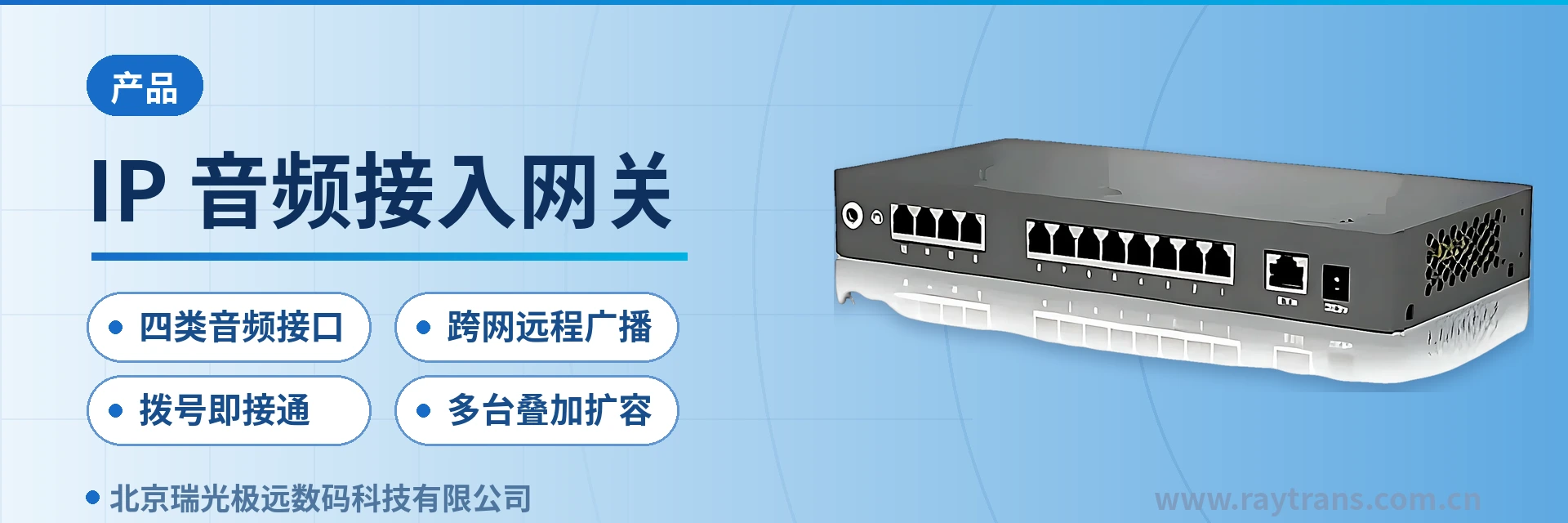
IP Audio Access Gateway
Four types of audio interfaces, input/output in the same unit, dial-to-connect on site, capacity expansion by stacking multiple units
The IDM-VG series audio access gateway interconnects with IP-PBX or other softswitch platforms through the network SIP protocol, and directly connects to any audio device downstream, such as microphones, loudspeakers, mixers, and conference terminals. This achieves voice access for these devices. These voice and audio devices can be reached directly by dialing their numbers.
The IP audio access gateway is the IDM-VG series audio access gateway, developed by Beijing Ruiguang Jiyuan Digital Technology Co., Ltd. (Raytrans), and is used to connect audio devices such as microphones, loudspeakers, mixers, and conference terminals to the IP voice network. As an IP access gateway, the device connects upstream to an IP-PBX or other softswitch platform through the standard SIP protocol, and connects downstream directly to on-site audio devices; a calling party can reach such voice and audio devices simply by dialing their numbers. Raytrans has accumulated rich experience in audio access and as a command and dispatch system manufacturer, and its product showcase covers a wide range of application scenarios.
Key specifications at a glance: TRS3.5mm · TRS6.3mm · RCA · XLR cannon connectors, four types of audio interfaces · standard SIP protocol upstream · input and output in the same unit · broadcast across LANs and the Internet · capacity expansion by stacking multiple units
One IDM-VG series audio access gateway provides both input and output interfaces, so it can connect audio input devices such as microphones as well as audio output devices such as broadcast power amplifiers. Existing analog audio devices on site do not need to be replaced; they can join the IP voice channel simply by being connected according to the interface type. As a complementary form to the SIP radio gateway and the SIP audio gateway, this series can flexibly adapt to the audio access requirements of government private network optical fiber communication solutions and smart mining communication solutions, and provides seamless interfacing with the platforms of command and dispatch system manufacturers.
How does one gateway support four types of audio interfaces?
One gateway provides four types of audio interfaces at the same time: TRS3.5mm, TRS6.3mm, RCA, and XLR cannon connectors. Existing microphones, mixers, power amplifiers, and conference terminals on site can be plugged in directly according to the connector type, with no need to add adapter boxes for interface mismatch. For a device serving as an IP access gateway, interface compatibility directly determines on-site deployment efficiency.
Input interfaces: all four terminal types — TRS3.5mm, TRS6.3mm, RCA, and XLR cannon connectors — can serve as audio inputs for microphones, audio pickups, mixers, and conference terminals.
Output interfaces: the same unit is also equipped with audio outputs for connecting loudspeakers and broadcast power amplifiers, delivering sound from the IP side to the site.
Mixed use: inputs and outputs can coexist on the same unit, collecting on-site sound for backhaul while playing remote announcements out to the site.
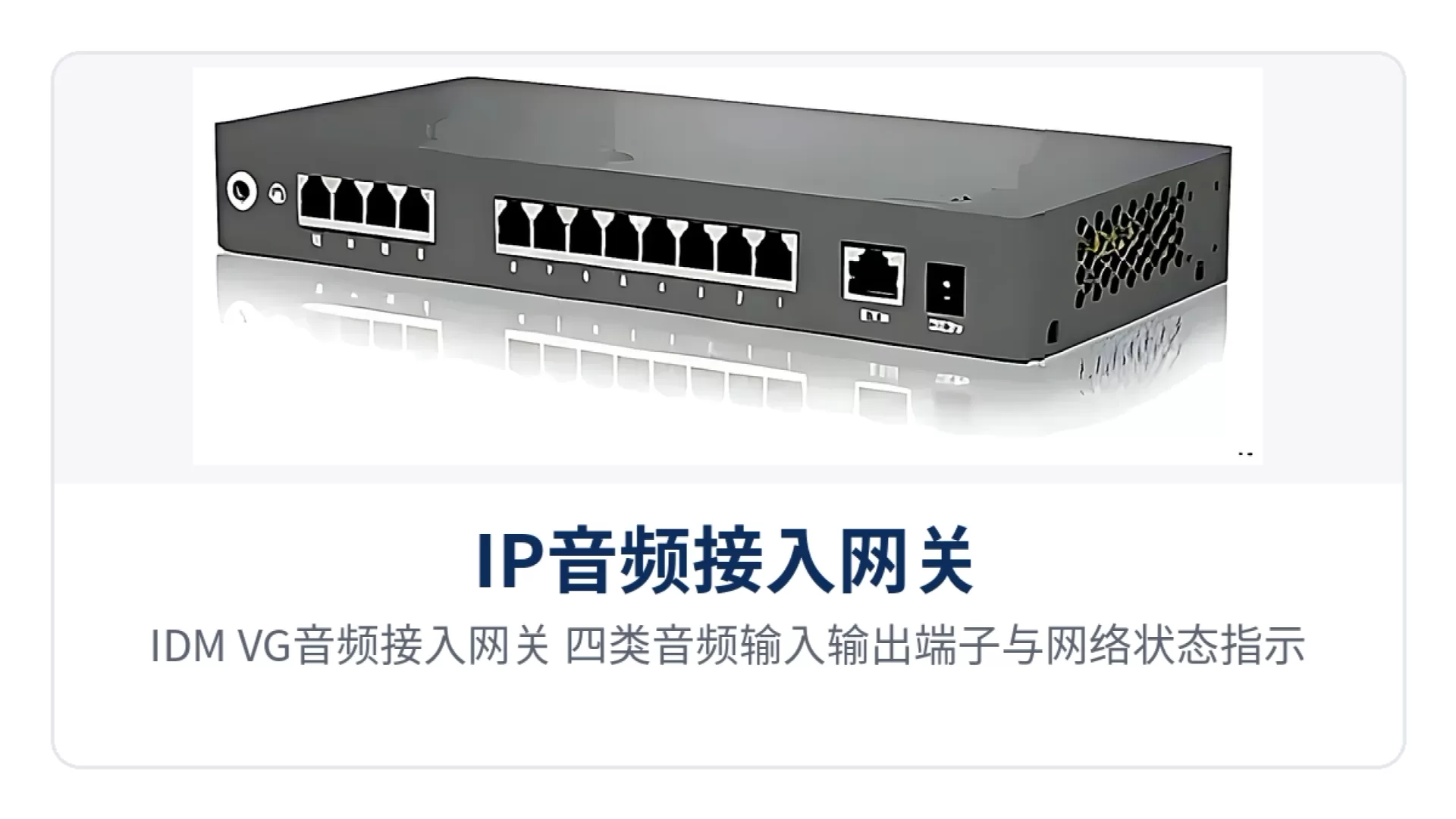
Figure 1: Close-up of the four types of audio input/output terminals and network status indicator LEDs on the IDM-VG audio access gateway
As a multi-interface audio gateway, the IDM-VG series integrates four types of interfaces and SIP conversion in a single unit; on site, users simply select the terminal matching the cable type to complete access. The number and arrangement of interface terminals are subject to the technical documentation supplied with the unit and the ordering configuration.
How does it access a softswitch via SIP and dial through to audio devices?
The IDM-VG series audio access gateway supports standard SIP and other protocols. After registering with an IP-PBX or other softswitch platform as a standard SIP terminal, it appears on the platform as a dialable number. When a dispatch console, IP telephone, or softphone dials this number, the voice channel is established to the site where the microphone or power amplifier is located. This capability also enables it to serve as a SIP audio gateway and to interface smoothly with dispatch platforms provided by command and dispatch system manufacturers.
Dialing through to audio devices is the direct use of this access method; the calling party does not need to operate any device on site or open dedicated broadcast software. The flexible network topology allows interfacing with other standard SIP devices, and the number plan follows the existing numbering rules of the softswitch platform.
How is cross-network remote broadcast implemented?
The audio sound reinforcement system transmits over a TCP/IP data network and can be used on a local area network in the same network segment, on a local area network across gateways, or on the Internet, so the broadcast scope is no longer limited by traditional broadcast cables or geography. A single gateway can handle remote point-to-point broadcast and can also organize remote point-to-multipoint broadcast, with the broadcast channel switched at any time.
Local area network in the same network segment: the gateway and the broadcast power amplifier are in the same network segment, and broadcast is completed directly on the local network.
Local area network across gateways: broadcast crosses multiple network segments and is forwarded by routing devices, suitable for zoned deployment in factories and industrial parks.
Internet: both ends are interconnected through the public network, and broadcast and audio pickup between remote sites and the center are organized by number.
All-digital transmission lets broadcast and audio pickup share the same data link, with less distortion and a higher signal-to-noise ratio (SNR) than analog signal transmission. Link bandwidth and port policies are planned according to on-site network conditions and verified with the network administrator before implementation. In government private network optical fiber communication solutions and smart mining communication solutions, such IP-based broadcast channels can be deployed in combination with existing optical fiber transmission links.
How are audio pickup backhaul and capacity expansion by stacking multiple units done?
The gateway supports remote audio pickup (monitoring), simultaneous audio pickup at multiple points (intelligent monitoring), as well as backhaul and live streaming, and the pickup (monitoring) channel can be switched flexibly. Duty personnel can switch channels on the softswitch side to listen to different sites one by one, without going on site to change wiring.
Stacking multiple units meets the requirements of multi-channel broadcast or multi-channel audio pickup; capacity is expanded by adding units per site, with unified numbering by the softswitch platform. On the IDM-MCC platform, service functions such as scheduled playback and automatic recording can also be implemented, and the device provides both automatic failure recovery and manual emergency recovery.
Overview of functions and performance specifications
The table below lists the capabilities of the IDM-VG series audio access gateway by function item; the four categories of capability — interfaces, broadcast, audio pickup, and capacity expansion — are carried by the same unit. During selection, users can check row by row according to the types of on-site audio devices and the broadcast scope, without purchasing multiple devices split by function.
Function | Description |
|---|---|
Four types of audio interfaces | Provides four types of audio input and output interfaces: TRS3.5mm, TRS6.3mm, RCA, and XLR cannon connectors |
Input and output in the same unit | One unit provides both input and output interfaces, connecting input devices such as audio pickups as well as output devices such as broadcast power amplifiers |
SIP protocol interconnection | Interconnects with an IP-PBX or other softswitch platform through the standard SIP protocol, and can interface with other standard SIP devices |
Dial-through to audio devices | Dialing the number directly reaches voice and audio devices such as microphones, loudspeakers, mixers, and conference terminals |
Remote point-to-multipoint broadcast | TCP/IP-based audio sound reinforcement system that supports remote point-to-point and point-to-multipoint broadcast on a local area network in the same network segment, a local area network across gateways, or the Internet, with flexible switching of broadcast channels |
Remote audio pickup and backhaul | Supports remote audio pickup (monitoring), simultaneous audio pickup at multiple points (intelligent monitoring), backhaul, and live streaming, with flexible switching of the pickup (monitoring) channel |
All-digital transmission | Less distortion and a higher signal-to-noise ratio (SNR) than analog signal transmission |
MCC platform services | Implements service functions such as scheduled playback and automatic recording on the IDM-MCC platform |
Automatic failure recovery | Provides both automatic failure recovery and manual emergency recovery |
Capacity expansion by stacking | Multiple units can be stacked to meet multi-channel broadcast or multi-channel audio pickup requirements |
The overall electrical and mechanical specifications are subject to the technical documentation supplied with the unit; items not given in the product documentation are marked as missing in the table below and are not filled in by inference. The determinable interface types, protocols, and network bearer modes are listed in the same row to facilitate the preparation of technical proposals and bid responses.
Item | Parameter/Specification | Description/Applicable Conditions |
|---|---|---|
Product series | IDM-VG series audio access gateway | Category: IP access gateway |
Audio input interface | TRS 3.5 mm, TRS 6.3 mm, RCA, XLR connector | Select terminals according to the on-site cable specifications; the number of terminals is subject to the ordering configuration |
Audio output interface | TRS 3.5 mm, TRS 6.3 mm, RCA, XLR connector | Configured in the same unit as the input interfaces; can connect to output devices such as broadcast power amplifiers |
Uplink protocol | Standard SIP protocol | Interconnects with IP-PBX or other softswitch platforms, and can interface with other standard SIP devices |
Network bearer | TCP/IP data network | LAN in the same network segment, LAN across gateways, or the Internet |
Broadcast mode | Remote point-to-point, remote point-to-multipoint | Broadcast channels can be switched flexibly |
Acquisition mode | Remote audio acquisition (monitoring), simultaneous multi-point acquisition (intelligent monitoring), backhaul, live streaming | Acquisition (monitoring) channels can be switched flexibly |
Transmission characteristics | All-digital transmission | Less distortion and a higher signal-to-noise ratio (SNR) than analog transmission |
Service expansion | Scheduled playback, automatic recording | Requires the IDM-MCC platform |
Reliability | Automatic failure recovery, manual emergency recovery | Perform emergency recovery on site according to the operating instructions |
Capacity expansion approach | Stacking multiple units | Meets the requirements for multi-channel broadcast or multi-channel audio acquisition |
Power supply and overall power consumption | not yet recorded in the knowledge base | Subject to the technical documentation supplied with the unit and the ordering confirmation |
Dimensions and installation method | not yet recorded in the knowledge base | Subject to the technical documentation supplied with the unit and the ordering confirmation |
Operating environment | not yet recorded in the knowledge base | Confirmed at ordering according to the equipment room and duty room conditions |
Typical Application Scenarios
Electric power, oil and petrochemicals, government, and transportation private networks share the same characteristics: audio devices are scattered across sites, few duty personnel are on site, and the dispatch side needs to reach the on-site sound at any time by number. The following describes, by industry, the positioning and access boundaries of the audio access gateway; for product showcase, you can refer to the IP access gateway and SIP radio gateway series of Raytrans for comparison and selection.
Electric power private network: substation broadcast and on-site audio backhaul
In substations and switching stations, broadcast speakers and microphones are installed in the equipment area and the main control room respectively, and audio cables form a network only within the station. The audio access gateway connects the speakers and microphones to the IP network within the station, so the dispatch side can dial to broadcast within the station or listen to the on-site sound without a dedicated broadcast main unit for each station.
After the in-station network accesses the dispatching data network through a cross-gateway link, broadcast and acquisition can be organized across stations: one gateway per audio site, with multiple stations stacked as required. The access mode runs in parallel with the existing SIP softswitch of the electric power private network, and the dialing habits of the dispatch console remain unchanged. As a command and dispatch system manufacturer, Raytrans can provide audio access support that connects with government private network optical fiber communication solutions.
Oil and petrochemicals: area broadcast and multi-point acquisition in process units
The sound reinforcement systems of refining units and oil transmission stations are divided by area, with speakers and power amplifiers concentrated in the cabinet room. The audio access gateway connects the area broadcast power amplifiers and on-site microphones to the IP bearer network, so the dispatch center can select area broadcast by number and can also acquire and backhaul audio from multiple process units simultaneously.
All-digital transmission lets long-distance broadcast and acquisition run over the same data link, with distortion and signal-to-noise ratio (SNR) better than analog methods. Both cross-gateway LAN and Internet access modes are available, and broadcast across plants and regions is organized under the same number rules; SIP audio gateways and SIP radio gateways can be selected separately according to the on-site device types.
Government and transportation: cross-network emergency broadcast and on-site duty
Audio sites at government emergency response duty points and along transportation lines are distributed across different LAN segments, and traditional broadcast is limited by cables and geography. The audio access gateway transmits over TCP/IP and can organize remote point-to-multipoint broadcast on the same network segment, across gateway LANs, or over the Internet, so one announcement sounds at multiple points simultaneously.
On the acquisition side, multiple sites can be monitored simultaneously with backhaul and live streaming, and duty personnel switch channels to check different sites. The device provides automatic failure recovery and manual emergency recovery, so the audio channels of unattended sites can remain connected; in smart mining communication solutions, the same type of gateway can also handle audio access between underground and surface.
From wiring to commissioning: how is the audio access gateway deployed?
On-site implementation of the audio access gateway proceeds in four steps: wiring, network access, registration, and commissioning. Each step has its own items to verify, and the next step starts only after the previous one is confirmed, which avoids rework on the day of official commissioning.
Wiring: connect microphones and mixers to the input terminals and broadcast power amplifiers to the output terminals, select TRS 3.5 mm, TRS 6.3 mm, RCA, or XLR connectors according to the on-site cable specifications, and label each cable.
Network access: connect the gateway to the TCP/IP data network carrying audio services, configure same-segment LAN or cross-gateway addresses according to the on-site plan, and confirm route reachability to the softswitch platform.
Registration: register the gateway's SIP account and number on the IP-PBX or other softswitch platform, confirm that the registration status is normal, and verify the interfacing parameters with other standard SIP devices.
Commissioning: dial numbers to test point-to-point connection, point-to-multipoint broadcast, and audio acquisition backhaul, and verify level and channel switching item by item; for sites requiring scheduled playback and automatic recording, verify again after connecting to the IDM-MCC platform.
After the four steps, it is recommended to keep a number and channel cross-reference table recording the audio site, broadcast scope, and acquisition channel corresponding to each number. When expanding capacity by stacking devices later, number them according to the same table, so O&M handover and troubleshooting can be checked directly; if interconnection with an existing platform of a command and dispatch system manufacturer is required, the numbering rules can also be verified at this stage.
Conclusion
The IP audio access gateway connects on-site audio devices with the IP voice network into a number-reachable path: four types of audio interfaces let microphones, speakers, mixers, and conference terminals connect directly, the SIP protocol lets softswitches interconnect in a standard way, and TCP/IP bearer lets broadcast and acquisition be organized across LANs and the Internet.
Audio sites in electric power, oil and petrochemicals, government, and transportation private networks are scattered and few personnel are on duty; one gateway handles one site, and multiple units stacked meet multi-channel broadcast and multi-channel acquisition needs. During selection, first verify the interface specifications of on-site audio devices and the broadcast scope, then determine the number of units to deploy and the channel plan; Raytrans can provide product showcase and technical support for matching IP access gateways, SIP radio gateways, and SIP audio gateways in combination with government private network optical fiber communication solutions and smart mining communication solutions.