IDM Fixed-Line Telephone to Wireless Headset
4-channel telephone to Ethernet, one main unit with 4 body-worn headsets, answer key as PTT
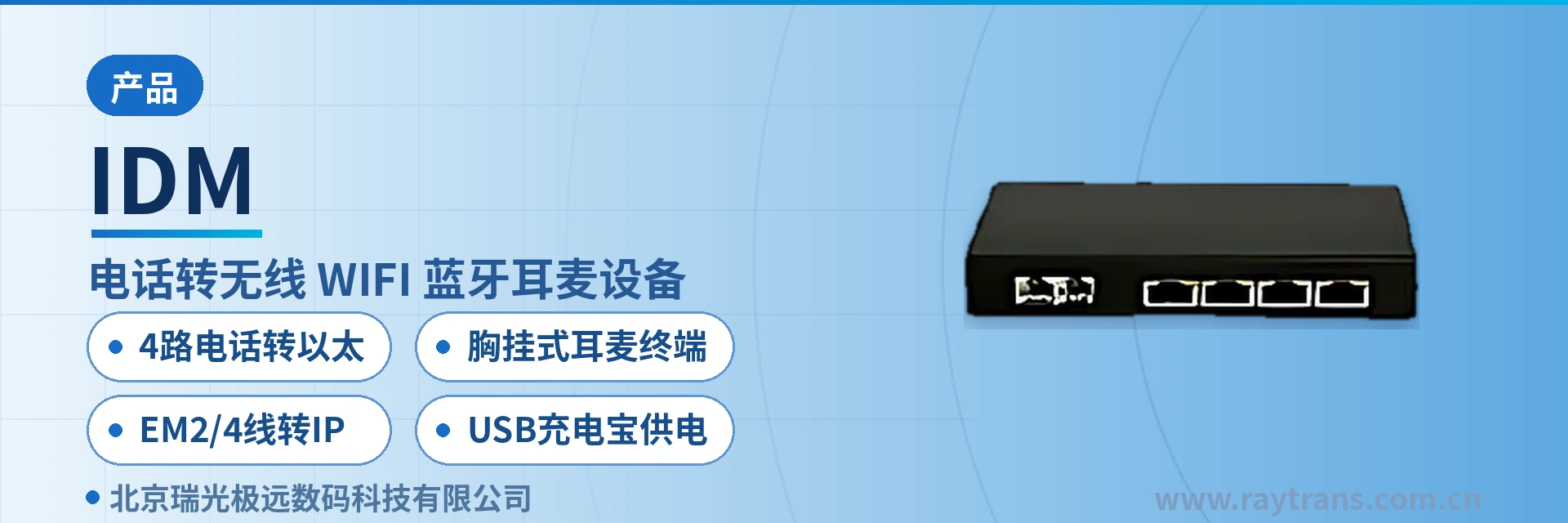
IDM fixed-line to wireless devices include the IDM NT204 (IP) for connecting fixed-line telephones, which can simultaneously provide audio access for 4 telephone lines and convert it to Ethernet; the IDM IP-talkie can connect wireless headsets and provides a call answer (or volume +, volume -) button.
IDM Fixed-Line Telephone to Wireless WiFi/Bluetooth Headset Device is an IP access terminal that converts fixed-line telephone audio and radio voice into IP signals and delivers them wirelessly to headsets. It consists of two parts: IDM NT204 (IP) on the telephone side and IDM IP-talkie on the headset side. The two sides pair independently, and one main unit can correspond to one or more headset terminals.
The device addresses call continuity after people and equipment are separated: when command personnel leave the dispatch console to handle other matters, the call remains connected on the headset they wear. In factory and community duty rooms, offices and home scenarios, the length of the handset cord no longer determines the answering range; the answering distance is determined by wireless coverage. As a fixed-line-to-wireless-headset solution for command and dispatch system manufacturers and integrators, Raytrans provides a clear form reference in its product showcase for this category.
Key Specifications at a Glance: 4 telephone lines to Ethernet · 4 headset pairings · EM 2/4-wire to IP · Bluetooth single-channel direct connection · WIFI single-channel direct connection · USB power bank supply
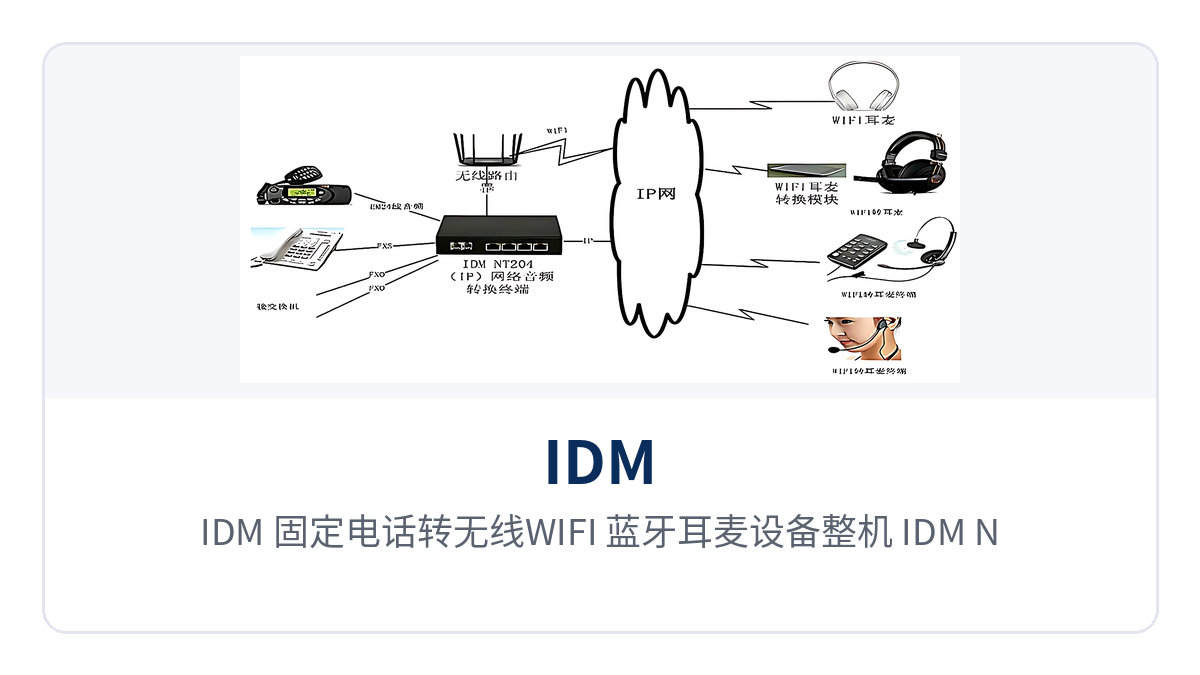
Figure 1: IDM Fixed-Line Telephone to Wireless WiFi/Bluetooth Headset Device, IDM NT204 (IP) main unit and IDM IP-talkie chest-worn terminal
What two parts make up the IDM Fixed-Line Telephone to Wireless WiFi/Bluetooth Headset Device?
The device is divided into a telephone side and a headset side, connected in between by a wired Ethernet or WIFI channel. The telephone side is IDM NT204 (IP), an IP access terminal installed near the telephone or dispatch console that converts the audio of 4 telephone lines into Ethernet data. The headset side is IDM IP-talkie, worn by on-duty personnel, which restores IP voice to the headset and receives key operations.
The two segments work without relying on a central platform; the main unit and the terminal pair directly. Upgrades on the dispatch console side are concentrated on the main unit, the movement range of on-duty personnel is determined by WIFI coverage, and the existing telephones and numbers remain unchanged. On site, the whole set is also often called a fixed-line-to-wireless-headphones device, a telephone-to-wireless-headset device or a WIFI intercom headset gateway; Raytrans gives a complete description of this in its product showcase for command and dispatch system manufacturers.
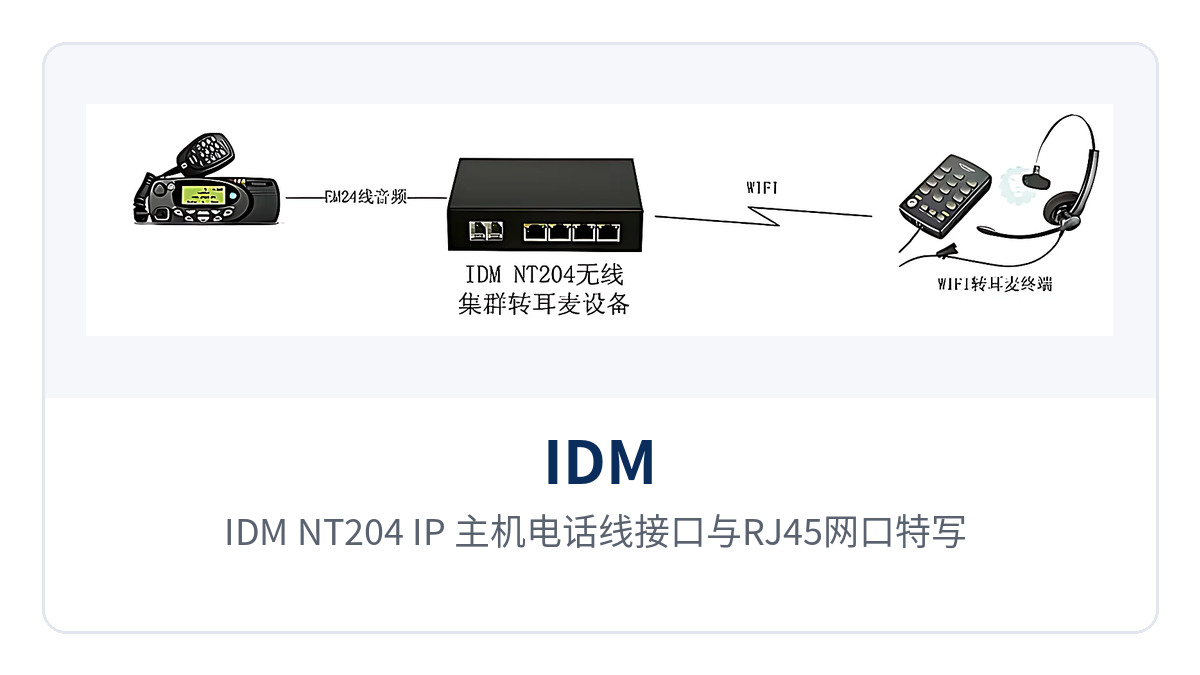
Figure 2: Close-up of the telephone line interfaces and RJ45 connector on the IDM NT204 (IP) main unit, with 4 channels of telephone audio access converted to Ethernet
What functions does this device provide?
The functions are organized into four groups: telephone access, wireless answering, radio transfer and platform access, each corresponding to a type of on-site service action. During selection, first confirm how many telephone lines are on site, whether there is a radio set, and whether access to the dispatch platform is required, then determine the main unit interface form and the number of terminals.
Function Group | Function | Description |
|---|---|---|
Telephone access | 4-channel telephone audio access | IDM NT204 (IP) can simultaneously provide audio access for 4 telephone lines and convert it into Ethernet data |
Telephone access | Independent pairing | IDM NT204 (IP) and IDM IP-talkie can pair independently without relying on a central service |
Wireless answering | Wireless headset answering | IDM IP-talkie connects to a wireless headset, so personnel can still answer calls after leaving the telephone |
Wireless answering | Answer key operation | The terminal provides a call answer key and also supports volume+ and volume- key operations |
Wireless answering | Dual-ear split voice | In some applications the voice played in the left and right headphones differs and can be delivered separately to each ear |
Wireless answering | Bluetooth single-channel direct connection | When the main unit is configured with a Bluetooth interface, it provides conversion for 1 telephone voice interface, directly corresponding to one Bluetooth headset |
Wireless answering | WIFI single-channel direct connection | When the main unit is configured with a WIFI interface, it provides conversion for 1 telephone voice interface, directly corresponding to one headset |
Radio transfer | EM 2/4-wire radio access | The EM 2/4-wire audio interface converts radio voice into IP signals, and the headset answer key acts as the PTT switch of the radio set |
Platform access | IoT protocol access | Devices on both sides can access the IoT communication server through IoT protocols to extend services such as recording, positioning and trunking |
How many telephone lines and headsets can one main unit support?
Capacity is determined by the interface form of the main unit; the three configurations of RJ45 wired network port, Bluetooth and WIFI correspond to different numbers of telephone lines and terminals. After selecting the configuration according to the number of on-site telephone lines and the movement range of personnel, the number of terminals corresponds one-to-one with the main unit ports, with no need to add extra aggregation equipment.
Item | Parameter/Specification | Description/Applicable Conditions |
|---|---|---|
RJ45 wired network port capacity | 4-channel fixed-line telephone conversion interface | One IDM NT204 (IP) corresponds to 4 IDM IP-talkie WiFi intercom headsets |
Bluetooth interface capacity | 1-channel telephone voice interface | When the Bluetooth interface is configured, it directly corresponds to one Bluetooth headset |
WiFi interface capacity | 1-channel telephone voice interface | When the WiFi interface is configured, it corresponds to one headset |
Telephone access mode | Fixed-line telephone line audio access | Connected on the telephone or dispatch console side, converting audio to Ethernet |
Radio set access mode | EM 2/4-wire audio interface | Converts radio set voice to IP signals, suitable for dispatching scenarios with radio sets |
Terminal power supply | Built-in power bank, charged by a mobile phone USB charger | Battery capacity is ordered according to the nature of the work |
Platform access | IoT protocol | After connecting to the IoT communication server, recording, positioning display, trunking intercom and audio conferencing are extended |
Terminal wearing | Chest-mounted | The IDM IP-talkie is hung on the chest like an employee badge, with a headset style of your choice |
Four capability labels: 4-channel telephone-to-Ethernet, chest-mounted headset terminal, EM 2/4-wire-to-IP, USB power bank supply
Each of the four capability labels corresponds to a specific interface or component. The following explains item by item the problems they solve and the configuration required. When checking a list or performing on-site acceptance, you can locate each item by label without going through the entire manual. The labels correspond one-to-one with the interfaces, so reading a label tells you which cable to connect and which terminal to configure.
4-channel telephone-to-Ethernet: a single IDM NT204 (IP) converts the audio of 4 telephone lines into Ethernet data through the RJ45 connector, corresponding to 4 IDM IP-talkie headsets.
Chest-mounted headset terminal: the IDM IP-talkie is hung on the chest like an employee badge, the headset style is chosen by the user, and answering does not require staying by the telephone.
EM 2/4-wire-to-IP: the EM 2/4-wire audio interface converts radio set voice into IP signals, and the answer key on the headset acts as the PTT switch on a radio set.
USB power bank supply: the terminal has a built-in power bank and can be recharged with a mobile phone USB charger; the battery capacity can be ordered according to the nature of the work.
How is radio set voice brought into the dispatch system? EM 2/4-wire interface and PTT takeover
Dispatching scenarios with radio sets use the EM 2/4-wire audio interface. The IDM NT204 (IP) converts the voice signal of the radio set into IP signals and sends them to the headset, and the answer key on the headset also controls speaking: pressing it is equivalent to the PTT switch on a radio set. On-duty personnel therefore do not need to stay beside the radio set; both announcement and listening are done on the headset.
For the interface definition, gain and wiring sequence on the radio set side, verify against the supplied technical documentation together with the on-site radio set model before wiring. When the left and right ears receive voice from different sources, the receiving channels are assigned by service to avoid crosstalk between the two voice paths. After wiring is complete, first test a single channel, then integrate it into the call handling process of the dispatch console.
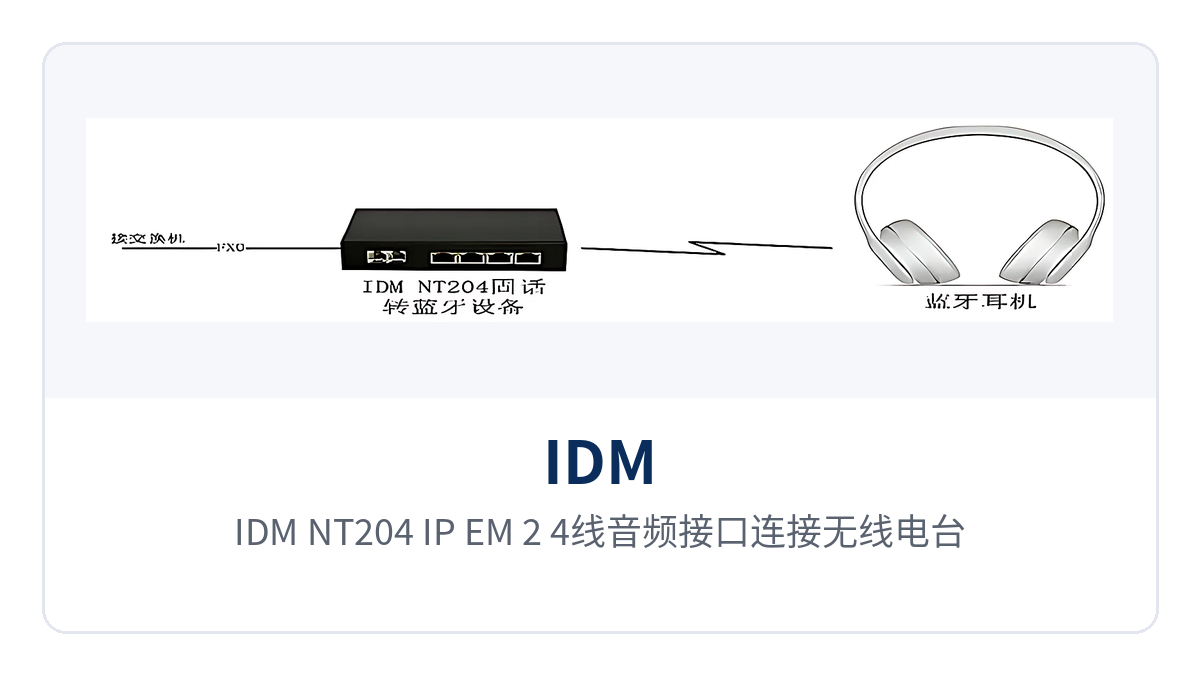
Figure 3: IDM NT204 (IP) EM 2/4-wire audio interface connected to a radio set, illustrating radio set voice-to-IP conversion
How is the IDM IP-talkie worn and charged?
The IDM IP-talkie is a WiFi-to-headset interface terminal, worn in the same way as an employee badge, simply hung on the chest, with the headset style chosen by the user. The terminal provides a call answer key and also supports volume+ and volume- operations, so answering while moving around does not require returning to the workstation.
Power is supplied by a built-in power bank design, rechargeable with a mobile phone USB charger, so no separate power cable is needed for the terminal. The battery capacity can be ordered according to the nature of the work: choose the high-capacity version for long-duty positions, and for inspection positions a spare battery per shift is sufficient.
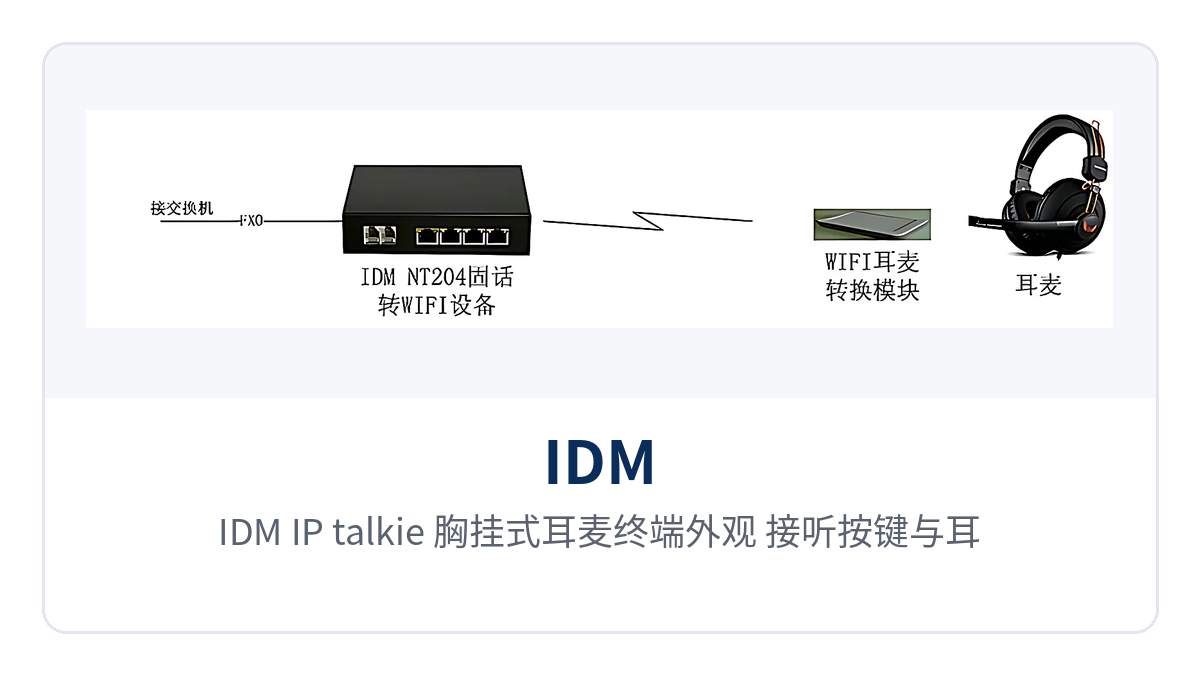
Figure 4: IDM IP-talkie chest-mounted headset terminal appearance, answer key and headset jack
How is this equipment used in three types of sites?
How do telephone calls in the command and dispatch hall follow the person?
Telephones in the command and dispatch hall are concentrated on the dispatch console, and when personnel get up to patrol the floor or handle other incidents, the calls cannot follow them. Connect the 4 telephone lines to the IDM NT204 (IP) IP access terminal, and the dispatcher wears the IDM IP-talkie, so incoming calls go directly to the headset and getting up does not affect answering. When the WiFi coverage in the hall is stable, one main unit can serve 4 on-duty personnel wearing terminals at the same time.
There is no need to run a separate handset cable for each telephone between operator seats; cabling changes are concentrated on the main unit side. The telephones and numbers of the dispatch console remain unchanged, and on-duty personnel only need to confirm the terminal battery level and pairing status when taking over a shift. When adding an operator seat, simply add one telephone line and one terminal on the remaining ports of the main unit. As a typical product showcase of a command and dispatch system manufacturer, this fixed-line-to-wireless-headset solution from Raytrans is particularly intuitive in the dispatch hall scenario.
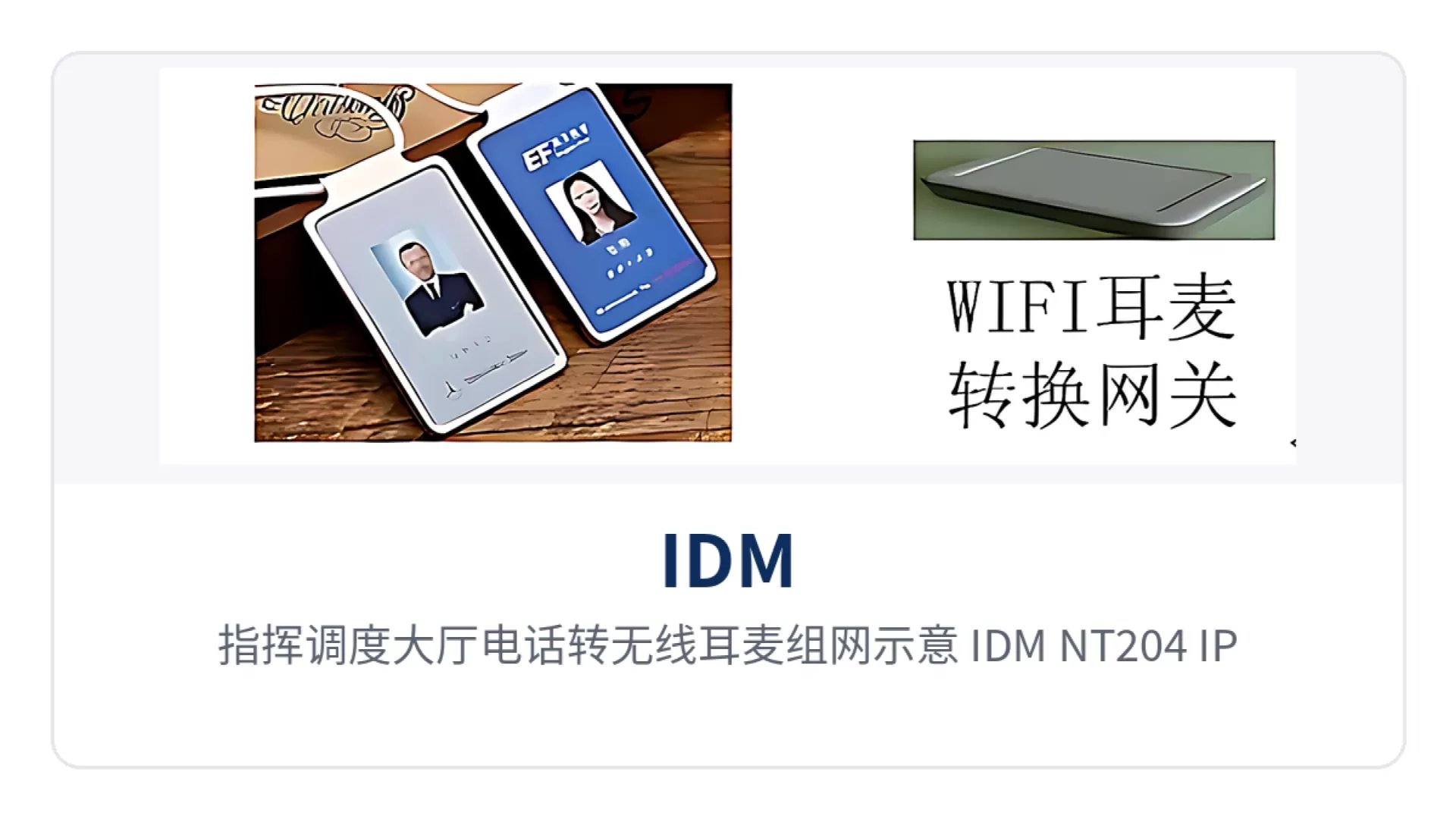
Figure 5: Networking schematic of telephone-to-wireless-headset in the command and dispatch hall, IDM NT204 (IP) main unit and 4 IP-talkie terminals
How are telephones in factory and community duty rooms connected?
Factory and community duty rooms are closer to the daily use of fixed-line-to-wireless-headset equipment: the duty operator has to patrol buildings, open doors and receive visitors, and cannot sit by the telephone all the time. Use one main unit to convert the duty telephone into Ethernet data and pair it with one chest-mounted terminal, and the call follows the person wherever they go.
Office and home scenarios can use a single-channel Bluetooth or WiFi configuration only, with one main unit corresponding to one Bluetooth headset or one headset, and the answering range determined by wireless coverage. For cases with only one telephone line and no intention of replacing the telephone, the single-channel configuration requires very little modification.
How do private network communication integrators calculate the number of devices?
Integrators care about the amount of modification and list calculation: one NT204 (IP) carries 4 telephone lines converted to Ethernet and pairs with 4 IP-talkie headsets, and the dispatch console side only needs one network port and 4 telephone line connections. Terminals and the main unit are paired independently, so no device needs to be added beside each telephone.
At delivery, the main unit is installed in the equipment room or on the dispatch console cabinet side, and terminals are issued with personnel; subsequently adding or removing one telephone line only affects port assignment on the main unit, without redoing the cabling of an entire floor. Spare parts are configured according to the number of terminals, and battery capacity and headset style are determined together at ordering. Raytrans can provide a complete product showcase and selection list, making it easy for integrators to calculate by number of channels.
What more can be done after connecting to the IoT communication server?
The IDM NT204 (IP) and IDM IP-talkie can connect to the IoT communication server using the IoT protocol, and after being integrated into the IoT large platform, more services are extended: the recording, positioning and conferencing functions on the platform side do not require changes to on-site wiring, and are enabled by account after access.
Recording: call voice is recorded on the platform side, facilitating later review and responsibility determination.
Positioning information display: the terminal reports its position, and the dispatch large display can show the area where personnel are currently located.
Wireless trunking intercom: interworking with the wireless trunking system, telephone and intercom are switched on the same headset.
Audio conferencing: multiple terminals join the same audio conference, so on-duty personnel do not need to gather in a conference room.