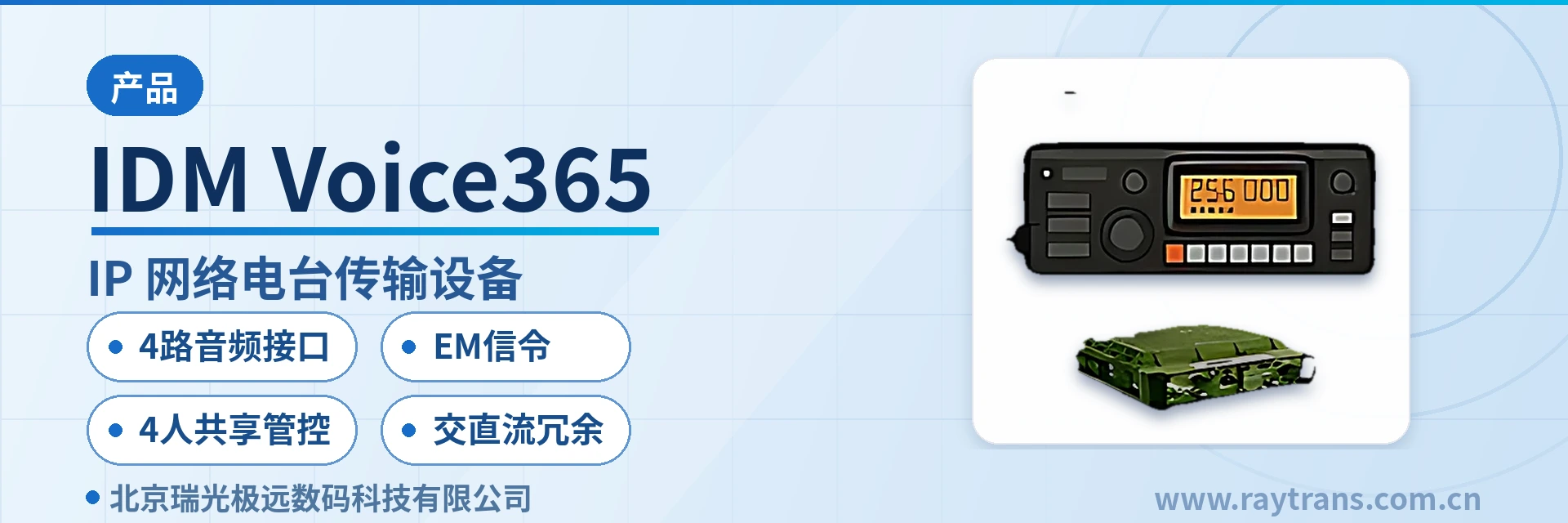
IDM Voice365-4 IP Network Radio Transmission Device
4-channel radio audio network access, 1 radio shared and controlled by 4 operators, point-to-multipoint networking
The IDM Voice365-4 IP network radio transmission device can transmit radio audio signals and status and control information over an IP network. It can be registered with an IoT server for use, or deployed in a local area network (LAN). The IP network radio transmission device can be used point-to-point as an extension of radio signals over an IP network. It can also be networked for transmission to achieve point-to-multipoint transmission control. The IP network radio transmission device has 4 audio channels and can connect to the audio of 4 radios. It can also connect to 4 remote control consoles.
IDM Voice365-4 4-Channel Radio Audio IP Transmission Device is an IP access gateway and shared management and control device developed by Beijing Ruiguang Jiyuan Digital Technology Co., Ltd., a product under the Raytrans brand. It is used to connect radio audio signals as well as status and control information to IP network transmission, realizing IP-extended transmission of radio audio. At the radio end, this device provides 4 audio interfaces with E&M signaling, and each audio interface connects to 1 radio interface. A single device can connect the audio of 4 radios, and can also connect 4 remote control stations, meeting the needs of command and dispatch system manufacturers for unified access of multiple radios.
At the operation and control end, IDM Voice365-4 provides 4 E&M 2/4-wire interfaces, and each interface can simultaneously connect 4 radios, allowing simultaneous listening to 4 radios. Radio audio is transmitted to the remote end over an IP channel and then shared and distributed, so 1 radio can be managed and used by 4 people at the same time. This suits shared control applications of radio audio channels and also facilitates shared management and control of radio audio in military emergency communications vehicle solutions.
Key Specifications at a Glance: 4 radio audio interfaces (with E&M signaling) · 4 E&M 2/4-wire control interfaces · 1 radio shared by 4 users · IP point-to-point extension and point-to-multipoint networking · AC/DC dual-channel redundant power supply · automatic switchover to +24V DC on AC failure · real-time fault indication via LED
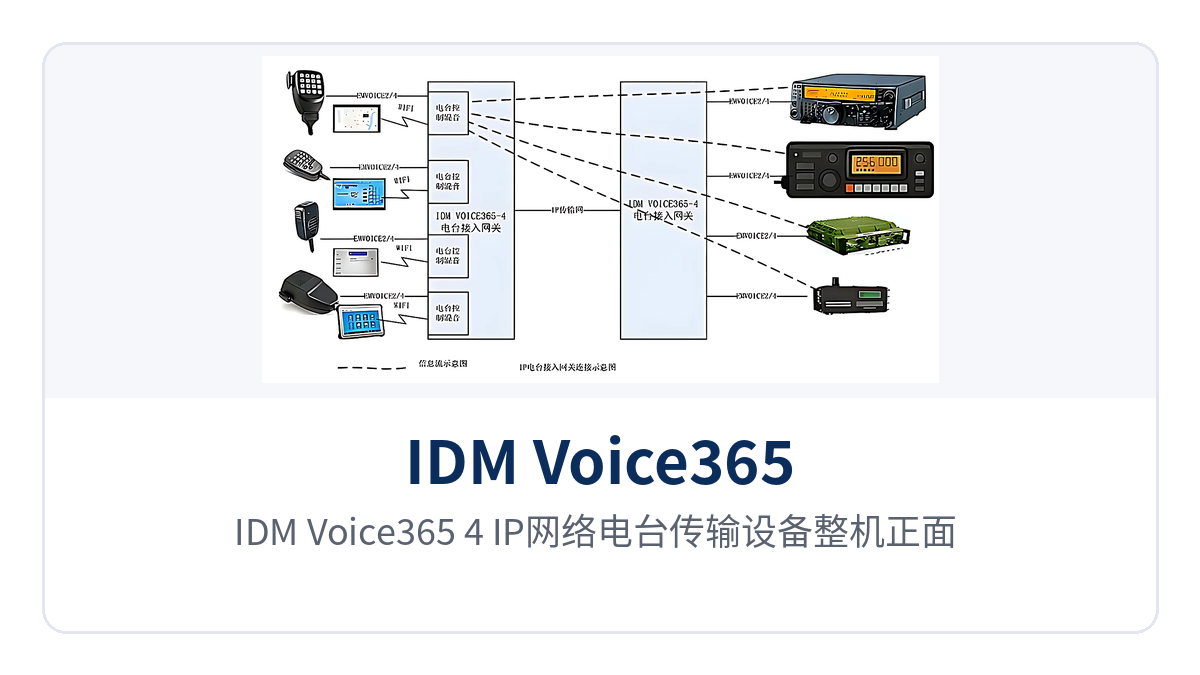
Figure 1: Front view of the IDM Voice365-4 IP network radio transmission device, showing the 4 audio interfaces at the radio end and the E&M 2/4-wire interface panel at the control end
What Is a 4-Channel Radio Audio IP Transmission Device? How Are Point-to-Point and Networking Used Respectively?
The positioning of this IP access gateway is to free radio audio from the constraints of local cables and carry it directly over an IP network. In point-to-point use, IDM Voice365-4 connects to a radio on the radio side and to a dispatch console or audio channel on the control side, extending radio audio signals over the IP network, so the voice heard at the remote end is consistent with listening beside the radio. In networking use, multiple devices form a point-to-multipoint network on the same IP bearer network, aggregating radio audio scattered across different sites to the same control end for centralized distribution and management and control.
Remote audio sharing is the main usage of this device. Radio audio is transmitted to the remote end over an IP channel and then shared and distributed. The control end does not need to be in the same place as the radio; wherever the dispatcher is, the radio voice can be listened to and managed there. This structure suits aggregating radio audio scattered across multiple locations to one dispatch console, and duty operator seats can also be set flexibly by shift.
Point-to-Point: IP Network Extended Transmission of Radio Audio
- The radio and the dispatch end are connected by an IP network, and IP network extended transmission of radio audio replaces the original one-to-one audio cables.
- Each remote control station can work with a PAD console to connect to any radio, and the remote control station does not have to belong to a fixed radio.
- It is suitable for scenarios where a remote radio is moved beside the dispatch console for use, such as audio extension between a fixed station and a rear command post.
Networking: Point-to-Multipoint Transmission Control
- Multiple devices form an IP bearer network to complete point-to-multipoint transmission control, and the voice of multiple radios is aggregated at the same control end.
- The device can be registered with an IoT server for use, or can be used in independent networking within a local area network (LAN). The two methods are selected according to on-site network conditions.
- The original operating mode of the radio does not need to be changed. The control end issues operations such as listen inhibit, mute, recording, and volume adjustment through the PAD console.
Core Functions and Interfaces
The functions of IDM Voice365-4 can be divided into three categories: radio-side access, control-side management and control, and IP-side sharing. These three capabilities are provided by the same IP access gateway, and no separate device needs to be configured on site for each category of function.
Radio-Side Access: 4 Audio Interfaces with E&M Signaling
- The radio end provides 4 audio interfaces, each of which is a radio audio interface with E&M signaling, and each audio interface connects to 1 radio interface.
- The 4 audio interfaces can connect the audio of 4 radios, and can also connect 4 remote control stations.
- Interface configuration is selected according to the number of on-site radios, and a modular design facilitates organizing access according to site scale.
Control-Side Management and Control: 4 E&M 2/4-Wire Interfaces and PAD Console
- The operation and control end provides 4 E&M 2/4-wire interfaces, and each interface can simultaneously connect 4 radios.
- It can simultaneously listen to 4 radios, and can also perform operations such as listen inhibit, mute, recording, deletion, and addition on any radio.
- One remote control station can simultaneously control multiple radios, and through the PAD console it can perform functions such as mute, listen inhibit, recording, and volume adjustment for each radio.
- The ways voice is sent from the console to the radio include PTT control mode, VAD voice activation mode, and PAD console operation mode. Transmit enable and receive enable can be realized through the console.
Shared Management and Control: 1 Radio Managed by 4 Users Simultaneously
Sharing of radio audio channels is one of the core values of this device. Multiple radio audio channels are transmitted to the remote end over the IP network and then distributed by the control end. 1 radio can be managed and used by 4 people at the same time, and the shared control of each seat does not conflict. The transmit and listening states of the same radio are uniformly issued by the PAD console. When multiple seats are online at the same time, they will not preempt the channel from each other, and changes in duty personnel do not affect the wiring at the radio end.
Function Overview
| Function | Description |
|---|---|
| Radio audio access | The radio end provides 4 audio interfaces with E&M signaling, each audio interface connects to 1 radio interface, and up to 4 radios can be connected |
| Remote control station access | The 4 audio interfaces can also connect 4 remote control stations, and each remote control station can work with a PAD console to connect to any radio |
| IP network extended transmission | Used point-to-point to extend radio audio signals over the IP network to the remote end |
| Point-to-multipoint networking | Multiple devices are networked for transmission to complete point-to-multipoint transmission control |
| Remote audio sharing and distribution | Audio is transmitted to the remote end over an IP channel and then shared and distributed, supporting shared control applications of radio audio channels |
| 4-user shared management and control | 1 radio can be managed and used by 4 people at the same time, with no conflict in shared control |
| Multi-radio connection at the control end | The control end has 4 E&M 2/4-wire interfaces, and each interface can simultaneously connect 4 radios |
| Multi-radio listening and operation | It can simultaneously listen to 4 radios, and can also perform listen inhibit, mute, recording, deletion, and addition on any radio |
| Voice sending modes | Provides PTT control mode, VAD voice activation mode, and PAD console operation mode |
| Transmit and receive enable | Transmit enable and receive enable are realized through the console |
| AC/DC redundant power supply | AC 220V is primary and DC is backup; on AC power failure, it automatically switches to an external +24V DC supply |
| Real-time fault detection | Displays fault status through indicator LEDs |
Technical Specifications and Interfaces
| Item | Parameter/Specification | Description/Applicable Conditions |
|---|---|---|
| Radio audio interfaces | 4 channels, with E&M signaling | Each audio interface connects to 1 radio interface, and can connect 4 radios or 4 remote control stations |
| Control-end interfaces | 4 E&M 2/4-wire interfaces | Each interface can simultaneously connect 4 radios, supporting simultaneous listening to 4 radios |
| Transmission network | IP network | Can be registered with an IoT server for use, or used in networking within a LAN |
| Transmission mode | Point-to-point extended transmission / point-to-multipoint networking | Point-to-point serves as the extension of radio signals over the IP network; networking completes point-to-multipoint transmission control |
| Voice sending modes | PTT control mode / VAD voice activation mode / PAD console operation mode | Transmit enable and receive enable can be realized through the console |
| Audio sharing method | Remote sharing and distribution | Audio is transmitted to the remote end over an IP channel and then shared and distributed |
| Number of radio sharing seats | 1 radio managed by 4 users simultaneously | Shared control applications of radio audio channels |
| Power supply structure | Modular design, AC/DC dual-channel redundant power supply | AC 220V power is primary and DC power is backup |
| Power switchover | Automatic switchover to +24V DC on AC failure | The switchover target is an externally supplied +24V DC power source |
| Fault detection | Indicator LEDs | Real-time fault detection and display of fault status |
Differentiated Value: One Unit for Four Channels, 4-User Sharing, AC/DC Redundancy
Compared with the practice of stacking multiple single-channel devices together, the value of IDM Voice365-4 is concentrated in three verifiable capabilities. A single device provides 4 radio audio interfaces with E&M signaling, one unit for four channels, saving cabinet space, power connectors, and wiring; 1 radio can be managed by 4 people at the same time, with no conflict in shared control, and duty seats can be added or removed by shift; AC/DC dual-channel redundant power supply keeps radio services carried when AC power fails, and the switchover is completed automatically by the device, so on-duty personnel do not need to handle it on site.
| Differentiation Point | Customer Value |
|---|---|
| 4 audio interfaces: a single device provides 4 radio audio interfaces | A single device provides 4 radio audio interfaces with E&M signaling, one unit for four channels. |
| E&M signaling: each audio interface includes associated E&M signaling | The control end interfaces through 4 E&M 2/4-wire interfaces and can simultaneously listen to 4 radios |
| 4-user shared management and control: 1 radio can be managed by 4 people simultaneously | 1 radio can be managed by 4 people at the same time, with no conflict in shared control. |
| AC/DC redundancy: AC 220V primary, DC +24V backup | AC/DC dual-channel redundant power supply, with automatic switchover to +24V DC on AC failure. |
Typical Application Scenarios
Emergency Communications and Public Safety Private Networks
In military emergency communications vehicle solutions, there is often a distance between the emergency communications vehicle, the on-site command post, and the rear command center that cannot be covered by cables, and radio is the main voice means between the site and the rear. As an IP access gateway, Raytrans IDM Voice365-4 connects the audio of on-site radios to the IP network and transmits it to the command center via satellite, 4G/5G, or a private network. The command center can simultaneously listen to multiple radios and perform listen inhibit, mute, and recording on any radio. With multi-seat duty, 1 radio can be managed by 4 people at the same time, and the commander and the communicator each listen to their own channel, with no conflict in shared control, so voice reported from the site will not be missed due to insufficient seats. This kind of radio audio shared management and control capability is exactly the product showcase indicator that command and dispatch system manufacturers focus on in emergency scenarios.
Industrial Private Networks Such as Electric Power and Rail Transit
In power dispatch and rail transit train dispatch, stations and unattended stations have many radios and distributed sites, and the cost for maintenance personnel to change stations is high. Using IDM Voice365-4 to aggregate the radio audio of each station to the dispatch center, dispatchers can listen to and manage remote radios from the center without laying audio cables separately for each radio. The device adopts a modular design and AC/DC redundant power supply, and the DC power system in the station can be directly used as backup power. On AC power failure, it automatically switches to an external +24V DC supply, adapting to stations such as substations and traction substations that have requirements for power supply continuity. Such government private network optical fiber communication solutions and industrial private network scenarios place particularly prominent requirements on the stability and redundancy capability of IP-extended transmission of radio audio.
Unattended Field Radio Stations
Field radio stations are unattended year-round, and once communications are interrupted, the cost of troubleshooting by visiting the site is very high. IDM Voice365-4 has real-time fault detection capability and displays fault status through indicator LEDs, so device status can be read directly during on-site inspection or remote video inspection; the device can be registered with an IoT server for use, incorporating site status into unified IoT monitoring. Radio audio and control information are backhauled over the IP network, so on-duty personnel can confirm at the remote end whether the radio is online and whether the voice is normal, reducing unnecessary site visits. As an IP network radio transmission device, its remote status backhaul capability provides reliable support for unattended scenarios.
Deployment and Wiring Key Points
During on-site deployment, cable wiring and the choice of voice sending mode directly determine whether the radio can be taken over smoothly.
- Radio-side wiring: Connect each radio's audio interface to the 4-channel audio interface on the radio side of the device, check the EM signaling channel by channel, and confirm that each channel corresponds to 1 radio interface.
- Remote control console wiring: When a remote control console is required, connect it to the 4-channel audio interface, and according to the on-site assignment, direct the remote control console together with the PAD dispatch console to the target radio.
- Control-side wiring: Connect the dispatch console or remote control console to the 4 E&M 2/4-wire interfaces; each interface can serve 4 radios, assigned according to the number of duty operator seats.
- Mode setting: Select PTT control mode, VAD voice activation mode, or PAD console operation mode according to on-site usage habits; when needed, set the transmit enable and receive enable through the console.
- Power supply wiring: Connect AC 220V to the main power supply, and also connect an external +24V DC supply as backup; confirm that the device automatically switches to the DC power supply when the AC supply fails.
- Provisioning check: After power-on, observe the indicator LEDs, check the audio and signaling of each radio one by one, and confirm there is no failure indication before enabling services.