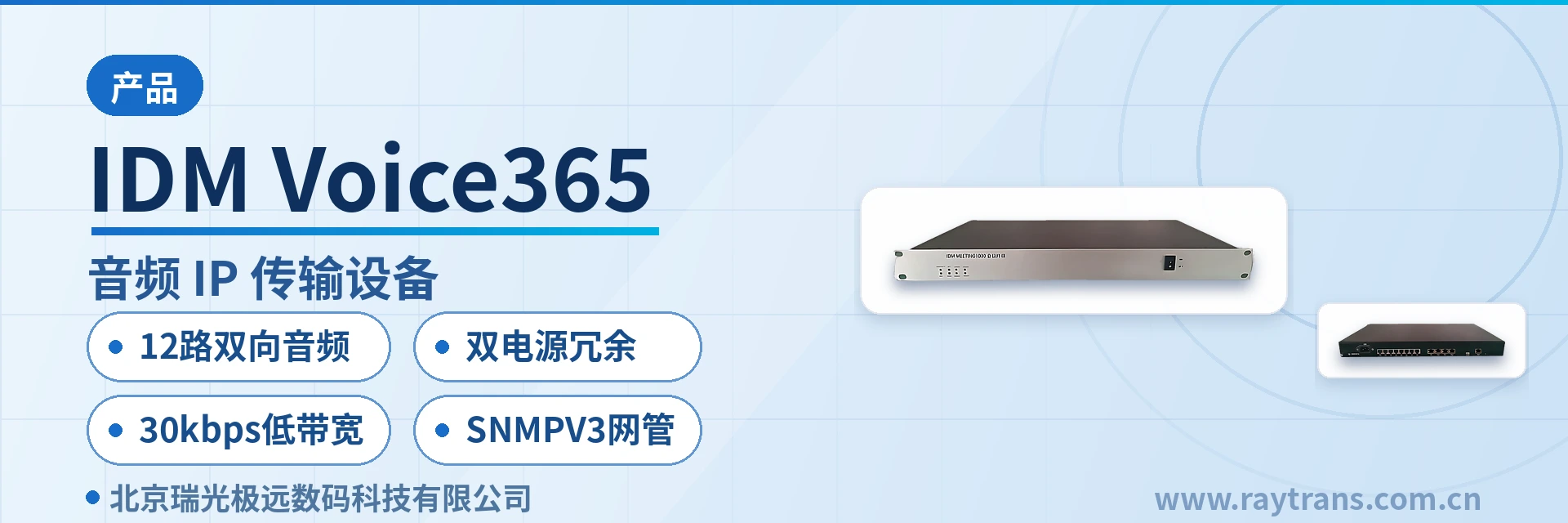
IDM Voice365-12 Audio IP Transmission Device
12-channel 4-wire audio with channel-associated signaling, lossless PCM narrowband 30k, AC/DC dual power supply
The IDM Voice365-12 is an audio IP transmission device that can transmit high-fidelity audio and control information over IP networks. It can be registered with an IoT server or networked within a local area network.
IDM Voice365-12 audio IP transmission equipment is an IP audio access gateway developed by Beijing Ruiguang Jiyuan Digital Technology Co., Ltd. It is an audio IP transmission device for private network communication scenarios, consisting of 4-wire analog audio interfaces and standard IP network interfaces, used to transmit high-fidelity audio and control information over IP networks. As a typical IP access gateway, the unit provides 12-channel bidirectional 4-wire analog audio interfaces, capable of connecting 12 channels of 64K time slot audio circuits or high-fidelity audio sources. It can be used point-to-point or networked to achieve point-to-multipoint transmission control.
This audio IP transmission equipment can register with an IoT server or form an independent network within a local area network (LAN). In point-to-point use, the device acts as a high-fidelity audio terminal, extending audio signal transmission over the IP network; in networked use, multiple devices exchange audio and signaling over the IP network, distributing one audio channel to multiple sites or aggregating audio from multiple sites to the center, no longer relying on dedicated analog audio cables. With its 4-wire analog audio interfaces and high-fidelity audio transmission capability, the product can flexibly integrate into government private network optical fiber communication solutions and military emergency communications vehicle solutions, serving as an important product showcase for Raytrans beyond the field of optical multiplexer manufacturers.
Key Specifications at a Glance: 12-channel bidirectional 4-wire audio · lossless PCM 16bit (24bit supported when fewer than 10 channels) · ≤30kbit/s under G.729A · encoding/decoding latency ≤100ms · AC/DC redundant dual power supply · SNMP V3 network management
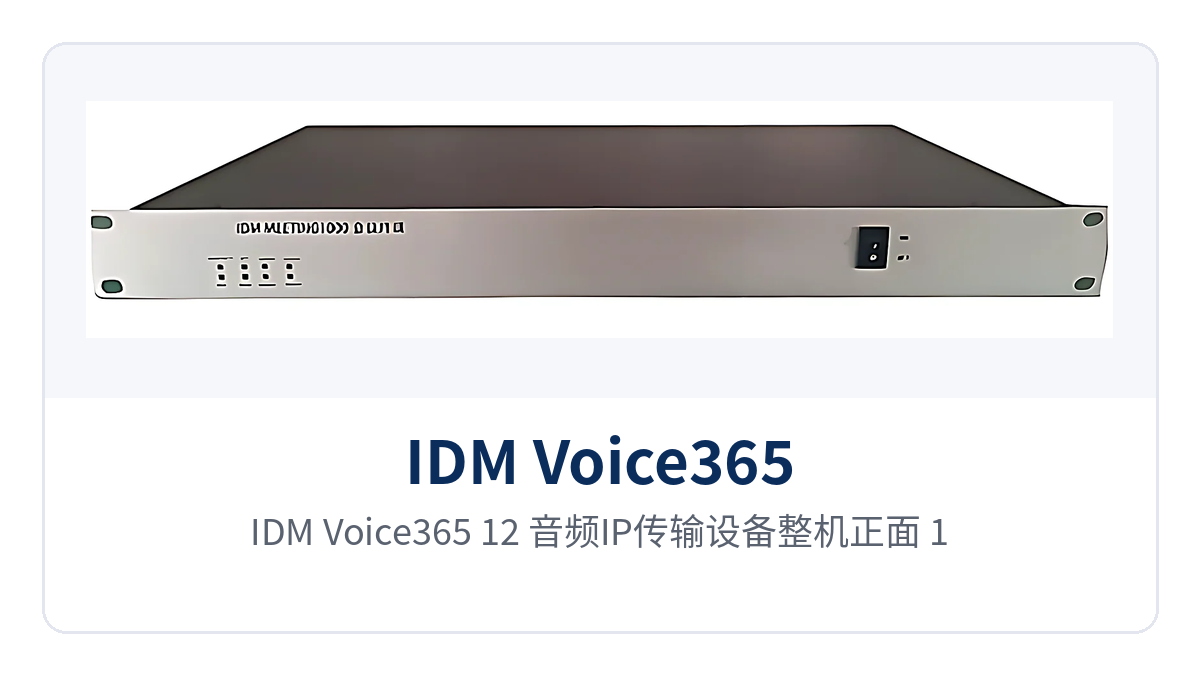
Figure 1: Front view of the IDM Voice365-12 audio IP transmission equipment, close-up of 12-channel 4-wire audio interfaces, running and alarm indicator LEDs
What Is an Audio IP Transmission Device?
An audio IP transmission device is a signal access device that encodes analog audio signals into IP packets, transmits them over Ethernet, and restores them to audio at the remote end. The IDM Voice365-12 is an audio IP transmission device that interfaces 4-wire analog audio with an IP network. As a professional IP access gateway, one side of the device is 4-wire analog audio interfaces, and the other side is standard Ethernet interfaces, with audio transmitted and received between the two ends as IP packets.
- Audio side: 12-channel bidirectional 4-wire analog audio interfaces, each providing independent audio input and output, capable of directly connecting to voice distribution frames (VDF), dispatch console audio ports, recording interfaces, or radio set 4-wire interfaces.
- Network side: the transmission protocol is the TCP/IP protocol suite, with audio and control information carried as IP packets, deployable across network segments and routes, and can also register with an IoT server.
- Usage: point-to-point use as a high-fidelity audio terminal for extended audio signal transmission over the IP network; networked use for point-to-multipoint transmission control.
Connecting on-site analog 4-wire audio to an IP network is a typical use of an IP audio access gateway. The existing audio cables do not need their routing changed — simply place one device at each end, each configured with an IP address, and the audio channel extends onto the IP data network, while the audio-side wiring method and O&M practices remain unchanged.
How 12-Channel Audio Connects to an IP Network: Wiring the 4-Wire Audio Interfaces
The IDM Voice365-12 audio IP transmission equipment has 12-channel bidirectional audio signal interfaces, capable of connecting 12 channels of 64K time slot audio circuits or high-fidelity audio sources, providing 12 channels of audio input and output, with each channel's input and output independently wired out.
- Wiring method: 4-wire analog audio interfaces are connected separately for receive and transmit; the 4-wire output of the on-site audio device connects to the input terminals of the corresponding channel, and the output terminals connect back to the 4-wire input of the opposite end.
- Channel-associated signaling (CAS): each channel supports channel-associated signaling transmission, with audio and control information traveling over the same IP channel, requiring no separate wiring for signaling.
- Access quantity: one device provides 12 channels of audio input and output, capable of connecting 12 channels of 64K time slot audio circuits or high-fidelity audio sources.
- Encoding/decoding settings: the audio encoding/decoding method of each channel can be set through network management or configured according to network bandwidth conditions.
The on-site commissioning sequence is wiring first, then network management configuration: audio cables are connected to the device following the existing wiring method, then the encoding/decoding method and transmission direction are specified for each channel through network management, all without changing the routing of existing audio cables or laying new cables separately for audio.
How Much Bandwidth Does an Audio IP Transmission Device Need: Choosing Among Four Encoding/Decoding Methods
The IDM Voice365-12 audio IP transmission equipment supports four audio encoding/decoding methods, with per-channel bandwidth ranging from 30kbit/s to 300kbit/s. Both private networks with ample link capacity and narrowband scenarios with tight links have corresponding options, selectable according to on-site link bandwidth.
| Encoding/Decoding Method | Per-Channel Bandwidth | Applicable Lines |
|---|---|---|
| Lossless PCM | ≤300kbit/s | High-speed lines such as optical fiber and wireless bridges, 16bit lossless transmission |
| G.711A | ≤90kbit/s | Conventional IP private networks, balancing audio quality and bandwidth |
| G.722 | ≤100kbit/s | Low-rate lines such as satellite and 4G |
| G.729A | ≤30kbit/s | Narrowband backhaul links such as satellite and 4G |
Lossless PCM encoding/decoding has a sampling frequency range of 0kHz–8kHz, a sampling frequency ≥16KHz, and 16-bit quantization; when the number of audio channels is fewer than 10, 24-bit quantization is supported. Network encoding/decoding latency is configurable; excluding network delay, system encoding/decoding latency is ≤100ms.
The selection logic is not complex: use lossless PCM or G.711A to preserve audio quality when the link is ample, switch to G.722 or G.729A when the link is tight, compressing per-channel bandwidth to below 100kbit/s or even 30kbit/s, allowing multiple audio channels to share a single narrowband backhaul link.
How Dual Power Supply Redundancy and Fault Detection Support Unattended Sites
The IDM Voice365-12 audio IP transmission equipment adopts a modular and AC/DC redundant power supply design. The dual power supplies can operate simultaneously or either one can be selected, adapting to the common "one AC plus one DC" power supply conditions at unattended sites.
- Power supply redundancy: AC and DC power feeds are connected simultaneously; when either feed loses power, the other continues to supply power, and audio services remain uninterrupted; when only one type of power supply is available on site, a single feed can also be used.
- Local fault indication: real-time fault detection, with fault status displayed through LED indicators, allowing on-site inspection to determine normal operation at a glance.
- Remote network management: supports the SNMP network management protocol, with the network management agent protocol being SNMP V3, allowing the central equipment room to centrally read device status and alarm information.
For unattended sites in the field, underground, or mountainous areas, dual power supply redundancy reduces communication interruption caused by single power supply failure. SNMP V3 network management works with local LED indication, so remote troubleshooting does not require traveling to the site every time, reducing manpower and time spent on site visits.
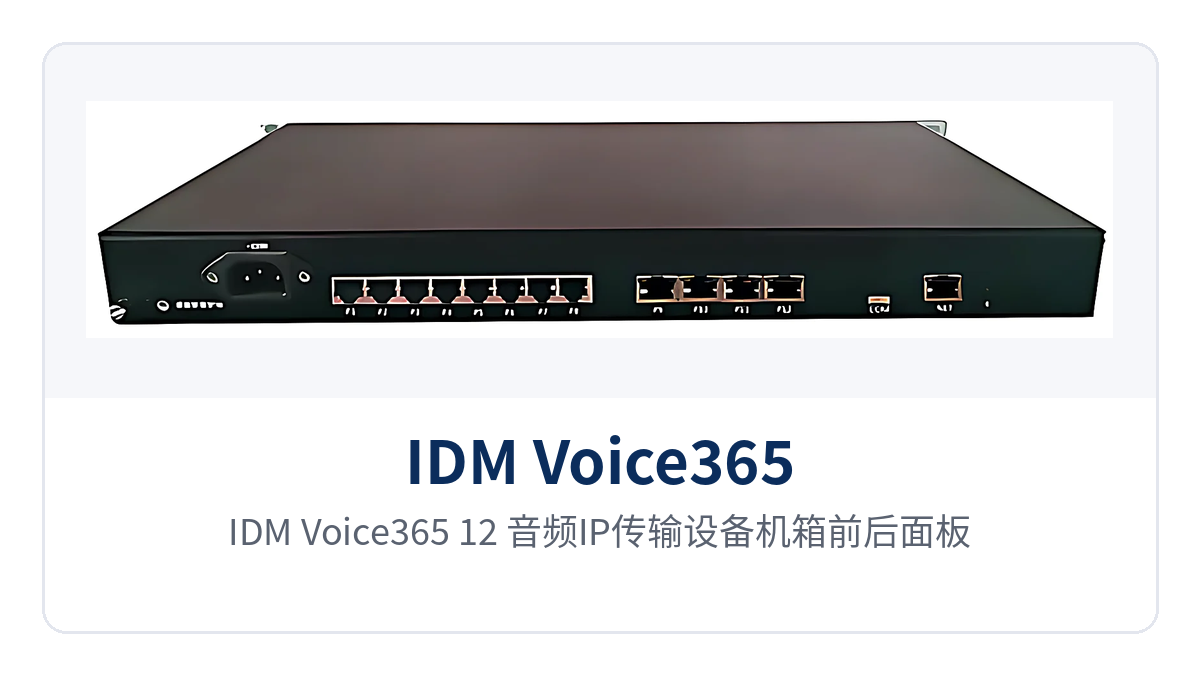
Figure 2: Front and rear panels of the IDM Voice365-12 audio IP transmission equipment chassis, close-up of AC/DC dual power supply terminals and power status indicator LEDs
Function and Performance Specifications at a Glance
| Function | Description |
|---|---|
| Audio encoding/decoding | Supports G.711A, G.729A, G.722 audio encoding/decoding, or 16bit high-fidelity lossless transmission |
| 12-channel bidirectional audio interfaces | Provides 12 channels of audio input and output, capable of connecting 12 channels of 64K time slot audio circuits or high-fidelity audio sources |
| Channel-associated signaling | Each channel supports channel-associated signaling transmission, with audio and control information traveling over the same IP channel |
| Encoding/decoding and direction control | The audio compression encoding format and transmission direction of each channel can be flexibly controlled by the gateway |
| AC/DC redundant power supply | Modular power supply design; dual power supplies can operate simultaneously or either one can be selected |
| Fault detection and indication | Real-time fault detection, with fault status displayed through LED indicators |
| Network management protocol | Supports the SNMP network management protocol, with the network management agent protocol being SNMP V3 |
| Point-to-point and networking | Can be used point-to-point as a high-fidelity audio terminal, or networked for point-to-multipoint transmission control |
| Item | Parameter/Specification | Description/Applicable Conditions |
|---|---|---|
| Model | IDM Voice365-12 | Audio IP transmission equipment |
| Transmission protocol | TCP/IP protocol suite | Can register with an IoT server or form a network within a LAN |
| Audio interface | 4-wire analog audio interface | 12-channel bidirectional, capable of connecting 12 channels of 64K time slot audio circuits or high-fidelity audio sources |
| High-bandwidth encoding/decoding | G.711A, lossless PCM | Applicable to high-speed lines such as optical fiber and wireless bridges |
| Lossless PCM specifications | Sampling frequency 0kHz–8kHz, sampling frequency ≥16KHz, 16-bit quantization | 24-bit quantization supported when the number of audio channels is fewer than 10 |
| Low-bandwidth encoding/decoding | G.722, G.729A | Applicable to low-rate lines such as satellite and 4G |
| Per-channel bandwidth | Lossless PCM ≤300kbit/s, G.722 ≤100kbit/s, G.711A ≤90kbit/s, G.729A ≤30kbit/s | Encoding/decoding method can be set through network management or matched according to network bandwidth conditions |
| System latency | Encoding/decoding latency ≤100ms | Excluding network delay |
| Network management agent protocol | SNMP V3 | Supports the SNMP network management protocol |
| Power supply | AC/DC redundant dual power supply | Dual power supplies operating simultaneously or either one selected, adapting to unattended sites |
Differentiated Value: 12-Channel Bidirectional Audio, Dual Power Supply Redundancy, 30kbps Low Bandwidth, SNMP V3 Network Management
| Differentiation Point | Customer Value |
|---|---|
| 12-channel bidirectional audio: 12-channel bidirectional 4-wire audio interfaces | 12-channel bidirectional 4-wire audio; a single unit replaces 12 channels of 64K time slot circuit transmission, saving a row of wiring and multiplexing equipment in the equipment room |
| Dual power supply redundancy: AC/DC redundant power supply design | AC/DC dual power supply redundancy operating simultaneously, adapting to unattended site power supply, with services uninterrupted when one power feed loses power |
| 30kbps low bandwidth: G.729A narrowband encoding/decoding | Only 30kbit/s under G.729A; high-fidelity audio can be transmitted over satellite/4G narrowband links without sacrificing audio quality |
| SNMP V3 network management: SNMP network management protocol | Each channel's encoding/decoding method and transmission direction can be flexibly controlled through network management; SNMP V3 centralized management works with local LED fault indication |
Typical Application Scenarios
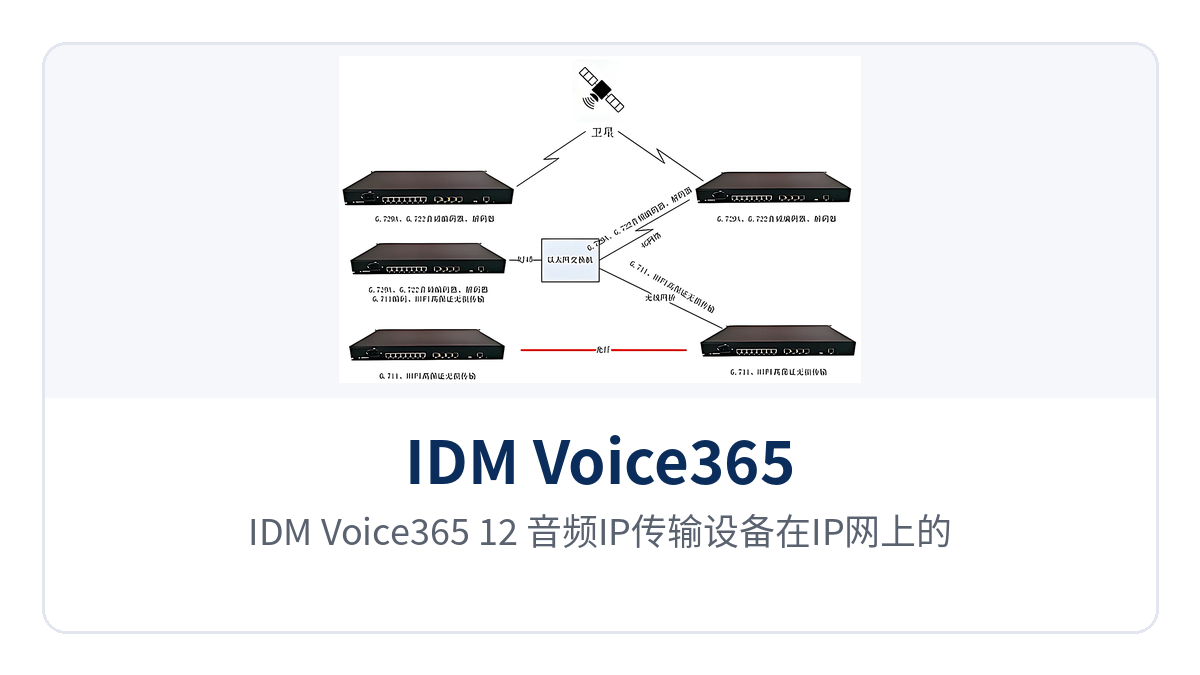
Figure 3: Application diagram of the IDM Voice365-12 audio IP transmission equipment in point-to-point and point-to-multipoint networking over an IP network
Electric Power and Rail Transit Private Networks
In electric power dispatch and rail transit private networks, audio channels at substations, stations, and sections are numerous and at scattered locations, previously requiring separate cable laying for each audio channel or renting a time slot circuit. Connecting scattered audio channels to the existing IP data network, a single IDM Voice365-12 audio IP transmission equipment can access 12 channels of bidirectional 4-wire audio, so the site side no longer needs separate wiring for audio, and capacity expansion only requires adjusting the encoding/decoding method and transmission direction through network management. Such scenarios have high requirements for the stability of the product showcase; Raytrans, as an optical multiplexer manufacturer, has long provided IP access gateways and audio IP transmission equipment for government private network optical fiber communication solutions.
Satellite and 4G Wireless Backhaul
When field sites use satellite or 4G backhaul, tight link bandwidth is the norm. The IDM Voice365-12 audio IP transmission device consumes no more than 30 kbit/s per channel with G.729A encoding and decoding, and no more than 100 kbit/s with G.722, so multiple audio channels can share a single narrowband backhaul link; where audio quality must be preserved, the encoding and decoding method can be specified per channel, leaving bandwidth for critical audio channels. For a military emergency communications vehicle solution, this IP audio access gateway enables high-fidelity audio transmission under limited bandwidth.
Industrial Unattended Sites
Unattended sites usually have only one AC power feed and one DC power feed, with long operation and maintenance cycles. The IDM Voice365-12 audio IP transmission device runs dual AC and DC power supplies in redundancy at the same time, so services are uninterrupted when either feed loses power; real-time failure detection is displayed on the spot by indicator LEDs, and SNMP V3 network management sends device status to the central equipment room, reducing the number of trips to the site together with remote troubleshooting.