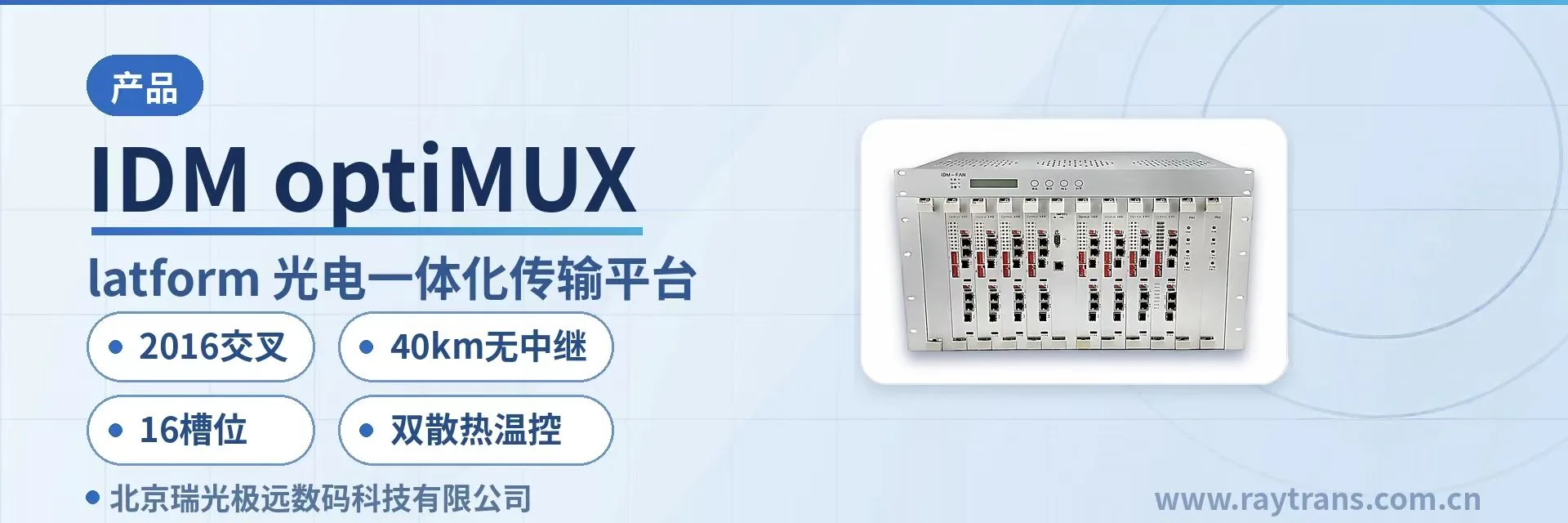
IDM optiMUX Optical-Electrical Integrated Transmission Platform
One unit integrates PBX switching, E1, and PCM, with 16-slot online capacity expansion and support for multiple networking approaches
The optical-electrical integrated transmission platform is a new-generation optical-electrical integrated transmission device developed by our company based on high-speed optical fiber transmission technology, PBX switching technology, and PCM technology. It integrates the stored program control (SPC) switching function for telephone voice, gigabit Ethernet transmission, E1 service transmission, and PCM multi-service access, meeting the requirements of a broad range of users for optical fiber transmission and access of both broadband and narrowband services. The IDM optiMUX Platform all-in-one unit can be directly connected to remote telephones, computers, cameras, and other terminals, and at the remote end it can also be extended through optical ports to connect PDH optical multiplexers, optical modems, and multi-service optical multiplexers.
What Kind of Device Is an Optical-Electrical Integrated Transmission Platform?
The IDM optiMUX Platform optical-electrical integrated transmission platform (OMP for short) is a new-generation optical-electrical integrated transmission device developed by Beijing Ruiguang Jiyuan Digital Technology Co., Ltd. With high-speed optical fiber transmission technology, PBX switching technology and PCM technology at its core, it integrates stored program control (SPC) switching of telephone voice, gigabit Ethernet transmission, E1 service transmission and PCM multi-service access into the same device. As a professional command and dispatch system manufacturer and optical multiplexer manufacturer, Raytrans designs the optical-electrical integrated transmission platform for on-site requirements of broadband and narrowband services backhauled over the same cable: the remote end can directly connect telephones, computers, cameras and other terminals, and when a site needs to be extended, PDH optical multiplexers, optical modems and multi-service optical multiplexers and other optical multiplexing equipment can be connected externally through the optical port.
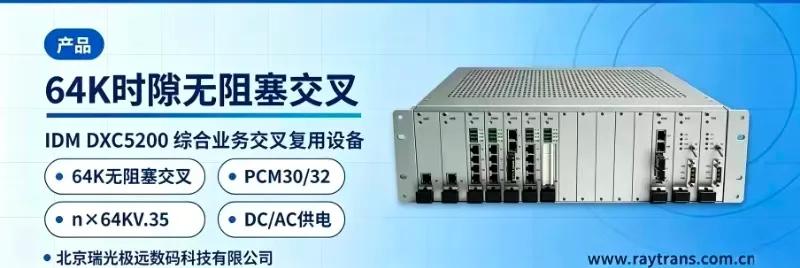
The optical-electrical integrated transmission platform adapts to point-to-point, chain, ring network, star, tree, ring-cut-ring, ring-intersecting and other network topologies. The chassis is a (6+1)U card-based structure providing 16 slots. The product can be widely used in private networks such as public security, electric power, railway and mining, as well as public networks such as China Mobile, China Unicom and telecommunications, providing reliable product showcase and equipment support for government private network optical fiber communication solutions and smart mining communication solutions.
Key specifications at a glance: (6+1)U card-based 16 slots · gigabit Ethernet · E1 and PCM multi-service · 2016×2016 VC-12 non-blocking cross-connection · 40km repeaterless for the standard model · dual heat dissipation and temperature control
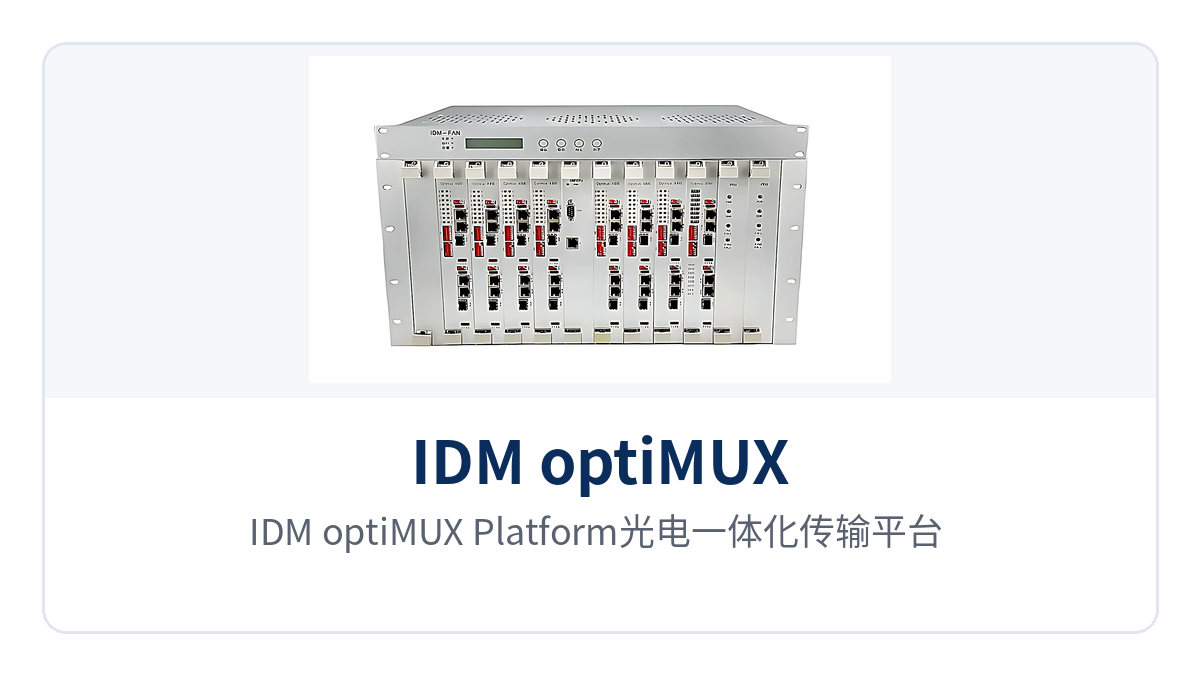
Figure 1: IDM optiMUX Platform optical-electrical integrated transmission platform (6+1)U chassis front panel and 16 card slots
Integrating voice switching, gigabit Ethernet, E1 and PCM multi-service into one device, so that private network multi-service is handled by a single unit, is the design starting point of the optical-electrical integrated transmission platform. The optical-electrical integrated transmission platform organizes services by means of PCM and PBX converged access. PCM service access cards can be inserted in the same chassis, and more than 20 types of PCM plug-in cards can be inserted on the PCM user card to provide voice and data services.
On the signaling side, a signaling gateway card can be inserted to support SS7, No.1, PRI, V5.2 and other signaling, and also SIP softswitch signaling; on the image dispatching side, an audio and video visualized command and dispatch card can be inserted to provide image dispatch communication based on E1 or IP transmission channels. The optical-electrical integrated transmission platform supports online upgrade of device software; for capacity expansion, simply add or replace service cards, while the chassis and optical paths continue to be used.
What Services Can the Optical-Electrical Integrated Transmission Platform Carry?
The optical-electrical integrated transmission platform brings voice switching, data transmission and image dispatching into one device, with functions organized along the lines of transmission, switching, access, cross-connection, network management and heat dissipation. The following table lists each function and its description item by item, making it easy to compare and select according to the site service list.
Function | Description |
|---|---|
Optical fiber transmission | Carries broadband and narrowband services with high-speed optical fiber transmission technology; the optical port can be extended to connect PDH optical multiplexers, optical modems and multi-service optical multiplexers and other optical multiplexing equipment, adapting to point-to-point, chain, ring network, star, tree, ring-cut-ring, ring-intersecting and other networking approaches |
PBX voice switching | Built-in PBX switching function directly connects remote telephones to complete stored program control (SPC) switching of telephone voice |
Gigabit Ethernet transmission | Provides gigabit Ethernet transmission, carrying data and video services of IP terminals such as computers and cameras |
E1 service transmission | Provides E1 service transmission channels for dispatching, telecontrol, trunk and other circuits with strict timing requirements |
PCM multi-service access | PCM service access cards can be inserted, and more than 20 types of PCM plug-in cards can be inserted on the PCM user card to provide voice and data services |
Signaling gateway card | Supports SS7, No.1, PRI, V5.2 and other signaling, and also SIP softswitch signaling |
Audio and video command and dispatch card | Provides image dispatch communication based on E1 or IP transmission channels |
TDM cross-connection | Provides 2016×2016 VC-12 level non-blocking cross-connection between TDM interface services, supporting unidirectional, bidirectional and broadcast services |
Network management | Provides an F (100Base-T) network management interface; through the Netguard management system it provides the five ITU-T recommended functions of configuration, alarm, performance, maintenance and security, and provides a device network management cascading interface |
Network management protocol and alarm | Supports the simple network management protocol (SNMP) and provides 2 device alarm output interfaces |
Online upgrade | Supports online upgrade of device software |
Heat dissipation design | Provides natural heat dissipation and forced fan heat dissipation, with intelligent temperature control fans and fan status detection |
Key Specifications and Performance Specifications
The optical-electrical integrated transmission platform provides 2016×2016 VC-12 non-blocking cross-connection and non-blocking scheduling of high-capacity TDM services, with telephone voice channels, E1 and data services each forming their own paths within the same device. The following table lists the main parameters item by item by chassis, cross-connection, networking and network management; for items not listed, the manufacturer's technical documentation shall prevail.
Item | Parameter/Specification | Description/Applicable Conditions |
|---|---|---|
Chassis and slots | (6+1)U card-based, 16 slots | Cards are inserted according to the site service list; capacity expansion adds or replaces service cards |
Network configuration mode | The same device can be configured as TM, ADM or MADM | Covers both terminal multiplexing and add/drop multiplexing site roles |
Networking approach | Point-to-point, chain, ring network, star, tree, ring-to-ring, ring intersection | Determined by the optical port configuration and site distribution |
Cross-connect capacity | 2016×2016 VC-12 non-blocking cross-connection | Supports unidirectional, bidirectional, and broadcast services; TDM services are scheduled at VC-12 granularity |
Repeaterless transmission distance | 40 km for the standard model; customizable beyond this distance | Sites more than 40 km from the center are customized according to the actual spacing between stations |
Network management interface | F (100Base-T) | The Netguard management system provides the five ITU-T recommended functions: configuration, alarm, performance, maintenance, and security |
Network management cascading interface | Provides a device network management cascading interface | Network management channels of multiple devices are connected in series for unified management at the central end |
Network management protocol | SNMP simple network management protocol | Used for centralized monitoring of device status and alarms |
Alarm output | 2-channel device alarm output interface | Can be connected to the site alarm system |
Signaling support | No.1, SS7, PRI, V5.2; supports SIP softswitch signaling | Provided by the signaling gateway card |
Software upgrade | Supports online upgrade of device software | New versions are delivered from the network management side |
Heat dissipation | Natural heat dissipation and forced fan cooling; intelligent temperature-controlled fans and fan status detection | Suitable for equipment rooms and sites with large temperature fluctuations |
Differentiated value: 2016 cross-connect, 40 km repeaterless, 16 slots, dual heat dissipation and temperature control
The differentiation of the optical-electrical integrated transmission platform centers on four points: cross-connect capacity, repeaterless distance, chassis slots, and heat dissipation. As an experienced command and dispatch system manufacturer, Raytrans integrates the advantages of PCM equipment and optical multiplexing equipment into one. The table below lists the four short labels alongside the corresponding capability and the value for private network users, making it easy to check item by item during selection.
Differentiation Point | Corresponding Capability | Value for Private Network Users |
|---|---|---|
2016 cross-connect: 2016×2016 VC-12 non-blocking cross-connection | Provides 2016×2016 VC-12 non-blocking cross-connection between TDM interface services, supporting unidirectional, bidirectional, and broadcast services | 2016×2016 VC-12 non-blocking cross-connection enables non-blocking scheduling of high-capacity TDM services; telephone voice channels, E1 and data services each form their own paths at VC-12 granularity without contending for one another |
40 km repeaterless: 40 km repeaterless transmission for the standard model | The standard model has a repeaterless transmission distance of 40 km; customization is available beyond this transmission distance | 40 km repeaterless transmission for the standard model allows direct reach to remote sites without repeaters, eliminating repeater equipment along the line and additional cabinet sites |
16 slots: the (6+1)U card-based chassis provides 16 slots | The chassis structure adopts a (6+1)U card-based design, providing 16 slots | The 16 slots are flexibly configured per project; signaling gateway cards, PCM service access cards, and video/audio command and dispatch cards are inserted as required |
Dual heat dissipation and temperature control: natural heat dissipation and forced fan cooling | Provides natural heat dissipation and forced fan cooling, with intelligent temperature-controlled fans and fan status detection | Dual heat dissipation and temperature control keep the optical-electrical integrated transmission platform working stably in both equipment rooms and sites with temperature fluctuations |
Typical application scenarios
The optical-electrical integrated transmission platform is used at the private network access layer and aggregation layer, converging upward into the optical fiber transmission network through optical ports and, downward, collecting telephone, data, IP and video services at the site into the same pair of optical fibers. The aggregation-type main unit can form a star network with the IDM GP5000 and IDM GP4000, providing users with telephone, data, IP, and video services. It is an integrated platform that combines PCM service access with optical multiplexing equipment capabilities.
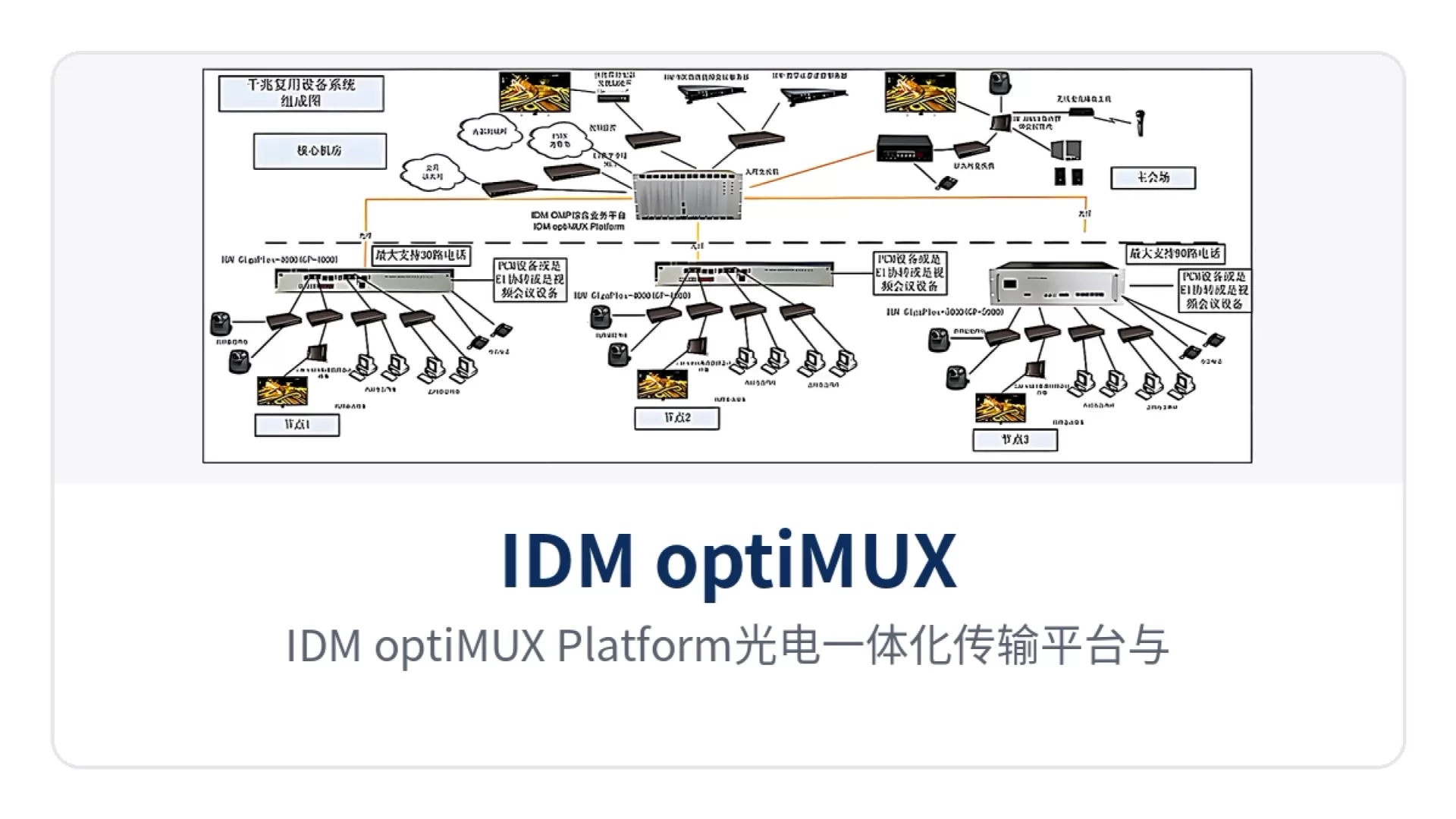
Figure 2: The IDM optiMUX Platform optical-electrical integrated transmission platform forms a star network with the IDM GP5000 and IDM GP4000 to provide users with telephone, data, IP, and video services
Public security private network
Between police stations, duty posts, and command centers of the public security private network, there are internal telephone calls as well as office data and video image backhaul. At these sites, the optical-electrical integrated transmission platform uses one PCM equipment to carry voice switching and gigabit Ethernet simultaneously: duty telephones are connected directly for PBX switching, cameras and office terminals are connected to Ethernet ports, and voice, data, and images are sent back to the center over the same pair of optical fibers. Remote stations that need extension connect to optical multiplexer equipment from optical multiplexer manufacturers through optical ports. Within the station, there is no need to lay separate fibers or configure a complete unit for each type of service, providing a concise product showcase for the access layer construction of government private network optical fiber communication solutions.
Electric power private network
Between substations, switching stations, and dispatch centers of the electric power private network, dispatch telephone, telecontrol data, and the office network need to be transmitted simultaneously. The optical-electrical integrated transmission platform provides 2016×2016 VC-12 non-blocking cross-connection, so telephone voice channels and E1 services each form their own paths at VC-12 granularity, and a pair of optical fibers between stations can carry multiple types of services. The standard model offers 40 km repeaterless transmission, allowing distant substations to reach the center directly and reducing repeater links along the line.
Management at the dispatch end relies on the network management channel: the optical-electrical integrated transmission platform provides an F (100Base-T) network management interface and the simple network management protocol (SNMP), allowing configuration, alarms, and performance to be viewed centrally through the Netguard management system. The working status of unattended sites can be checked from the central end for abnormalities before a call is placed.
Railway and Mining Private Networks
Sites along railway lines and aboveground and underground locations in mining areas are scattered, and equipment room conditions and temperature control conditions vary. The optical-electrical integrated transmission platform adopts natural heat dissipation and forced fan cooling, with intelligent temperature-controlled fans and fan status detection, maintaining heat dissipation according to the temperature control policy even under temperature fluctuation. Online software upgrade allows sites put into operation in batches to update versions without interrupting services in use. When the spacing between stations exceeds 40 km, optical modules can be customized according to the actual distance, or repeater nodes can be added for segmented networking. This feature makes it a reliable choice for access layer equipment in smart mining communication solutions, and also meets the requirements of military emergency communications vehicle solutions for rapid deployment and stable transmission.
Conclusion
The optical-electrical integrated transmission platform carries voice switching, gigabit Ethernet (GE), E1, and PCM multi-service on a single (6+1)U card-based device, completes high-capacity TDM service dispatching through 2016×2016 non-blocking cross-connection, covers remote sites with repeaterless transmission of 40 km on standard models, and can expand signaling gateway and video and audio command and dispatch capabilities through plug-in boards. For projects in public security, electric power, railway, and mining private networks with many service types and distributed sites, the optical-electrical integrated transmission platform provides an access mode that brings broadband and narrowband services into a pair of optical fibers, and also provides flexible and reliable optical multiplexing equipment support for government private network optical fiber communication solutions, smart mining communication solutions, and military emergency communications vehicle solutions.