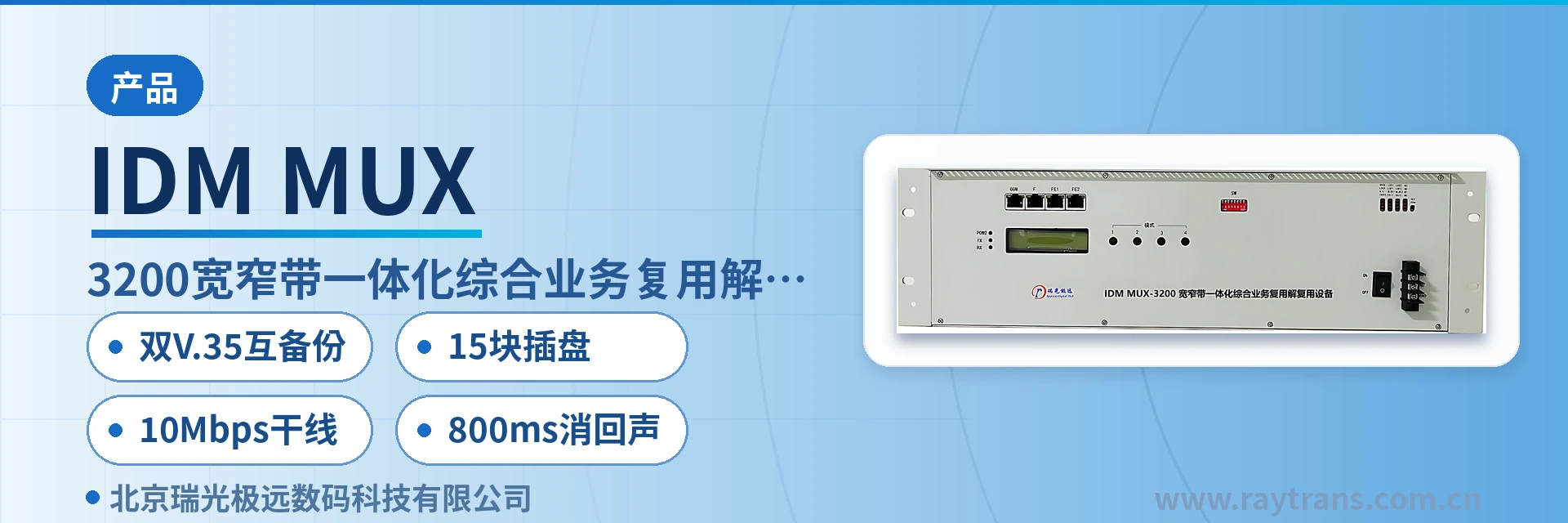
IDM MUX-3200 Narrowband/Broadband Integrated Multiplexer
Dual V.35 trunk mutual backup, 15 plug-in boards mixed, 32-channel audio 800 ms echo cancellation
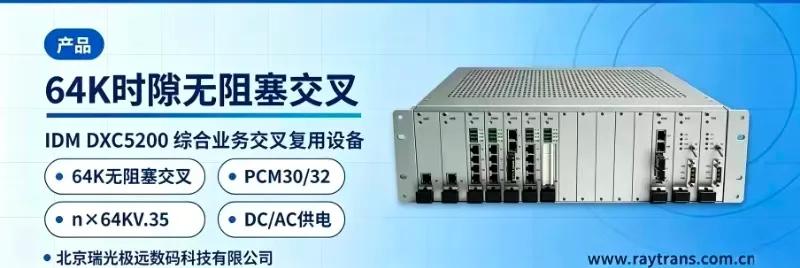
IDM MUX-3200 is a modular integrated service multiplexer housed in a 19-inch 3U chassis, designed for easy installation in equipment rooms or vehicles. It adopts TDM multiplexing technology, offering low information latency and fixed transmission latency for data and voice. All services to be connected occupy physically isolated independent channels, ensuring information security and confidentiality. It multiplexes broadband and narrowband services such as data, voice, video and network into a single high-speed data stream (which may use E1 or V.35 transmission bandwidth), and then performs bidirectional transmission over DDN leased lines, microwave, satellite and other communication links. It can be easy to interconnect with confidential communications equipment.
Note: After a sentence-by-sentence check of the full text, no promotional expression describing the product level with "first-class" was found; the only hit was "this process" in the closing paragraph: it is merely the literal consecutive characters formed by "one" and "process", not a promotional phrase. To avoid retrieval misjudgment, that occurrence has been changed to "the process"; all other technical facts, model numbers, figures, tables, and images are retained as-is.
What kind of device is the narrowband/broadband integrated service multiplexer?
The IDM MUX-3200 is a narrowband/broadband integrated service multiplexer developed by Beijing Ruiguang Jiyuan Digital Technology Co., Ltd. It combines broadband and narrowband services such as data, voice, video, and Ethernet into a single high-speed data stream, which is then transmitted bidirectionally over links such as DDN leased lines, microwave, and satellite. The device uses a 19-inch 3U modular chassis and can hold 15 service boards; it can be installed in equipment room cabinets and in vehicle-mounted racks in communication vehicles. As a mature PCM equipment and integrated service access device, the product plays a core role in multi-service aggregation and transmission in private network communication scenarios.
The trunk side can be configured with V.35 or E1 interfaces; a single V.35 port supports rates up to 10 Mbps and dual-port mutual backup. On the service side, voice channel, audio, E1, Ethernet, video, serial port, and LTE access boards can be mixed in the same chassis according to on-site requirements, with broadband and narrowband services each occupying an independent channel inside the device.
Key specifications at a glance: 19-inch 3U chassis · 15 service boards · dual V.35 mutual backup · 10 Mbps trunk rate · 32 audio channels · 8 E1 ports · 800 ms echo cancellation
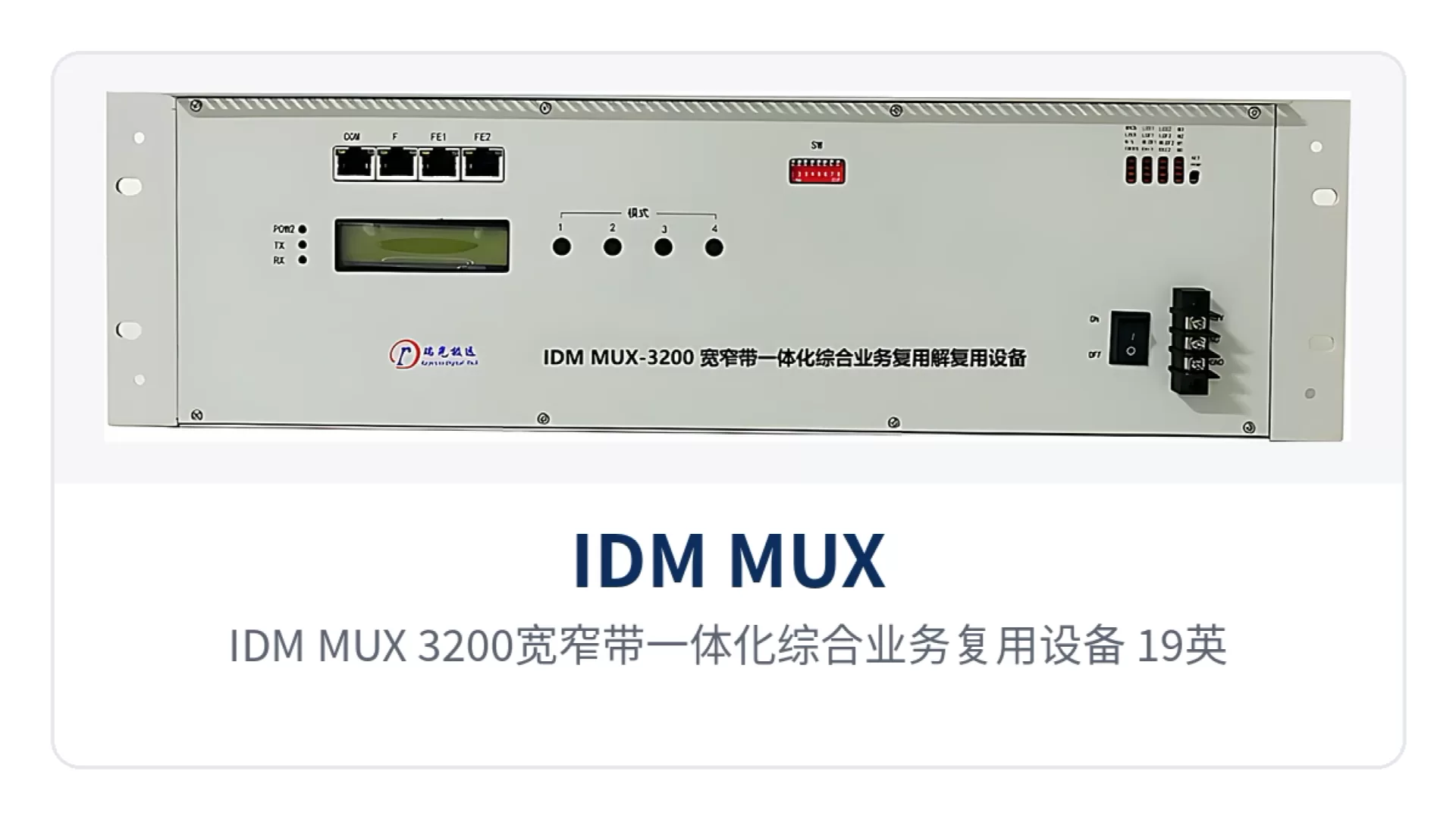
Figure 1: IDM MUX-3200 narrowband/broadband integrated service multiplexer — close-up of the 19-inch 3U chassis front view, LCD display screen, and status indicator LEDs
Why TDM multiplexing suits satellite and microwave links
TDM multiplexing loads each service into a fixed frame structure by time slot; each service permanently occupies a defined segment of link bandwidth, and both the transmission delay and the position within the frame are fixed. Fixed delay brings two direct results: voice does not speed up or slow down due to queuing, and the timing relationship between data and signaling remains unchanged across the entire link. This characteristic makes TDM multiplexing equipment applicable in scenarios sensitive to delay jitter.
A satellite link has a large single-hop delay, and the bandwidth of microwave and tropospheric scatter links is relatively tight; queuing-based multiplexing tends to amplify jitter on these two types of links. TDM allocates bandwidth rigidly by time slot, so burst traffic on any one service will not occupy the time slots of other services, and each service is a physically isolated channel at the physical layer — which is also why confidential services are willing to adopt this technical approach.
How the 15 boards in the 3U chassis are divided
The chassis can hold 15 service boards, and the service types are determined by the boards: voice boards, audio boards, E1 boards, bridge boards, video boards, serial port boards, and LTE boards are combined according to the site list. When services are added or removed, it is enough to replace or add boards; the chassis, backplane, and existing trunk links remain unchanged, and the site does not need to purchase another complete unit for a new service type.
The front panel provides an input keypad and an LCD display, so on-site personnel can directly view link status and modify configurations without opening the chassis while powered. Power and interfaces have multi-level lightning protection, so the device can also be used in locations with ordinary power supply and grounding conditions, such as vehicle-mounted racks and field equipment rooms.
How does dual V.35 trunk mutual backup keep services running through link failures
The trunk is the outlet of the entire device. The IDM MUX-3200 provides 2 V.35 high-speed serial interfaces, one active and one standby, with a per-port rate of up to 10 Mbps. When the primary link is interrupted or the bit error rate exceeds the usable range, services continue to be carried by the backup link; the site side does not need manual cable swapping or temporary configuration changes.
Dual V.35 mutual backup addresses continuity when the trunk travels over only one path. If the two V.35 links are taken from the same microwave equipment or the same optical cable, the points of failure coincide, and the backup effect is weakened by the common point of failure; when the active and standby links belong to different transmission paths, maintenance on a single link does not affect online services.
Rate configuration is selected according to service volume: below 2.048 Mbps in 64 Kbps steps, above 2.048 Mbps in 256 Kbps steps, increasing step by step up to 10 Mbps. When the active/standby protection function is not enabled, the standby V.35 interface can be used as a service interface, feeding one broadband data channel directly into the trunk.
How to configure the E1 trunk interface and system clock
The trunk can also use an E1 interface, which complies with G.703/G.704, has a rate of 2.048 Mbps, uses a DB37 connector, and is supplied with a DB37-to-micro-coaxial converter. The E1 trunk is suitable for connecting to existing PDH and SDH optical transmission equipment, attaching local services to the existing transmission network without laying new optical cables.
The system clock supports five modes: DTE, DCE, local clock, external clock, and subscriber interface clock. During networking, select one according to the clock source on both sides of the link to avoid slips caused by both ends using the local clock. Satellite and microwave links usually have their clock provided by the link equipment, so the device side only needs external clock access.
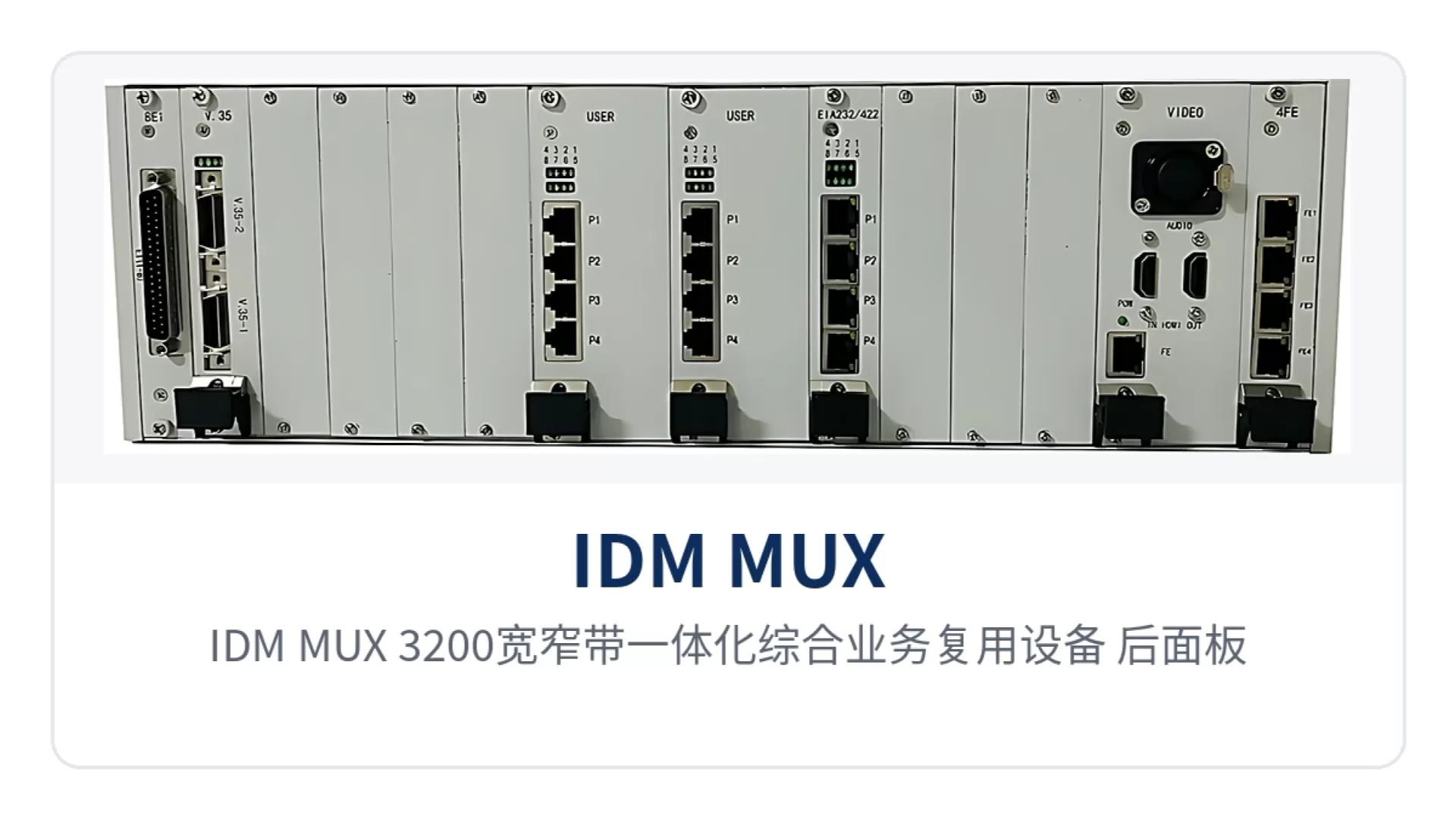
Figure 2: IDM MUX-3200 narrowband/broadband integrated service multiplexer — rear panel layout of dual V.35 trunk interfaces, E1 interfaces, and service board interfaces
Which services one device can access: functions and carrying capacity at a glance
The access capacity of the IDM MUX-3200 is determined by the boards; broadband and narrowband services are multiplexed in the same chassis. Each function and its purpose are shown in the table below. During selection, check row by row against the site service list, and determine the number of boards according to chassis slots and service channel counts.
| Function | Description |
|---|---|
| Dual V.35 trunk mutual backup | Provides 2 V.35 high-speed serial trunk interfaces, one active and one standby, with a per-port rate of up to 10 Mbps; when the primary link is abnormal, services are carried by the backup link |
| E1 trunk or transparent transmission | The E1 board provides 8 G.703 interfaces, which can serve as an E1 trunk or transparently transmit existing E1 services; interfaces comply with G.703/G.704 |
| Voice access | The voice board uses RJ45 connectors and provides 8 analog telephone FXO/FXS channels per board, with G.711 A-law encoding and an audio range of 300 Hz to 3400 Hz |
| Audio access | Each voice universal board provides 4 audio module interfaces, and each interface can hold 2 modules of the same type, supporting FXS, FXO, magneto, 2100 Hz carrier magneto, and E&M 2-wire/4-wire |
| Ethernet bridging | The bridge board provides 4 groups of 10/100M Ethernet interfaces, with groups isolated from one another; the two ports in the same group provide Layer 2 switching and support end-to-end (E2E) bridging |
| Video codec | The video board provides 1 HDMI input and 1 HDMI output; video is encoded and decoded in H.264 and then transmitted over the network port |
| Serial data | The serial port board provides 4 serial interfaces, supporting HDLC, transparent synchronous data, and asynchronous data, with rates up to 115200 bps |
| LTE gateway access | The LTE gateway access board supports 2 to 4 4G LTE accesses, uses SIP, and can interconnect with various SIP-based softswitches |
| Duty telephone dispatching | Each device provides 2 duty telephone interfaces, supporting dialing and consultation between duty telephones, and accepting barge-in, forced release, transfer, and other dispatch operations from the dispatch console |
| Audio dispatch service | The audio dispatch server board supports 50 IP subscriber registrations and 25 concurrent voice channels by default, and provides functions such as auto attendant, voice conference, and recording |
| Network management | Provides an SNMP network management interface and can be incorporated into an existing network management system (NMS) to monitor device and link status |
| On-site operation and protection | The front panel provides an input keypad and an LCD display for viewing status and modifying configurations; power and interfaces have multi-level lightning protection |
Key Specifications
Parameters are listed in five categories: trunk interfaces, E1 interfaces, subscriber interfaces, Ethernet and video, and power supply environment; values are taken from the original product documentation. Use the table values for engineering calculations. The power supply mode, overall power consumption, and operating temperature are not given in the product documentation; confirm with the Raytrans manufacturer before ordering.
| Item | Parameter/Specification | Description/Applicable Conditions |
|---|---|---|
| V.35 trunk interface standard | V.35, supporting dual-port mutual backup | One active and one standby; the standby port can serve as a service interface when protection is disabled |
| V.35 connector type | V26, supplied with DB25 conversion cable | Connects to V.35 devices such as routers and satellite modems |
| V.35 data rate | Up to 10 Mbps | 64 Kbps steps below 2.048 Mbps, 256 Kbps steps above |
| V.35 interface quantity | 2 | Active/standby mutual backup configuration |
| E1 interface standard | G.703 / G.704 | Can serve as an E1 trunk or transparently transmit E1 services |
| E1 connector type | DB37, supplied with DB37-to-micro-coaxial converter | Brought out in micro-coaxial form |
| E1 data rate | 2.048 Mbps | Standard single-channel E1 rate |
| E1 quantity per board | 8 E1 interfaces/modules | The chassis can hold two E1 boards |
| Serial interface standard | EIA-422 / EIA-232 | Both synchronous and asynchronous data can be carried |
| Serial interface quantity and connector | 4, RJ45 physical interfaces, supplied with DB25 conversion cable | 4 DB25 interfaces provided on site |
| Serial interface rate | Asynchronous 300 bps to 115200 bps, synchronous 1200 bps to 115200 bps | Rates configured step by step according to the peer device |
| Analog voice interface | RJ45, FXS, FXO, E&M, MSG | Encoding G.711, compression ITU G.711 A-law |
| Voice audio specifications | 300 Hz to 3400 Hz, balanced 600 Ω impedance | 8 voice channels per board |
| Ethernet interface | RJ45, 10/100 Mbps, IEEE802.3 | 2 groups, 2 ports per group, groups isolated from one another |
| Ethernet bandwidth | N×64 Kbps per channel (N=1 to 128) | End-to-end (E2E) bridging, bandwidth allocated by service volume |
| HDMI video encoding | H.264, H.265, bit rate 256K to 4 Mbps | Input supports 4K30; encoding supports 4K30×3 or 1080P30×12 |
| LTE access | 2 to 4 4G LTE channels, SIP v2.0 (RFC3261) | Supports FDD/TDD networks and NAT traversal |
| Total audio access | 32 channels | Provided by the media gateway (MG) board; interface types include magneto, E&M, trunking, and HF |
| Duty telephone interface | 2 per device | Supports dialing and consultation between duty telephones |
| Echo cancellation | G.168, cancels delayed echo within 800 ms | Implemented in hardware circuitry; suitable for long-delay satellite link scenarios |
| Chassis structure | 19-inch 3U, holds 15 service boards | Equipment room cabinet and vehicle-mounted rack installation |
| Power supply mode | not yet recorded in the knowledge base | Confirm at ordering according to the site AC or DC power supply mode |
| Overall power consumption | not yet recorded in the knowledge base | Subject to the accompanying technical documentation |
| Operating environment | not yet recorded in the knowledge base | Confirm vehicle-mounted and field equipment room conditions at ordering |
How 800 ms echo cancellation and duty dispatching are used
A satellite link can have a single-hop delay of several hundred milliseconds; after voice travels round trip over the satellite and returns to the local end, the speaker hears a delayed echo of their own voice. The IDM MUX-3200 performs echo cancellation in hardware and supports the G.168 protocol, canceling transmission delay echo within 800 ms, so no external acoustic processing equipment needs to be added in the vehicle.
Echo cancellation is completed inside the PCM equipment; voice is processed as soon as it enters the device and is transparent to both parties of the call. The 800 ms cancellation window covers the round-trip delay of a single satellite hop and some double-hop scenarios, and echo suppression remains effective when link delay fluctuates in the downstream direction.
The duty communications dispatch system is supplied with the device. Each device provides 2 duty telephone interfaces; duty telephones can dial each other and conduct voice consultation. After the dispatch console is connected, it can perform one-touch call, broadcast, forced release, barge-in, transfer, roll call, polling, and intercom on duty telephones, so there is no need to build a separate command and dispatch system between the duty operator seat and on-site duty personnel.
The service side provides point-to-point bidirectional transmission of data, network, video and voice services and supports bidirectional provisioning: voice channels and data accessed at one end are restored to the corresponding interfaces at the opposite end, and services in both directions are carried symmetrically over the same backbone. The provisioning tables at both ends follow the same numbering, so when a service is reassigned only the number mapping has to be changed, and neither the backbone nor the time slot allocation has to be redone.
Typical Application Scenarios
IDM MUX-3200 is deployed mainly in point-to-point mode, with one piece of PCM equipment at each end connected over a V.35 dedicated line, an E1 channel, a microwave or a satellite link. The three industries differ mainly in the mix of service boards and in the choice of backbone; the networking topology and the way services are commissioned are the same.
Public Security and Firefighting Satellite Communication Vehicle: Voice, Video and E1 Multiplexed onto the Satellite Link in One Pass
The antenna and modem of a satellite communication vehicle provide only one broadband data channel, yet the vehicle has to run command telephones, on-site video backhaul, the office network and a remote E1 leased line at the same time. IDM MUX-3200 allows mixed insertion of these services in the same 3U chassis and combines them into one high-speed data stream that is fed to the satellite modulator, so the vehicle does not need a separate multiplexer for each type of service.
Once the in-vehicle service telephones and the dispatch console are connected, the on-site commander can reach any duty telephone with one-touch direct calls or barge in, and voice consultation is completed locally inside the vehicle. Echo on the satellite link is cancelled by the G.168 circuit, so commanders do not have to change their calling habits to accommodate the long latency.
Vibration, power source switching and grounding conditions in a vehicle-mounted rack impose requirements on the mechanical structure and the lightning protection of the equipment. The unit is a 19-inch 3U chassis whose mounting holes follow the 19-inch standard rack, and its power supply and interfaces have multi-level lightning protection. During installation on the vehicle the unit is fixed to the mounting holes of the vehicle-mounted rack, and interface cables are tied in the cable trunking so that vibration while driving does not loosen the connectors.
Military Field Mobile Communications: Dual V.35 Mutual Backup Protecting the Backbone
The backbone of field mobile communications is often provided by microwave relay, troposcatter or satellite links, and link availability varies with terrain and weather. IDM MUX-3200 uses 2 V.35 interfaces in active/standby mode, each with a per-port rate of up to 10 Mbps, so when the primary link goes down services continue over the backup link, and telephony and data between the command post and forward detachments do not lose contact at the same time because a single link is interrupted.
Field scenarios involve a wide variety of service interfaces: high frequency (HF) radio sets, trunked vehicle-mounted radios, magneto telephones, E&M audio and serial port data may all be present. Audio access totals 32 channels, and the interface types cover magneto, E&M, trunking interfaces and very high/ultra high frequency (VHF/UHF), so audio services of different formats are accessed in the same chassis and the command post does not need a separate converter for each type of radio.
The unit can be installed in the standard rack of a shelter or a communication vehicle; the keyboard and LCD on the front panel let duty personnel check link status and switch configurations without a laptop. When the equipment interworks with confidential communications equipment, each service is transmitted in a physically isolated channel, and the wiring can be laid out in separate frames according to classification level.
Electric Power and Emergency Private Networks: E1 Backbone Access to an Existing Transmission Network
PDH or SDH optical transmission equipment is usually already deployed between the sites of electric power and emergency private networks, and the available resource is one or several E1 channels. The E1 board of IDM MUX-3200 provides 8 G.703 interfaces, loading local services into E1 so that they can enter the existing transmission network and reach the dispatch center without laying new optical cable.
Services at substations and emergency command centers are mainly dispatch telephones, telecontrol data and video surveillance, and voice boards, serial boards and bridge boards are configured according to the site list. Ethernet interface groups are physically isolated from one another, with the surveillance network and the office network on different interfaces, so the two types of service are invisible to each other.
Services at emergency repair and emergency sites are usually commissioned within hours: the equipment is installed in a standard rack, cables are terminated port by port as labeled on the interface silkscreen, and services can be enabled as soon as the plug-in boards and provisioning tables at both ends match. When the backbone is accessed over E1, the clock is provided by the transmission device and the equipment side is configured for external clock.
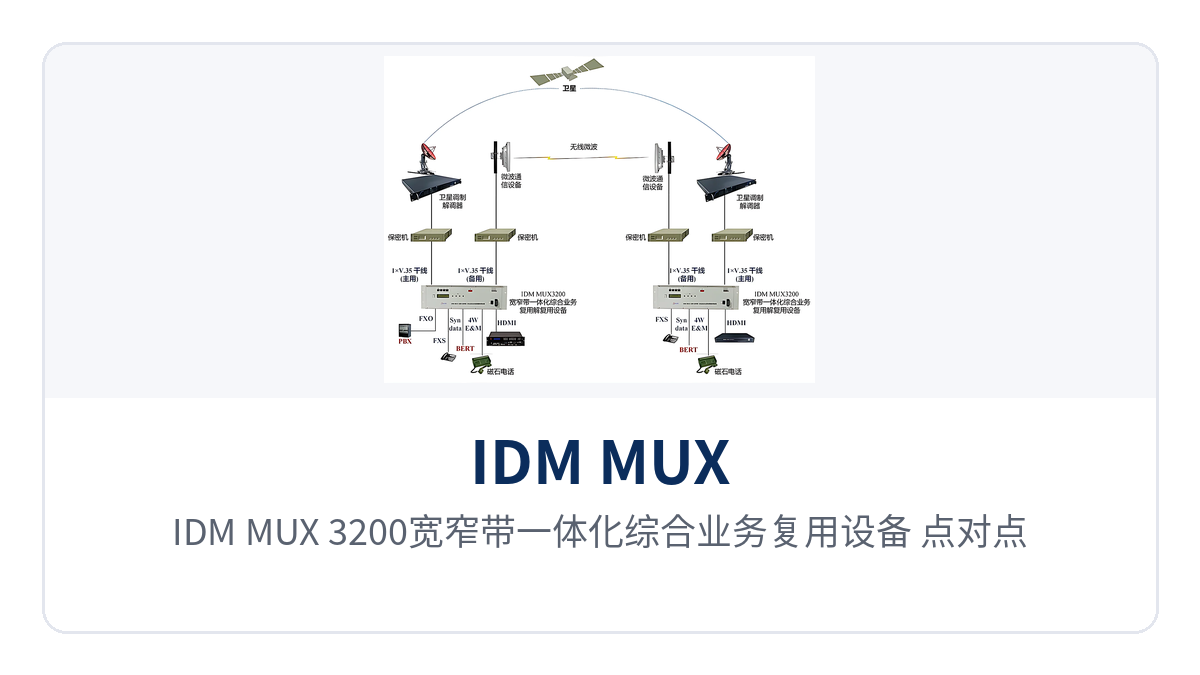
Figure 3: IDM MUX-3200 Wideband and Narrowband Integrated Service Multiplexer Point-to-Point Networking Topology, with Both Ends Interconnected over a Satellite or Microwave Link and Carrying Voice, Video and E1 Services
Conclusion
IDM MUX-3200 is a wideband and narrowband integrated service multiplexer launched by Raytrans for communication vehicles and private network sites. Its 19-inch 3U chassis holds 15 service boards and combines 32 audio channels, 8 E1 channels, voice, Ethernet, video and serial services into one high-speed data stream. Dual V.35 mutual backup brings the backbone rate to 10 Mbps while providing link redundancy, and G.168 hardware echo cancellation removes delayed satellite link echo within 800 ms, giving military emergency communications vehicle solutions reliable PCM equipment support.
For selection, check the type and number of boards against the site service list, decide whether the backbone runs over V.35 or E1 according to link conditions, and then place the active and standby links on different transmission paths, so that wideband and narrowband services can be carried reliably on the same link. Before commissioning, use the provisioning table to match the interfaces at both ends port by port; after the equipment is put into operation, check link and service status against network management alarms. Manufacturers of government private network optical fiber communication solutions and command and dispatch systems can also follow this procedure for commissioning and acceptance when deploying integrated service access devices.