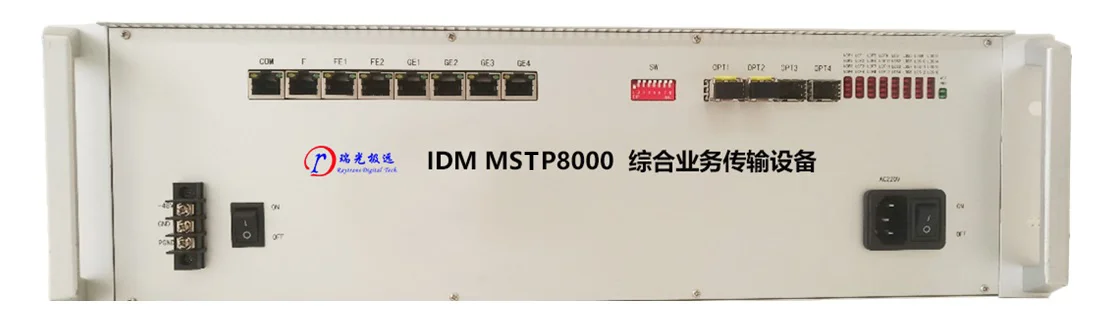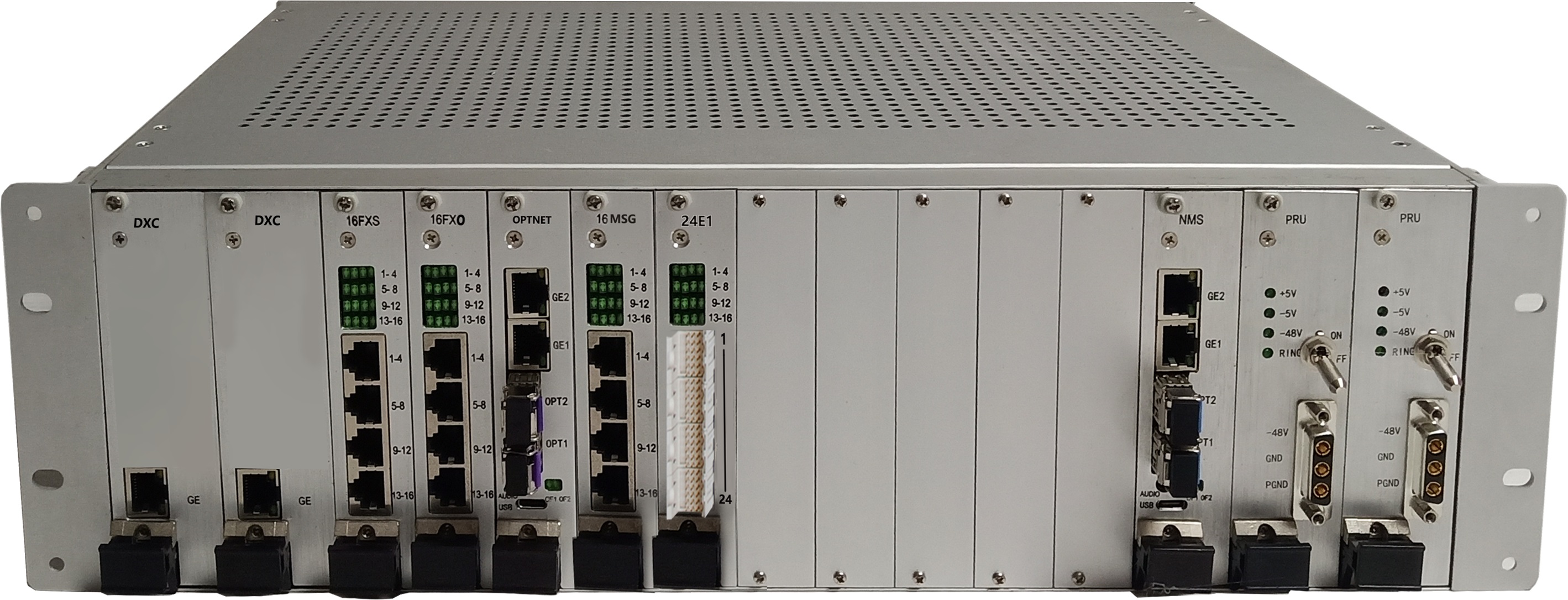
IDM-MSTP2500
IDM-MSTP2500
The SDH equipment is an STM-16 level MSTP product launched by our company in response to market demand. It enables the transmission of multiple services such as Ethernet, traditional PDH, digital television signals, and high-speed fiber access signals over the SDH system, meeting the needs of users for broadband and narrowband multi-service fiber transmission and access. This product adopts a single-chip integrated design solution, featuring high integration density, compact size, and rich service interfaces.
Overview:
The IDM MSTP2500 Multi-Service Transmission Platform is an STM-16 level MSTP product launched by our company in response to market demand. It enables the transmission of multiple services such as Ethernet, traditional PDH, digital television signals, and high-speed fiber access signals over the SDH system, meeting the needs of users for broadband and narrowband multi-service fiber transmission and access. This product adopts a single-chip integrated design solution, featuring high integration density, compact size, and rich service interfaces. It is suitable for a wide range of communication scenarios, public network backbone transmission networks, and private network systems, such as power dispatch systems, military networks, broadband access networks, traditional SDH systems, and user-customized services.


Product Features:
- 19-inch 1U standard chassis, compliant with relevant ITU-T recommendations and SDH technical specifications;
- Integrates SDH optical transmission, PCM multiplexing, and Ethernet access multi-services into one platform;
- Provides 4 rate-configurable 2.5Gb/s (STM-16) or 622Mb/s (STM-4) optical interfaces;
- Provides 4 rate-configurable 622Mb/s (STM-4) or 155Mb/s (STM-1) optical interfaces;
- Supports 1+1 protection and hybrid networking;
- Provides 2 GE (Gigabit Ethernet) interfaces and 8 FE (Fast Ethernet) interfaces, supporting physical isolation or VLAN partitioning;
- FE cross-connection uses VC-12 as the minimum granularity, GE cross-connection uses VC-3 as the minimum granularity;
- Provides 3 E3 (34Mb/s) interfaces and 16 E1 interfaces;
- Supports add/drop of 3 channels of EC-1 signals;
- Supports transmission of digital television signals (DVB-ASI) and high-speed fiber access signals (ESCON) over the SDH system;
- Full timeslot cross-connection function, providing powerful and convenient add/drop service capabilities and modes;
- Supports AC/DC power supply, with dual power board mutual backup;
- Supports point-to-point, chain, and ring networking topologies, and can also be jointly networked with centralized MSTP systems;
- Provides F (100Base-T) and f (RS232) network management interfaces, offering the five major functions recommended by ITU-T: configuration, alarm, performance, maintenance, and security;
- Provides remote network management access, supporting remote monitoring.
Technical Specifications:
Optical Interface
- Interface Type: FC (SC and others customizable) | Fiber Mode: Single-mode (multi-mode optional)
- Rate: 2.5G/622M/155M | Transmit/Receive Wavelength: 1310nm/1550nm
- Transmit Optical Power: -15~-8dBm | Receive Sensitivity: Better than -32dBm
- Transmission Distance: 20Km, optional long-distance optical modules available for extended fiber transmission.
E1 Interface
- Bit Rate: 2048Kbps | Line Code: HDB3
- Standard Protocol: Supports ITU-T G.703 | Impedance: 75Ω/120Ω
- Frame Structure: PCM30/31 | Signaling: Channel-associated signaling
Ethernet
- Interface Type: RJ-45 | Transmission Rate: N×2.048Mbps (N≤50)
- Standard Protocol: Supports IEEE802.3 | Operating Mode: Full/Half duplex/Auto-negotiation
FXO, FXS Interfaces
- Audio Range: 300Hz~3400Hz | Compression Rate: ITU G.711 A-law
- Impedance: Three-element complex impedance 200Ω+560Ω//0.1μF | Loop Current: 25mA/channel
Power Supply and Consumption
- Power Supply Mode: AC220V or DC-48V | Total Power Consumption: ≤50W
Typical Network Configuration Example:
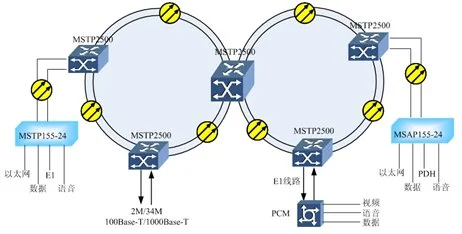
The MSTP2500 can be used to build various network types such as point-to-point, chain networks, ring networks, and multi-ring networks. The following uses a relatively complex multi-ring network application as an example to illustrate the functional application of this device in actual networks.
FAQs
What are the features of SDH technology and MSTP products?
I. Development Directions of Next-Generation SDH Technology and Products Regarding the development direction of…
View answerWhat is the difference between PDH and SDH?
I. PDH PDH is the Plesiochronous Digital Hierarchy, which is divided into the European standard and the…
View answerLow-Cost SDH Is an Inevitable Choice for Access Network Construction in the Near to Medium Term
The current status of metropolitan optical networks is that SDH/MSTP (DWDM) optical networks have become the mainstream…
View answerIntroduction to Ethernet Over SDH Technology
Interface specifications: On the SDH side, provides 1 x 155.52Mbps LVDS interface, supporting STM-1.
View answerEthernet Switch Board Principle
The Ethernet switch board launched by Raytrans on the IDM MSTP155-24 platform is based on the Spanning Tree Protocol…
View answer