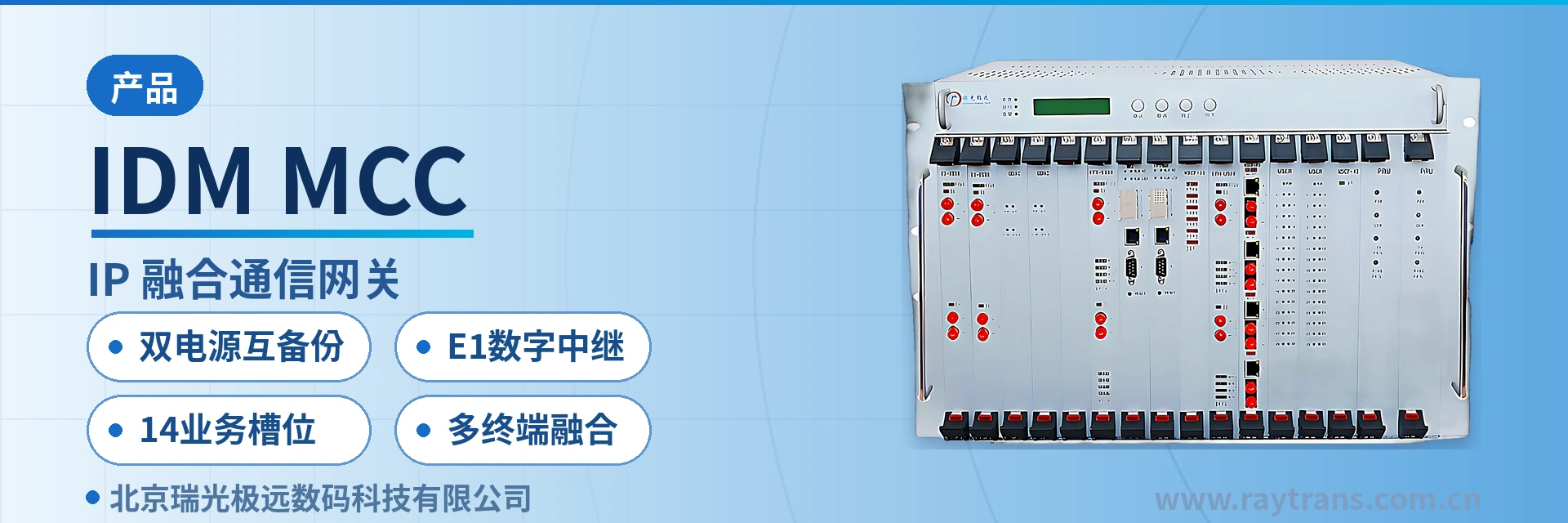
IDM MCC SIP Converged Communication Gateway
Five E1 signaling types, SIP, FXO three trunk types in parallel, magneto, HF, fax, PA, and others
The IDM MCC SIP converged communication gateway seamlessly integrates SIP softswitch dispatching with traditional TDM dispatching. It supports converged communication for multiple dispatch terminals, including SIP terminals, analog telephones (FXS), magneto telephones, HF/VHF/UHF radios, and PA terminals, and also provides E1 digital trunk interfaces and FXO analog trunk interfaces for compatibility with traditional PSTN networks.
The IDM MCC SIP converged communication gateway is an IP access gateway developed by Beijing Ruiguang Jiyuan Digital Technology Co., Ltd. It consists of a softswitch server hardware module, a converged dispatch software platform, and a service card enclosure. It is used to combine SIP softswitch dispatching and traditional TDM SPC dispatching into one network, and is a converged communication product showcase solution for private network users.
In electric power, railway, and civil air defense private networks, SPC exchanges and SIP softswitches have long coexisted: the newly deployed converged dispatch system runs over IP, while existing exchanges, magneto telephones, and HF radio sets remain in place. What is missing between the two systems is a trunk equipment that translates call signaling and carries 64K voice into the IP network. This is exactly where IDM MCC fits in, and it is also a key link in deploying the converged communication command and dispatch system in private networks.
Key Specifications at a Glance: 19-inch 7U enclosure with 16 slots · 2 power slots + 14 service slots · SIP signaling and E1 digital trunk · E1 supports NO.1/No.7/PRI/R2/V5.2 · FXO analog trunk access to PSTN · Dual mutual-backup power supplies AC 220 V/DC -48 V · HF/VHF/magneto/PA multi-terminal convergence
As a representative model from the command and dispatch system manufacturer Raytrans, this SIP converged communication gateway can be used with a dispatch console and can serve as the core access device in a military emergency communications vehicle solution.
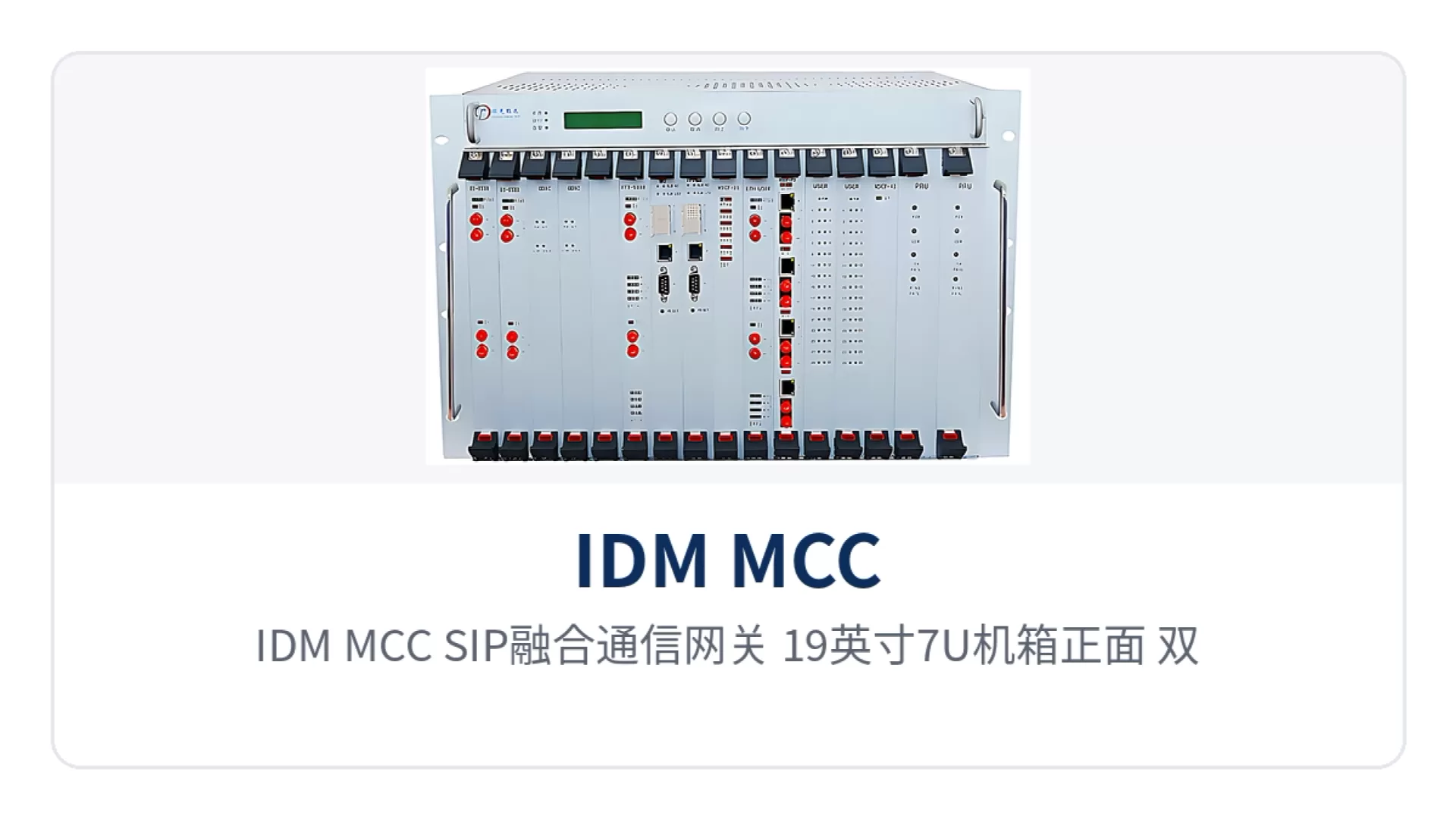
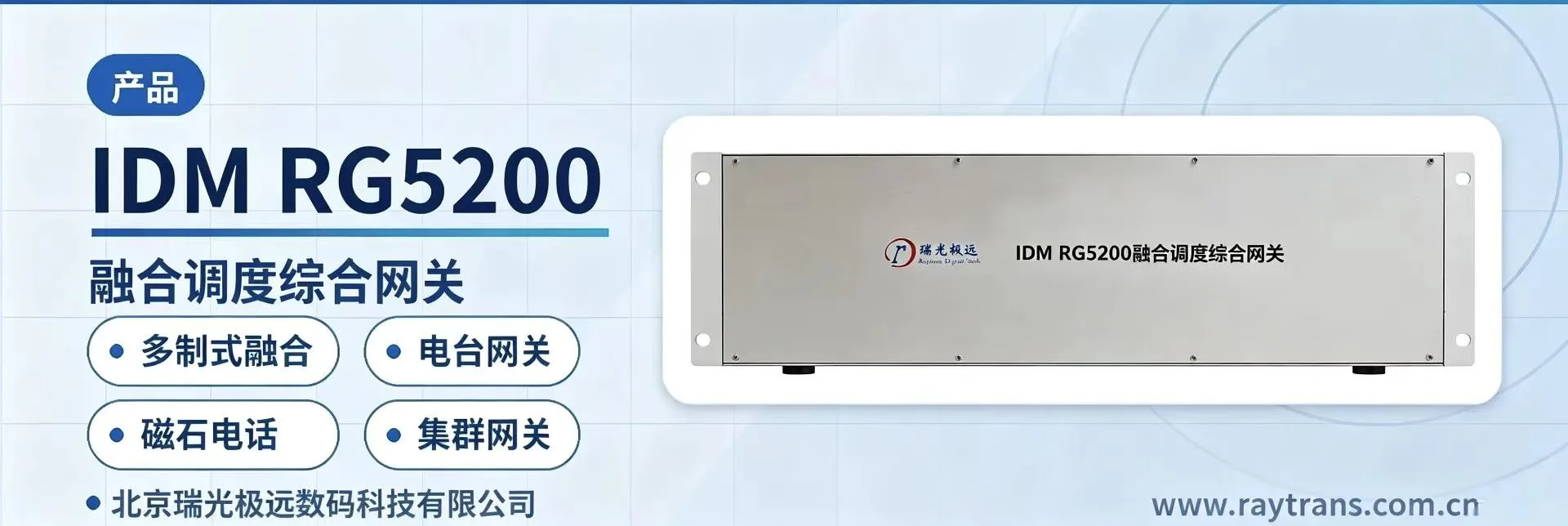
Figure 1: IDM MCC SIP converged communication gateway 19-inch 7U enclosure front view, dual power supplies, and 14 service card slots
What kind of device is the SIP converged communication gateway, and how are softswitch and SPC switching combined into one network
The SIP converged communication gateway is a signaling and media conversion device between the SIP softswitch network and the traditional TDM switching network. On one side, it interfaces with the softswitch and dispatch server using SIP signaling; on the other side, it interfaces with SPC exchanges and the PSTN using E1 digital trunks and FXO analog trunks. The call protocols, voice encoding, and clock systems on the two sides are all different, and the gateway is responsible for translating call signaling and packaging 64K voice into IP media streams. As the core device of the IP access gateway, it plays a connecting role in converged communication transformation.
Inside IDM MCC, voice channels are organized as 64K channels: HF and VHF radio voice, fax, audio broadcasting, analog telephones, and magneto telephones each occupy an independent 64K channel and do not contend for bandwidth with one another. Signaling processing and switching on the 2M interface support NO.1 and PRI. One voice channel from an HF radio set and one voice channel from a local telephone call have the same status in terms of time slots, and the dispatch console can program them into the same call table by number.
How to connect on the trunk side: SIP, E1 digital trunk, and FXO analog trunk
The three trunk types face three different types of opposite end, and which one to choose is determined by the interface and signaling format of the opposite-end device. The same SIP converged communication gateway can be equipped with several trunk types at the same time: the IP side connects to the new dispatch network, the E1 side connects to the old exchange, and the FXO side connects to local outside lines. During transformation, the three paths run in parallel without conflict, as listed item by item in the table below.
| Trunk Type | Interface and Signaling | Interfacing Object and Applicable Conditions |
|---|---|---|
| IP trunk | IP interface, supports SIP signaling | Interfaces with SIP softswitch, dispatch server, and IP phones; the new IP dispatch network uses this path |
| E1 digital trunk | E1 interface, supports NO.1, No.7, PRI, R2, and V5.2 signaling | Interfaces with existing SPC exchanges and tandem offices in electric power and railway networks, compatible with traditional TDM private networks |
| FXO analog trunk | FXO loop-start trunk interface | Connects to carrier analog outside lines or the user side of a superior exchange, compatible with access to the traditional PSTN |
SPC exchanges in domestic private networks span a wide range of years, and their signaling formats are not uniform: NO.1 and PRI are common on the electric power dispatch side, No.7 is used by railways and some old offices, and equipment introduced in earlier years may use R2 and V5.2. The E1 digital trunk incorporates all five signaling types, so during transformation you only need to select one according to the actual configuration of the opposite end, and there is no need to cascade another protocol converter for a single trunk.
The FXO analog trunk addresses scenarios where there is no E1 and only a pair of copper wires: the carrier provides only analog outside lines, or the superior unit provides only one subscriber line. After the outside line is plugged into the FXO port, incoming calls are routed to the specified extension according to rules, and outgoing calls are routed uniformly through the softswitch, so the analog outside line becomes a manageable and assignable trunk resource.
How to connect on the terminal side: HF, magneto, fax, PA, and SIP terminals
A common access situation on site is a mix of several terminal types: analog telephones in the duty room, magneto telephones in the equipment room, HF radio sets on the roof, and PA on the platform. Terminals of different standards each use their own interface and are uniformly converted into IP voice channels after entering the IP access gateway. The correspondence between interfaces and terminals is shown in the table below.
| Terminal Type | Access Interface | Access Mode and Description |
|---|---|---|
| SIP terminals and IP phones | IP interface | Register with the built-in softswitch and can access IP video streams at the same time |
| Analog telephone | FXS interface | An ordinary analog telephone can be used by plugging it in directly, without replacing the terminal |
| Magneto telephone | Magneto telephone interface | A telephone that generates ringing current by hand-cranking is connected, and the line reuses the existing telephone and cabling |
| HF and VHF radio sets | Radio interface | The radio voice channel is converted into an IP voice channel, and the dispatch console can directly initiate selective calls |
| Fax machine | FXS interface | Fax uses an independent 64K channel and does not interfere with voice |
| Audio broadcasting terminal | Audio broadcasting interface | The broadcasting terminal joins the network, and the dispatch console can deliver broadcasts |
Magneto telephone access and HF radio set access are two types of requirements frequently asked about on site: the former has old lines and only analog audio, while the latter uses dedicated equipment with non-standard interfaces. IDM MCC reserves independent channels and interfaces for both types of terminals, and after access both are uniformly numbered by the converged dispatch software platform, so dispatchers do not need to switch between multiple consoles.
Recording is performed by the soft dispatch platform, or a 4-channel or 8-channel recording card can be inserted into the enclosure for hardware recording, and video recording is saved together with the video stream on the dispatch console. The device can be fitted with a storage hard disk or connected to an external storage device, and call records and recordings are kept locally without relying on an external server.
Function and performance parameter summary table
Functions are listed item by item in the table below, among which trunk access and terminal access are two different capabilities: the former faces the switching network, and the latter faces on-site devices. Recording and local storage are supporting capabilities, and units that need to retain evidence should check them together at the time of ordering to avoid having to add accessories after the boards arrive.
| Function | Description |
|---|---|
| Softswitch and SPC switching convergence | Built-in softswitch server hardware module and converged dispatch software platform realize interconnection between SIP softswitch and SPC switching |
| Multi-format trunk access | Provides three types of uplink channels: IP/SIP trunk, E1 digital trunk (five signaling types), and FXO analog trunk |
| Multi-terminal converged access | Supports SIP terminals, analog telephones, magneto telephones, HF and VHF radio sets, fax, and audio broadcasting terminals |
| Audio and video recording | Recording is performed by the soft dispatch platform, or a 4-channel/8-channel recording card can be inserted; video recording is saved with the video stream |
| Local storage | Can be fitted with a storage hard disk or connected to an external storage device; recordings and call records are retained locally |
| Human-machine interaction dispatch software | The converged dispatch software platform provides number management, call control, and terminal status display |
| Service card expansion | The 14 service slots are populated with service boards according to on-site terminal types, and capacity varies with the number of cards installed |
Check the overall unit specifications and interface specifications against the table below. For items not yet recorded in the knowledge base, the accompanying technical documentation and ordering confirmation shall prevail. The number of slots, power supply mode, and signaling formats in the table can be used directly to write technical proposals and bid responses, without the need to separately compile a specification list.
| Item | Parameter/Specification | Description/Applicable Conditions |
|---|---|---|
| Model | IDM MCC | SIP converged communication gateway |
| Equipment form factor | 19-inch rack-mounted, 7U high | The fan unit occupies 1U |
| Slot configuration | 16 slots in total, 2 occupied by dual power supplies, 14 service slots | Service boards are populated according to terminal types |
| Power supply mode | AC 220 V or DC -48 V selectable, dual mutual-backup power supplies | The two power slots connect to two independent power feeds |
| IP trunk | IP interface, SIP signaling | Interfaces with softswitch and dispatch server |
| E1 digital trunk | Supports NO.1, No.7, PRI, R2, and V5.2 signaling | The 2M interface performs signaling processing and switching |
| FXO analog trunk | Supported | Compatible with access to the traditional PSTN |
| Subscriber interface | FXS interface, magneto telephone interface | Analog telephones and fax use FXS; magneto telephones use the magneto port |
| Radio interface | HF and VHF radio set interfaces | Radio voice is converted into IP voice channels through the gateway |
| Broadcasting interface | Audio broadcasting interface | Connects to audio broadcasting terminals |
| Voice channel organization | Each terminal channel is an independent 64K channel | Channels do not contend with one another |
| Overall power consumption | Not yet recorded in the knowledge base | Subject to the accompanying technical documentation |
| Operating temperature and humidity | Not yet recorded in the knowledge base | Confirm at the time of ordering according to equipment room conditions |
Differentiated value: what dual power supplies, five E1 signaling types, and 14 service slots deliver
The three designs correspond to three types of on-site pain points: power supply must not be interrupted, old exchanges must not be replaced, and the variety of terminals cannot be reduced. The fourth item is the capacity flexibility brought by card expansion: what to deploy first and what to add later is determined by the business rhythm, and it is not necessary to equip everything at once. Compare item by item below.
| Differentiation Point | On-site Value |
|---|---|
| Dual mutual-backup power supplies, AC 220 V/DC -48 V selectable | Substations, trackside equipment rooms, and civil air defense underground command posts are mostly unattended; when one power feed fails, the other continues to supply power. AC sites and DC equipment rooms can use the same model, and spare parts do not need to be split into two types by power supply format |
| E1 digital trunk supports NO.1/No.7/PRI/R2/V5.2 | During transformation, select the signaling according to the actual configuration of the opposite end, and old offices do not need to replace their exchanges; one E1 trunk directly connects to existing tandem equipment, eliminating the intermediate protocol conversion step |
| Converged access of multiple terminals such as HF/VHF/magneto/PA | HF radio sets, magneto telephones, PA terminals, and SIP phones are uniformly selected and called on one dispatch console, and duty operators do not need to watch multiple operating terminals |
| 14 service slots | Boards are populated according to on-site terminal types; telephones can be deployed first and radios and PA added later, and capacity expansion only requires adding boards without touching the main unit |
Typical application scenarios
What the three types of private networks have in common is that existing SPC equipment is still in service while the new dispatch system already runs over IP. The IP access gateway sits at the boundary between the two, undertaking signaling translation and voice channel aggregation. The access modes and transformation boundaries are described below by industry, making it easier to select card combinations against your own existing network conditions.
Electric power/energy private network: intercommunication between substation magneto telephones and dispatch softswitch
Magneto telephones in substation duty rooms work by hand-cranked ringing current, and their lines carry only analog audio, so they cannot enter the IP-based dispatch network. IDM MCC connects the magneto telephones on site, collects them together with analog telephones and HF radio sets into service slots, interfaces with the regional dispatch center SPC exchange through the E1 digital trunk, and uploads to the dispatch center through SIP signaling. The transformation does not touch the telephones or change on-site cabling, duty operators keep their dialing habits, and the dispatch center can see the voice channel status of each site on one table, achieving a smooth transition under converged communications.
Rail transit/railway private network: E1 trunk access to existing SPC exchanges
SPC exchanges at railway stations along the line mostly use NO.1 or PRI trunks, and section telephones, PA, and radio train dispatching each form their own system, while the dispatch center requires centralized calling. IDM MCC interfaces with existing exchanges through E1 digital trunks, brings section telephones and audio broadcasting into the same number table, and HF and VHF radio sets are connected through radio interfaces and then directly selected and called by the dispatch console. On site, it is only necessary to parallel-connect trunk lines on the existing patch panel without changing the data of existing exchanges, and converged dispatching capability thus extends to stations along the line.
Emergency command/civil air defense private network: network-integrated dispatching of HF radio sets and PA terminals
Civil air defense underground command posts and emergency command centers must still be able to maintain external contact by HF radio when ground communications are interrupted, while in daily operations they also need to interoperate with local telephone calls and private network telephones. IDM MCC connects HF and VHF radio sets, magneto telephones, PA terminals, and SIP phones to the same platform, retains one PSTN outlet through the FXO analog trunk, and dual mutual-backup power supplies ensure that dispatching does not fail when mains power is interrupted. The solution is also applicable to vehicle-mounted dispatching scenarios in a military emergency communications vehicle solution, achieving front-and-rear coordination through the converged communication command and dispatch system.
How to deploy: rack mounting, cabling, and commissioning in three steps
On-site implementation proceeds in three steps: rack mounting and power supply, card installation and wiring, and data commissioning. Each step has corresponding items to verify, and the next step starts only after the previous one is confirmed correct, which avoids repeated rework on the cutover day. The man-hours of the three steps are mainly spent on card installation and wiring and on link-by-link signaling commissioning.
- Rack mounting and power supply: Install the 19-inch 7U chassis into a standard cabinet. The fan unit occupies 1U of height. Select an AC 220V or DC -48V power supply according to equipment room conditions, connect the two power supply slots to two independent power feeds, and check the indicator LEDs after connection.
- Card installation and wiring: Insert and configure service boards in the 14 service slots according to the on-site terminal list. Lead out the E1 digital trunk with coaxial cables, route FXO, FXS and magneto voice channels over voice distribution frames, connect HF and VHF/UHF radio sets with dedicated interface cables, and label every wiring run.
- Data configuration and commissioning: Register trunk and terminal numbers on the converged dispatching software platform, select one signaling type from NO.1, PRI, SS7, R2 or V5.2 according to the actual configuration at the opposite end, and test dial-in landing, dial-out routing and recording storage one by one. Cut over only after everything is confirmed correct.