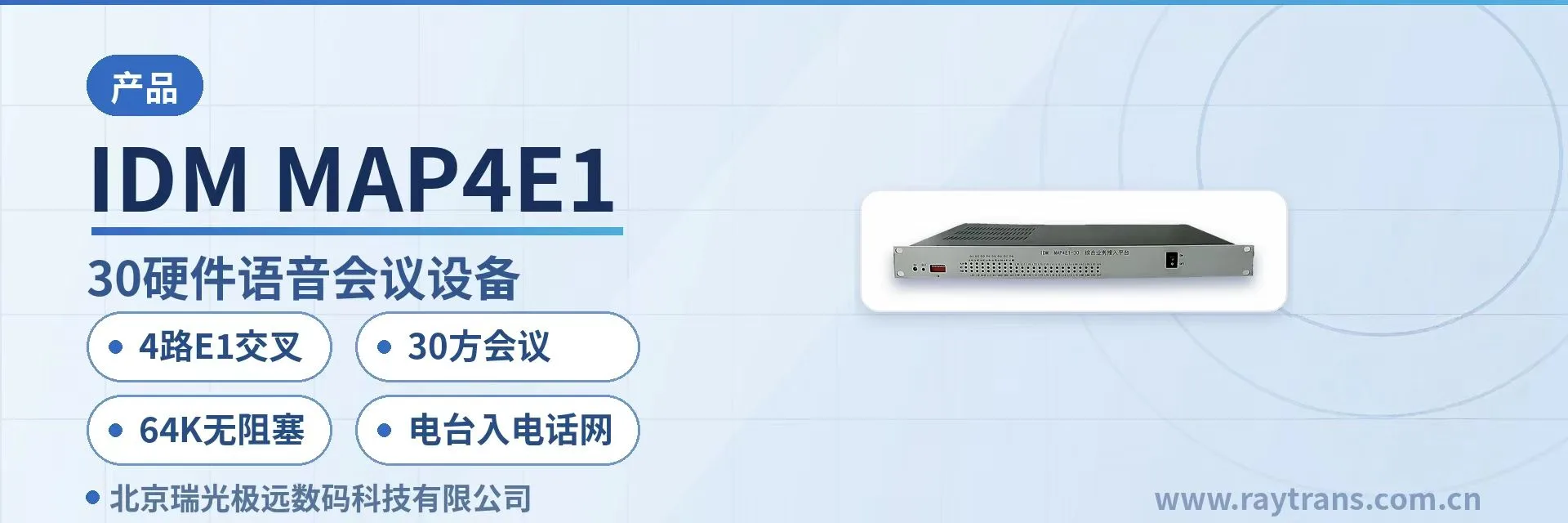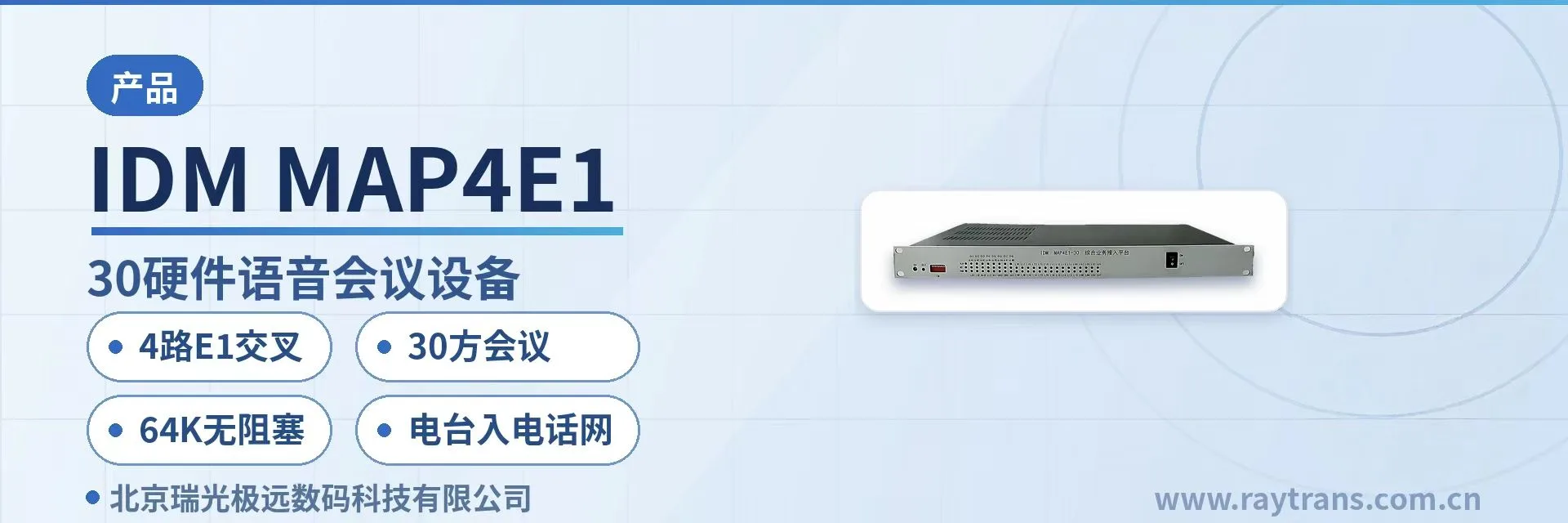
IDM MAP4E1-30 Hardware Voice Conference Device
4-channel E1 cross-connect, 30-party conference, radio sets directly connected to the telephone network, no conferencing server required
The IDM MAP4E1-30 Hardware Voice Conference Device is an integrated service platform that combines 64K narrowband service access, PCM multiplexing, 64K time-slot cross-connection, and a 30-party voice conference room.
The IDM MAP4E1-30 hardware voice conference device is a narrowband voice conference device developed by Raytrans. It is used for service access and cross-connection at the access layer of a data communication network, bringing in narrowband services such as 2/4-wire audio, telephone, magneto telephone, common battery telephone, and V.24 data, and completing 64K-level non-blocking cross-connection of 4 E1 channels and 30-party voice consultation within the same chassis. This PCM equipment integrates 64K narrowband service access, PCM multiplexing, 64K time-slot cross-connection, and a 30-party voice conference room into a 19-inch 1U chassis. Voice conferencing and service access are both completed inside the device, with no need for an additional conferencing server, fully reflecting Raytrans's deep accumulation in the field of integrated service access devices.
Key Specifications at a Glance: 4 E1 cross-connections · 30-party conference · 64K non-blocking · radio sets into the telephone network
What Kind of Device Is a Narrowband Voice Conference Device?
A narrowband voice conference device is a PCM equipment that combines voice conferencing and narrowband service access in one place. Conference mixing and service access are both implemented inside the device, and 30-party voice consultation requires no external conferencing server. As a professional voice conference terminal, the IDM MAP4E1-30 narrowband voice conference device simultaneously handles three tasks: bringing in on-site audio and data narrowband services; performing 64K-level non-blocking cross-connection over 4 E1 channels to assign each service to the required direction; and then organizing the audio terminals that need to be linked into a 30-party voice conference room, so that the local end and the remote end can hold consultation in the same conference room.
The IDM MAP4E1-30 narrowband voice conference device uses a standard 19-inch 1U chassis. The main board provides 15 service card slots, each card can provide two services, and the local end can provide 30 channels of 64K services. The interface types are determined by the service cards configured for the project. The IDM MAP4E1-30 narrowband voice conference device has complete synchronous timing functions, providing system synchronization for E1 channels and subscriber interfaces. The 4 E1 channels can form point-to-point, chain network, star network, and other structures, making it suitable for scenarios such as electric power and rail transit private network dispatch, petrochemical and mining emergency communications, and elevator Internet of Things (IoT) and building intercom operation, completing service access and conference dispatching within the same chassis.
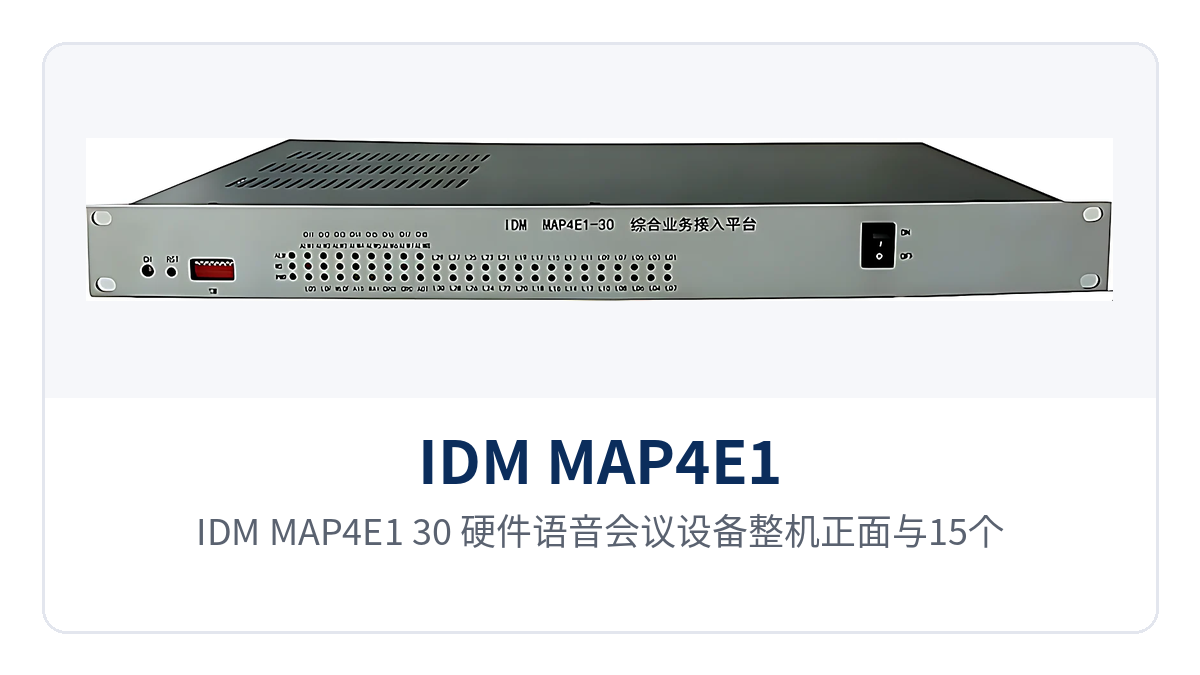
Figure 1: Close-up of the front of the IDM MAP4E1-30 hardware voice conference device and its 15 service card slots
Which Audio Terminals Can the IDM MAP4E1-30 Connect To?
The local end of the IDM MAP4E1-30 narrowband voice conference device can provide access for 30 audio terminals. The terminal types cover analog telephones, switch-side interfaces, radio sets and intercoms, microphones and speakers, and elevator five-party intercom systems. The specific interface types are determined by the configured service cards. Service types include 2/4-wire audio, telephone, magneto telephone, common battery telephone, and V.24 data services. Audio interfaces use A-law encoding as specified in ITU-T G.711.
Interface/Module | Connectable Terminal or Service |
|---|---|
FXS interface | Used for connecting telephones |
FXO interface | Used for connecting switches |
EMVOICE24 | Used for connecting radio sets, trunking intercoms, access control intercoms, conference microphones, headsets, etc. |
MicPhone interface | Used for connecting microphones and speakers to implement monitoring and dedicated-line intercom |
NKT five-party intercom interface | Used for transmitting the five-party intercom system of Otis brand elevators over the network |
VoiceSL five-party intercom module | Used for connecting the five-party intercom of Mitsubishi, Deling, and other brand elevators, and transmitting and dispatching over the IoT network |
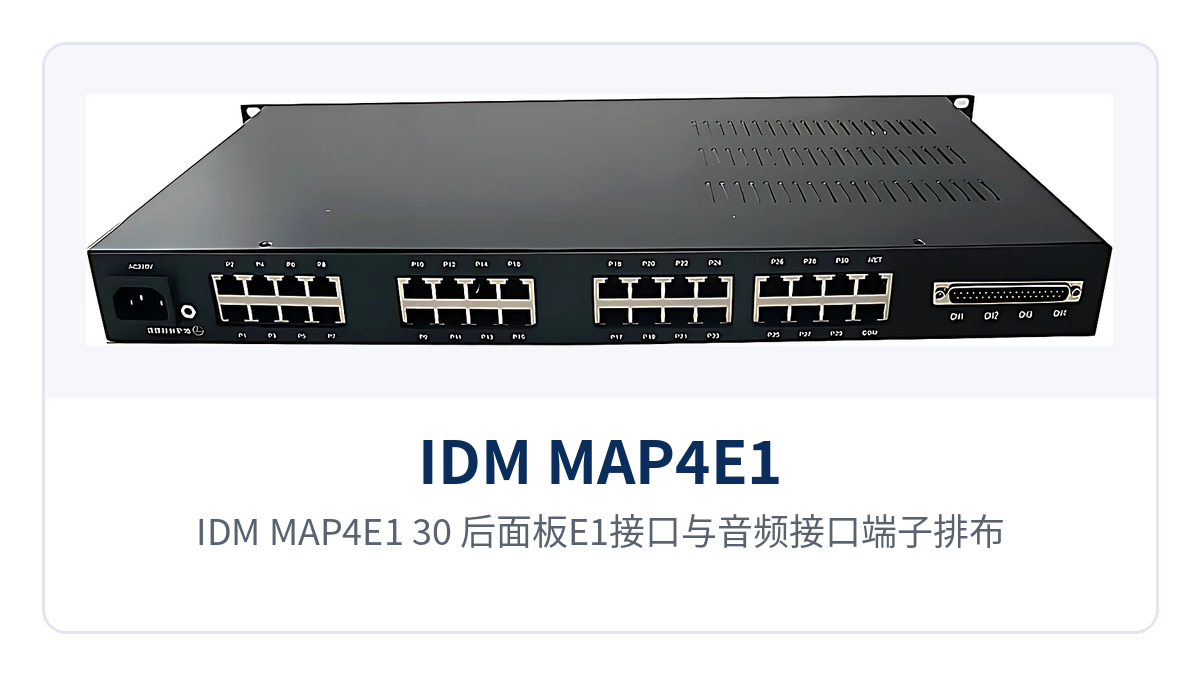
Figure 2: Layout of the E1 interfaces and audio interface terminal blocks on the rear panel of the IDM MAP4E1-30
When different service cards are mixed in the same device, cross-connection and multiplexing between the interfaces are completed inside the device, with no need to connect multiple single-function devices in series at the access layer. The conference room can not only access local terminals, but also transmit to other local audio interfaces through E1 interfaces, so that audio interfaces between sites can enter the same conference room. The IDM MAP4E1-30 narrowband voice conference device has a gateway configuration function, which can add a certain audio interface to the conference room or delete it from the conference room as required. By default, all parties in the conference room can speak, and a mode in which a certain client is muted can also be set.
What Core Functions Does the IDM MAP4E1-30 Narrowband Voice Conference Device Have?
The functions of the IDM MAP4E1-30 narrowband voice conference device revolve around three threads: narrowband service access, E1 time-slot cross-connection, and hardware voice conferencing. Both service access and conference room members can be adjusted according to project needs through gateway configuration. The following table summarizes the main function items and corresponding descriptions of the IDM MAP4E1-30 hardware voice conference device.
Function | Description |
|---|---|
64K narrowband service access | A standalone unit can access 30 audio terminals at the local end. Service types include 2/4-wire audio, telephone, magneto telephone, common battery telephone, and V.24 data services |
PCM multiplexing | 30 channels of 64K services are multiplexed into E1 channels for transmission. Audio uses A-law encoding as specified in ITU-T G.711 |
64K time-slot cross-connection | Provides 64K-level non-blocking cross-connection in 4 E1 channels. Services can be assigned between channels as required |
30-party voice conference room | The conference room can accommodate 30-party voice terminals. By default, all parties can speak, and a certain client can also be muted |
Voice-Triggered Communication Activation (optional) | Used to connect half-duplex communication devices (such as trunking radio sets, radio sets, and network intercoms) to full-duplex communication networks such as the telephone network |
Conference room stacking | The conference room can not only access local terminals, but also transmit to other local audio interfaces through E1 interfaces. The conference rooms of multiple devices can be directly stacked into one large conference room |
Gateway configuration | Add a certain audio interface to the conference room or delete it from the conference room as required |
Synchronous timing | Complete synchronous timing functions, providing system synchronization for E1 channels and subscriber interfaces |
Network management | Provides serial port network management or Ethernet SNMP network management |
Voice-triggered communication activation and conference room stacking are two capabilities that determine the networking approach. Voice-triggered communication activation connects half-duplex trunking radio sets, radio sets, and network intercoms to full-duplex communication networks such as the telephone network. Radio sets into the telephone network require no additional protocol conversion gateway. Conference room stacking allows the conference scope to expand with the number of sites. Each time a new site is added, only the conference room of the local device needs to be merged into the existing conference room through an E1 channel. The types of conference terminals and the conference scope grow in step with the number of connected devices.
IDM MAP4E1-30 Technical Specifications
The E1 interface and audio interface specifications of the IDM MAP4E1-30 hardware voice conference device comply with public recommendations such as ITU-T G.703, PCM30/32, and ITU-T G.711, and the V.24 interface complies with the CCITT V.28 protocol. The following parameters are taken from the public information of the same model of PCM equipment and the public specifications of the same model of integrated service cross-connect multiplexing equipment. The specific configuration is subject to the manufacturer's technical documentation and commercial confirmation.
Item | Parameter/Specification | Description or Applicable Conditions |
|---|---|---|
Line-side E1 channel | 4-channel | 64K non-blocking cross-connection among the 4 E1 channels, supporting point-to-point, chain network, and star network structures |
E1 bit rate | 2.048 Mbps | Compliant with ITU-T G.703 |
E1 line coding | HDB3 | Compliant with ITU-T G.703 |
E1 frame structure | PCM30/32 | Channel-associated signaling |
E1 impedance | 75 Ω/120 Ω | Subject to the manufacturer's technical documentation and commercial confirmation |
64K service capacity | 30-channel (or N×64K) | 2/4-wire audio, telephone, magneto telephone, common battery telephone, and V.24 data services |
Service card slot | 15 | Each card can provide two service channels, subject to the manufacturer's technical documentation and commercial confirmation |
FXO/FXS interface | Audio range 300 Hz~3400 Hz, A-law per ITU-T G.711 | Three-element complex impedance 200 Ω+560 Ω//0.1 μF, loop current 20 mA per channel |
EM 2/4-wire and magneto interface | Audio range 300 Hz~3400 Hz, balanced 600 Ω | Return loss no less than 18 dB |
V.24 interface | Asynchronous ≤9600 bps; synchronous 64 Kbps | Compliant with CCITT V.28 |
Codirectional 64K interface | 64 Kbps, balanced 120 Ω | Compliant with ITU-T G.703 |
Voice conference capacity | 30-party | By default all parties in the conference room can speak, and an individual customer can also be muted |
Network management mode | Serial port network management or Ethernet SNMP network management | Subject to the manufacturer's technical documentation and commercial confirmation |
Power supply mode | AC 220 V / DC -48 V | Subject to the manufacturer's technical documentation and commercial confirmation |
Overall power consumption | ≤150 W | Subject to the manufacturer's technical documentation and commercial confirmation |
Operating temperature | -10 ℃~+50 ℃ | Relative humidity 0~95% (non-condensing) |
Product dimensions | 482×309×44 mm | 19-inch 1U chassis, subject to the manufacturer's technical documentation and commercial confirmation |
The 2.048 Mbps rate and PCM30/32 frame structure of the E1 channel determine that each E1 channel can carry 30 64K time slots. The E1 time-slot cross-connection among the 4 E1 channels is completed inside the device at a 64K granularity, so 30 channels of audio terminals and data services can be assigned to any E1 channel and can also intercommunicate between different channels. The interface level, impedance, and encoding of 2-wire audio and 4-wire audio are implemented per ITU-T G.711, so no additional voice compression conversion is required when interconnecting with existing network PCM equipment.
What is the difference between a narrowband voice conference device and an IP voice conference room?
The difference between a narrowband voice conference device and an IP voice conference room lies in where the voice path is implemented and the operating overhead: the conference function of the IDM MAP4E1-30 narrowband voice conference device is completed by hardware inside the device, and the hardware-based voice conference terminal has no delay, with clear and stable sound and convenient control; a server-based IP voice conference room relies on server software and the IP network to carry voice, requiring additional server investment and O&M. For a private network already interconnected by E1 channels, the IDM MAP4E1-30 narrowband voice conference device can complete voice consultation directly on the same PCM equipment at the access layer, with lower investment cost and less operating overhead than an IP voice conference room.
In terms of terminal types and conference scope, a narrowband voice conference device and an IP voice conference room also differ. A voice conference terminal based on the PCM structure has the characteristics of many types of conference terminals and a large conference scope. The IDM MAP4E1-30 hardware voice conference device can connect analog telephones, magneto telephones, microphones and speakers, radio sets, and elevator five-party intercom systems, and merge remote audio interfaces into the conference room through E1 channels; the conference rooms of multiple devices can be directly superimposed into one large conference room, and the conference scope expands with the number of sites.
Differentiated Capability | Value to Users |
|---|---|
4-channel E1 cross-connection and 30-channel audio in the same chassis | 4-channel E1, 64K non-blocking cross-connection, 30-channel narrowband service access and dispatching within the same chassis, 30-channel voice conferencing in one device, and no need to cascade multiple single-function devices at the access layer |
Hardware-based PCM conferencing with no delay | The hardware-based voice conference terminal has no delay, delivers clear and stable sound, and is easy to control; compared with a server-based IP voice conference room, it requires lower investment and less operating overhead |
Half-duplex radio sets access the full-duplex telephone network | The conference room offers an optional voice-triggered communication activation function, so half-duplex devices such as trunking radio sets, radio sets, and network intercoms can access full-duplex communication networks such as the telephone network through voice triggering |
Conference room stacking | The conference rooms of multiple devices can be directly stacked into one large conference room, and the conference scope expands with the number of sites |
What scenarios are narrowband voice conference devices suitable for?
Electric power and rail transit private network dispatching: 4-channel E1 cross-connection and 30-party consultation in the same chassis
Power substations and rail transit stations have a large number of dispatch telephones and audio dedicated lines that are widely distributed, and sites are interconnected through E1 channels. The IDM MAP4E1-30 narrowband voice conference device directly connects 30 audio terminals at the access layer, then uses 4-channel E1 channels for 64K non-blocking cross-connection to assign voice services from different directions to the required links; for multi-point consultation, the 30-party voice conference room organizes telephones, microphones, and speakers at sites along the line into the same conference, so site voice dispatching does not depend on an external conferencing server. The conference room can mute an individual customer, adapting to the voice organization mode in dispatching scenarios where the main dispatcher speaks and the others listen.
Petrochemical and mining emergency communications: half-duplex radio sets access the telephone network through voice triggering
On-site communication in plants and mines makes extensive use of half-duplex devices such as trunking radio sets and radio sets, which require pressing a button to speak and are originally incompatible with the full-duplex calling mode of the telephone network. The EMVOICE24 interface of the IDM MAP4E1-30 narrowband voice conference device can directly connect radio sets, trunking intercoms, and access control intercoms, and the voice-triggered communication activation function provided by the conference room connects half-duplex communication devices to full-duplex communication networks such as the telephone network, so calls from on-site radio sets can be brought into the telephone conference of the command center, and the voice of the command center can also return to the on-site radio sets, keeping the voice path uninterrupted during emergency dispatching. The IDM MAP4E1-30 narrowband voice conference device can be deployed in coordination with intrinsically safe mining communication equipment to provide a path for on-site voice access in plants and mines, and together with Raytrans' smart mining communication solution and military emergency communications vehicle solution, it meets the networking requirements of command and dispatch system manufacturers for integrated service access devices and PCM equipment.
Elevator IoT and building intercom operation: unified dispatching of NKT and VoiceSL
Elevator five-party intercom requires calls among the cable car cabin, equipment room, car top, pit, and duty room, and the traditional approach is for each brand's intercom system to build its own network, making it difficult for property management and operators to dispatch in a unified manner. The IDM MAP4E1-30 narrowband voice conference device provides an NKT five-party intercom interface for the five-party intercom system of Otis brand elevators to transmit over the network; it provides a VoiceSL five-party intercom module for connecting the five-party intercom of Mitsubishi, Deling, and other brand elevators for transmission and dispatching over the IoT network. Property management and operators can access the intercom voice of different elevator brands on the same platform, and incorporate duty room telephones, microphones, and speakers into the voice conference room, so five-party intercom and the voice conference terminal for site voice dispatching are managed in a unified manner on the same device. Raytrans' time-slot cross-connect equipment and integrated service access devices have been deployed in batches in private networks such as electric power, mining, and military, and elevator five-party intercom and building intercom operation can be presented together as typical applications in the product showcase.
Conclusion
The IDM MAP4E1-30 narrowband voice conference device accomplishes both service access and voice conferencing in one 19-inch 1U device: 64K non-blocking cross-connection in 4-channel E1 channels, 30-channel narrowband service access within the same chassis, 30-party voice conferencing in one device, and support for conference room stacking and half-duplex radio sets accessing the full-duplex telephone network through voice triggering. The IDM MAP4E1-30 narrowband voice conference device is suitable for scenarios such as electric power and rail transit private network dispatching, petrochemical and mining emergency communications, and elevator IoT and building intercom operation. Before deployment, it is recommended to confirm the service card configuration according to the number of sites, audio terminal types, and conference scale.
FAQs
What is the working principle of Pulse Code Modulation (PCM)?
Working Principle Pulse Code Modulation is the process of converting a time-continuous…
View answerPCM30 Working Principle: What Is PCM30/32
PCM30 Equipment Working Principle The 30-channel PCM equipment refers to equipment that provides 30 user interfaces and…
View answerWhat are the common problems of PCM equipment in enterprise applications?
At present, PCM equipment has become basically ubiquitous in enterprise network applications.
View answerWhat is E1? How to Use E1
What is E1 The European 30-channel pulse code modulation PCM is abbreviated as E1, with a rate of 2.048Mbit/s.
View answerFrame Structure of 30/32-Channel PCM Primary Group
A communication system consists of transmitting equipment, receiving equipment, and transmission equipment.
View answer