IDM M3000
IDM M3000
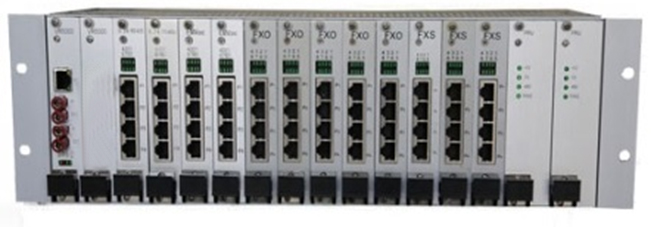
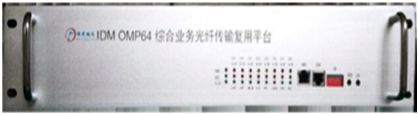
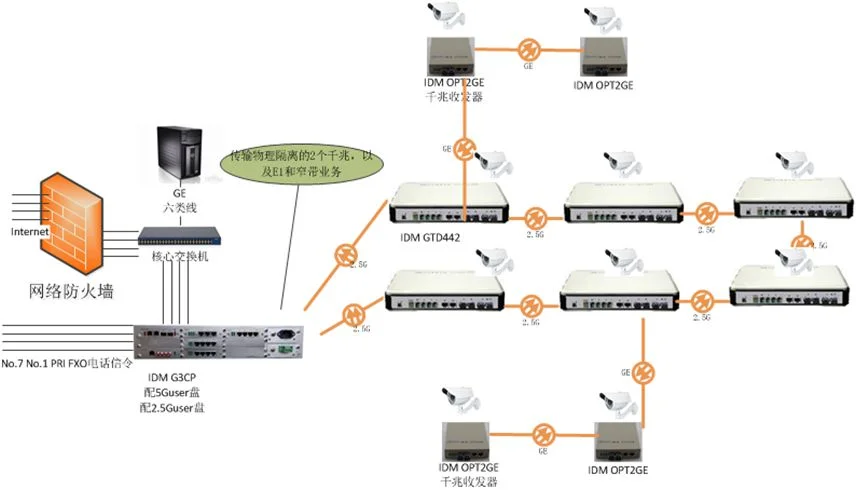
The IDM M3000 is a 19-inch 2U dispatch switch. The IDM M3000 provides access to a set of 2.5G fiber ring network equipment (IDM GTD442) via the IDM 120N-GP optical module. This equipment provides 2 groups of physically isolated Gigabit Ethernet ports and 4 telephone lines, and can also accommodate a serial port server card to connect various monitoring devices. Many HD cameras can be connected to the Gigabit ring network. A WG300 card can be inserted to implement telephone access over 3 E1 lines. It provides No.1, No.7, and PRI signaling access over 2 E1 lines. The M3000 can provide a 2.5Gbps fiber ring network, on which 30 telephone lines can be allocated. A serial port server card can also be inserted to aggregate remote serial ports.
Currently, the development trend of dispatch switches is toward IP-based solutions. The International Civil Aviation Organization (ICAO) has also issued specifications for IP dispatch in air traffic control applications. However, IP dispatch in critical fields imposes specific requirements on IP transport network performance, such as port traffic limiting and VLAN partitioning, which are fundamental guarantees for reliable IP dispatch applications. Transmitting IP voice over office networks without IP transport planning still poses many security risks. The M3000 is a voice dispatch system based on traditional TDM timeslot switching, featuring fast switching response, large hardware voice conference capacity, and rapid module startup. For remote transmission, it uses VoIP transmission terminals over IP networks for flexibility and convenience. It remains the preferred product in high-security application domains.
The IDM M3000 is a 19-inch 2U dispatch switch.
The IDM M3000 provides access to a set of 2.5G fiber ring network equipment (IDM GTD442) via the IDM 120N-GP optical module. This equipment provides 2 groups of physically isolated Gigabit Ethernet ports and 4 telephone lines, and can also accommodate a serial port server card to connect various monitoring devices. Many HD cameras can be connected to the Gigabit ring network.
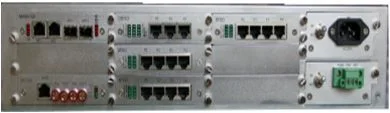
The IDM M3000 can accommodate a WG300 card to implement telephone access over 3 E1 lines. It provides No.1, No.7, and PRI signaling access over 2 E1 lines.
The M3000 can provide a 2.5Gbps fiber ring network, on which 30 telephone lines can be allocated. A serial port server card can also be inserted to aggregate remote serial ports.
Functional Overview
The IDM-M3000 can connect up to 24 radio transceiver units, including HF (shortwave), VHF (ultra-shortwave) single-sideband radios, and 350M/800M trunked radios.
The trunk interfaces of the equipment can be:
GSM/CDMA interfaces;
WAN ports supporting electrical (RJ45) or optical (FC) interfaces for IP phone access channels;
Standard telephone trunk interfaces;
Standard magneto interfaces or 2100Hz magneto interfaces;
Satellite telephone interfaces;
China No.1 signaling, China No.7 signaling, PRI signaling, etc.;
The equipment supports up to 90 interfaces for standard telephones or wired intercom terminals.
IDM M3000 Communication Command & Dispatch System — Product Series
1. IDM M3000 Communication Command & Dispatch System Composition
The main control switching card provides 64-party telephone conferencing (expandable to 128 parties on this model), supports up to 32 simultaneous telephone conferences, and provides simultaneous detection of 64 DTMF signals. The main control card provides 2 groups of E1 interfaces, configurable for China No.7 signaling or PRI signaling.
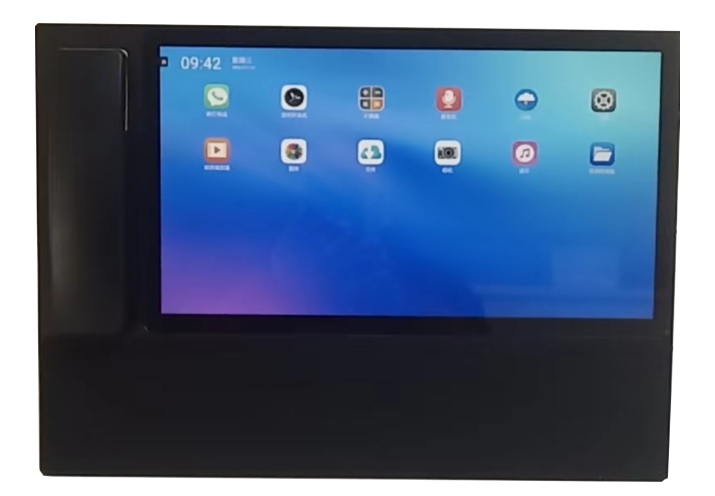
The M3000 can be directly connected to dispatch telephones and other terminals, or used in conjunction with dispatch consoles to implement flexible dispatch functions.
An IP recording system can be used to record up to 30 telephone lines simultaneously.
The unit provides 6 user card slots, each of which can accommodate a VHF interface card, FXS subscriber telephone card, FXO central office telephone card, Hot hotline telephone card, MAG magneto telephone card, Mpconv 100M fiber extension card, etc.
When a VHF radio interface card is inserted in a user slot, each card provides 4 channels, capable of connecting radio transmitters, receivers, remote control consoles, etc.
When FXS, FXO, or MAG cards are inserted, each card provides 10 channels.
The Mpconv card provides 4 optical ports per card, and each optical direction can connect to an NTD421 fiber link network.
FXO interfaces allow access to dispatch resources on the M3000 via switch subscriber lines. That is, external lines can also monitor VHF radio interfaces through FXO.
FXS user interfaces can connect standard telephones, PTT intercom terminals, etc. They can also be extended to more remote operating sites via PCM transmission.
2. IDM M3000 Communication Command & Dispatch System Information Flow Diagram
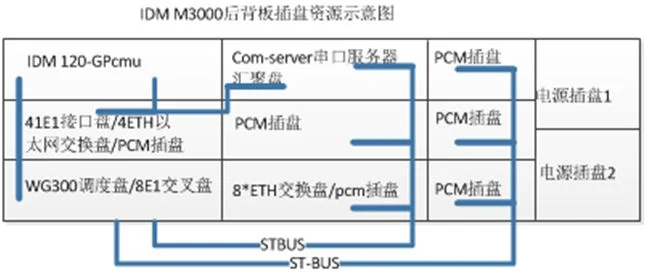
3. IDM M3000 Communication Command & Dispatch Working Modes
- Multiparty conference mode: Intercom with standard telephones uses a multiparty conference mode. That is, one conference number is configured for each VHF radio channel. All telephones monitoring that radio channel can dial into the conference room. Within the conference room, audio from any party (including radios and telephones) is transmitted to all other telephones and also to the VHF radio. The continuous transmission time of the VHF radio is limited to 2 minutes. Due to limited conference room capacity, the number of telephone terminals that can freely converse is limited. However, additional receive-only terminals can be added.
- Standard telephone intercom mode: In this mode, there is no limit on the number of telephones that can join a VHF intercom session. After dialing the VHF access number, a telephone can monitor the radio channel audio. To speak to the radio, the user must press the flash key or tap the hook switch to obtain 20 seconds of talk time (20 seconds by default, configurable in the system). To prevent contention among multiple users, the telephone that has obtained talk time receives an audible talk indication tone.
- PTT terminal intercom mode: In this mode, terminals are normally in the radio monitoring state. When needing to speak, the user presses the PTT key (standard telephones require a PTT adapter; our company provides telephones with PTT switching functionality). Talk time is determined by the terminal!
- Broadcast mode: VHF radio audio is broadcast one-way to all telephones that have joined for monitoring. Terminals only receive VHF audio. This mode does not limit the number of telephones monitoring each VHF channel.
Note:
In actual use, mode 4 can be combined with the other three modes.
Multiple VHF radios can be operated in parallel by bridging 2 or more radios into the same conference room. Audio received by one radio can be forwarded to other radios or telephone terminals.
A single telephone can join monitoring of multiple VHF radios, and its speech can be transmitted to multiple radios simultaneously.
4. IDM M3000 Communication Command & Dispatch Working Modes (Continued) — Wireless Channel Access Control Modes
- PTT control mode: Audio interfaces with PTT functionality should prioritize PTT control mode when interfacing with radio transceivers or trunked radio systems.
- DSP volume control mode: Some audio terminals do not have PTT functionality (e.g., conference microphones). In such cases, sound level is dynamically monitored, and the receive/transmit state of the wireless interface is controlled by audio level.
- DTMF telephone keypad control mode: Telephones and mobile phones can send commands to the dispatch switch via DTMF keypads to control the receive/transmit state of wireless interfaces.
Note 1: Each wireless interface can select one control mode.
Note 2: Mobile phones or external fixed-line telephones can input *02 to access a 2-channel radio. After pressing the # key, the user obtains 15 seconds of talk time (system-configurable). To exit, input [*#] or [*3302].
5. IDM M3000 Communication Command & Dispatch System Typical Terminal Diagram
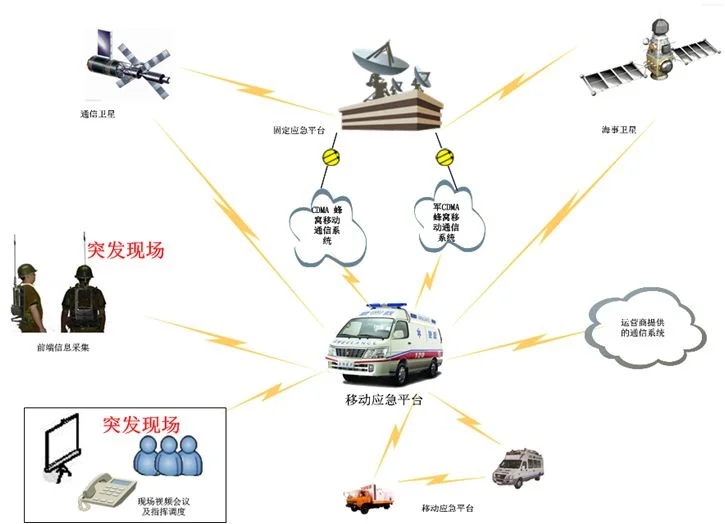
6. IDM M3000 Communication Command & Dispatch System Remote Transmission Diagram
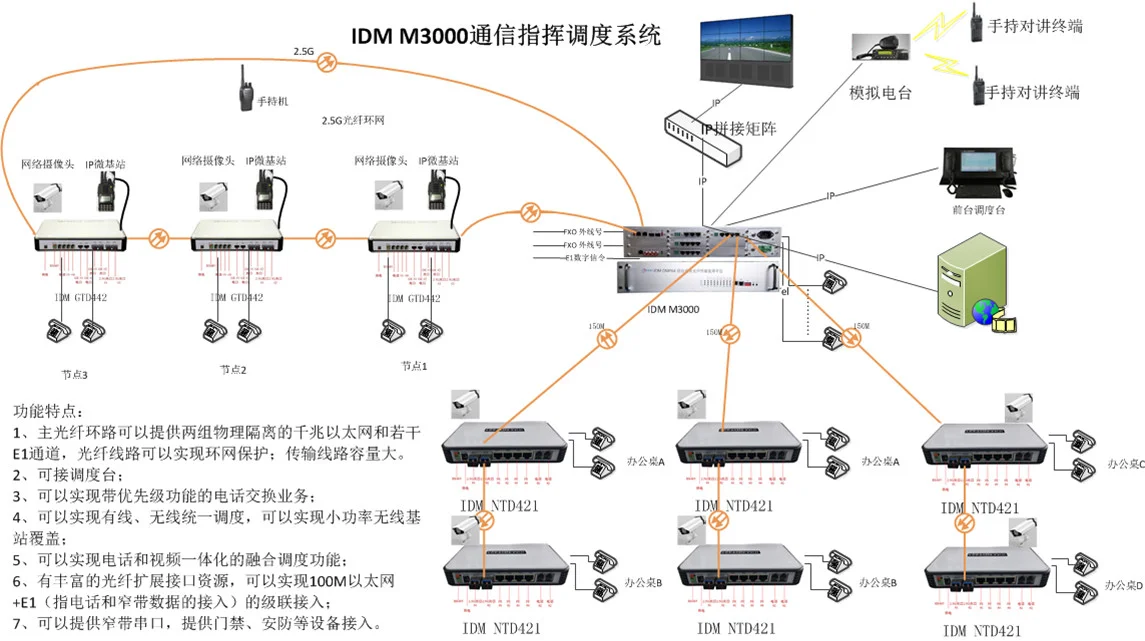
7. IDM M3000 Communication Command & Dispatch System Functions
- Provides communication interfaces of multiple standards
- Provides automatic and manual connection modes
- Provides one-key direct-connect dispatch functionality
- Provides tablet remote synchronized operation functionality
- Provides rapid group splitting and group combining command functionality
- Provides same-level and higher-level override command functionality
- Provides command recording and playback functionality
IDM M3000 Application 1 — M3000 2.5G Fiber Ring Network Audio/Video Surveillance and Deployment System
IDM M3000 Application 2 — Fiber Ring Network Audio/Video Surveillance and Deployment System
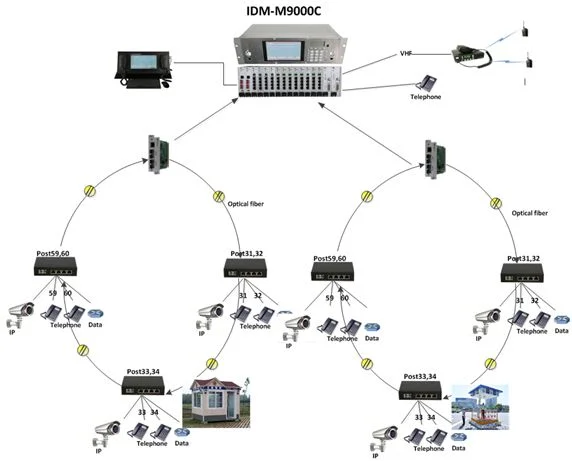
The IDM M3000 can connect up to 90 wired and wireless systems. It can also implement audio/video surveillance and command via the fiber ring network.
The advantage of the ring network is that if the fiber is broken at any point in the middle, normal communication is not affected.
Remote terminals can achieve instant connectivity upon off-hook, with synchronized image display. Broadcasting and call transfer can also be performed to various positions. Telephones and trunked radios can monitor simultaneously. This achieves a combination of mobile and fixed posts.
This system can support up to 8 fiber rings, with every two rings sharing 30 telephone lines.
The ring network card supported is the IDM MPconv card, with remote connections to the IDM NTD421.
IDM M3000 Communication Command & Dispatch System — System Advantages
The TDM-based dispatch system features reserved bandwidth, never busy, strong anti-interference capability, and low voice latency, whereas IP softswitch is susceptible to IP broadcast storms and other burst IP traffic.
Supports a wide variety of terminal types; user terminals support diverse communication methods to meet various emergency requirements;
This command terminal provides multiple means of accessing external communication resources, directly offering multiple communication methods;
The most commonly used command operations are completed with one key;
Group command (conference command) is flexible, feature-rich, and one-key operated;
Compact size, portable, with built-in battery, suitable for field operations and rapid field deployment;
System status and user status are indicated by multi-color LED indicators, with LCD screen auxiliary display for system configuration and system function operations.
Baseband audio bridging provides reliable confidentiality. (No receive/no transmit function)
Unified dispatch functionality is operated by authorized consoles, ensuring safety and reliability.
Modular structure supports hot-swapping for real-time replacement of other universal modules.
Module configuration parameters can be saved, eliminating the need to change operating frequency ranges when replacing similar modules.
Rapidly and flexibly forms temporary communication networks and priority communication networks. Has cross-connect and interworking capabilities, supporting multi-network switching and interworking.
Rapidly establishes/tears down temporary unattended monitoring functions.
The equipment is powered by 11V15V DC, can use lightweight rechargeable batteries or vehicle power, and can also use 110V220V AC power.
The equipment features time-domain noise reduction and transmit/receive audio delay.
•Voice-operated transmit detection (VOX)
•Voice modulation recognition (VMR)
•DTMF detection and generation (DTMF)
•Adaptive hybrid for public switched telephone network (PSTN)
•Transmitter monitoring tone
•Radio signal transmission over IP networks (RoIP)
•Voice signal transmission over IP networks (VoIP)
FAQs
What Are the Functions and Advantages of Video Optical Terminals?
The function of a video optical terminal is to convert one or multiple channels of analog video signals into optical…
View answerWhat is the difference between a Video Optical Terminal and a Network Video Server?
Composition and Function of Video Optical Terminal and Network Video Server An optical terminal is a device used to…
View answerWhat are common issues when using optical terminals in security surveillance?
Fiber optic technology is increasingly used in security surveillance projects to transmit images, audio, data…
View answerWhat is IPTV and Its Key Technologies
IPTV, or Interactive Network Television, is an innovative technology that utilizes broadband cable TV networks…
View answer