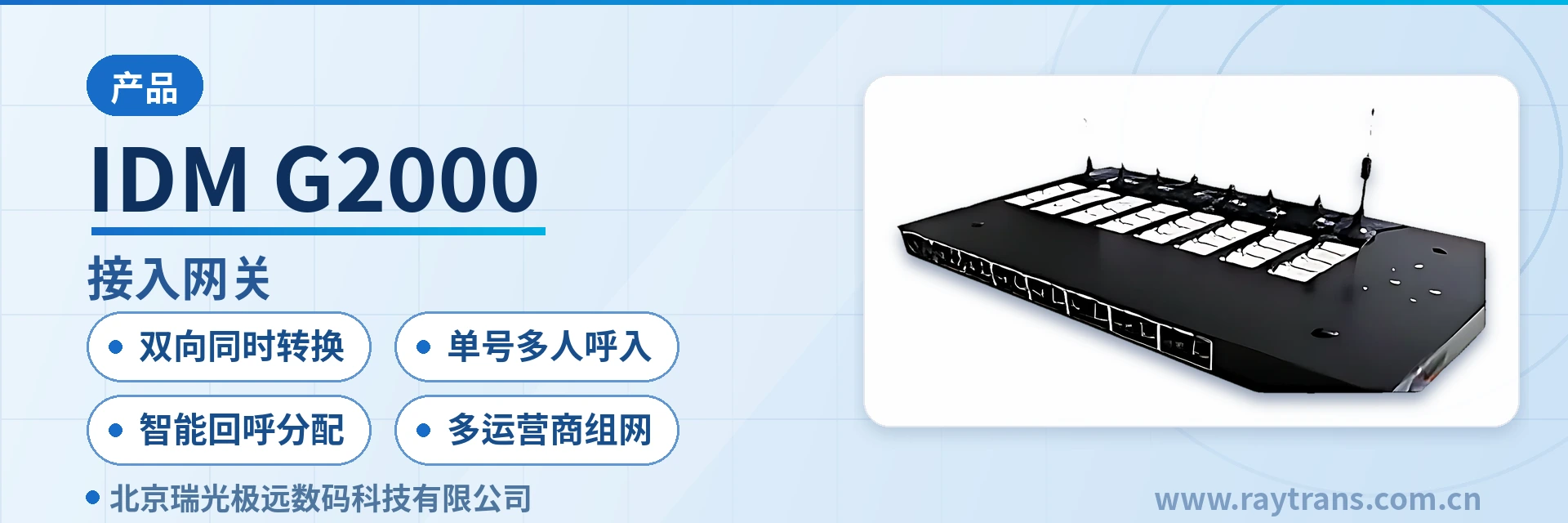
IDM-G2000 Access Gateway
4/8-channel SIM plug-in card, simultaneous bidirectional wireless-IP conversion, single-number multi-party dial-in with intelligent callback
The IDM-G2000 access gateway is used in the product showcase field, targeting industry customers' communication/transmission/dispatch equipment (to be further detailed based on documentation)
IDM-G2000 is a GSM/CDMA and IP bidirectional conversion wireless access gateway developed by Beijing Ruiguang Jiyuan Digital Technology Co., Ltd. As a product showcase for private networks, it adopts a 4- to 8-channel SIM card modular plug-in card structure. Inserting mobile phone SIM cards into the device connects wireless (GSM/CDMA) traffic with the IP voice network, completing bidirectional voice and signaling conversion between wireless-to-IP and IP-to-wireless within a single enclosure. IDM-G2000 adds or removes SIM card modules as required, supports GSM/CDMA multi-format frequency bands and multi-carrier networking, and addresses the wireless telephone access requirements of private networks such as energy and electric power, rail transit, and military and government emergency command. As a professional command and dispatch system manufacturer, Raytrans has long been deeply engaged in the IP access gateway and wireless access gateway fields, and IDM-G2000 is its representative achievement in the SIP radio gateway direction.
In private network communications, wireless channels both carry outbound calls and serve as important redundant access resources. The traditional approach is to deploy a separate gateway for each format or each carrier, resulting in equipment stacking, many protocol conversion steps, and scattered O&M interfaces. IDM-G2000 places 4 to 8 wireless channels and the VoIP softswitch in the same modular device, using all-digital time-division switching for intelligent routing and traffic sharing, and automatically switching to a backup route when a call fails, so that wireless tariffs and the IP voice network work together within one system. This design also enables it to flexibly adapt to various private network scenarios such as military emergency communications vehicle solutions, government private network optical fiber communication solutions, and smart mining communication solutions, providing reliable wireless access support for the integration requirements of command and dispatch system manufacturers across different industries.
Key Specifications at a Glance: 4-8 channel SIM card modular · simultaneous bidirectional wireless-to-IP and IP-to-wireless conversion · all-digital non-blocking time-division switching · GSM900/1800/1900M and CDMA800/1900/450M · SIP 2.0 (RFC3261) · single-number multi-party dial-in access network
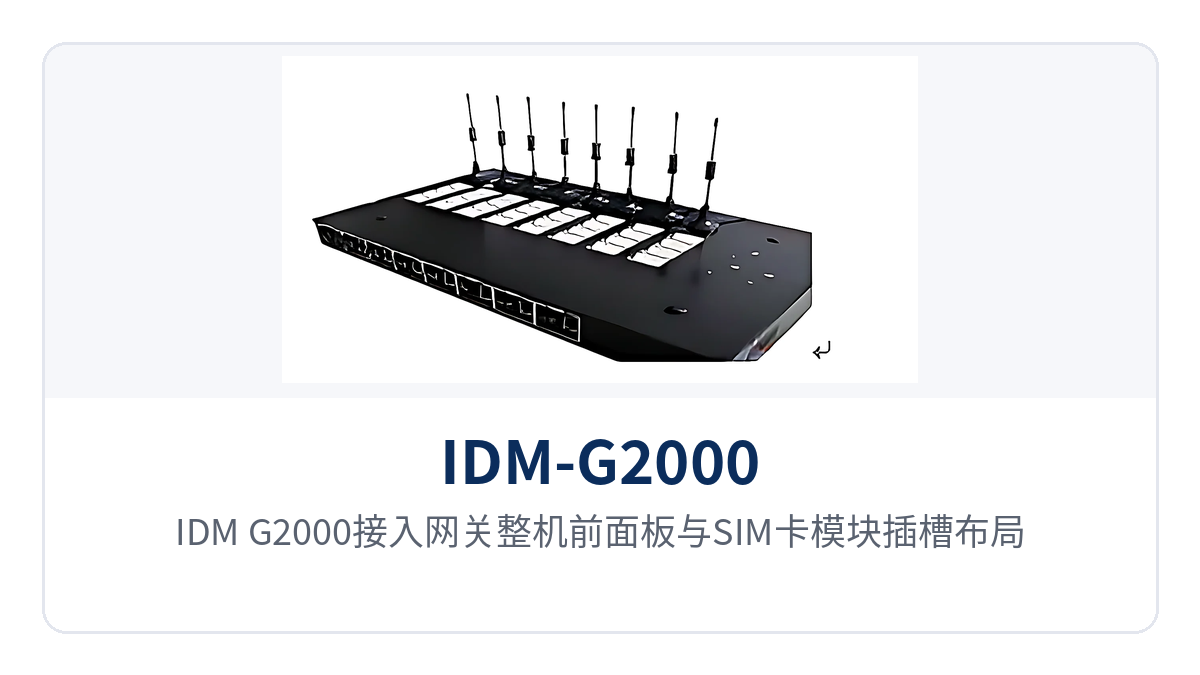
Figure 1: IDM-G2000 access gateway front panel and SIM card module slot layout
What Is a GSM/CDMA and IP Bidirectional Conversion Wireless Access Gateway
What is a wireless access gateway? In one sentence: it is an access device that uses mobile phone SIM cards as call channels and performs bidirectional voice and signaling conversion between the wireless network and the IP voice network. After SIM cards are installed in IDM-G2000, wireless calls are registered to the VoIP softswitch system; the wireless side can call out to the SIP platform, and telephones on the SIP platform can also enter the wireless network to call mobile numbers. All boarding and alighting of the wireless network is completed onboard, without an external protocol conversion server.
As an IP access gateway, IDM-G2000 performs all-digital time-division switching between 4 to 8 wireless channels and SIP channels, with multiple SIM cards sharing traffic and balancing it to avoid single-card congestion. The device adopts a modular structure with low power consumption and high reliability, making it easy to deploy in outdoor cabinets and lightly staffed sites for long-term wireless telephone access. As a command and dispatch system manufacturer, Raytrans widely applies this device in scenarios such as military emergency communications vehicle solutions, government private network optical fiber communication solutions, and smart mining communication solutions, providing industry users with stable product showcase and wireless access gateway capabilities.
How Is Simultaneous Bidirectional Conversion Achieved: Wireless-to-IP and IP-to-Wireless in Parallel
Simultaneous bidirectional conversion is the core capability of IDM-G2000, with the wireless side and the IP side each hosting calls at the same time without queuing for each other. The device has two built-in conversion paths: wireless (GSM/CDMA) to IP and IP to wireless (GSM/CDMA). Wireless incoming calls are converted into IP voice and submitted to the softswitch, and calls initiated from the SIP side can likewise be converted into wireless voice and sent to the mobile phone card lines. The two paths work simultaneously without occupying each other.
Simultaneous bidirectional conversion relies on all-digital non-blocking time-division switching. IDM-G2000 organizes switching internally by multiple routes and multiple office directions, can manage by group and subgroup, and performs intelligent route allocation and traffic sharing. The device automatically analyzes user numbers and selects call routes according to rules; when a call on a certain route fails, it automatically switches to a backup route, avoiding traffic interruption caused by signal fluctuations of a single carrier. This wireless access gateway capability enables Raytrans's SIP radio gateway and IP access gateway to complement each other in military emergency communications vehicle solutions, ensuring voice connectivity for command and dispatch system manufacturer-level solutions in complex environments.
What Functions Does IDM-G2000 Have
The functions of IDM-G2000 revolve around wireless access, signaling conversion, route management, and networking capabilities. All capabilities are enabled simultaneously within the same modular device, without an external protocol conversion server. Each function item and its purpose are shown in the table below.
| Function | Description |
|---|---|
| Simultaneous bidirectional conversion | Wireless (GSM/CDMA) to IP and IP to wireless (GSM/CDMA) supported simultaneously, without third-party trunking |
| Modular SIM card configuration | 4 to 8 wireless channels; line quantity flexibly configured by adding or removing SIM card modules, with capacity expansion as required |
| All-digital non-blocking switching | Time-division switching; non-blocking switching with intelligent route selection, multi-card traffic sharing |
| Single-number multi-party dial-in | Mobile numbers of G2000 units within and outside the local area network form one access network, publishing one mobile number externally for multiple simultaneous dial-ins |
| Intelligent callback allocation | Automatically records call information, analyzes calls on dial-in and intelligently allocates them to extension lines |
| Automatic routing and backup switching | Automatically analyzes user numbers to select call routes, and automatically switches to a backup route when a call fails |
| Multi-route multi-office-direction management | Group and subgroup switching management, intelligent route allocation and traffic sharing |
| Multi-carrier adaptation | Supports GSM900M/1800M/1900M, CDMA800M/1900M, and CDMA450M networking environments |
| Standard SIP access | Supports SIP 2.0 (RFC3261) and related RFC protocols, registering with the VoIP softswitch system |
Key Specifications and Applicable Conditions
The interfaces and operating parameters of IDM-G2000 are subject to the manufacturer's product documentation. The table below summarizes the parameters specified in the product documentation for selection verification. Engineering parameters such as power supply specifications, overall power consumption, and operating temperature are not yet recorded in the knowledge base; please confirm with the manufacturer based on on-site project conditions.
| Item | Parameter/Specification | Description/Applicable Conditions |
|---|---|---|
| Product form | 4- to 8-channel broadband telephone gateway, modular SIM card plug-in | Insert as many cards as wireless channels required |
| SIM card channels | 4 to 8 (4-8 SIM Card) | Line quantity flexibly configured by adding or removing modules |
| Conversion direction | GSM/CDMA to IP, IP to GSM/CDMA, simultaneous bidirectional | Both sides host calls independently without queuing for each other |
| Format and frequency band | GSM900M/1800M/1900M, CDMA800M/1900M/450M | Adapts to multi-carrier networking |
| Switching mode | All-digital time-division switching, non-blocking switching | Multi-card traffic sharing, intelligent route selection |
| Route management | Multiple routes, multiple office directions, group and subgroup | Automatic route selection, automatic backup route switching on call failure |
| Callback capability | Intelligent callback, records and analyzes calls | Automatically allocated to extension lines on dial-in |
| Networking capability | G2000 units across local and non-local area networks form an access network | Publishes one mobile number externally for multiple simultaneous dial-ins |
| VoIP protocol | SIP 2.0 (RFC3261) and related RFC protocols | Registers with the VoIP softswitch system |
| Structural design | Modular structure, low power consumption, high reliability | Suited to field and unattended sites |
How Is Single-Number Multi-Party Dial-In Networked: Mobile Numbers Across Local Area Networks Form One Access Network
How is single-number multi-party dial-in achieved? The approach is to organize the mobile numbers in multiple IDM-G2000 units scattered in different locations (within or outside the local area network) into one access network, publishing one mobile number externally. When an external customer dials this number, multiple SIM cards connect in parallel, and multiple extensions or operators can serve different incoming calls simultaneously, rather than missing calls once a line is busy as in single-person single-number solutions.
How does intelligent callback allocate extensions? The key lies in the device's ability to analyze calls. IDM-G2000 automatically records each call, analyzes the call source and service type on dial-in, and then intelligently allocates the incoming call to a suitable extension line; when the primary route fails, it automatically switches to a backup route. How is GSM/CDMA-to-IP networked? It likewise revolves around this routing logic: first plan SIM card grouping and carrier combinations, then set number analysis and routing rules, so that the two paths of wireless-to-IP and IP-to-wireless are distributed according to service needs. With this networking capability, Raytrans integrates the wireless access gateway and SIP radio gateway into smart mining communication solutions, providing command and dispatch system manufacturers with flexible cross-network access means.
Differentiated Value: Simultaneous Bidirectional Conversion, Single-Number Multi-Party Dial-In, and Intelligent Callback Allocation
The differentiated value of IDM-G2000 centers on three aspects: simultaneous bidirectional wireless and IP conversion, multi-mobile-number networking for dial-in, and intelligent callback allocation. Each item and its corresponding capability are shown in the table below. The parameters in the table are organized according to the product documentation; for specific configurations, please confirm with the manufacturer based on project requirements.
| Selling Point | Corresponding Capability | Customer Value |
|---|---|---|
| Simultaneous bidirectional conversion: bidirectional wireless and IP conversion, one device connecting public and private network voice | Wireless (GSM/CDMA) to IP and IP to wireless (GSM/CDMA) supported simultaneously, without third-party trunking | One device handles both outbound calls and inbound call connection, with private and public network voice intercommunicating within one system |
| Single-number multi-party dial-in: multiple mobile numbers networked into one access network, publishing a single number for multiple simultaneous dial-ins | Mobile numbers of G2000 units within and outside the local area network form one access network, with multi-card parallel connection | One enterprise access number carries simultaneous dial-ins from multiple employees, no longer maintaining an independent external number for each employee |
| Intelligent callback allocation: intelligent callback automatically analyzes calls and allocates intelligently by extension line | Automatically records call information, analyzes calls on dial-in and intelligently allocates them to extension lines, switching to a backup route on failure | Important calls land on the corresponding extension by service type, with automatic remediation when routes are interrupted, reducing missed calls |
| Multi-carrier networking | Supports GSM900M/1800M/1900M and CDMA800M/1900M/450M, multi-route multi-office-direction management | One device mixes SIM cards from multiple carriers, avoiding single-carrier coverage and failure risks |
As a command and dispatch system manufacturer, Raytrans continues to provide products such as IP access gateways, wireless access gateways, and SIP radio gateways for military emergency communications vehicle solutions, government private network optical fiber communication solutions, and smart mining communication solutions, serving industry customers with a complete product showcase and reliable technical solutions.
Typical Application Scenarios
Energy and Electric Power Industry Private Network: Wireless Telephone Access at Substations and Plant Stations
Substations and switching stations of electric power and energy private networks are usually lightly staffed. In addition to existing dispatch telephones, the stations also need a reliable wireless channel as a means of external contact. As a professional command and dispatch system manufacturer, Raytrans offers IDM-G2000, which provides multi-carrier physical backup with 4 to 8 SIM cards. When a certain card or a certain carrier's signal degrades, the all-digital non-blocking switching automatically distributes traffic to other SIM cards, and automatically switches to a backup route when a call fails. The device has low power consumption and high reliability, and its modular structure facilitates capacity expansion as required within a communications cabinet, making it suitable for long-term operation at unattended sites. It also provides a reliable product showcase for wireless-side access in government private network optical fiber communication solutions and smart mining communication solutions.
Rail Transit and Rail Transit Communications: Wireless Traffic Aggregation at Stations and Sections Along the Line
Stations, sections, and depots along rail transit lines are scattered sites, and wireless channels are used to reinforce external contact beyond wired transmission. As a mature wireless access gateway, IDM-G2000 centralizes the SIM card resources of mobile phones at sites along the line into one modular device, aggregating multiple wireless traffic streams into the VoIP softswitch through intelligent routing and traffic sharing. Dispatch terminals on the SIP side can call on-site mobile cards, and on-site wireless incoming calls can also be connected to the dispatch console for unified answering. Format and frequency band coverage spans multiple GSM and CDMA bands, facilitating combined configuration according to carrier coverage along the line.
Military and Government Emergency Command Private Network: Unified Dispatch Access to On-Site Mobile Card Resources
On-site emergency command has high requirements for reachability and redundancy, and mobile phone card lines are often the last available external channel. After IDM-G2000 is deployed as an IP access gateway to connect to the emergency command and dispatch system, it converts multiple SIM card lines into dial-in and dial-out resources that the softswitch can dispatch. The SIP dispatch console at the emergency command center can directly call on-site mobile phone cards, and can also bring wireless incoming calls into the dispatch console for unified answering. Multi-user dial-in on a single number allows simultaneous on-site dial-ins to be connected, while intelligent callback distribution and backup routing automatically remedy unstable links. Together with vehicle-mounted and field site deployment forms, it provides wireless access support for forward command organizations, meeting the high reliability requirements of the military emergency communications vehicle solution for on-site communication.