

IDM-ENT448
IDM-ENT448
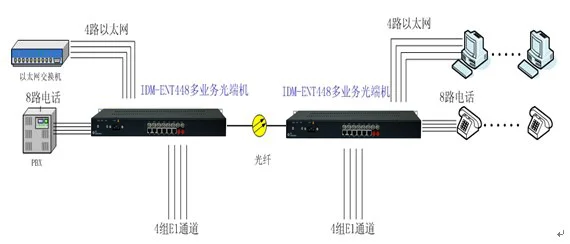
The IDM-ENT448 multi-service optical multiplexer provides a 155M optical interface, housed in a 19-inch 1U standard chassis. It offers 8 telephone channels + 4 shared 100M Ethernet ports (with VLAN partitioning) + 4 E1 transparent transmission. Power supply options include ~220V or -48V, with dual power supply as an option.
Overview:
The IDM-ENT448 telephone optical terminal utilizes the optical interface, digital trunk interface, or analog subscriber interface resources equipped on the central office switch to extend voice and data services to various subscriber areas through the IDM device, serving as a substitute for remote small exchanges, enabling cross-boundary subscriber provisioning, and deferring the construction of switching offices; alternatively, it resolves the constraints of twisted pair in terms of frequency band and transmission distance within urban areas, thereby expanding the service coverage of the switching office.

Product Features:
Adopts a 19-inch 1U standard chassis for easy installation.
Optical interface rate of 155Mbps, with FC/SC/LC optical interface options, and selectable transmission distance.
The optical terminal provides 4 channels of Ethernet service, with 4 channels of Ethernet sharing a line-rate 100Mbps, and supports VLAN partitioning.
4 channels of transparent transmission E1 service interfaces, in BNC interface form.
The optical terminal provides 8 channels of telephone service interfaces, supporting caller ID.
Comprehensive function control switches and alarm indication functions.
Technical Specifications:
Optical Interface
Interface Type | FC (SC etc. customizable) | Fiber Mode | Single-mode (multi-mode optional) |
Optical Rate | 155bps±50ppm | Wavelength | 1310nm |
Transmit Power | -2~-11dBm | Receiver Sensitivity | Better than -36dBm |
E1 Interface
Line Rate | 2048Kbps | Line Code | HDB3 |
Standard Protocol | Supports ITU-T G.703 | Impedance | 75Ω/120Ω |
Frame Structure | PCM30/31 | Signaling | Channel-associated signaling |
Ethernet
Interface Type | RJ-45 | Transmission Rate | 10/100Base-T 10M/100M |
Standard Protocol | Supports IEEE802.3 | Operating Mode | Full/Half duplex/Auto-negotiation |
FXO/FXS Interface
Audio Frequency Range | 300Hz~3400Hz | Impedance | Three-element compound impedance 200Ω+560Ω//0.1μF |
Compression Rate | ITU G.711 A-law | Loop Current | 25mA/channel |
Power Supply and Consumption
Power Supply | DC-48V or AC 220V | Total Power Consumption | 40W ±10% |
Environmental Conditions
Operating Temperature | 0ºC~40ºC | Humidity | ≤90% (non-condensing) |
Product Dimensions
Length×Depth×Height | 440×230×45 (mm) |
Application Example:
FAQs
Top 10 Common Questions About Telephone Optical Terminals
Based on years of experience in the production and R&D of telephone optical terminals…
View answerHow to Troubleshoot Common Faults of Telephone Optical Terminal?
Device cannot be powered on Check whether the power cable is connected correctly.
View answerWhat is an Optical Terminal?
Many people are unfamiliar with the optical terminal, but in essence, it is a dedicated device for optical-electrical…
View answer