
IDM-30EN
IDM-30EN
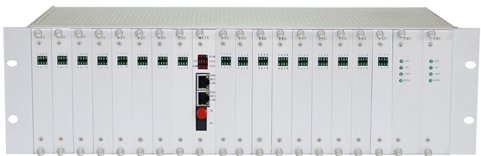
The IDM-30EN multi-service optical terminal adopts a 19-inch 1U standard chassis. The IDM-30EN multi-service optical terminal provides 30 user interfaces as defined by the standard; 2 groups of wire-speed 100M Ethernet interfaces, supporting VLAN partitioning, and the Ethernet can be configured as 4 groups; 4 groups of E1 interfaces support transparent transmission mode.
Overview:
The IDM-30EN Integrated Service Multiplexer uses optical fiber as the transmission medium, utilizing standard optical fiber or E1 transmission channels (G.703 standard), adopting the PCM30/32 format to convert telephone service signals or data signals to be transmitted into optical signals for transmission to the remote end via optical fiber; in addition, unlike the IDM-30E Integrated Service Access Device, it can provide two Ethernet services in addition to all services available on the former.
This series of equipment features easy installation, simple operation and maintenance, and high system reliability, and can be widely applied in public telephone network access or private line information transmission in industries such as telecommunications, electric power, banking, and public security.


Main Features:
- Adopts a 19-inch 1U standard chassis for easy installation.
- Provides standard 30-channel data services;
- Clock modes: master clock and user clock can be set to meet various application environments;
- Rich 64K user interfaces: provides ordinary telephone cards with caller ID display (FXO, FXS);
- 4 groups of E1 interfaces support transparent transmission mode;
- 2 groups of wire-speed 100M Ethernet interfaces, supporting VLAN partitioning, and the Ethernet can be configured as 4 groups;
- Equipped with comprehensive function control switches and alarm indication functions;
Technical Specifications:
E1 Interface Specifications
- Fully compliant with ITU-T G.703 recommendations
- Line code: HDB3
- Line rate: 2048kbit/s±50ppm
- Impedance: 75Ω (unbalanced interface)/120Ω (balanced interface)
(Note: an external impedance converter is required when using the 120Ω balanced interface) - Frame structure: PCM30/32
- Signaling: Channel-associated signaling
FXO/FXS Interface Specifications - Impedance: Triple compound impedance 200Ω+560Ω//0.1μF
- Audio range: 300Hz~3400Hz
- Compression rate: A-law in ITU G.711
- Loop current: 25mA/channel
Ethernet Interface Specifications - Ethernet interface rate: 10/100M half/full duplex
- Interface protocol: compliant with IEEE-802.3u standard;
- Interface type: RJ-45
- Port mode: 10/100Mbps auto-negotiation mode
Optical Interface Specifications - Optical fiber rate: 155Mbps±50ppm
- Wavelength: 1310nm
- Transmit power: -4~-12dBm
- Receive sensitivity: better than -34 dBm
- Receive dynamic range: 34 dBm
- Connector type: FC
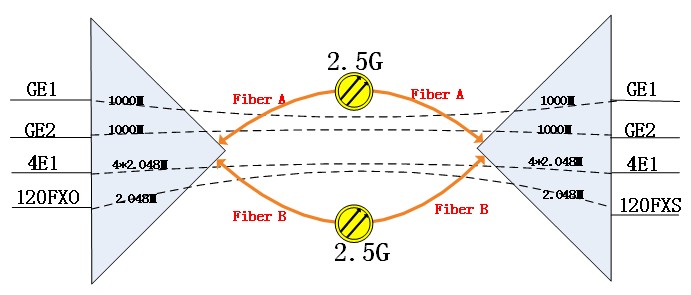
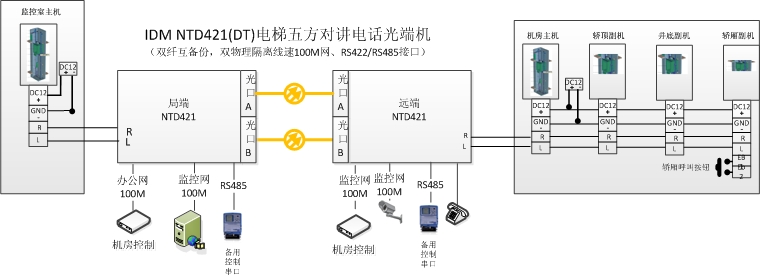
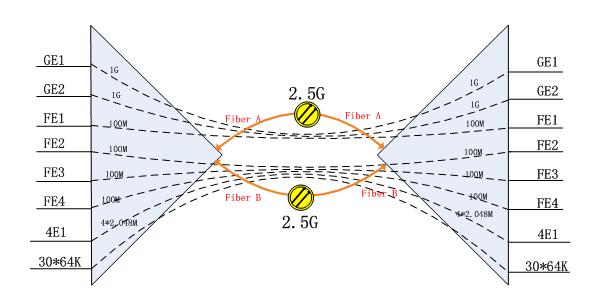
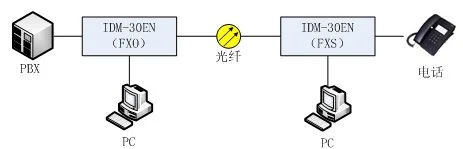
Application Scheme:
FAQs
Top 10 Common Questions About Telephone Optical Terminals
Based on years of experience in the production and R&D of telephone optical terminals…
View answerHow to Troubleshoot Common Faults of Telephone Optical Terminal?
Device cannot be powered on Check whether the power cable is connected correctly.
View answerWhat is an Optical Terminal?
Many people are unfamiliar with the optical terminal, but in essence, it is a dedicated device for optical-electrical…
View answer