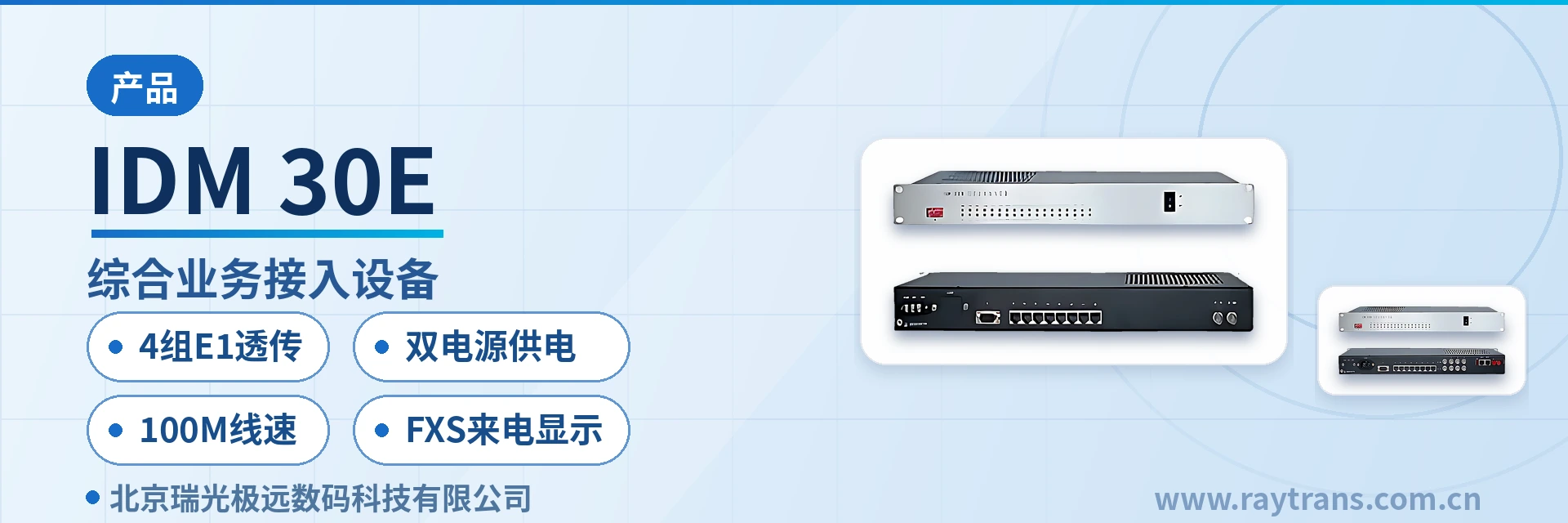
IDM-30E Integrated Service Access Device
4-group E1 transparent transmission, 30-channel telephone, dual 100M Ethernet, single-fiber transmission saves three devices
The IDM-30E integrated service access device is used in the product showcase field, targeting industry customers' communication/transmission/dispatching equipment (to be further detailed based on documentation)
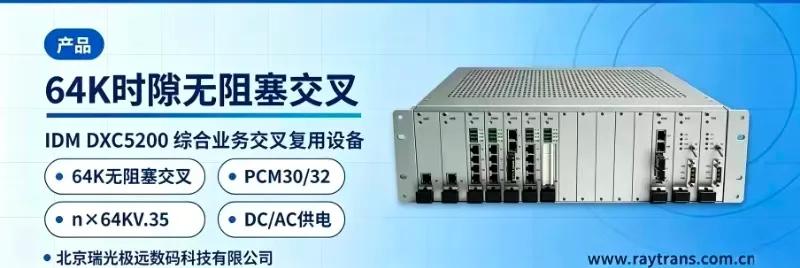
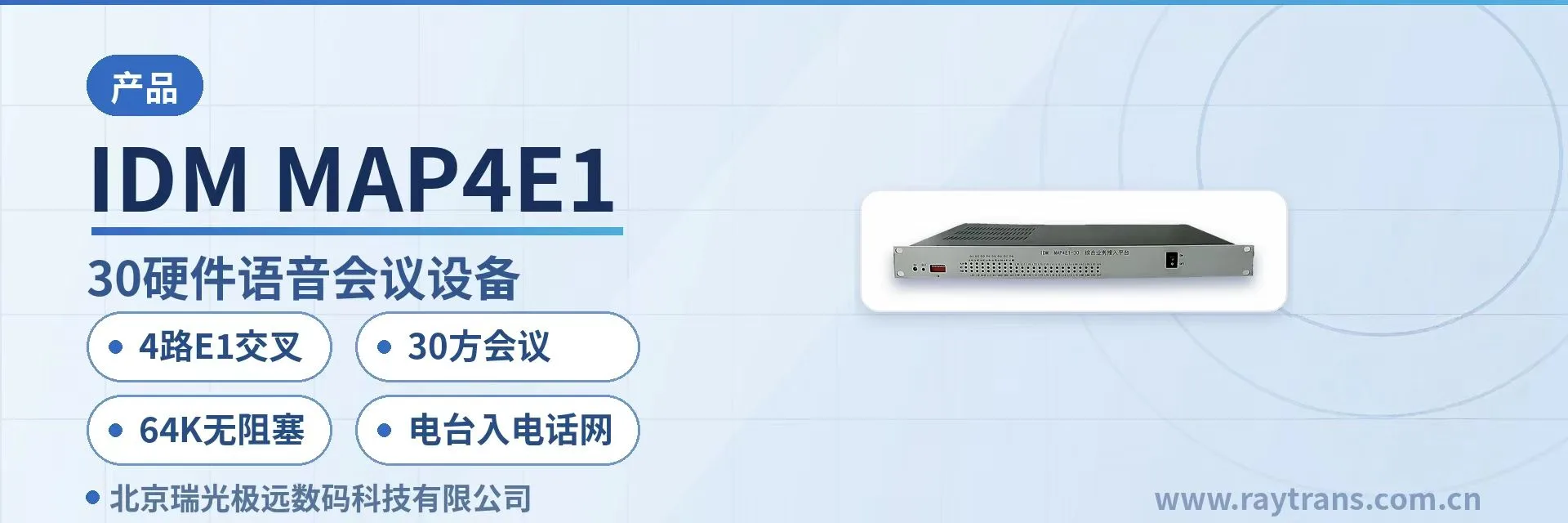
A 4-group E1 transparent transmission integrated service access device is an optical multiplexing device that multiplexes 4 groups of transparent E1, 2 groups of line-rate 100M Ethernet, and 30 channels of telephone or data services onto a single optical fiber for transmission, and restores the corresponding subscriber interfaces at the remote end. The IDM-30E integrated service access device belongs to this category of PCM equipment and is developed by Beijing Ruiguang Jiyuan Digital Technology Co., Ltd. What is an integrated service access device? In one sentence, it lets a single PCM device simultaneously handle three types of access needs: making calls, transmitting data, and connecting to the network. The IDM-30E integrated service access device organizes voice and data into 64K time slots using the PCM30/32 format, providing 4 groups of E1 transparent transmission interfaces, 2 groups of line-rate 100M Ethernet interfaces, and 30 telephone interfaces. It is suitable for long-distance service backhaul at sites such as electric power private networks, rail transit communications, and military and government private networks, and is a common access node in government private network optical fiber communication solutions, smart mining communication solutions, and military emergency communications vehicle solutions.
Key Specifications at a Glance: 30 channels of telephone or data · 4 groups of E1 transparent transmission · 2 channels of line-rate 100M Ethernet · dual power supply DC-48V/AC220V · 19-inch 1U chassis · optical port 155Mbps/1310nm · overall power consumption ≤100W
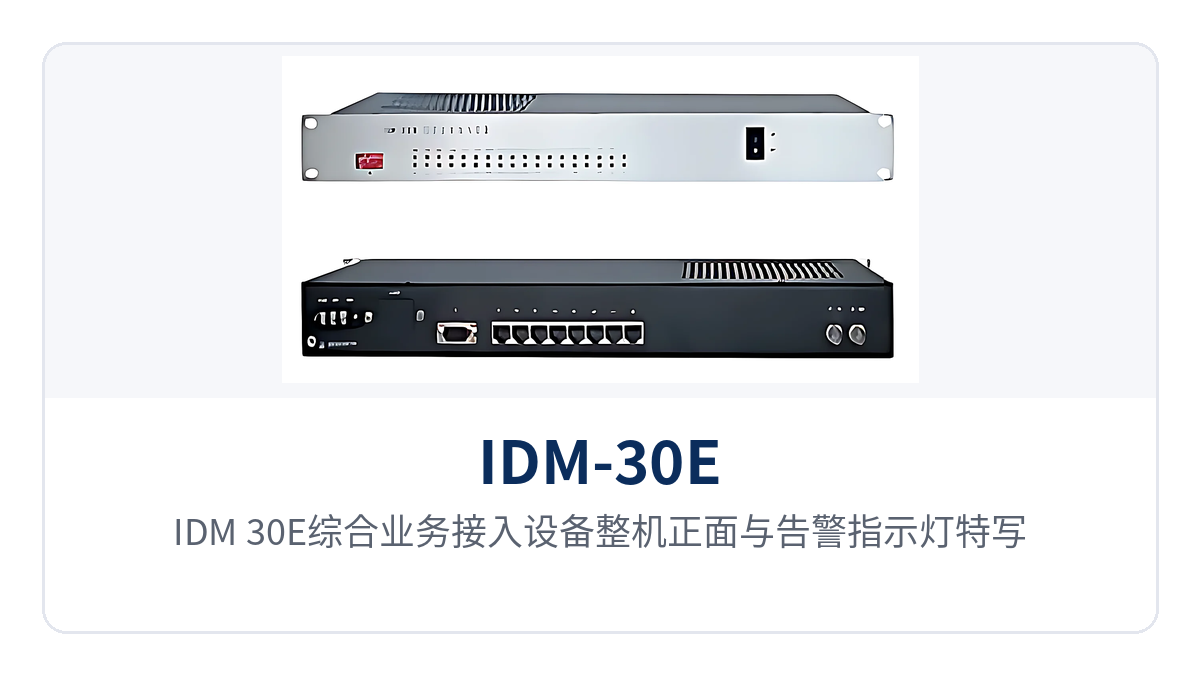
Figure 1: Close-up of the front panel and alarm indicator LEDs of the IDM-30E integrated service access device
As an integrated service access device under Raytrans, the IDM-30E often appears alongside transmission products from optical multiplexer manufacturers and SDH equipment manufacturers in PCM equipment product showcases: at the front end, voice and data time slot arrangement can be completed through PCM equipment, then carried over long distances via optical multiplexing equipment or channels provided by SDH equipment manufacturers, and finally multi-service deployment is completed in scenarios such as government private network optical fiber communication solutions, smart mining communication solutions, and military emergency communications vehicle solutions. Raytrans has formed a complete product showcase system around PCM, integrated service access devices, and optical multiplexing equipment, making it easy for users to confirm interface types, transmission capacity, and power supply mode item by item during selection.
What kind of device is a 4-group E1 transparent transmission integrated service access device?
A 4-group E1 transparent transmission integrated service access device is an access device that multiplexes three types of services—telephone, Ethernet, and E1—into a single optical fiber. The IDM-30E integrated service access device uses a standard 19-inch 1U chassis and can accommodate 30 standard-defined subscriber interfaces within one chassis, fitting 30 channels of 64K telephone or data services, 2 groups of line-rate 100M Ethernet interfaces, and 4 groups of transparent transmission E1 interfaces into a single device; after receiving the optical signal, the opposite end device restores the corresponding FXO/FXS telephone ports and RJ-45 Ethernet ports, so a point-to-point optical fiber link can be set up on site with a pair of devices.
The narrowband section of the IDM-30E integrated service access device uses the PCM30/32 format. The E1 interface has a bit rate of 2048Kbps, line coding of HDB3, impedance of 75Ω/120Ω, and a frame structure of PCM30/32, all designed in accordance with ITU-T G.703 recommendations, and can be directly connected to existing PCM primary group links on site or idle E1 channels of SDH/PDH links. The device panel provides comprehensive function control switches and alarm indication functions. When an optical port or E1 interface fails, the corresponding alarm indicator LED lights up, facilitating commissioning and routine maintenance.
What service interfaces and functions does the IDM-30E provide?
The functions of the IDM-30E integrated service access device are divided into four categories: narrowband access, Ethernet access, E1 transmission, and O&M management. See the table below for details.
| Function | Description |
|---|---|
| 30 channels of telephone or data services | Provides 30 standard-defined subscriber interfaces, uses the PCM30/32 format, and carries telephone or data services in 64K time slots |
| 2 channels of line-rate 100M Ethernet | Provides 2 groups of line-rate 100M Ethernet interfaces, supports VLAN partitioning, and can be made into 4 groups as required on site |
| 4 groups of E1 interface transparent transmission | 4 groups of E1 interfaces support transparent transmission mode, comply with ITU-T G.703, and can reuse E1 channels of existing PCM, SDH/PDH networks |
| 64K subscriber interface | Provides ordinary telephone boards with FXS caller ID (CID) function; interface types cover FXO and FXS, landing 64K time slots as voice channels or data ports |
| Clock mode setting | Master clock and user clock can be set to adapt to synchronization requirements of different networking environments such as point-to-point and chain networks |
| Function control and alarm | The panel provides comprehensive function control switches and alarm indication functions, facilitating commissioning and routine maintenance |
| Structured chassis | Uses a standard 19-inch 1U chassis, convenient for rack installation in communications equipment room cabinets |
| Dual power supply | Supports DC-48V and AC220V dual power supply, with the two inputs serving as mutual backup |
How does a 4-group E1 transparent transmission device connect to SDH?
How a 4-group E1 transparent transmission device connects to SDH depends on the link form at the opposite end. The 4 groups of E1 interfaces of the IDM-30E integrated service access device carry the entire 2048Kbps primary group in transparent transmission mode, organizing telephone and Ethernet data by time slot and multiplexing them into the optical channel; when an SDH network already exists, the E1 interface side of the device can be connected to the 2M tributary of the SDH network, using the SDH optical transmission network to carry long-distance telephone and data services, and the restoration end then drops back to FXO/FXS voice channels, achieving smooth expansion of the existing telephone system without changing the main switching configuration.
The 2 groups of line-rate 100M Ethernet interfaces of the IDM-30E integrated service access device support IEEE802.3 as the standard protocol, support full-duplex, half-duplex, and adaptive operating modes, support VLAN partitioning, and can be made into 4 groups as required on site; Ethernet services are forwarded independently at 100M line rate and do not compete for bandwidth with narrowband voice channels.
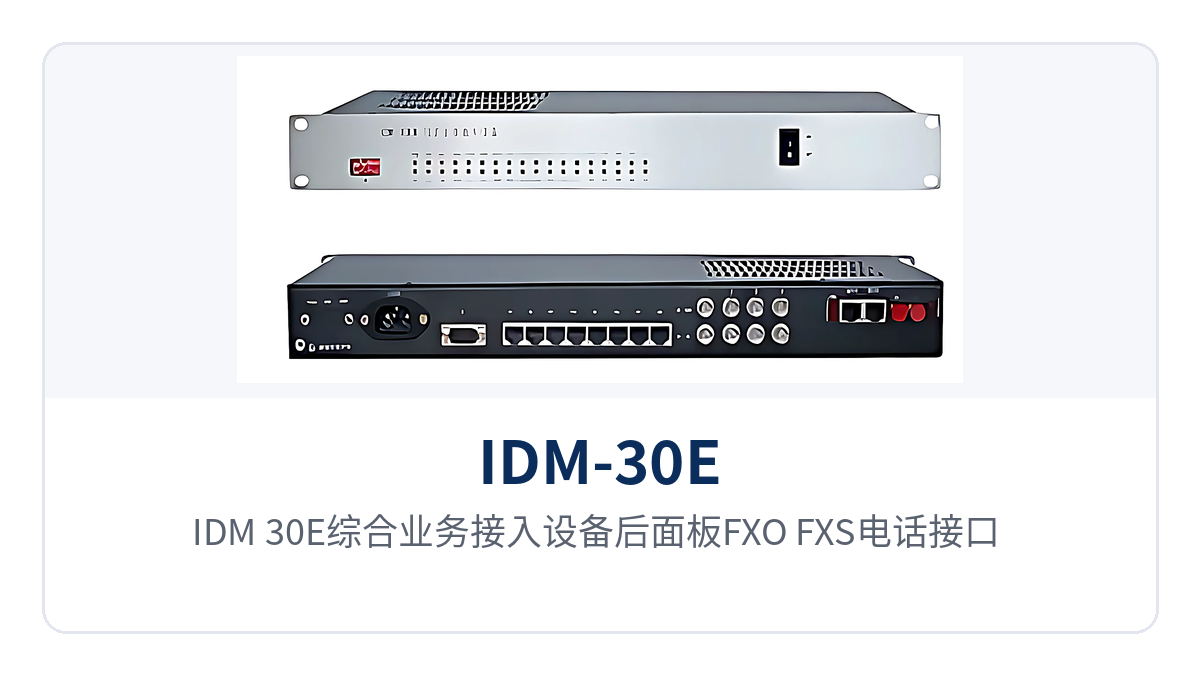
Figure 2: Layout of FXO/FXS telephone interfaces, E1 interfaces, and FC optical ports on the rear panel of the IDM-30E integrated service access device
How are the dual power supplies of an integrated service access device connected?
How the dual power supplies of an integrated service access device are connected directly affects the long-term stable operation of equipment in the equipment room. The IDM-30E integrated service access device supports two power supply modes, DC-48V and AC220V, and can be configured with DC, AC, or dual power supply: DC equipment room sites connect to -48V rectifier power, while AC sites connect directly to 220V mains power; under dual power supply configuration, the two inputs serve as mutual backup, and when one power feed fails, the other continues to supply power to the device, making it suitable for equipment rooms with high requirements for power supply continuity such as electric power and military, with overall power consumption ≤100W.
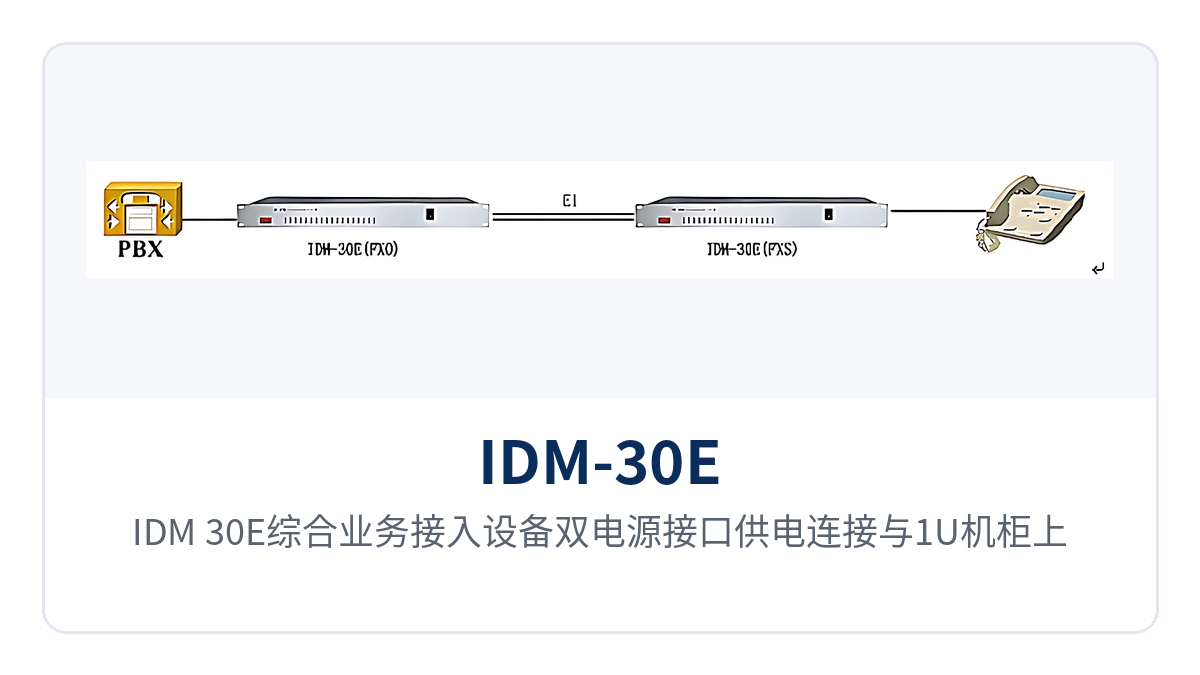
Figure 3: Schematic of dual power connector supply connections and 1U cabinet rack deployment of the IDM-30E integrated service access device
IDM-30E Technical Specifications
The technical specifications of the IDM-30E integrated service access device are shown in the table below. The parameters are subject to the product documentation; please confirm the specific configuration with the manufacturer's commercial confirmation.
| Item | Parameter/Specification | Description/Applicable Conditions |
|---|---|---|
| Optical interface type | FC (SC and others can be customized) | Selected according to fiber core and engineering practice |
| Fiber mode | Single-mode (multi-mode optional) | Selected according to line distance and fiber core conditions |
| Optical fiber rate | 155Mbps±50ppm | Corresponds to the 155M optical transmission platform; telephone and Ethernet services share it |
| Wavelength | 1310nm | Typical single-mode operating wavelength |
| Transmit optical power | -2~-11dBm | Typical single-mode value; subject to actual measurement with an optical power meter |
| Receiver sensitivity | Better than -36dBm | The link loss budget and available transmission distance can be calculated on this basis |
| E1 bit rate | 2048Kbps | Primary group rate |
| E1 line coding | HDB3 | Keep consistent with the line coding configuration of the opposite end device |
| E1 standard protocol | Supports ITU-T G.703, impedance 75Ω/120Ω | Selected according to the interface of the interconnected equipment; a 120Ω balanced interface requires an external impedance converter |
| E1 frame structure | PCM30/32, transparent transmission mode | Services are transmitted as they are, without changing time slot content |
| Ethernet interface | RJ-45, 10/100Base-T, 10M/100M | Operating modes: full-duplex, half-duplex, and adaptive |
| Ethernet standard protocol | Supports IEEE802.3 | Negotiated according to port capabilities when connecting to switches and routers |
| Ethernet group count | 2 groups of line-rate 100M, can be made into 4 groups | Supports VLAN partitioning |
| FXO/FXS audio range | 300Hz~3400Hz | Telephone voice channel bandwidth |
| FXO/FXS impedance | Three-element complex impedance 200Ω+560Ω//0.1μF | AC and DC characteristic specification of voice channel interfaces |
| FXO/FXS compression | ITU G.711 A-law | Voice encoded at 64K using A-law |
| FXO/FXS loop current | 25mA/channel | Feed loop current for each telephone |
| Power supply mode | DC-48V / AC220V / dual power supply | The two inputs serve as mutual backup, improving power supply reliability |
| Overall power consumption | ≤100W | Overall value including optical modules and service boards |
| Chassis structure | Standard 19-inch 1U chassis | Can provide 30 standard-defined subscriber interfaces |
How far can a 100M line-rate Ethernet optical multiplexer transmit?
How far a 100M line-rate Ethernet optical multiplexer can transmit is determined jointly by the selected optical module and the link loss budget. The optical interface of the IDM-30E integrated service access device is single-mode FC (SC and others can be customized), with an optical rate of 155Mbps±50ppm and a wavelength of 1310nm, transmit optical power of -2~-11dBm, and receiver sensitivity better than -36dBm. In engineering practice, the available transmission distance is calculated based on the transmit optical power at both ends and the total link loss, and verified by actual measurement with an optical power meter during acceptance.
The product documentation of the IDM-30E integrated service access device does not give a fixed nominal transmission distance. For long-distance sites, it is recommended to select a suitable single-mode optical module based on on-site fiber core quality, number of splice points, and connector loss; Ethernet and telephone services share the same 155M optical channel, and when the optical path margin is sufficient, both types of services can operate stably at the same time. For the specific transmission distance, please confirm with the manufacturer's commercial confirmation according to on-site link conditions.
Typical Applications of the IDM-30E in Private Network Scenarios
Electric power private network: same-fiber backhaul of substation dispatch telephone and station intranet
Between electric power substations and the dispatch center, it is necessary to transmit both narrowband services such as dispatch telephone and telecontrol data, and Ethernet data for in-station office and monitoring. One IDM-30E integrated service access device is placed at each site, using 1 optical fiber to send 30 channels of telephone and 2 channels of Fast Ethernet between stations back to the dispatch equipment room: telephone interfaces are encoded using ITU G.711 A-law with a loop current of 25mA/channel and can be directly connected to dispatch voice channels; the 4 groups of E1 interfaces are transparently transmitted in accordance with ITU-T G.703, and the opposite end dispatching switching equipment usually requires no adjustment to time slot configuration. DC-48V and AC220V dual power supply and overall power consumption ≤100W meet the power supply redundancy and low power consumption requirements of electric power equipment rooms. As professional PCM equipment and optical multiplexing equipment, this product also performs excellently in government private network optical fiber communication solutions.
Rail transit communications: multi-service over a single fiber access for stations and depots
Stations and depots in rail transit need to simultaneously provide official telephone, digital recording telephone, and office monitoring networks. The IDM-30E integrated service access device provides 30 telephone interfaces and 2 channels of line-rate 100M Ethernet interfaces to the station through 1 optical fiber channel. Existing PCM and SDH transmission equipment can be cascaded with this device to form various networks, occupying only one pair of fiber cores between stations, facilitating capacity expansion in sections where existing optical cable resources are tight. Ethernet supports VLAN partitioning and can be made into 4 groups, isolating dispatch, public security, and office networks by VLAN and then transmitting them in parallel over one physical link. For the multi-service access needs in smart mining communication solutions and military emergency communications vehicle solutions, this integrated service access device is equally capable.
Military and government private networks: single-fiber access for unattended equipment rooms
Remote stations and duty posts of military and government private networks often have few maintenance personnel and limited power supply conditions. The IDM-30E integrated service access device uses a 19-inch 1U standard chassis and is simple to install. Its front panel provides comprehensive function control switches and alarm indication, enabling duty personnel to quickly locate abnormalities on the optical fiber side or the power supply side. The 30 voice channels carried over a single fiber can be used for internal command telephone services, while 2-channel Fast Ethernet carries office and video services, and forms various networks with existing SDH and PCM equipment to shorten dedicated line provisioning time. As an experienced optical multiplexer manufacturer and SDH equipment manufacturer, Raytrans provides solid technical support for the product showcase and deployment of this device in various private networks.
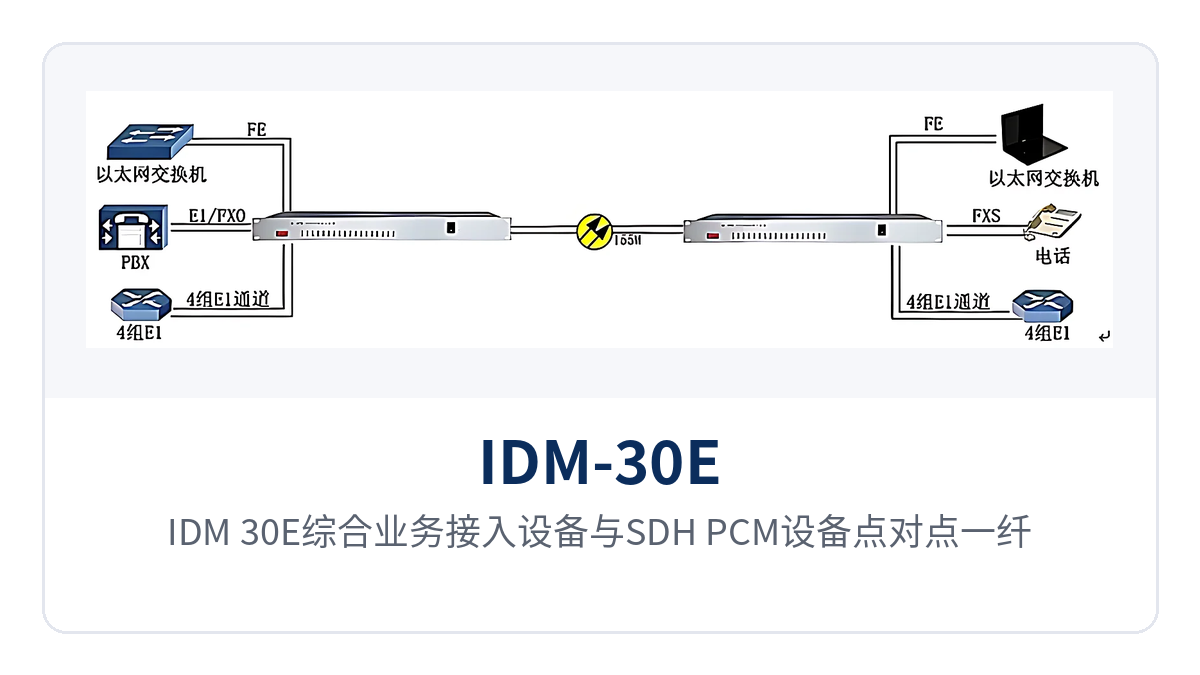
Figure 4: Point-to-point multi-service over a single fiber networking of the IDM-30E integrated service access device with SDH and PCM equipment
Differentiated Capabilities and Private Network Value of the IDM-30E
The differentiated capabilities of the IDM-30E integrated service access device, combined with the actual requirements of private network access points, are reflected in the following four points, as detailed in the table below.
| Differentiated Selling Point | Specific Capability | Value to Private Network Customers |
|---|---|---|
| 4 groups of E1 transparent transmission | 4 groups of E1 interfaces support transparent transmission mode, comply with ITU-T G.703, and can reuse the E1 channels of existing PCM and SDH/PDH networks | Compatible with existing SDH/PCM networks for fast access, reuses existing 2M channels, and requires no changes to trunk switching configuration |
| Dual power supply | Power supply modes support DC-48V/AC220V/dual power supply, with overall power consumption ≤100W | The two inputs serve as mutual backup, power supply redundancy improves operational continuity, and low power consumption suits long-time operation in equipment rooms |
| 100M wire-speed | Provides 2 groups of wire-speed 100M Ethernet interfaces, supports VLAN partitioning, and can be expanded to 4 groups | Multi-service over a single fiber saves optical fibers, replaces two sets of equipment—a telephone optical multiplexer and a network optical multiplexer—and reduces optical cable usage and equipment stacking |
| FXS caller ID | Provides ordinary telephone cards with FXS caller ID, and FXO and FXS interfaces are configured as required | Caller ID is available as soon as the voice channel is enabled, 64K subscriber interfaces provide flexible access, and on-site modification is reduced |
The value of the IDM-30E integrated service access device in terms of carrying capacity lies in multiplexing rather than stacking. Compared with the traditional practice of deploying one telephone optical multiplexer and one Fast Ethernet network optical multiplexer separately, the IDM-30E uses one 1U device and one optical port to carry both types of services simultaneously, organizing telephone, Ethernet, and E1 signals on the same optical fiber by time slot and channel. For private networks, each fiber core saved reduces optical cable construction and rental costs, and each device eliminated reduces cabinet and maintenance burdens at one site. With its technical accumulation in the fields of PCM equipment and optical multiplexing equipment, Raytrans integrates this advantage into various application scenarios such as government private network optical fiber communication solutions, smart mining communication solutions, and military emergency communications vehicle solutions.
In terms of power supply and O&M, the IDM-30E integrated service access device supports DC-48V and AC220V dual power supply, with the two inputs serving as mutual backup, so a power loss on one path will not cause service interruption. Together with the function control switches and alarm indications on the front panel, duty personnel can quickly locate abnormalities on the optical fiber, E1, or power supply side, making it suitable for long-time unattended operation in electric power, rail transit, and military and government private networks.
Conclusion
The 4-group E1 transparent transmission integrated service access device (IDM-30E integrated service access device) uses one 19-inch 1U standard chassis and, through one optical fiber channel, simultaneously carries 30 telephone interfaces and 2 wire-speed 100M Ethernet interfaces, supports VLAN partitioning, can be expanded to 4 groups of Ethernet, transmits 4 groups of E1 interfaces transparently in accordance with ITU-T G.703 and is compatible with existing SDH/PCM networks, and supports DC-48V/AC220V dual power supply with overall power consumption ≤100W. On site, only one optical fiber is needed to bring 30 remote telephone channels and 2 Fast Ethernet channels back to the central equipment room at once, making it suitable for multi-service access at sites such as electric power private networks, rail transit communications, and military and government private networks. For selection and configuration, please confirm commercially with the Raytrans manufacturer.