IDM-120PN
IDM-120PN
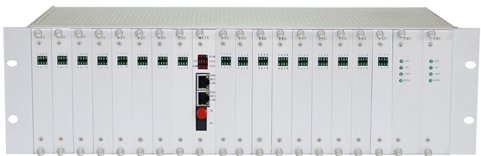
The IDM-120PN multi-service optical terminal is an optical fiber multiplexing device that utilizes dedicated large-scale integrated circuits to provide fiber-based wire-speed 100M Ethernet interfaces and 8 E1 interfaces over optical fiber transmission, of which 4 E1 channels are used for cross-connect multiplexing and the other 4 E1 channels for transparent transmission, completing processing of 2 to 4 optical signal channels. The IDM-120PN multi-service optical terminal adopts a 19-inch 1U standard chassis with 8 universal slots and 2 expansion slots.
Overview:
The IDM-120PN integrated service cross-connect multiplexer is an optical fiber multiplexing device that utilizes dedicated large-scale integrated circuits to provide fiber-based wire-speed 100M Ethernet interfaces and 8 E1 interfaces over optical fiber transmission, of which 4 E1 channels are used for cross-connect multiplexing and the other 4 E1 channels for transparent transmission, completing processing of 2 to 4 optical signal channels. It adopts a 19-inch 1U standard chassis with 8 universal slots and 2 expansion slots. It can provide 16 channels of 64K plus 8 channels of n×64K user interfaces, and more than 20 types of interface cards can be arbitrarily configured as required. This enables multiplexing of broadband and narrowband services over E1 or optical fiber, making it a multi-service integrated platform for PCM multiplexing and Ethernet access. The 24 user interface channels provided by the IDM-120P can be transmitted over 4 E1 directions. It can be arbitrarily combined with the IDM-240 series, IDM-120 series, IDM-30 series, and mini series to form various networks, including chain, star, and tree topologies.


Main Features:
◆ Flexible optical fiber multiplexing
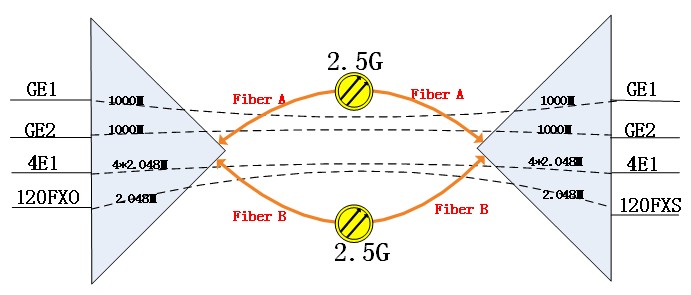
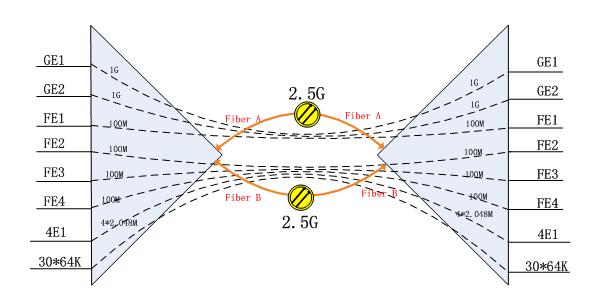
Provides up to 4 channels of E1 transparent transmission and 4 channels of E1 cross-connection, while simultaneously providing 1 to 4 Ethernet channels operable in full-duplex/half-duplex mode at 10M/100M. The Ethernet interface features data frame filtering and MAC address auto-learning, supports VLAN and flow control. The optical fiber rate is 155Mbps with a transmission distance of no less than 40KM. SC/FC/ST interfaces are optional, and single-fiber transmission mode is supported.
◆ High stability
Utilizes dedicated large-scale integrated circuits. A single chip completes signal processing for 4 E1 channels, greatly enhancing the long-term stability of the device.
◆ Flexible configuration of multi-functional interfaces
Built-in 4 multi-timeslot card channels. V.35 cards with n×64K bandwidth and 10BASE-T cards can be inserted, and the multi-timeslot card channels can also be used to provide high-rate asynchronous RS232 or RS485 interfaces. The V.35 card can operate in both DTE and DCE modes, providing cost-effective multi-timeslot user interface cards such as V.35 and 10Base-T. An Ethernet switching board can be built in to connect one Ethernet interface to 4 groups of 100M Ethernet interfaces.
◆ Rich user interfaces and flexible access methods
The IDM-120PN adopts an independent user module design with a variety of voice and data interfaces available, including 64K co-directional, V.24/V.28 (RS232/RS485), V.35 (n×64K), 10Base-T, polarity reversal and caller ID telephones (FXO, FXS), magneto, 2100Hz carrier magneto, hotline, carrier, EM 2/4-wire audio, high-fidelity audio, baseband trunk interface card, No.1 signaling card, telephone switching card, and more than 30 types of user interfaces. These can be arbitrarily changed according to user requirements. The high-capacity, high-integration design can satisfy diverse user needs.
◆ Two-level timeslot cross-connect function
Built-in 128-timeslot cross-connect matrix. It enables data and signaling cross-connection between user-to-user, user-to-line, and line-to-line. Therefore, this unit can also be used as a timeslot cross-connect device for 4 E1 channels.
◆ Multiple clock modes
Can be set to master clock, external clock, line clock, or user clock modes, and can be configured as a switch interface or user interface, compatible with both central office and remote end.
◆ Flexible networking capability
Provides four transmission directions of optical fiber line transceiver. It can be used in combination with the IDM-240 series, IDM-120 series, IDM-30 series, and IDM-mini series. Users can freely choose according to different capacity requirements and application scenarios, offering flexible, economical, and reliable networking.
◆ Network management function
Features concise and comprehensive network management functions. Device configuration, query, and fault statistics management can be performed. The network management interface is available in both RS232 and RS485 forms. When RS485 is used, multiple devices can be cascaded simultaneously, and rack alarm output is also provided.
◆ Comprehensive monitoring and alarm functions
The host can issue an audible alarm when the E1 status changes. Panel indicators display specific alarm states. The device can also output rack alarm information. The network management system can monitor device status at any time.
◆ Dual power supply and dual ring power backup
Dual power supply and dual ring power modules are selected. The power supply operates in half-power mode, extending the service life of the power supply. At the same time, normal operation is maintained even when one module is damaged.
Typical Applications:
- Dedicated line access for voice, data, and video surveillance in power, public security, financial, and educational systems
- Broadband and narrowband integrated service access for residential communities/smart buildings
- Extension of data networks for telecom, Netcom, and Unicom operators
FAQs
Top 10 Common Questions About Telephone Optical Terminals
Based on years of experience in the production and R&D of telephone optical terminals…
View answerHow to Troubleshoot Common Faults of Telephone Optical Terminal?
Device cannot be powered on Check whether the power cable is connected correctly.
View answerWhat is the difference between single-fiber and dual-fiber?
The biggest difference between single-fiber and dual-fiber optical terminals lies in the optical modules on their…
View answerWhat is an Optical Terminal?
Many people are unfamiliar with the optical terminal, but in essence, it is a dedicated device for optical-electrical…
View answer