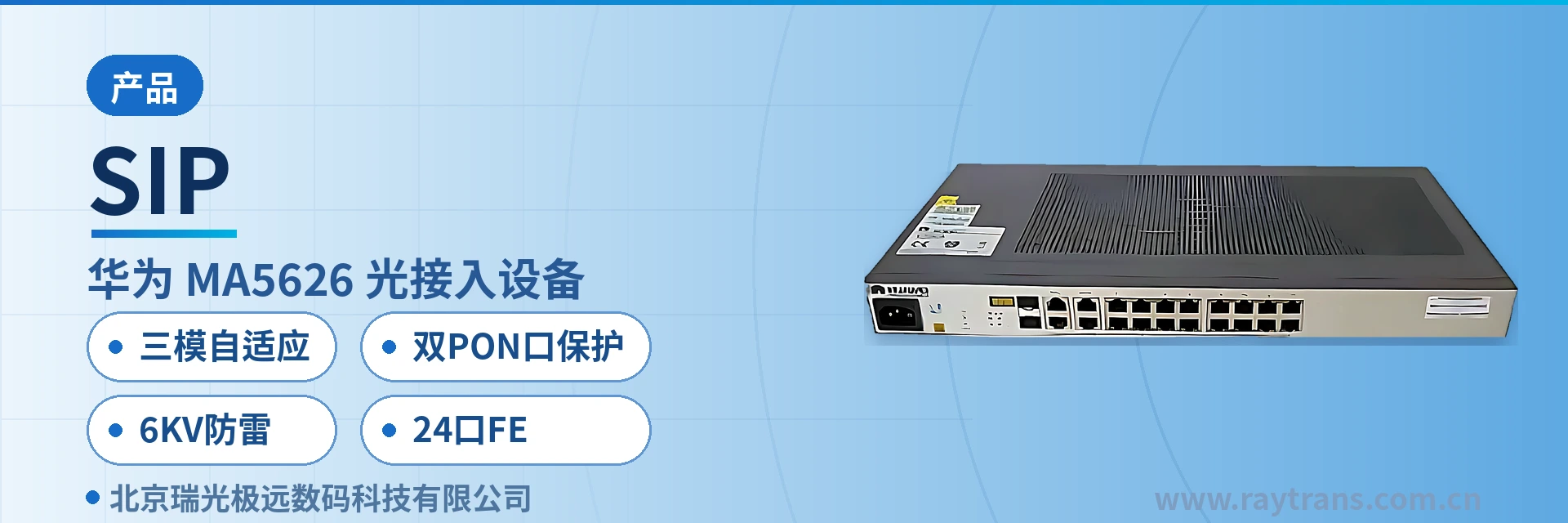
SIP Huawei MA5626 Optical Access Device
Triple-mode adaptive, Type C dual-PON port protection, forward/reverse PoE power supply
The Huawei MA5626 optical access device is used in the product showcase field and is a communication/transmission/dispatching device for industry customers (to be detailed and completed based on technical documentation)
The Huawei MA5626 MDU optical access device is a GPON/EPON subscriber-side access device (MDU, multi-dwelling unit) developed by Huawei. It consists of a fixed chassis and FE electrical interfaces, and works with a central office OLT to provide GPON/EPON access services to subscriber terminals in networking scenarios such as FTTB (fiber to the building). It is a common product showcase form among FTTB optical access devices.
In an optical access network, the MDU optical access device handles the last segment of access: the uplink uses one EPON/GPON optical interface to connect to the OLT over optical fiber, and the downlink restores access services to FE electrical interfaces so that computers, SIP telephones, cameras and other terminals in the building can connect directly to the network. In networking solutions provided by media converter manufacturers, such devices are also often used as in-building edge access nodes.
The differentiation of the MA5626 centers on three points: one device with three-mode adaptation, so private network upgrades do not require changing the model according to the OLT format and spare parts are unified; Type C dual-PON port protection enables millisecond-level switchover upon a single-link failure with services uninterrupted; and 6KV lightning protection together with an external heater supports startup at -40℃, making unattended sites in the field maintenance-free. With these features, the device can flexibly adapt to scenarios such as government private network optical fiber communication solutions and smart mining communication solutions, and it is also easy to deploy in line with the power supply requirements of FTTW PoE power supply solutions.
Key Specifications at a Glance: 1 EPON/GPON optical interface · 8/16/24 FE ports · GPON/EPON/GE three-mode adaptation · 6KV lightning protection · Type C dual-PON port protection · forward and reverse POE power supply
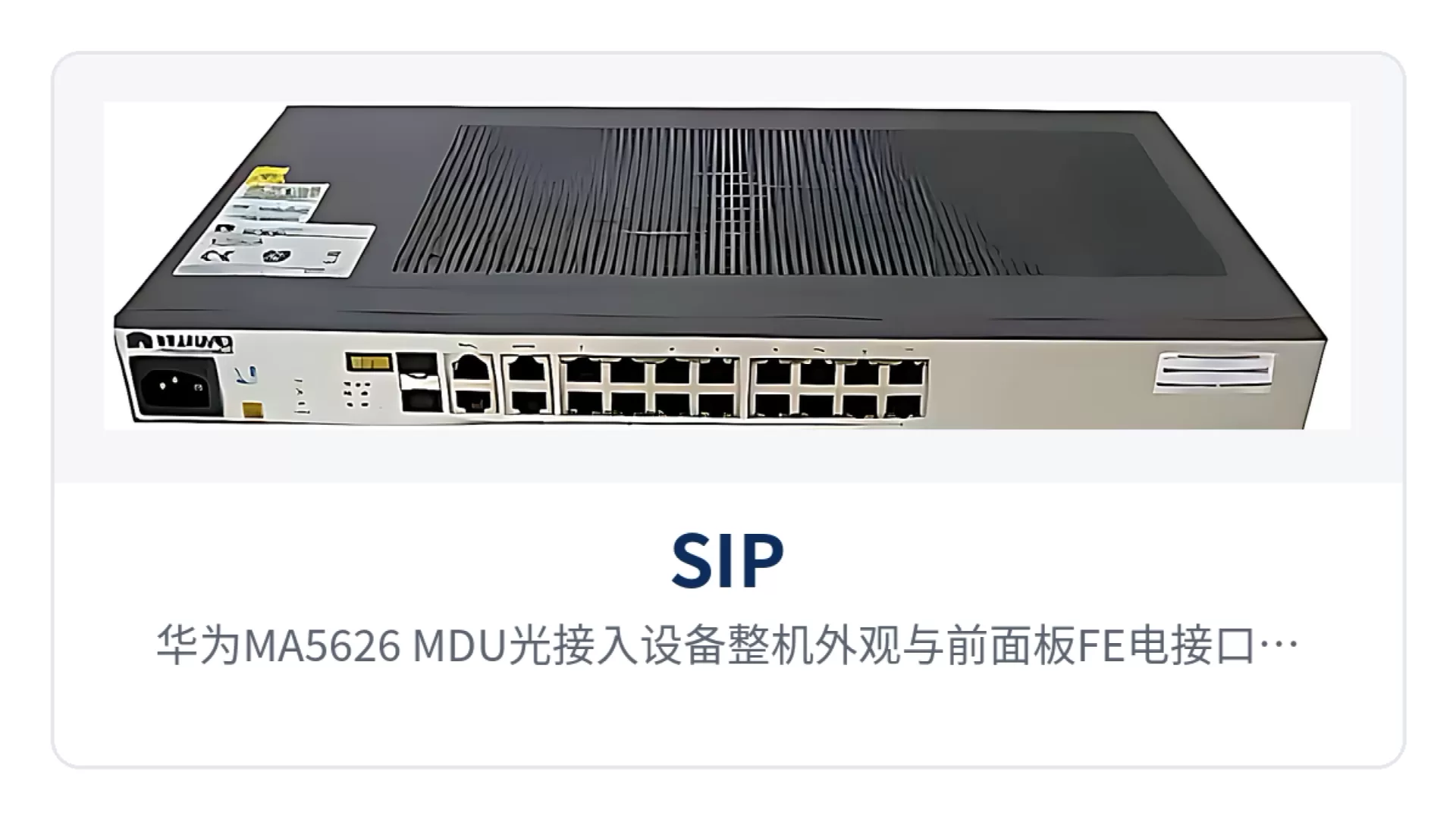
Figure 1: Overall appearance of the Huawei MA5626 MDU optical access device, with close-ups of the front-panel FE electrical interfaces and EPON/GPON optical ports
What Kind of Device Is an MDU Optical Access Device?
The Huawei MA5626 MDU optical access device is a building- or site-level access device between the central office OLT and home gateways, responsible for distributing the access services on one optical fiber to multiple Ethernet terminals throughout a building or site. By industry convention, an MDU is the edge aggregation device in a fiber-to-the-building solution and a common type of FTTB optical access device in product showcases.
The MA5626 adopts a fixed design and provides only FE electrical interfaces as service interfaces. By capacity it comes in 24-port, 16-port and 8-port versions, plus 8-port forward POE and 8-port reverse POE models, for a total of 5 selectable specifications. The number of interfaces is fixed at the time of ordering and plug-in card capacity expansion is not supported.
The chassis dimensions are 482.6mm×220mm×85.2mm, with a width matching the 19-inch rack standard, so it can be deployed on a desktop, in a corridor weak-current box or in a standard cabinet. The FE electrical interface is a 100M fast Ethernet (FE) port, an Ethernet interface defined by the IEEE 802.3 series of standards; on the terminal side, services can be enabled by direct connection with an ordinary network cable.
What Core Functions Does an MDU Optical Access Device Provide?
The functions of the MA5626 fall into five categories: optical access adaptation, voice service interfacing, remote O&M, link protection and power supply access. Each is described in the table below. Each row corresponds to a capability that can be checked directly against on-site requirements, and can be ticked off row by row during selection discussions.
Function | Description |
|---|---|
GPON/EPON/GE three-mode adaptation | One device adapts to three uplink modes, GPON, EPON and GE, meeting different FTTx network access requirements, so private network upgrades do not require changing the device model according to the OLT format |
SIP and H.248 protocols | Supports both SIP and H.248 protocols for convenient interfacing with softswitch, and can carry in-building voice services and connect to terminals such as SIP telephones |
Remote configuration delivery | Once the device is powered on and registered successfully, the management channel and service channel are established without manual on-site operation, plug-and-play |
Management, maintenance and monitoring | Supports sound management, maintenance and monitoring functions for daily operation management and fault diagnosis |
6KV high lightning protection | Supports 6KV high lightning protection capability against lightning surges introduced by external cables |
Type C dual-PON port protection | The two PON ports back up each other; when a single PON link fails, services are carried by the other link without link interruption |
Forward POE power supply | Solves the power supply access problem for Wi-Fi terminals in FTTW construction, i.e. the power supply access step of FTTW PoE power supply solutions |
Reverse POE power supply | Solves the difficulty of power supply access in corridors during FTTB construction |
Service emulation and remote fault location | Supports service emulation and remote fault location to reduce on-site troubleshooting and O&M costs |
Wide temperature range, low power consumption, natural heat dissipation | Wide-temperature, low-power, natural heat dissipation and mute design with fanless operation, suitable for corridor and desktop installation positions |
Key Specifications: How to Choose Between 8-Port, 16-Port and 24-Port FE
The MA5626 specifications differ mainly in the number of FE electrical interfaces and the power supply access method, while the optical interface, lightning protection level and operating environment are the same across all specifications. During selection, first confirm the number of terminals on the floor or at the site, then check the on-site power supply conditions and ambient temperature. The parameter values are listed in the table below.
Item | Parameter/Specification | Description/Applicable Conditions |
|---|---|---|
Optical interface | 1 EPON/GPON optical interface | Works with the OLT at the central office to carry GPON/EPON access services |
Service interface | 8/16/24 FE electrical interfaces | FE electrical interfaces are the only service interface provided |
Equipment form factor | Fixed design | Specification selected by capacity; plug-in card capacity expansion is not supported |
Specification variants | 24-port/16-port/8-port, plus 8-port forward POE and 8-port reverse POE | 5 variants in total, selected by terminal count and power supply conditions |
Lightning protection | 6KV | Withstands lightning surge introduced by external lines |
PON port protection | Type C dual-PON port protection | Dual PON ports back up each other; services uninterrupted on link failure |
POE power supply | Forward POE, reverse POE | Forward POE powers Wi-Fi terminals in FTTW scenarios; reverse POE solves the difficulty of power supply access in FTTB corridors |
Operating temperature | 0℃~45℃ | Normal operating ambient temperature range |
Low-temperature startup | Startup in -40℃ low-temperature environments supported via an external heating device | Low-temperature startup requires an external heating device; a low-temperature environment adaptation option |
Operating humidity | 20%~85% (non-condensing) | For use under non-condensing conditions |
Storage humidity | 5%~95% (non-condensing) | Storage and non-condensing transportation conditions |
Dimensions | 482.6mm×220mm×85.2mm | Width matches the standard 19-inch rack width |
Power supply mode | not yet recorded in the knowledge base | The product documentation does not give the power input specification; the manufacturer's technical documentation and commercial confirmation shall prevail |
Transmission distance and optical fiber type | not yet recorded in the knowledge base | The product documentation does not give the optical transmission distance figure; the manufacturer's technical documentation and commercial confirmation shall prevail |
Typical Application Scenarios
The deployment locations of the MA5626 are concentrated in three types of sites: substations and distribution rooms, stations and section equipment rooms, and oil and gas pipeline valve chambers. What they share is a fixed number of terminals, no permanent on-site staff, and only two incoming routes: optical cable and power. The capacity selection and protection configuration for the three scenarios are described below.
Smart Grid Private Network: Terminal Access in Substations and Distribution Rooms
Substations, distribution rooms and switching stations house telecontrol communication terminals, environmental monitoring collectors, access control and video front ends, with information points at a single site usually ranging from a dozen to twenty-odd. A 24-port FE MA5626 is installed in the site cabinet or weak-current box, covering all Ethernet terminals of one site with a single unit; the uplink connects back to the OLT at the central office through 1 EPON/GPON optical interface, forming a typical combination of a government private network optical fiber communication solution and FTTB optical access device.
Power grid private networks often run optical access central offices of several formats side by side. The GPON/EPON/GE tri-mode adaptation of the MA5626 lets the same device interface with OLTs of different formats, so no model change by central office format is needed during upgrades, and the variety of spare parts and training is narrowed accordingly. Sites are mostly in the field, where aerial cables readily introduce lightning surge; the 6KV lightning protection reduces the probability of port damage.
Link reliability is provided by Type C dual-PON port protection: the two PON ports back up each other, and on failure of a single PON link the services are carried by the other, with millisecond-level switchover keeping in-station monitoring and communication circuits online without waiting for O&M personnel to attend on site for patching.
Rail Transit Communication: FE Terminal Aggregation at Stations and Section Nodes
Rail transit and railway sites along the line are distributed, and stations, section equipment rooms and depots need to connect turnstiles, surveillance cameras, PA and office terminals to the communication private network. The MA5626 is selected in 8-port, 16-port or 24-port FE variants according to the number of terminals at the site and installed in the station communications equipment room and section equipment cabinets; the uplink goes back to the control center along the line optical cable through the EPON/GPON optical interface.
Central office formats are not fully uniform across lines. GPON/EPON/GE tri-mode adaptation lets the same model suit central offices of different formats, reducing spare parts and training varieties along the line. The device uses a wide-temperature range, low power consumption and natural heat dissipation silent design, so no fan noise is introduced when installed in equipment cabinets and near platforms.
Remote configuration delivery means new stations can be enabled without on-site line-by-line configuration; once powered on and registered successfully, the management channel and service channel are established automatically. Service emulation and remote fault location let the center first determine whether a fault lies in the terminal, the network cable or the optical path, and then decide whether a site visit is needed.
Unattended Sites on Oil and Gas Pipelines: Remote O&M of Valve Chambers and Monitoring Terminals
Valve chambers, cathodic protection stations and offtake stations along long-distance oil and gas pipelines are mostly unattended sites, usually with only surveillance cameras, combustible gas detection collectors and telephone terminals on site, placing high demands on equipment reliability and remote maintainability. The MA5626 supports remote configuration delivery; after the site is powered on, the management channel and service channel are established automatically, and on site only power-on plus optical path and network cable connection are needed — plug-and-play. It is an access choice equally suited to unattended field sites beyond the smart mining communication solution.
Service emulation and remote fault location let O&M personnel check port and service status at the central equipment room and determine the fault location without going on site. Aerial optical cables along the pipeline readily introduce lightning surge; the 6KV lightning protection reduces the probability of port damage and cuts port replacement and inspection frequency caused by lightning strikes.
Field cabinets often have no local power. The 8-port reverse POE variant draws power from the Ethernet side, solving the difficulty of power supply access in corridors and cabinets; in winter, low-temperature sites can support startup in -40℃ environments via an external heating device, changing power-on from waiting for room temperature to rise to scheduled enablement. As an FTTB optical access device often recommended alongside media converter manufacturers, the MA5626 can also serve as a site-level aggregation node in smart mining communication solutions and government private network optical fiber communication solutions, working with media converters to complete end-point product showcase and access.
Differentiated Value: Tri-Mode Adaptation, Dual-PON Port Protection and 6KV Lightning Protection
The differentiation of the MA5626 centers on three points: tri-mode adaptation, dual-PON port protection, and high lightning protection with wide temperature. The correspondence between these three capabilities and the actual value to private network customers is given in the table below, row by row setting out the capability definition and the change perceivable on site. In selection discussions, first check whether the first two columns match the on-site central office format and optical cable conditions, then look at the project benefits in the third column — this is closer to reality than looking at port count alone. As a product showcase aimed at private networks, its capability definitions align closely with the on-site requirements of government private network optical fiber communication solutions and smart mining communication solutions.
Differentiated Selling Point | Specific Capability | Value to Private Network Customers |
|---|---|---|
Triple-mode adaptation: GPON/EPON/GE triple-mode adaptation | One EPON/GPON optical interface supports three uplink modes — GPON, EPON and GE — so one device connects to central office OLTs of different formats | One device with triple-mode adaptation; private network upgrades need no model change by OLT format, and spare parts are unified |
Dual PON port protection: Type C dual PON port protection | Two PON ports back each other up; when a single PON link fails, services are carried by the other link | Type C dual PON port protection; millisecond-level switchover on single-link failure keeps services uninterrupted |
6KV lightning protection: 6KV high lightning protection plus wide-temperature design | Supports 6KV lightning protection, wide-temperature low power consumption with natural heat dissipation, and with an external heating device supports startup at -40℃ | 6KV lightning protection + external heating supports startup at -40℃; maintenance-free at unattended field sites |
24-port FE: full single-site coverage with 24-port FE | Fixed design in three capacities — 24-port, 16-port and 8-port — selected at ordering according to site information points | 24-port FE covers one site; plug-and-play on power-up, no configuration required on site for service enablement |
How to Select and Deploy MDU Optical Access Devices
How MDU Optical Access Devices Work with OLTs
MDU optical access devices and OLTs are upstream and downstream in the access link: the OLT is deployed in the central office equipment room and handles GPON/EPON uplink aggregation and service configuration delivery; the MA5626 is deployed in user-side buildings or sites, connects to the OLT over optical fiber through one EPON/GPON optical interface, and converts the uplink optical signal back into FE electrical interfaces for terminal access. This architecture is a typical form of edge access in both government private network optical fiber communication solutions and smart mining communication solutions.
After the device is powered on and registered successfully, the management channel and service channel are established automatically. When a building or site is added, only registration and service configuration on the OLT side are required; no line-by-line local CLI configuration is involved on site. The enablement time depends mainly on whether the optical path is in place and whether the terminal network cables are terminated.
What to Check in Site Selection
Four items are enough to fix the configuration in selection. The first three determine the device specifications, and the fourth determines installation accessories and on-site conditions. Confirm each item with commercial and construction parties before fixing the ordering version, so that a cabinet that does not fit or a device that will not start in winter is not discovered only after delivery. Beyond these four items, no other parameters need to be deliberated: once capacity and power supply access are fixed, the overall configuration is fixed.
Number of terminals: first count the information points of the site or floor, and choose the slightly larger of the 8-port, 16-port and 24-port capacities, so that no expansion position is lost when one unit is fully loaded.
Power supply access: when the weak-current box has local power and Wi-Fi terminals need power, consider the forward POE specification; when the corridor and field cabinet have no local power, consider the reverse POE specification, drawing power from the Ethernet side, which is also the power supply access method commonly used at the edge in FTTW power over Ethernet (PoE) solutions.
Ambient temperature: the standard operating temperature range is 0℃~45℃; sites that may see -40℃ in winter need an external heating device. The installation position can be a desktop, a corridor weak-current box or a cabinet.
Optical path conditions: the optical transmission distance and optical fiber type are not yet recorded in the knowledge base. The specific model configuration, board and power supply requirements are subject to the manufacturer's technical documentation and commercial confirmation.
Installation, Power-Up and Online Process
Proceed on site in the following four steps; manual intervention is needed only at physical installation and online confirmation. Registration, channel establishment and service configuration delivery are completed by the device in cooperation with the OLT side, which shortens the enablement time of buildings and sites and reduces the configuration records that must be kept on site:
Determine the installation method: choose among desktop installation, corridor weak-current box installation and cabinet installation according to on-site conditions, and leave space for heat dissipation.
Connect the optical path and network cables: connect the optical fiber from the OLT to one EPON/GPON optical interface, and connect the terminal network cables to the FE electrical interfaces; for forward or reverse POE specifications, complete the power supply wiring according to the specification. On-site wiring for FTTW power over Ethernet (PoE) solutions and FTTB optical access devices follows the same order.
Power up and register: power on the device and wait for successful registration and automatic establishment of the management channel and service channel; this step requires no line-by-line local configuration.
Verify port by port: confirm on the network management side that the device is online, check terminal connectivity port by port, and if necessary use service simulation and remote fault location functions to check service status.
Conclusion
As an MDU optical access device, the MA5626 packs edge access, protection and link reliability for private networks into one fixed chassis with one EPON/GPON optical interface, three FE capacities of 8/16/24 ports, 6KV lightning protection and Type C dual PON port protection.
In three scenarios — smart grid private networks, rail transit communication and unattended sites along oil and gas pipelines — one device with triple-mode adaptation needs no model change by OLT format during upgrades, is plug-and-play on power-up with no configuration required on site for service enablement, and with reverse POE and an external heating device adapts to field conditions without local power and with low-temperature startup. The above capabilities also apply to the edge access link where media converters and FTTB optical access devices are used. Model configuration and quotation are subject to the manufacturer's technical documentation and commercial confirmation.