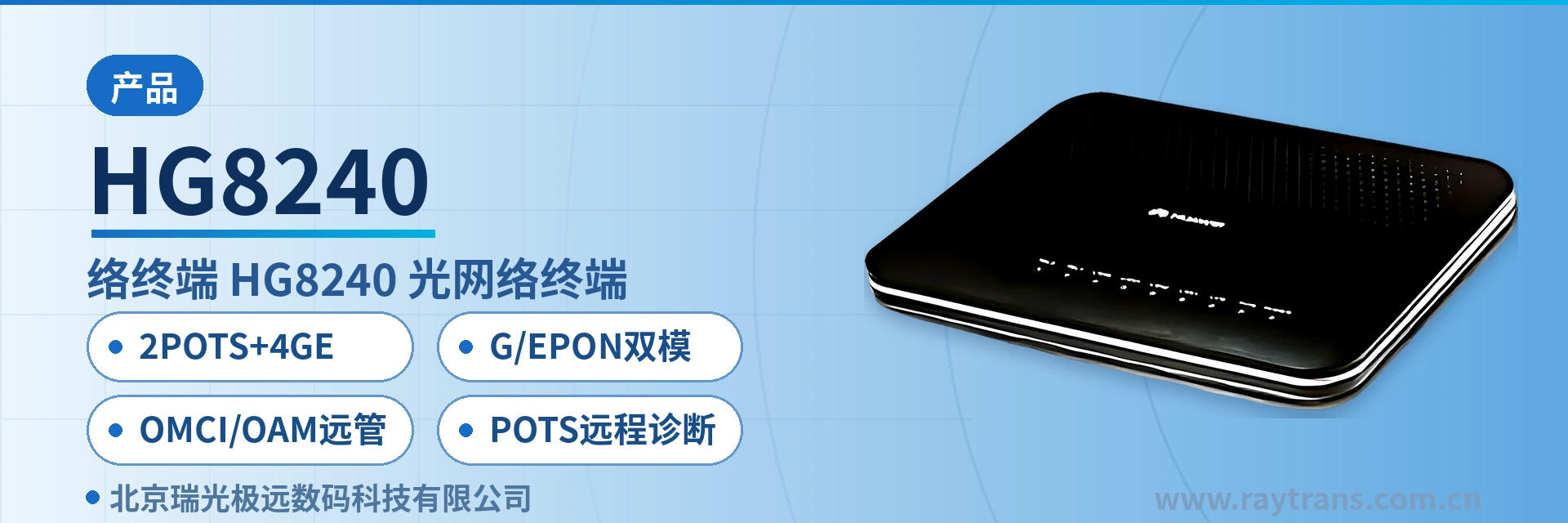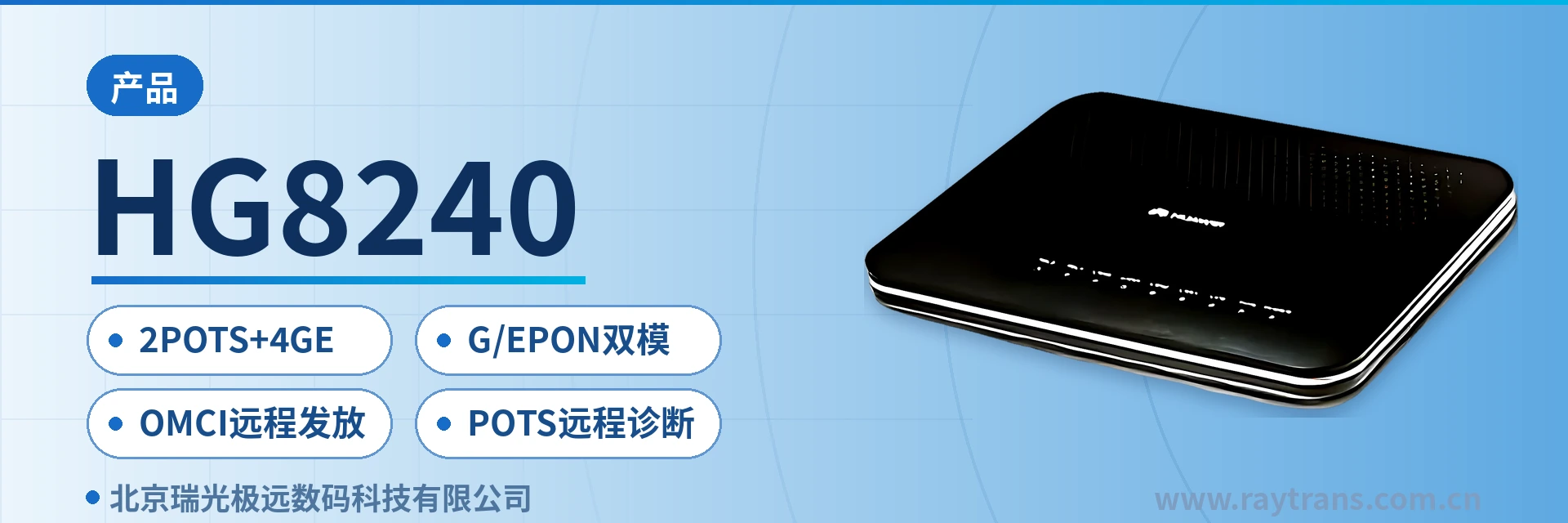
HG8240 HG8240
2 POTS + 4 GE, G/EPON dual-mode, POTS remote diagnosis, SIP and H.248 dual protocol
Key point: The EchoLife HG8240 is a bridge + voice home-side device in Huawei's FTTH solution. It provides ultra-broadband access for home and SOHO users through G/EPON technology, offering 2 POTS voice interfaces and 4 GE/FE adaptive Ethernet ports, and supports
HG8240 is an unattended-site voice broadband terminal developed by Huawei. It is a bridge + voice user-side device in FTTH network access, used to provide 2 telephone lines and 4 Ethernet accesses simultaneously over the same PON optical fiber. Once an ordinary telephone and a switch are connected on the site side, voice and data services can be provisioned; the two service types no longer need to be carried by two separate devices, and the rack position, power supply and wiring in the cabinet are counted as one unit, making it easy to plan uniformly and present as a product as an edge access node in a government private network optical fiber communication solution.
Key Specifications at a Glance: 2POTS+4GE · G/EPON dual-mode · OMCI remote provisioning · POTS remote diagnosis · SIP and H.248 dual protocol · GE line-rate forwarding
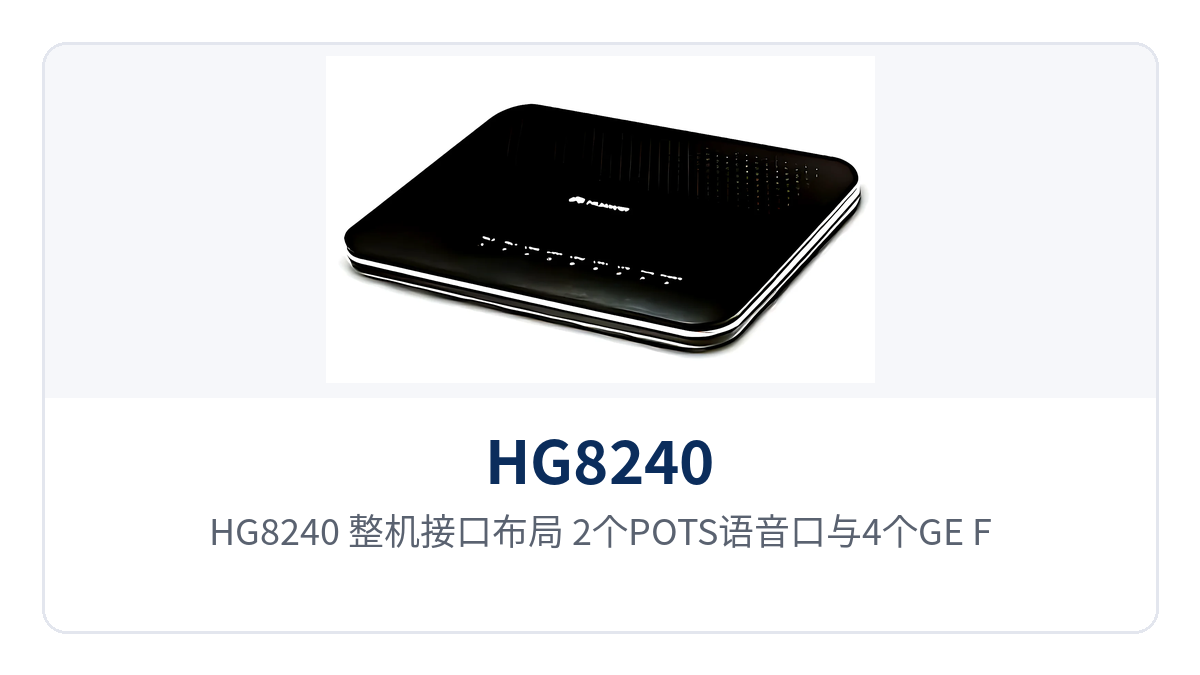
Figure 1: HG8240 overall interface layout, with 2 POTS voice ports and 4 GE/FE adaptive Ethernet ports
What Kind of Device Is an Unattended-Site Voice Broadband Terminal?
An unattended-site voice broadband terminal refers to an access device placed on the site side that directly converts one PON optical fiber into ordinary telephone ports and Ethernet ports, so that a site can provision services without separately configuring a voice gateway and a switch. HG8240 plays exactly this role: on the optical side it connects to the central office OLT, and on the electrical side it provides 2 POTS ports and 4 GE/FE adaptive ports. As a user-side device for FTTH network access scenarios, it often appears in product showcase together with supporting products from fiber optic switch and optical multiplexer manufacturers.
In terms of protocols, HG8240 is a bridge + voice ONU. On the data side it performs Layer 2 bridging, transparently transmitting the site's Ethernet service to the metro bearer network; on the voice side it connects analog telephones and converts them into SIP or H.248 signaling, which is handed to the softswitch for registration and call control. The two service types occupy separate channels on the same PON optical fiber, and voice does not consume the data forwarding resources.
No on-site configuration is a key capability of such terminals at unattended sites. HG8240 receives configuration delivered from the network management side through the OMCI/OAM channel; after the terminal is powered on and registers, it automatically obtains voice, broadband and multicast parameters, so provisioning a new site does not require engineers to visit and set up each device. For integration projects undertaking a government private network optical fiber communication solution, this remote provisioning capability can significantly shorten the provisioning cycle.
Which Services Can One Terminal Support: Functions and Interfaces
HG8240's capabilities center on four main lines: voice access, data access, remote provisioning and fault diagnosis. During selection, simply check item by item against the site's number of telephones and number of Ethernet ports. The table below lists the specific function and applicable conditions of each item.
Function | Description |
|---|---|
2POTS+4GE interfaces | Provides 2 POTS voice interfaces and 4 GE/FE adaptive Ethernet ports; connecting an ordinary telephone and a switch on the site side is enough to provision telephone and internet services |
G/EPON dual-mode adaptation | The same terminal supports adaptive operation in both GPON and EPON PON formats, so no model change by format is needed when connecting to different OLTs for FTTH network access |
SIP and H.248 voice protocols | The voice side supports both SIP and H.248 protocols and interfaces according to the protocol already enabled on the softswitch side; telephone registration and calls are managed uniformly by the softswitch |
OMCI/OAM plug-and-play | Delivers service parameters such as voice, broadband and multicast remotely through the OMCI/OAM channel; the terminal automatically retrieves the configuration after power-on registration, with no need for on-site setup device by device |
POTS port outside line test | Supports testing the outside line of POTS ports, determining the working state of telephone lines and ports without dispatching personnel |
Call simulation | Supports call simulation, simulating a call process to verify whether the voice channel is normal; together with the outside line test, it narrows the fault scope down to the port, the line or the softswitch side |
GE line-rate forwarding | The Ethernet side forwards at GE line rate, so forwarding capability does not become a service bottleneck when voice and multiple data streams run in parallel |
Key Specifications
Specifications are listed in four parts: PON format, user-side interfaces, protocols and O&M. Items given in the product documentation are reproduced as is; optical interface specifications and electrical environment items not covered by the documentation are marked separately, so that sales and engineering can confirm with the manufacturer before ordering and avoid filling in values by industry convention. The table below can also serve as a reference framework for side-by-side comparison with similar products from media converter manufacturers and optical multiplexer manufacturers.
Item | Parameter/Specification | Description/Applicable Conditions |
|---|---|---|
PON format | G/EPON dual-mode adaptation | The same terminal adapts to two FTTH network access modes and automatically matches the OLT-side format |
Voice interface | 2 POTS ports | Connects to an ordinary analog telephone or fax machine; the number of ports is fixed on the unit itself |
Ethernet interface | 4 GE/FE adaptive ports | RJ45 electrical ports that auto-negotiate the rate with the opposite-end equipment; can connect to a fiber optic switch or directly to a terminal |
Voice protocol | SIP, H.248 | Consistent with the protocol already enabled on the softswitch side |
Remote management | OMCI/OAM | Voice, broadband and multicast service parameters are delivered from the network management side |
Service provisioning method | Remote automatic provisioning | The terminal automatically retrieves its configuration after going online and registering; no on-site setup is needed unit by unit |
Diagnosis means | POTS port outside line test, call simulation | Used to determine the status of the telephone line, terminal ports and voice channel |
Forwarding capability | GE wire-speed forwarding | Forwards at wire speed when voice and data run in parallel |
Equipment form factor | Bridge + voice user-side device | FTTH network access terminal form for home and SOHO scenarios |
Optical interface rate and wavelength | Not yet recorded in the knowledge base | Subject to the manufacturer's technical documentation and ordering configuration |
Split ratio and transmission distance | Not yet recorded in the knowledge base | Determined by the OLT-side optical link design and splitting scheme |
Power supply and overall power consumption | Not yet recorded in the knowledge base | Subject to the manufacturer's technical documentation and the label on the unit |
Operating temperature and dimensions | Not yet recorded in the knowledge base | Confirm environmental adaptability with the manufacturer before deployment in an outdoor cabinet |
What Is the Difference Between an ONU and a Media Converter
The conclusion first: a media converter only performs optical-to-electrical conversion and Layer 2 transparent transmission, whereas an ONU is a managed terminal in a PON network and, beyond transmission, must also complete registration, authentication and service configuration. The difference between the two lies not in the number of interfaces but in who is responsible for the services.
In terms of interface form, a media converter generally provides one optical port to one or two Ethernet ports and carries data only; an ONU such as the HG8240 provides 2 POTS voice ports in addition to data ports, with voice running over the softswitch and data over the bearer network, so that a single optical fiber carries both types of service out together.
In terms of management, a media converter mostly relies on local DIP switches or simple network management, with service parameters set on the device side; the service parameters of an ONU are delivered by the OLT through OMCI/OAM, and a single configuration change on the network management side covers an entire batch of terminals. This is also why unattended sites prefer ONUs over media converters plus voice gateways.
The selection decision can be made according to the service list: when a site has only data requirements and does not need remote configuration changes, a media converter is sufficient; when a site has both telephone and data services and requires remote provisioning and fault location, an ONU is more suitable, as both provisioning and troubleshooting actions are centralized on the network management side. If the site also needs to connect legacy telephones other than SIP telephones, the POTS ports of the ONU are directly compatible and no additional voice gateway is required.
How SIP and H.248 Interwork with the Softswitch
SIP and H.248 are the two common voice control protocols on the softswitch side. The HG8240 supports both, and during interfacing either one can be selected according to the protocol already enabled on the softswitch, without changing the terminal model for protocol differences. Once the protocol is selected, both ends register under the same account system, and call permissions remain under the unified control of the softswitch. For office scenarios using SIP telephones, the terminal can also complete protocol conversion after connection through the POTS ports.
The interfacing process can be checked in three steps, all performed on the network management side and the softswitch side; on site, you only need to plug the telephone into the POTS port and confirm the dial tone, without logging in to the terminal to change parameters item by item, and without pulling a separate copper cable for voice. The order of the three steps is not recommended to be changed; if the next step is configured before the previous one is confirmed, it is difficult to tell which link caused a problem.
Protocol alignment: confirm whether SIP or H.248 is enabled on the softswitch side, select the same protocol in the service template, and have the registration address and account delivered uniformly by the network management system.
Account binding: write the mapping between telephone numbers and POTS ports into the configuration template, and apply the same template to the same batch of sites to avoid errors from entering numbers unit by unit.
Call verification: run a dial test with call simulation to confirm successful registration and a working voice channel, then have on-site personnel make actual dial tests with the telephone.
Once the protocol is selected, both capacity expansion and replacement follow the same set of templates. A new site can go online by applying the existing template; when a faulty terminal is replaced, the new unit is connected to the optical fiber and automatically retrieves the original configuration after registration, with no change on the telephone side, the numbers and call permissions kept as they were, and the site's external contact information unchanged.
What Services Can OMCI Remote Automatic Provisioning Deliver
OMCI/OAM is the channel for managing ONUs in a PON network, through which the HG8240 receives configurations delivered from the network management side. The services that can be provisioned automatically include voice, broadband and multicast: voice delivers numbers, protocols and registration parameters; broadband delivers Internet access services and port rates; multicast delivers channels and multicast addresses.
What automatic provisioning eliminates is the step of logging in to each unit for configuration. During bulk provisioning, the network management side generates configurations according to the site list, and terminals automatically retrieve them after powering on and registering; parameters stay consistent across the same batch of sites, and provisioning progress depends only on whether the optical fiber is in place and whether the terminals are powered on. In the bulk deployment of a government private network optical fiber communication solution, this mechanism allows the voice and data services of dozens of sites to go online simultaneously.
Prerequisites need to be confirmed in advance: the terminal type and service template planning has been completed on the OLT side, and the terminal's optical path has been established and its registration status is visible on the network management side. If these two conditions are not met, remote provisioning cannot start, and on-site troubleshooting should target the optical path and the OLT-side data rather than the terminal itself.
How G/EPON Dual-Mode Adaptation Reduces Spare Part Models
G/EPON dual-mode adaptation means that the same terminal can work in both a GPON network and an EPON network, automatically matching the OLT-side format at access. The direct benefit for O&M is that only one model needs to be kept as spare parts, with no separate stocking for the two PON formats; this is consistent with the approach of media converter manufacturers to spare parts management—the fewer the models, the lower the inventory pressure.
This value is even more evident during phased network upgrades. Where old sites in the same area are still on EPON while new sites are already on GPON, one terminal can cover both types of sites, and a service vehicle carrying one box of spare parts can handle the entire area, with replacement and repair not requiring a prior judgment of which format the site belongs to. For projects undertaking a government private network optical fiber communication solution, this dual-mode adaptation capability likewise simplifies spare parts planning during phased commissioning.
Dual-mode does not mean no configuration required. Format adaptation addresses physical-layer and link-layer matching, while service parameters such as voice, broadband and multicast still need to be delivered from the network management side through OMCI/OAM; the service-side planning effort is not reduced by dual-mode.
Typical Application Scenarios
HG8240 is deployed as a site-side terminal, with one end connected to the PON fiber and the other to telephones and switches, while services are aggregated at the central office by the OLT and softswitch. The following three industry use cases show how the same terminal divides its roles across different sites.
Unattended Site Private Network: Remote Telephone and Broadband Provisioning, No Site Visit for O&M
Unattended communications equipment rooms, hydrological stations, meteorological observation points and road monitoring points usually have only one optical fiber in place, and each site needs both a duty telephone and Ethernet ports for monitoring and data devices. HG8240 provides 2 telephone ports and 4 Ethernet ports from a single terminal, so the site side no longer needs a voice gateway or a small switch, and SIP telephones can connect directly to the POTS ports.
Service provisioning and fault handling are both handled on the network management side: voice and broadband parameters are delivered through OMCI/OAM, telephone line state is checked with the POTS port outside line test, and call links are verified with call simulation. O&M personnel decide from network management alarms whether a site visit is needed, reducing unnecessary trips.
Field Industrial Site Access: One Terminal Brings Voice and Data to Pumping Stations and Valve Chambers
Field sites such as oil pumping stations, water source well houses and gas valve chambers are mostly unattended, with limited cabinet space and power supply conditions, and each site needs one dispatch telephone and a small number of data ports. The 2 POTS ports of HG8240 connect dispatch telephones, and the 4 GE/FE ports connect video and acquisition devices, so the number of devices and the wiring in the cabinet decrease together, equivalent to folding the functions of a fiber optic switch and a voice gateway into one terminal.
Maintenance costs at field sites are mainly spent on travel, and remote diagnosis capability directly determines O&M efficiency. Outside line tests and call simulation can be completed on the central side to determine whether the problem lies in the telephone line, the terminal port or the softswitch side, and then a single site visit is arranged, avoiding repeated trips to the site based on experience.
Distributed Energy Sites: Dispatch Telephone and Data Backhaul at PV and Energy Storage Sites
The communication needs of distributed PV, energy storage plants and charging sites center on one dispatch telephone and one data channel. These sites are distributed across distribution rooms, rooftops and corners of the plant, and often have only one optical fiber to the master station. HG8240 provides voice and Ethernet interfaces on one terminal, so the site can be connected once the fiber is in place, and the central office equipment provided by the optical multiplexer manufacturer completes the optical fiber communication of the whole link.
Such sites are usually put into operation in batches following the owner's PON network construction schedule, and the terminal must adapt to the network formats of different batches. G/EPON dual-mode lets the same model cover two types of PON networks, voice and broadband services are uniformly provisioned on the network management side, and the commissioning time is no longer constrained by on-site configuration work, which also makes it easier to incorporate into the overall FTTH network access plan.
Differentiated Capabilities and On-Site Value
The three capabilities correspond respectively to the number of devices, spare part models and O&M radius on the site side. The table below lists each capability alongside its on-site value, so that during selection you can compare row by row against the project's pain points; if a row does not match, the corresponding capability need not be a focus in this project.
Differentiated Capability | Value to the Site |
|---|---|
2 POTS + 4 GE, one unit carrying both voice and broadband | The site no longer needs a voice gateway or a switch: 2 telephone ports for telephones, 4 Ethernet ports for monitoring and office use, with rack position, power supply and wiring calculated for one device |
G/EPON dual-mode adaptation | The same terminal adapts to two FTTH networks, so no separate stocking by format is needed during network upgrades or phased construction, and spare part models and inventory pressure decrease accordingly |
OMCI remote provisioning and POTS remote diagnosis | Provisioning and troubleshooting are both completed on the network management side: voice, broadband and multicast parameters are delivered remotely, outside line tests and call simulation replace on-site checks, and O&M workload is calculated in person-days |
Conclusion
As a voice and broadband terminal for unattended sites, HG8240 folds 2 telephone ports and 4 Ethernet ports into one device, uses G/EPON dual-mode to adapt to FTTH networks of different batches, and uses OMCI/OAM to move service provisioning to the network management side. Whether deployed at the site side as a complementary form of media converter, or networked together with fiber optic switches and optical multiplexer manufacturer equipment, this terminal can undertake the site-side voice and data access tasks in government private network optical fiber communication solutions and FTTH network access projects.
During selection, first count the number of telephones and Ethernet port requirements at the site, then confirm the OLT-side format and softswitch protocol, and finally check the optical path and power supply conditions. Once these three items are aligned, the devices at both ends can be configured as a pair to enable voice and data services, and the site's O&M actions remain mainly on the network management side.