
SIP
SIP
SIP Shared Radio Gateway registered on multiple independent softswitch platforms. SIP softswitch applications are becoming increasingly widespread, leveraging 4G/5G IP channels. In coastal radio stations, there are typically multiple radios operating on different frequency bands, each assigned to different tasks and serving different vessels in various environments, including electronic fence radio broadcasting.
SIP Shared Radio Gateway Registered on Multiple Independent Softswitch Platforms
SIP softswitch applications are becoming increasingly widespread, leveraging 4G/5G IP channels.
In coastal radio stations, there are typically multiple radios operating on different frequency bands, each assigned to different tasks and serving different vessels in various environments, including electronic fence radio broadcasting.
These radios are usually shared by the Maritime Safety Administration, maritime surveillance authorities, and various enterprises (such as offshore aquaculture companies, wind power generation companies, and transportation companies).
Typically, a radio gateway is registered on a single dispatch platform. In more critical systems, dual servers may be deployed, but applications where the same radio gateway is registered on multiple platforms remain uncommon. Moreover, multiple independent user gateways controlling multiple radios are even rarer.
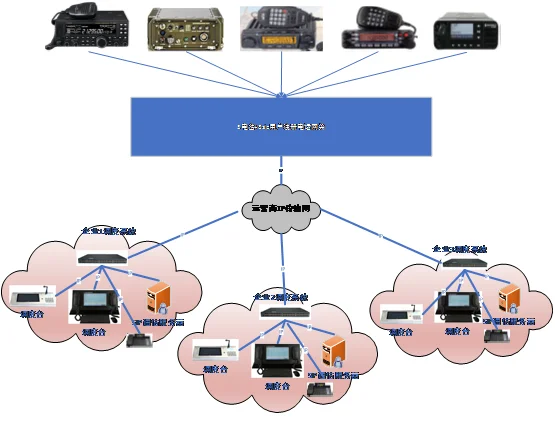
In our SIP radio gateway application, there are 3 radios (with a capacity of 5) covering maritime affairs, aquaculture, and power generation, serving several independent users. Each user must be able to monitor all radios and also send information through any radio via the dispatch console. We have configured 10 SIP trunks for the five radios, with each organization able to use 3 SIP trunks to connect to the radio gateway.
We mix the voice received from the five radios in a conference room and deliver it to each user, while also identifying which radio the current voice originates from. If voice traffic is heavy, fewer radios can be included in the conference mix. When a user needs to transmit voice through a specific radio, the radio selection information can be sent to the gateway. When multiple systems use the same radio, only the system that accesses it first has usage rights.
This SIP radio gateway, the IDM RG2000-5 SIP Radio Gateway, has been operating stably over an extended period of use.
The IDM RG2000 is a SIP dispatch gateway that can independently register to multiple softswitch dispatch systems via SIP trunks. Through remote configuration, it can designate which softphone interfaces are used by a specific system. It is a multi-platform shared SIP gateway.
Additionally, there are cases in other industries where multiple systems share a single radio, such as ground-to-air radios in air traffic control, radios in emergency management, and multi-radio control in military applications.
The IDM RG2000 enables better converged communication project applications by integrating two-way radios with IPPBX voice communication systems. It allows interoperability between radios and desktop phones. Picking up a phone allows you to call a radio channel directly.
The IDM RG2000 can serve as a trunking gateway, converting radio channels into SIP extensions under an IPPBX. By picking up a phone and dialing the corresponding number, you can communicate with the radio. The numbers corresponding to radio channels can be programmed as speed-dial keys, enabling one-touch communication with radios on IP phone terminals.
The IDM RG2000 SIP gateway supports multiple dialing and digit collection rule configurations;
Multi-channel telephony (SIP, PSTN) access processing capability;
Adaptive VOX (voice-activated operation) with adjustable sensitivity;
Adjustable input and output volume levels;
COR and PTT active signals are user-configurable;
In some field emergency projects, the remote command center communicates with command vehicles via 4G networks, satellite networks, and satellite phones. However, direct communication with on-site radio personnel at the emergency scene is not possible.
By deploying the RG2000 ROIP trunking gateway in the command vehicle, the on-site mobile radio is interfaced with the trunking gateway, enabling interoperability and interaction with the command center via SIP. The command center can access the on-site radios through the IP network, enabling direct voice communication with field radio users.
The open SIP protocol and functionality enable the integration of richer solutions, enhancing the competitiveness of overall project solutions.
FAQs
What is the working principle and function of a media converter?
The rapid advancement of informatization has led to growing demand for multimedia communications such as data, voice…
View answerWhat Is the Definition of Communication?
Communication: the exchange and transmission of information between people, or between people and nature…
View answerWhat is an E1 line? What are the core knowledge points?
E1 Basics Frame Structure of the E1 Channel In an E1 channel, 8 bits form one timeslot (TS)…
View answerPQC-Based FreeSWITCH and PJSIP Quantum-Resistant Communication System Upgrade Solution
The PQC-Based FreeSWITCH and PJSIP Quantum-Resistant Communication System Upgrade Solution transforms FreeSWITCH and…
View answerFortifying VoIP Communication with Quantum-Safe Defense | FreeSWITCH Softswitch Quantum-Safe Communication Mode Analysis, Selection, and Implementation Path
With the rapid iteration of quantum computing technology, traditional cryptographic algorithms such as RSA and ECC face…
View answer