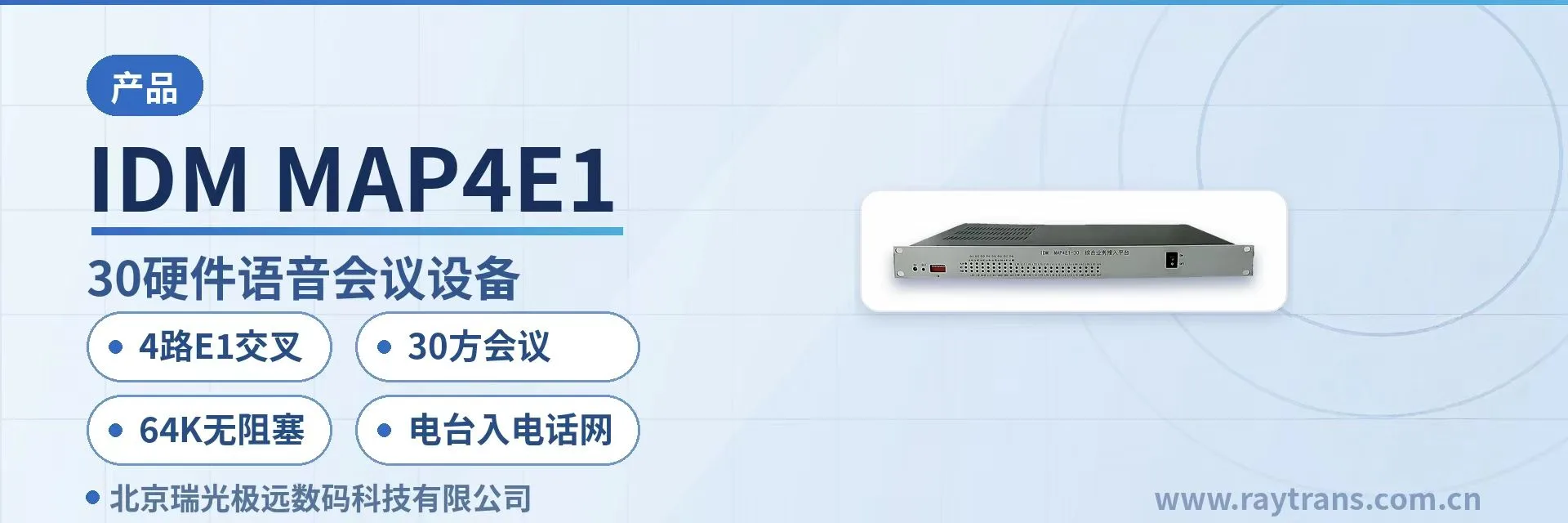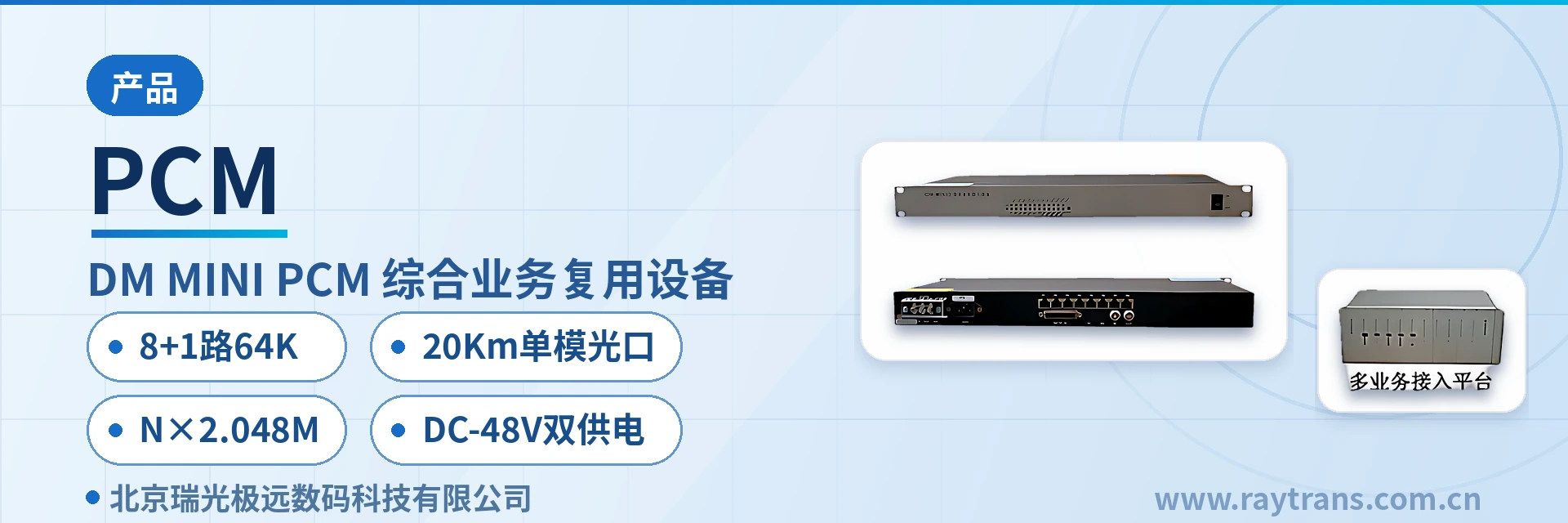
IDM-MINI Single-E1 Optical Port Dual-Channel PCM Multiplexer
One unit with dual channels, 8+1 channels of voice and data, transparent Ethernet transmission, replacing three remote-end optical multiplexers
The IDM-MINI integrated service multiplexer adopts an independent structure and can simultaneously transmit 8+1 channels of 64K or n×64K voice and data services over one E1 or optical fiber transmission channel. By converting services such as 10Base-T Ethernet, voice channels, V.35, and V.24
IDM-MINI single-E1 optical port dual-channel PCM multiplexer is an integrated service access device developed by Beijing Ruiguang Jiyuan Digital Technology Co., Ltd. for private network edge sites. With an independent structure, it integrates optical port and E1 transmission channels in a single frame, and can simultaneously transmit 8+1 channels of 64K or n×64K voice and data services over one E1 or optical fiber channel, while transparently transmitting multiple Ethernet channels. It is used for multi-purpose deployment at the private network edge in electric power, rail transit, military and government, and oilfield and mining area scenarios. It exists in the form of a PCM integrated service multiplexer, is backward compatible with existing PCM networking architectures, and is a representative optical multiplexer that Raytrans offers to the private network market.
Key specifications at a glance: 8+1 channels of 64K · 155M optical port, 20Km single-mode · N×2.048M Ethernet transparent transmission · DC-48V dual power supply · single-mode with multi-mode optional · E1 frame PCM30/31
Product Introduction
IDM-MINI is a single-E1 optical port dual-channel PCM multiplexer, a compact model in the IDM series of integrated service access devices from Raytrans. The unit adopts an independent structure, integrating optical port and E1 transmission channels in a single frame, and can simultaneously transmit 8+1 channels of 64K or n×64K voice and data services over one E1 or optical fiber channel, while transparently transmitting multiple Ethernet channels. As a compact optical multiplexer, it balances the multi-service access capability commonly seen in product showcases with the strict requirements of private network edge sites for size and power consumption.
The device is positioned for multi-purpose deployment at the private network edge, suitable for edge access in industries such as electric power, rail transit, military and government, and oilfield and mining areas. In a government private network optical fiber communication solution, IDM-MINI can serve as an end node for unified voice and data access; in a military emergency communications vehicle solution, its compact size and dual power supply features facilitate rapid deployment; in a smart mining communication solution, it can handle voice and data multiplexing and transmission between underground and surface. As a professional optical multiplexer manufacturer, Raytrans provides complete technical support and networking accessories for this device.
Product Appearance
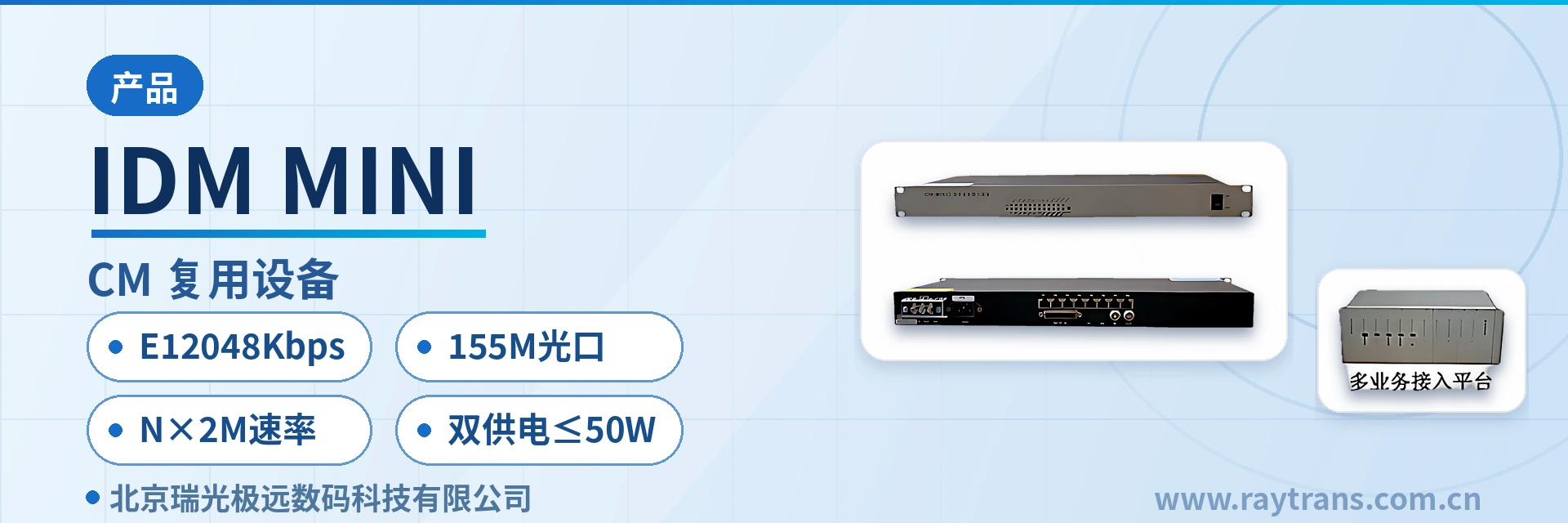
IDM-MINI adopts a compact independent enclosure. The front panel provides status indicator LEDs for the optical port, E1 interface, and various service interfaces, helping on-site O&M personnel quickly determine the operating status of the device. The device supports DC-48V dual power supply, suitable for scenarios with complex power supply environments such as communications equipment rooms and emergency communications vehicles.
Features
Optical port and E1 transmission channels integrated in a single frame, supporting simultaneous transmission of 8+1 channels of 64K or n×64K voice and data services over one E1 or optical fiber channel
Transparent transmission of multiple Ethernet channels, supporting N×2.048M Ethernet transparent transmission
155M optical port supports 20Km single-mode transmission, single-mode with multi-mode optional
E1 frame format supports PCM30/31
DC-48V dual power supply, adapting to power supply environments such as communications equipment rooms and emergency communications vehicles
Independent structure, small size and low power consumption, suitable for multi-purpose deployment at the private network edge
As an integrated service access device, backward compatible with existing PCM networking architectures
Suitable for scenarios such as government private network optical fiber communication solutions, military emergency communications vehicle solutions, and smart mining communication solutions
Technical Specifications
Parameter | Specification |
|---|---|
Model | IDM-MINI |
Transmission channel | 1 group of E1 or optical fiber channel |
Voice/data capacity | 8+1 channels of 64K or n×64K |
Ethernet transparent transmission | N×2.048M |
Optical port rate | 155M |
Optical port transmission distance | 20Km (single-mode) |
Optical port mode | single-mode with multi-mode optional |
E1 frame format | PCM30/31 |
Power supply mode | DC-48V dual power supply |
Structure | Independent structure |
Application Scenarios
IDM-MINI single-E1 optical port dual-channel PCM multiplexer is mainly aimed at multi-purpose deployment at the private network edge. Typical applications include:
Electric power private network: multiplexed transmission of voice, data, and Ethernet services between substations and the dispatch center
Rail transit: integrated service access between sites along the line and the central equipment room
Military and government: end node access in government private network optical fiber communication solutions, and rapid deployment in military emergency communications vehicle solutions
Oilfields and mining areas: voice and data multiplexing and transmission between underground and surface in smart mining communication solutions
As an optical multiplexer under Raytrans, IDM-MINI can be networked with other integrated service access devices in the IDM series, providing private network users with a complete PCM integrated service multiplexing solution from the center to the edge.
What Kind of Device Is This: How to Understand a Single-E1 Optical Port Dual-Channel PCM Multiplexer
A single-E1 optical port dual-channel PCM multiplexer refers to an access form in which the same device simultaneously provides two physical transmission channels, an E1 electrical port and a 155M optical port, both carrying the same set of PCM-multiplexed 64K services. IDM-MINI is the device that implements this form: it multiplexes signals such as telephone, V.35, and V.24 according to the 2048Kbps E1 frame, and sends out one multi-service digital stream over a 75Ω/120Ω E1 interface or an FC optical port (SC and other interfaces can be customized), with one device at the far end replacing the original multiple single-service optical multiplexers. As a representative product of an optical multiplexer manufacturer under Raytrans, this device is often used in product showcases for scenarios such as government private network optical fiber communication solutions, military emergency communications vehicle solutions, and smart mining communication solutions, combining the roles of an integrated service access device and an optical multiplexer in one.
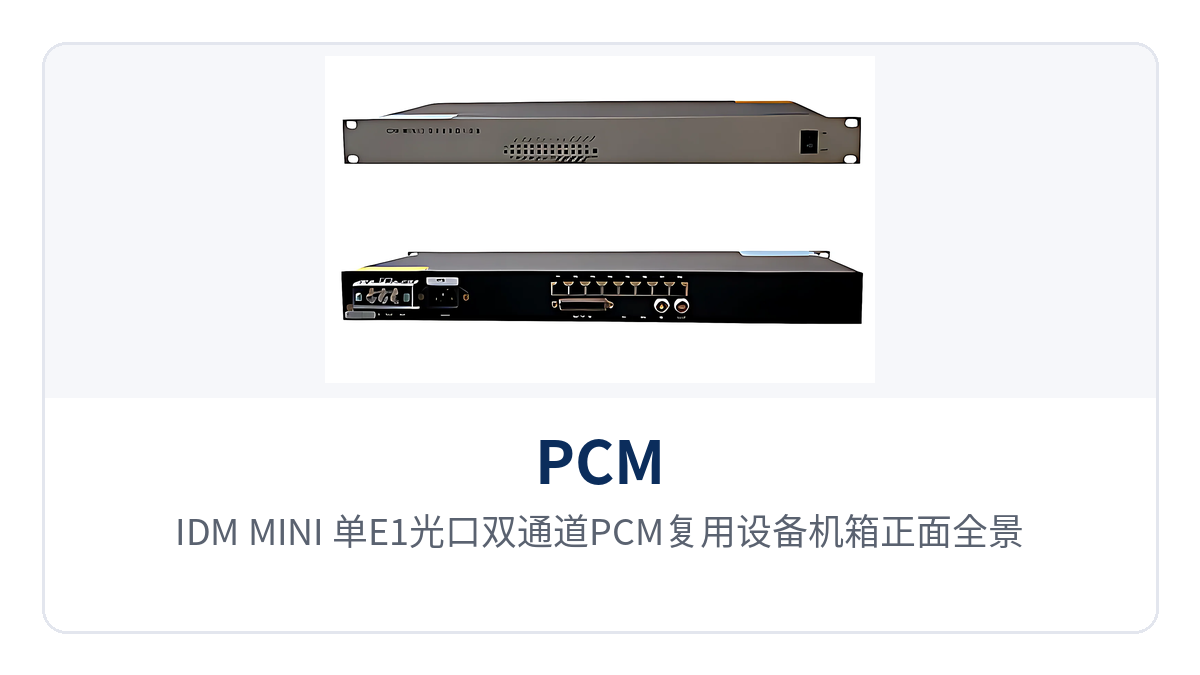
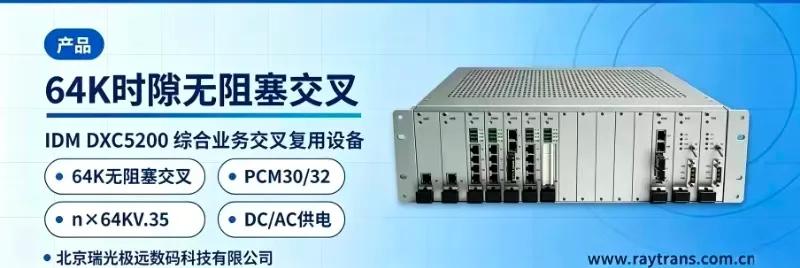
Figure 1: Front view of the IDM-MINI single-E1 optical port dual-channel PCM multiplexer enclosure, showing the layout of voice channel interfaces and alarm indicator LEDs
The distinction lies in the number of channels and the capacity specification: the optical port of IDM-MINI is 155M/155M, carried over 1310nm/1550nm single-mode (multi-mode optional) optical fiber, and can provide full N×2.048Mbps (N≤50) Ethernet transparent transmission, and supports 20Km single-mode transmission, meaning a single 20Km single-mode optical port brings remote services back; the E1 channel is a standard 2048Kbps bundle, with voice and data services sharing this bandwidth. Which channel to choose depends on whether there is an existing E1 digital trunk or optical fiber resource on site. Both can serve as the uplink channel for E1 optical port multi-service transmission, corresponding to two types of networking.
How the Single-E1 and 155M Optical Port Channels Divide Their Work
The value of the single-E1 optical port dual-channel design lies in putting E1 trunk access and optical port cascading capability into the same device, so that on site there is no need to configure separate devices for different channel types. The E1 channel is used to access an existing digital trunk or interconnect with an upper-level multiplexer, with the multiplexing protocol fully compliant with ITU-T G.703, a bit rate of 2048Kbps, HDB3 line coding, PCM30/31 frame structure, channel-associated signaling, and selectable 75Ω/120Ω impedance; the optical port handles remote extension and broadband Ethernet carriage, with symmetric 155M receive/transmit, a transmit optical power of -3 to -11dBm, receiver sensitivity better than -36dBm, and coverage of remote edge sites over a 20Km single-mode optical fiber.
Channel | Rate/Bandwidth | Carried Services | Key Interface Parameters |
|---|---|---|---|
E1 electrical port | 2048Kbps | 8+1 channels and n×64K voice and data | Line coding HDB3, ITU-T G.703, 75Ω/120Ω, frame PCM30/31, channel-associated signaling |
155M optical port | 155M/155M | Voice and data + N×2.048M Ethernet | FC (SC and other interfaces can be customized), single-mode with multi-mode optional, 1310nm/1550nm, transmit -3~-11dBm, receive better than -36dBm, 20Km |
8+1 channels of concurrent voice and data: what services one device runs at the same time
8+1 channels of concurrency is the core capability of the single-E1 optical port dual-channel PCM multiplexer — within one 2048Kbps channel it simultaneously separates 8 channels of ordinary voice plus 1 channel of 64K data service, with voltage, serial port and telephone not crowding each other out. Voice is compression-encoded per ITU G.711 A-law at 300Hz~3400Hz, with a loop current of 25mA per channel; at the same time, data interfaces such as V.24 (asynchronous ≤9600bps / synchronous 64Kbps, compliant with CCITT V.28) and V.35 (n×64Kbps, n=0~31, compliant with ITU-T V.35, terminal interface ISO2593) can be configured, so that telephone, telecontrol and collected data at a private network site are aggregated within one device at the end. This integrated service access capability enables Raytrans optical multiplexing equipment to serve as an end aggregation node in government private network optical fiber communication solutions, military emergency communications vehicle solutions and smart mining communication solutions, where one PCM equipment completes unified access at a multi-service product showcase level.
Service | Key Specifications |
|---|---|
Voice (three-element composite side) | 300Hz~3400Hz; ITU G.711 A-law; impedance 200Ω+560Ω//0.1μF; loop current 25mA per channel |
Voice (balanced side) | 300Hz~3400Hz; ITU G.711 A-law; balanced impedance 600Ω; return loss not less than 18dB |
V.24 data | Asynchronous ≤9600bps; synchronous 64Kbps; compliant with CCITT V.28 |
V.35 data | n×64Kbps (n=0~31); compliant with ITU-T V.35 recommendation; terminal interface compliant with ISO2593 |
Ethernet N×2.048M transparent transmission and Adaptive half-duplex/full-duplex
The single-E1 optical port dual-channel PCM multiplexer also brings Ethernet into the same transmission system: the RJ-45 Ethernet interface supports a transmission rate of N×2.048Mbps (N≤50), is compatible with IEEE802.3, and operates in Adaptive half-duplex/full-duplex mode, so Ethernet services such as switches and cameras need no additional bridge and are carried away in one multiplexing and transmission pass. Note the scope — the N≤50 Ethernet capacity holds only on the 155M optical port channel, while the E1 channel remains shared 2048Kbps; the bandwidth capacity of the two channels is jointly determined by the on-site transmission distance and bandwidth requirement.
Ethernet parameters | Value |
|---|---|
Interface type | RJ-45 |
Transmission rate | N×2.048Mbps (N≤50) |
Standard protocol | Supports IEEE802.3 |
Operating mode | Adaptive half-duplex/full-duplex |
Power supply and environment: AC220V/DC-48V dual power supply suited to field sites
For unattended field sites, one thing that makes it worry-free is the power supply: the single-E1 optical port dual-channel PCM multiplexer supports both AC220V and DC-48V power supply, with an overall power consumption of ≤50W, so a site can use either a -48V storage battery bank or mains power; the operating temperature is 0℃~40℃ and the relative humidity ≤90% (non-condensing), and together with a 495×307×47(mm) 1U-high enclosure, it suits both cabinet and field pole-mounted installation. For military emergency communications vehicle solutions and smart mining communication solutions, this wide power supply adaptability and compact structure are exactly the on-site adaptability that Raytrans, as an optical multiplexer manufacturer, repeatedly emphasizes in its product showcase.
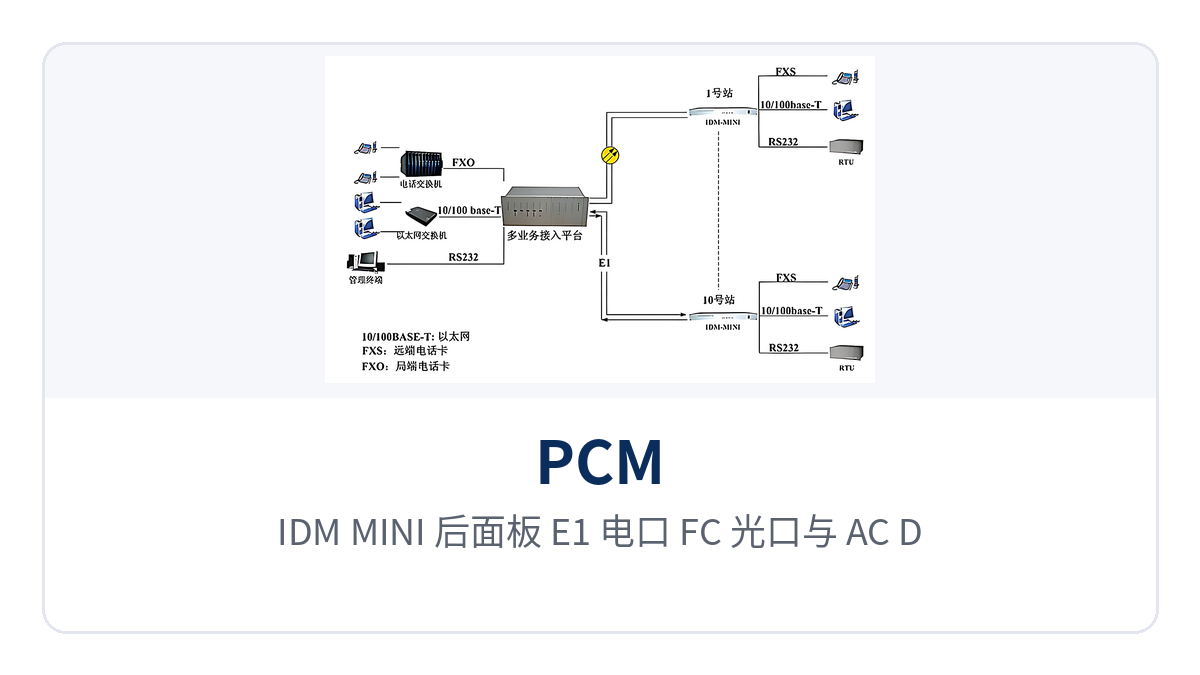
Figure 2: Close-up of the E1 electrical port, FC optical port and AC/DC power terminals on the IDM-MINI rear panel
Single-E1 optical port dual-channel PCM multiplexer technical specifications summary
The following are the complete technical specifications of the single-E1 optical port dual-channel PCM multiplexer IDM-MINI, sourced from the official IDM-MINI documentation.
Item | Parameter/Specification | Description/Applicable Conditions |
|---|---|---|
Optical port interface | FC (SC and others can be customized) | Single-mode, multi-mode optional |
Receive/transmit rate | 155M/155M | Symmetric bidirectional |
Receive/transmit wavelength | 1310nm/1550nm | Single-mode fiber |
Transmit optical power | -3~-11dBm | Optical port |
Receiver sensitivity | Better than -36dBm | Optical port |
Transmission distance | 20Km | Long-distance optical module optional for extension |
E1 bit rate | 2048Kbps | Line coding HDB3 |
E1 standard protocol | Supports ITU-T G.703 | Impedance 75Ω/120Ω |
E1 frame structure | PCM30/31 | Signaling: channel-associated signaling |
Ethernet transmission rate | N×2.048Mbps (N≤50) | 155M optical port channel |
Ethernet protocol | Supports IEEE802.3 | Full/half duplex/adaptive |
Power supply mode | AC220V / DC-48V | Dual power supply |
Overall power consumption | ≤50W | Either AC or DC |
Operating temperature | 0℃~40℃ | Relative humidity ≤90% (non-condensing) |
Dimensions | 495×307×47 (mm) | 1U high |
Typical Application Scenarios
One Unit Handles the End of Electric Power and Rail Transit Private Networks
With E1 + optical fiber dual channels and 8+1 channels of concurrent voice and data, the single-E1 optical port dual-channel PCM multiplexer handles the end of an electric power substation or a rail transit station with one unit. The intra-station dispatch telephone, monitoring data, and inter-station liaison each take one 64K channel, and are aggregated into one device and sent to the main station uniformly over a 155M optical port or an E1 trunk, eliminating the previous practice of deploying one transmission device and its corresponding fiber core for each type of service. As a professional optical multiplexer manufacturer, Raytrans has achieved efficient product showcase and integrated service access for its PCM products in electric power and rail transit private networks.
Long-Distance Reliable Transmission for Military and Government Private Networks
With 155M optical port 20Km single-mode transmission and receiver sensitivity better than -36dBm, the single-E1 optical port dual-channel PCM multiplexer is suitable for long-distance links in military and government private networks. It can still receive reliably under weak transmit margin conditions, and with AC220V/DC-48V dual power supply, important nodes are not affected by a single power supply interruption. The optical multiplexing equipment provided by Raytrans, together with its military emergency communications vehicle solution and government private network optical fiber communication solution, has been verified in multiple key projects.
Unattended Deployment for Oilfield and Mining Area Industrial Private Networks
With AC220V/DC-48V dual power supply and power consumption ≤50W, the single-E1 optical port dual-channel PCM multiplexer supports year-round online operation at unattended field sites in oilfields and mining areas. The site can be powered by a storage battery bank on DC, the optical and electrical dual channels leave sufficient redundancy for voice and data backhaul, and maintenance only requires routine inspection without on-site replacement of the power supply configuration. Raytrans' smart mining communication solution and integrated service access device provide stable and reliable PCM multiplexing product showcase for mining area industrial private networks.
FAQs
What is the working principle of Pulse Code Modulation (PCM)?
Working Principle Pulse Code Modulation is the process of converting a time-continuous…
View answerPCM30 Working Principle: What Is PCM30/32
PCM30 Equipment Working Principle The 30-channel PCM equipment refers to equipment that provides 30 user interfaces and…
View answerWhat are the common problems of PCM equipment in enterprise applications?
At present, PCM equipment has become basically ubiquitous in enterprise network applications.
View answerFrame Structure of 30/32-Channel PCM Primary Group
A communication system consists of transmitting equipment, receiving equipment, and transmission equipment.
View answer63E1 and STM-1
The process of multiplexing 2Mbit/s signals into STM-1 can be described as follows…
View answer