PCM
PCM
The IDM-30A Integrated Service Multiplexer adopts a 19-inch 1U standard chassis; provides 30 user interfaces as defined by the standard; rich 64K user interfaces, allowing arbitrary configuration of more than 20 types of interface cards; can be configured with n×64K V.35/V.11 or Ethernet user interfaces;
Overview:
The IDM-30A Integrated Service Multiplexer connects user terminal equipment or user terminal equipment to the public switched telephone network via 2M transmission media. By utilizing the 2M digital trunk interfaces or analog subscriber interfaces equipped on the central office switch, the IDM equipment extends voice and data services to various subscriber areas, serving as a substitute for remote small exchanges, enabling cross-boundary number assignment, and deferring the construction of switching offices.
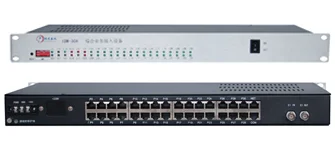
IDM-30A Integrated Service Multiplexer
Product Features:
- Adopts a 19-inch 1U standard chassis;
- Provides 30 user interfaces as defined by the standard;
- Rich 64K user interfaces, allowing arbitrary configuration of more than 20 types of interface cards;
- Can be configured with n×64K V.35/V.11 or Ethernet user interfaces;
- The front panel features comprehensive function control switches and alarm indication functions;
- Equipped with concise and comprehensive network management functions, enabling real-time online monitoring of the equipment.
Technical Specifications:
E1 Interface
Bit Rate | 2048Kbps | Line Code | HDB3 |
Standard Protocol | Supports ITU-T G.703 | Impedance | 75Ω/120Ω |
Frame Structure | PCM30/31 | Signaling | Channel Associated Signaling |
Ethernet
Interface Type | RJ-45 | Transmission Rate | n×64Kbps (n≤30) |
Standard Protocol | Supports IEEE802.3 | Operating Mode | Full/Half Duplex/Auto-negotiation |
FXO, FXS Interface
Audio Range | 300Hz~3400Hz | Compression Rate | A-law in ITU G.711 |
Impedance | Triple complex impedance 200Ω+560Ω//0.1μF | Loop Current | 25mA/channel |
EM2/4-Wire Interface
Audio Range | 300Hz~3400Hz | Impedance | Balanced 600Ω |
Compression Rate | A-law in ITU G.711 | Return Loss | Not less than 18dB |
V.24 Interface
Transmission Rate | Asynchronous ≤9600bps; Synchronous 64Kbps | Electrical Characteristics | Compliant with CCITT V.28 protocol |
V.35 Interface
Interface Type | RJ-45 | Electrical Characteristics | Compliant with ITU-T V.35 recommendation |
Transmission Rate | n×64Kbps (n=0~31) | Terminal Interface | Compliant with ISO2593 specification |
Power Supply and Consumption
Power Supply Mode | AC220V/DC-48V | Total Power Consumption | ≤50W |
Environmental Conditions
Operating Temperature | 0ºC~40ºC | Relative Humidity | ≤90% (non-condensing) |
Product Dimensions
Length × Depth × Height | 440×230×45(mm) |
Typical Applications:
- Dedicated line access for voice, data, and video surveillance in power, public security, finance, education, and other systems
- Broadband and narrowband integrated service access for residential communities/smart buildings
- Data network extension for telecom, CNC, and Unicom networks
FAQs
What is the working principle of Pulse Code Modulation (PCM)?
Working Principle Pulse Code Modulation is the process of converting a time-continuous…
View answerPCM30 Working Principle: What Is PCM30/32
PCM30 Equipment Working Principle The 30-channel PCM equipment refers to equipment that provides 30 user interfaces and…
View answerWhat are the common problems of PCM equipment in enterprise applications?
At present, PCM equipment has become basically ubiquitous in enterprise network applications.
View answerWhat is E1? How to Use E1
What is E1 The European 30-channel pulse code modulation PCM is abbreviated as E1, with a rate of 2.048Mbit/s.
View answerFrame Structure of 30/32-Channel PCM Primary Group
A communication system consists of transmitting equipment, receiving equipment, and transmission equipment.
View answer