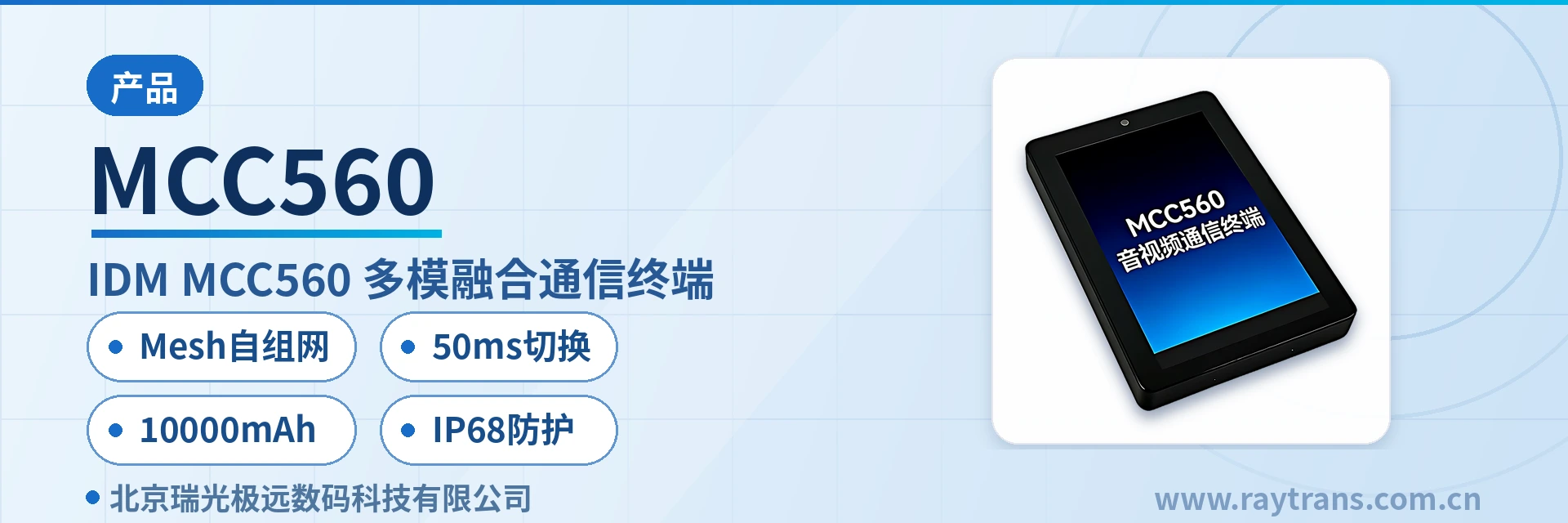
IDM MCC560 Multi-Mode Converged Communication Terminal
Mesh ad-hoc network audio and video intercommunication even with network outage and no server
The IDM MCC560 is a multi-mode converged communication terminal that supports 4G, WiFi, digital trunking intercom, LoRa, infrared and other links. It features Mesh ad-hoc network, AI-assisted operation, full-scenario audio and video dispatching, strong endurance and strong protection, and flexible expansion, making it suitable for emergency rescue, tactical command, electric power/oil/mining inspection, public security and border defense duty, engineering construction, smart industrial park and other scenarios.
IDM MCC560 multi-mode ad-hoc network converged communication terminal is a multi-mode converged communication terminal developed by Beijing Ruiguang Jiyuan Digital Technology Co., Ltd. It integrates multiple links such as 4G, WiFi, digital trunking intercom, LoRa, and infrared, together with Mesh ad-hoc network capabilities, into a single portable unit, and is used for group audio and video communication and on-site command and dispatch under conditions of no public network, no server, and weak signal. As an emergency communication terminal built for emergency communications scenarios, it can quickly set up on-site converged communication links under extreme conditions such as network outage, power failure, and road blockage, providing frontline rescue forces with stable and reliable voice, video, and data channels. It is also one of Raytrans's important terminal products in the field of converged communication command and dispatch systems. The unit features a portable design and can be carried by an individual soldier or deployed vehicle-mounted. It is suitable both for rapid response on the front line of emergency communications and as an end node in a military emergency communications vehicle solution, working in coordination with a vehicle-mounted converged dispatching platform to achieve real-time flow of command and dispatch information between the front and rear.
Key Specifications at a Glance: 4G/WiFi/digital trunking intercom/LoRa/infrared multi-link · Mesh ad-hoc network · automatic switchover between primary and backup links within 50ms · 10000mAh large-capacity battery · IP68 protection · high-brightness touchscreen visible in sunlight
What kind of device is a multi-mode ad-hoc network converged communication terminal?
The IDM MCC560 multi-mode ad-hoc network converged communication terminal is an emergency communication terminal that packs multiple communication links and command and dispatch capabilities into a single portable enclosure. It supports real-time transmission of voice, video, text, images, and data, and is suitable for operating scenarios with no public network, weak signal, or high confidentiality requirements. The unit uses a high-brightness touchscreen as its main operating interface, has a built-in 10000mAh large-capacity battery, and features IP68 protection and drop and shock resistance. It can be carried to sites such as emergency rescue, tactical command, and inspection duty, and after the device is powered on, a link can be selected as needed to establish communication, providing on-site a reliable product showcase-level converged communication experience.
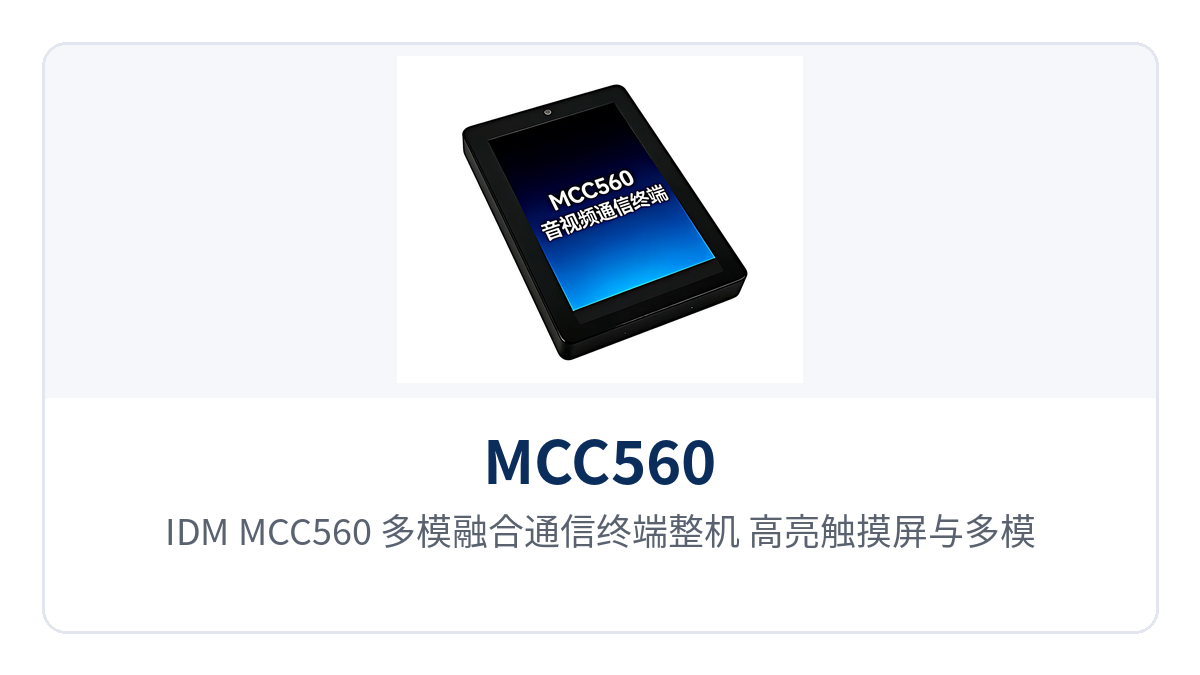
Figure 1: IDM MCC560 multi-mode converged communication terminal unit, high-brightness touchscreen and multi-mode communication antennas
Key Specifications
| Item | Parameter/Specification | Description/Applicable Conditions |
|---|---|---|
| Communication link | 4G, WiFi, digital trunking intercom, LoRa, infrared | Integrated in one unit, switchable on demand, no need to carry multiple devices |
| Ad-hoc network | Mesh ad-hoc network, centerless, server-free | Audio and video intercommunication is still possible in environments with no network and no server |
| Link switchover | Automatic switchover between primary and backup links within 50ms | Voice, video, and data services continue to run when a link is abnormal |
| Battery | Built-in 10000mAh large-capacity battery | Supports long-time outdoor and emergency site operations |
| Ingress protection (IP) rating | IP68 | Drop and shock resistance, adapts to harsh outdoor environments |
| Display and operation | High-brightness touchscreen, visible in sunlight | Screen reading and touch operation remain possible under strong on-site light |
| Expansion interface | mini PCIe, RJ45, Type-C | Can be expanded with 5G, satellite, SDR Mesh, and other modules |
| IoT interface | LoRa / NB-IoT interface | Supports sensor data acquisition and linked device control |
| Security and management | End-to-end (E2E) encryption, remote device management, log auditing | Ensures communication security and command continuity, with unified management of device status |
| Display layout | Split-screen display (map + video + data) | On-site visualized command, viewing situation and footage on one screen |
| Unit dimensions, weight, and price | not yet recorded in the knowledge base | subject to the manufacturer's technical documentation and commercial confirmation |
Which communication links can the converged communication terminal access?
The IDM MCC560 multi-mode ad-hoc network converged communication terminal concentrates public network, private network, ad-hoc network, and IoT links in one unit. On site, they can be switched or used in combination according to coverage conditions, avoiding communication interruption caused by the failure of a single link and providing diversified access assurance for emergency communications and converged dispatching.
| Communication link | Access capacity | Applicable conditions |
|---|---|---|
| 4G | Mobile public network voice, video, and data services | Areas with cellular network coverage, can serve as the primary link |
| WiFi | Wireless local area network (WLAN) access and temporary on-site networking | When a wireless access point is available on site or local interconnection is needed |
| Digital trunking intercom | Access to digital trunking intercom links, supports PDT trunking intercom | Interworking with existing trunking intercom systems, unified command |
| LoRa | Low power consumption wide area IoT link | Sensor data acquisition, low-speed long-distance backhaul |
| NB-IoT | Narrowband IoT link | Data reporting for meter and monitoring terminals |
| Infrared | Short-range infrared communication | Short-range remote control and data switching |
| Mesh ad-hoc network | Automatic formation of mesh links under centerless, server-free conditions | Sites such as tunnels, mountainous areas, and basements with no infrastructure and no public network |
| Expansion module | Expansion of 5G, satellite, SDR Mesh via mini PCIe, RJ45, Type-C | When public network is missing, cross-regional backhaul is needed, or networking capability must be temporarily enhanced |
What are the core functions?
| Function | Description |
|---|---|
| Multi-mode converged communication | Supports multiple links such as 4G, WiFi, digital trunking intercom, LoRa, and infrared, integrated in one unit and switchable on demand |
| Intelligent networking capability | Features Mesh ad-hoc network functionality, still enabling audio and video intercommunication in centerless, server-free environments |
| Multi-mode intelligent switching | Automatic switchover between primary and backup links within 50ms, ensuring continuous voice, video, and data communication |
| Centerless ad-hoc network communication | Automatically forms a mesh network in extreme environments with no network and no server, enabling group audio and video communication and data sharing |
| AI-assisted operation | Integrates speech recognition, speech synthesis, and AI video recognition, supports voice reporting, intelligent recording, and command control |
| Full-scenario audio and video dispatching | Supports point-to-point call, multi-party conferencing, instant messaging, and PDT trunking intercom, compatible with various dispatch systems |
| Strong endurance and strong protection | Built-in 10000mAh large-capacity battery, IP68 protection, and high-brightness touchscreen, adapting to harsh outdoor environments |
| Flexible expansion | Provides interfaces such as mini PCIe, RJ45, and Type-C, and can be expanded with 5G, satellite, SDR Mesh, and other modules |
| Open convergence | Can connect to various sensors, dispatch systems, and IoT devices, and be integrated with existing systems |
| Security and management | Supports end-to-end (E2E) encryption, automatic link switchover, remote device management, and log auditing |
| On-site operation assistance | Supports offline map, AI voice reporting, direct sensor connection, one-touch PTT emergency call, and split-screen display (map/video/data) |
| IoT linkage | Built-in LoRa/NB-IoT interface, supports sensor data acquisition and linked device control |
How does automatic switchover between primary and backup links within 50ms ensure uninterrupted communication?
Automatic switchover within 50ms means the terminal maintains both a primary and a backup link at the same time. When the quality of the primary link drops to unusable or the link is interrupted, services switch to the backup link within 50ms to continue transmission, and users usually do not perceive the link change during calls and video. The IDM MCC560 multi-mode ad-hoc network converged communication terminal can combine links such as 4G, WiFi, and digital trunking intercom into a primary-backup relationship. The switchover is performed automatically by the terminal without manual on-site reconnection. It is suitable for scenarios with high requirements for communication continuity, such as emergency rescue and tactical command, and also provides stable link assurance for the emergency communication terminal in a military emergency communications vehicle solution.
The 50ms switchover time specification is taken from the value marked in the product documentation; the actual link recovery effect is related to on-site signal conditions, service load, and the selected link combination. For specific projects, it is recommended to conduct on-site measurements or confirm the selection with the manufacturer.
How does a centerless ad-hoc network form a network?
A centerless ad-hoc network means terminals do not rely on a base station, server, or public network, but discover neighbors by themselves and form a mesh network. After the IDM MCC560 multi-mode ad-hoc network converged communication terminal is powered on, it automatically searches for same-frequency terminals and establishes mesh links. Any two terminals in the network can reach each other, and voice, video, and data are shared within the network; when a link is interrupted, services automatically reroute to other nodes, and the network has self-organizing and self-healing capabilities. No infrastructure needs to be deployed in advance on site, and group audio and video communication can be enabled as soon as the terminals are in place. It is suitable for environments with no public network coverage such as basements, mountainous areas, tunnels, and the field, and together with ad-hoc network communication terminals it can quickly build the underlying links of emergency communications and converged communication command and dispatch systems.
How are the core pain points of customers in different industries solved?
| Customer type | Core pain point | IDM MCC560 solution |
|---|---|---|
| Electric power/oil/mining inspection | No signal in remote areas, inspection data cannot be transmitted back in real time; device status relies on manual recording | Supports offline map, ad-hoc network communication, AI voice reporting, and direct sensor connection, enabling inspection in uninhabited areas and automatic data acquisition, meeting the needs of smart mining communication solutions |
| Emergency rescue and firefighting | Chaotic on-site communication, multiple systems cannot interoperate; command and dispatch lack visualized support | Multi-mode convergence, one-touch PTT emergency call, split-screen display (map + video + data), supports multi-party conferencing and real-time video backhaul |
| Public security and border defense duty | High communication confidentiality requirements; audio and video prone to interruption in mobile environments; devices difficult to manage uniformly | Supports end-to-end (E2E) encryption, automatic link switchover, remote device management, and log auditing, ensuring communication security and command continuity |
| Engineering construction and field operations | Scattered teams, low communication efficiency; numerous devices inconvenient to carry; harsh environments easily damage equipment | Multiple communication modes integrated in one unit, supports group intercom, offline voice commands, and IP68 protection, adapting to environments with sand and dust, rain, and more |
| Smart industrial park and Industrial IoT | Inconsistent communication protocols among IoT devices, difficult to access and manage uniformly | Built-in LoRa/NB-IoT interface, supports sensor data acquisition and linked device control, achieving integrated "communication + monitoring" |
Raytrans has long been deeply engaged in the fields of emergency communications and converged dispatching, continuously refining products around scenarios such as military emergency communications vehicle solutions and smart mining communication solutions. The converged communication command and dispatch systems and ad-hoc network communication terminals represented by the IDM MCC560 are providing reliable converged dispatching and command and dispatch capabilities to an increasing number of industry customers.
Typical Application Scenarios
Electric power, oil, and mining inspection
Uninhabited areas, long-distance pipelines, and mining areas often have no available public network coverage. The IDM MCC560 multi-mode ad-hoc network converged communication terminal enables inspection teams to automatically form a mesh network under server-free conditions, keeping group voice and video communication among teams, with inspection tracks viewable together with offline maps; the built-in LoRa/NB-IoT interface can directly connect to on-site sensors, collecting and transmitting device status data from nearby, and AI voice reporting allows inspection personnel to record defects and device status by voice, reducing manual recording steps. This emergency communication terminal is equally suitable for smart mining communication solutions, ensuring stable backhaul of inspection data and voice in the complex environment of mining areas.
Emergency rescue and firefighting
Disaster sites often have neither a public network nor a fixed power source, and multiple teams use different communication systems, making on-site information difficult to aggregate. The IDM MCC560 multi-mode ad-hoc network converged communication terminal uses multi-mode convergence to bring links such as 4G, WiFi, and digital trunking intercom into unified command. One-touch PTT emergency call can quickly summon on-site forces, and split-screen display puts the map, video, and data on the same screen, making it easier for commanders to grasp the situation in sync; the 10000mAh large-capacity battery and IP68 protection support long-time outdoor operations, and automatic switchover between primary and backup links within 50ms prevents call interruption at critical moments. With the cooperation of emergency communications and converged communication command and dispatch systems, multiple on-site forces can achieve unified command and dispatch and converged dispatching.
Public security and border defense duty
Mobile duty scenarios have high requirements for communication confidentiality and device management. The IDM MCC560 multi-mode ad-hoc network converged communication terminal supports end-to-end (E2E) encryption, and works with primary and backup link automatic switchover to keep audio and video continuous. Remote device management and log auditing let the command center keep track of terminal presence and usage records. In border and forest area sections without public network coverage, it can switch to a Mesh ad-hoc network to form intra-team communication, or introduce links such as 5G, satellite, and SDR Mesh through expansion modules to fill coverage gaps. As an ad-hoc network communication terminal, it can also be incorporated into a military emergency communications vehicle solution, providing reliable emergency communications assurance and product showcase capabilities for border defense duty.
How to select and deploy an emergency communication terminal?
During selection, first check whether there is an available network on site: in areas with 4G coverage, use 4G as the primary link and WiFi for nearby interconnection; in areas without public network coverage, use a Mesh ad-hoc network as the primary option, and for cross-regional backhaul, expand with satellite or 5G modules through interfaces such as mini PCIe. Then look at the existing system: when digital trunking intercom, sensors, or a dispatch system are already on site, connect them according to the corresponding interfaces and protocols to avoid duplicate construction. Finally, look at the operating intensity: for long-time outdoor operations, confirm battery capacity and ingress protection (IP) rating first. The IDM MCC560 multi-mode ad-hoc network converged communication terminal has a built-in 10000mAh battery, and features IP68 protection and a high-brightness touchscreen.
During deployment, enable the required links in sequence and set their primary/backup relationship, and check whether automatic switchover within 50ms takes effect; configure AI speech recognition, voice reporting, and offline map functions according to the on-site language and business habits, and confirm policies for end-to-end (E2E) encryption, remote device management, and log auditing with the management department before enabling. If access to a converged communication command and dispatch system is required, the converged dispatching capabilities of Raytrans can be combined to incorporate voice, video, and data into the command and dispatch process in a unified manner.
The overall dimensions, weight, and price of the IDM MCC560 multi-mode ad-hoc network converged communication terminal are not yet recorded in the knowledge base. Please refer to the manufacturer's technical documentation and commercial confirmation.
Overall, the IDM MCC560 multi-mode ad-hoc network converged communication terminal uses multi-mode links, a centerless Mesh ad-hoc network, automatic switchover between primary and backup links within 50ms, a 10000mAh battery, and IP68 protection to solve voice, video, and data communication problems in sites without public network coverage or with weak signals. It is suitable for scenarios such as emergency rescue and firefighting, public security and border defense duty, electric power, oil, and mining inspection, and engineering construction and field operations, and can also serve as a selection reference for emergency communication terminals and ad-hoc network communication terminals in military emergency communications vehicle solutions and smart mining communication solutions.