IDM WiCall Wireless Telephone
SIP telephone, intercom, and broadcast 3-in-1; number follows the person, no number change on shift change; one-touch emergency alarm
The IDM WiCall SIP telephone broadcast intercom wireless telephone is an internal telephone terminal for enterprises or administrative units. In areas covered by WiFi or the Internet, it can make internal telephone calls and also serves as a group intercom communication tool for communication anytime and anywhere. Together with a dedicated enterprise SIP telephone dispatching exchange, it provides an efficient means of rapid internal communication for enterprises. It can also be used with a broadcast dispatch console; together with a broadcast dispatching exchange, it supports unicast, multicast, and broadcast, as well as real-time announcements, scheduled announcements, time-triggered announcements, and hourly time signals, and enables functions such as one-touch emergency alarm.
The IDM WiCall SIP telephone broadcast intercom wireless telephone is an enterprise-grade wireless IP access terminal developed by Beijing Ruiguang Jiyuan Digital Technology Co., Ltd. (Raytrans). It combines a SIP telephone, a group intercom terminal, and a broadcast receiving terminal in a single device, making it a typical multi-function smart telephone terminal. Within areas covered by WiFi or the Internet, the terminal handles internal calls, and once registered to the enterprise SIP telephone dispatching exchange, it can make point-to-point calls, initiate emergency calls, and receive broadcasts.
For factories and administrative institutions, one terminal serves both as an internal telephone and a mobile intercom, so temporary positions and patrol areas no longer need separate cabling. When duty personnel move around inside a building, their numbers stay unchanged and calls are not interrupted, so inspection and coordination no longer require returning to the workstation to dial again. As a terminal that combines a SIP intercom and a WiFi wireless telephone, it can also connect to the dispatching platform provided by a command and dispatch system manufacturer, and work with a government private network optical fiber communication solution to achieve unified communications and emergency linkage within the private network.
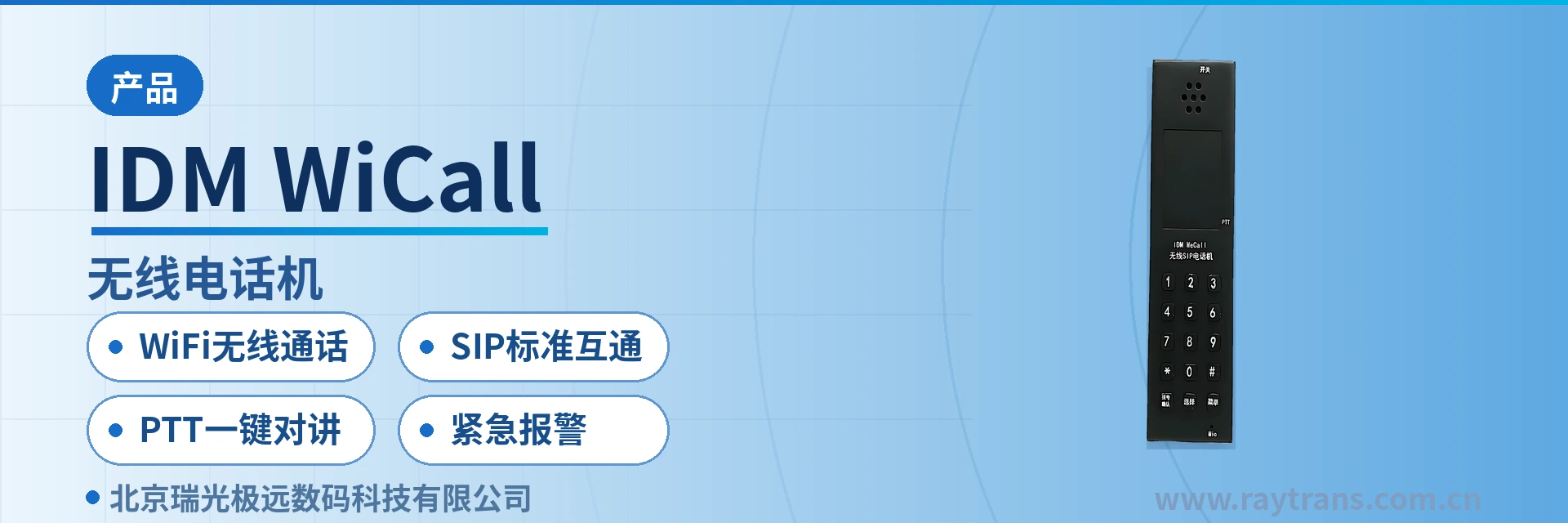
Key Specifications at a Glance: WiFi wireless calling · SIP standard intercommunication · PTT one-touch intercom · emergency alarm · full-duplex conference room intercom · 2.0-inch image and text display
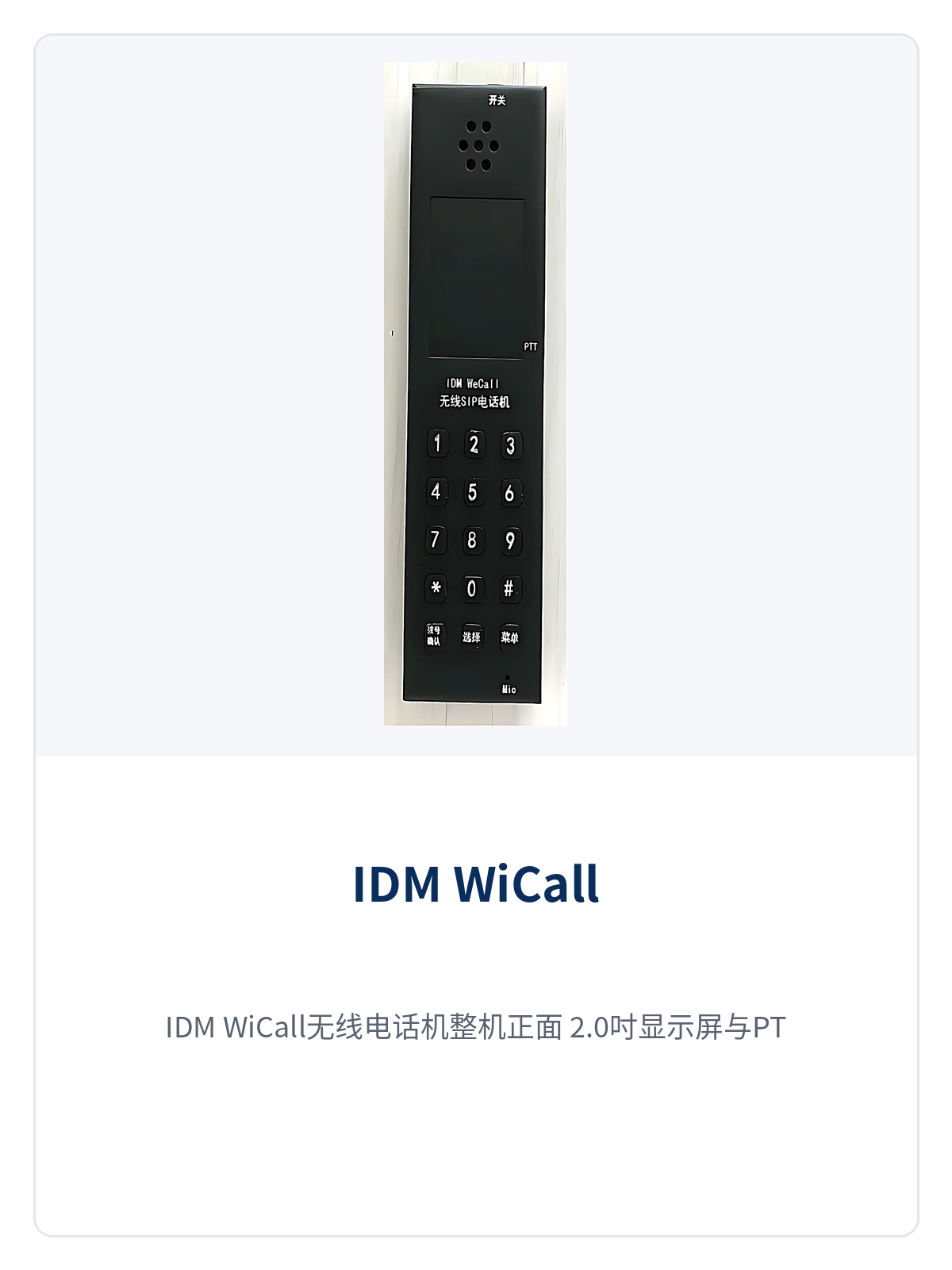
Figure 1: Close-up of the 2.0-inch display screen and PTT intercom button on the front of the IDM WiCall wireless telephone
What networks does the SIP telephone broadcast intercom wireless telephone rely on?
The call capability of the IDM WiCall is built on two networks: the on-site WiFi wireless network connects the IP access terminal, and the SIP protocol delivers voice to the opposite end. As long as the area has WiFi coverage or an Internet outlet, the terminal can register to the enterprise SIP telephone dispatching exchange and talk to any extension; branch offices across regions that register to the same platform can still dial each other's internal numbers as usual, without building a separate dedicated line for long-distance calls.
As a WiFi wireless telephone, this smart telephone terminal does not occupy a fixed information point, so mobile positions can carry it wherever they go. Calls in conference rooms, warehouses, and along inspection routes are all made with the same telephone; the number follows the person rather than the workstation, and when personnel change posts, the central side only needs to reconfigure the extension.
SIP is the session initiation protocol defined by IETF RFC 3261. It negotiates media between the two calling parties and establishes and tears down sessions, while voice encoding and real-time transport are handled by RTP. The protocol itself only specifies the signaling flow and the media negotiation method, not the terminal form, so the same SIP platform can accommodate desktop SIP telephones, wireless terminals, and broadcast equipment at the same time.
Enterprise SIP telephone dispatching exchanges, SIP broadcast, SIP apps, and webRTC terminals can dial and communicate with each other as long as they follow the same SIP signaling; the terminal side only needs registration, authentication, and number provisioning. In daily duty, the same terminal is both an internal SIP telephone and a SIP intercom and broadcast receiving terminal that can speak at any time, so cross-system communication no longer needs to go through a transfer console.
On-site deployment focuses on the central side; the terminal side is basically register-and-use after being issued. Following the sequence below, calls and broadcasts can be connected in one pass, without laying separate telephone lines for mobile positions. The six tasks are arranged in implementation order, with central-side configuration and wireless coverage advanced in parallel, to avoid rework when terminals arrive first and the platform is built later:
- Confirm on the central side that an enterprise SIP telephone dispatching exchange already exists, and allocate a separate number range and call permissions for wireless terminals;
- Check AP site layout according to the coverage area; offices, workshops, station buildings, and corridors must all have stable signals, and terminals are issued only after edge areas are supplemented;
- Pre-provision extension numbers, group numbers, and broadcast zones on the central side, so that after registration and going online, the terminal can make one-to-one calls and PTT group intercom;
- Where announcements are needed, add a broadcast dispatch console, and set real-time announcements, scheduled announcements, time-triggered announcements, and hourly time signals by zone;
- Enable outside line permissions for positions that need outside line services, while keeping internal calls in a dispatchable state, so that dispatchers can perform barge-in, monitoring, and transfer;
- Before going online, use one terminal for commissioning of calls, broadcasts, and emergency alarms, and confirm that the central-end response order and call handling policies meet on-site requirements.
What call and dispatch functions can one wireless telephone provide?
The functions of the IDM WiCall cover calls, intercom, dispatch, broadcast, and information display, listed one by one in the table below for selection according to job requirements. Each item in the table requires cooperation from the central-side platform; the terminal itself handles voice capture, key operations, and information presentation, and no additional software needs to be loaded on the terminal.
| Function | Description |
|---|---|
| One-to-one voice call | Establishes a point-to-point full-duplex call with a specified extension or number; go off-hook and dial to use |
| Full-duplex conference room intercom | Dials into an audio conference to join a call where multiple parties speak simultaneously; suitable for pre-shift meetings, shift handover, and multi-position coordinated handling |
| PTT one-touch intercom | Press to speak, release to listen; sends voice to group members in a pre-defined group, with usage habits close to an intercom but without occupying a frequency |
| SIP standard intercommunication | Intercommunicates with SIP telephones, SIP broadcast, and SIP apps, and can also exchange voice with surveillance cameras and webRTC terminals |
| Cross-region internal calls | Registers to the same platform anywhere with WiFi or Internet access; remote branches share the extension number range |
| Ordinary calls and emergency calls | Can send ordinary calls and emergency calls; the central end handles ordinary dial-in and emergency dial-in separately and arranges the response order by priority |
| Dispatch operations | Internal calls remain in a dispatchable state; dispatchers can perform forced release, barge-in, monitoring, transfer, and hold on the terminal |
| Outside line transfer | Can transfer to or dial out to outside lines; internal call handling and external incoming calls share the same number resources |
| Broadcast reception and announcement | Works with the broadcast dispatch console to achieve unicast, multicast, and broadcast, as well as real-time announcements, scheduled announcements, time-triggered announcements, and hourly time signals |
| One-touch emergency alarm | One touch triggers an emergency alarm call and reports to the duty console, which the central end handles according to the pre-defined plan |
| 2.0-inch information display | The display screen can show image and text information for numbers, notifications, and terminal status prompts |
The difference between intercom and telephone lies in how a call is initiated: one-to-one calls and full-duplex conference room intercom are dialed by number and are suitable for sitting down and explaining a matter clearly; PTT key intercom is initiated by group, press to speak and release to listen, and is suitable for dispatching while on the move. Both methods coexist on the same smart telephone terminal, so teams no longer need to switch between a telephone and a SIP intercom, and the cost of initiating on-site communication is reduced accordingly.
What are the on-site effects of the three differentiated capabilities?
Three differentiated capabilities determine what sites this terminal suits: call on coverage, SIP standard intercommunication, and dispatch priority with emergency calls. The table below maps each capability to its on-site effect line by line, so that selection can be compared directly against on-site conditions, avoiding looking only at parameters without considering usage.
| Differentiation Point | On-site Value |
|---|---|
| WiFi wireless calling: call within the coverage area | When the plant, office building, and station building already have WiFi coverage, the terminal can make calls once registered and online, without laying separate telephone lines for telephones or reserving information points for mobile positions |
| SIP standard intercommunication: one protocol connects to multiple types of systems | New or existing SIP telephone dispatching exchanges, SIP broadcast, and SIP apps can all interconnect directly, and surveillance cameras and webRTC terminals can also exchange voice, without separate networking for each type of terminal |
| Dispatch priority response: ordinary dial-in and emergency dial-in queue separately | The central end arranges the response order by priority, emergency dial-in is handled before ordinary dial-in, and dispatchers can perform forced release, barge-in, monitoring, and transfer |
| Emergency alarm: one touch direct to the duty console | On-site personnel press one key to send an emergency alarm call; the duty console handles it according to the pre-defined plan and can maintain a call with the site |
The no-cabling advantage is especially evident in upgrade projects: information points in old factory buildings and existing office buildings are often insufficient, and re-chasing walls after renovation is costly; areas with adequate WiFi coverage can simply be issued terminals and go online. Branch offices across regions also do not need to build their own switching equipment; after registering to the same dispatching platform, numbers can be dialed mutually and broadcasts played simultaneously, and the management scope converges to one central location.
What are the key specifications and configuration details?
The product documentation of the IDM WiCall focuses on protocol form, service capabilities, and display mode; the overall power supply, endurance, and ingress protection (IP) rating are not given in the documentation. The table below lists verifiable items line by line; missing items are uniformly handled by confirming with the manufacturer before ordering, without estimating by industry convention or substituting specifications of other terminals from the same manufacturer.
| Item | Parameter/Specification | Description/Applicable Conditions |
|---|---|---|
| Communication protocol | SIP (IETF RFC 3261) | Used after registration to the enterprise SIP telephone dispatching exchange or IP PBX; intercommunicates with SIP telephones, SIP broadcast, and SIP apps |
| Access mode | WiFi wireless access, cross-region communication via the Internet | The site needs available WiFi coverage or an Internet outlet; for edge coverage areas, the AP supplementation plan confirmed by the manufacturer shall prevail |
| Call forms | One-to-one call, full-duplex conference room intercom, PTT group intercom | Groups and conference rooms are configured by the central dispatching exchange; the terminal joins by pre-defined group number |
| Dispatch capability | Forced release, barge-in, monitoring, transfer, hold; ordinary calls and emergency calls | The central dispatching exchange must support the corresponding services; numbers and permissions are set according to the enterprise call handling plan |
| Broadcast capability | Unicast, multicast, broadcast; real-time announcements, scheduled announcements, time-triggered announcements, hourly time signals | Must be used with the broadcast dispatch console; announcement periods and zones are set on the broadcast dispatch console side |
| Voice intercommunication objects | SIP telephones, SIP broadcast, SIP apps, surveillance cameras, webRTC terminals | The opposite end must support SIP or webRTC access; the protocol version is confirmed during commissioning |
| Display | 2.0-inch display screen, can show image and text information | Used for numbers, notifications, and terminal status prompts; display content is delivered from the central side |
| Power supply and endurance | Subject to the product documentation supplied with the unit | For installation position, power supply conditions, and charging method, please confirm with the manufacturer before ordering |
| Protection and operating environment | Subject to the product documentation supplied with the unit | For outdoor, dusty, or high/low-temperature sites, please confirm the applicable model and installation method with the manufacturer |
Before ordering, it is recommended to confirm three things with the manufacturer: the on-site WiFi coverage and AP supplementation plan, the terminal power supply and charging method, and the interfacing version with the existing SIP telephone dispatching exchange and broadcast dispatch console. Once these three are confirmed, the number of terminals is divided by position and patrol area, and broadcast zones and call permissions are configured on the central side at the same time, so no rework adjustments are needed when going online.
Typical Application Scenarios
The three types of sites have different requirements for wireless calling, but share the same IP access terminal and central platform: plants value mobile positions being reachable at any time, energy and petrochemical plant stations value dispatch permissions and emergency calls, and administrative institutions value unified numbers across floors and regions.
Industrial Parks and Plants
Plants are large, with workshops and warehouses scattered around, and teams must be reachable beside equipment, in loading areas, and along inspection routes. Internal telephones in office buildings often reach only workstations, temporary positions in workshops have no information points, and contacting by mobile phone mixes production communication into personal numbers. After IDM WiCall terminals are issued in plants with adequate WiFi coverage, teams can dial each other's extensions once registered and online, patrol personnel use the PTT key for group announcements, and loading dispatch and equipment emergency repair no longer require running back and forth to the office to relay messages.
Upgrade projects care more about construction workload: re-chasing walls and cabling in old factory buildings takes a long time and affects production; the WiFi wireless telephone eliminates cables and information points, and the go-online pace follows AP site layout. When the plant network has a local failure, the terminal can still make calls after moving to an area with signal, and the dispatch console handles dial-in by priority, so production command is not interrupted by a single network outage.
Energy, Electric Power, and Petrochemical Plant Stations
Call requirements at electric power and petrochemical sites focus on two things: instructions must reach the duty room directly, and emergencies need a channel that does not queue. After IDM WiCall terminals are issued to on-site duty personnel, inspection, switching operations, and maintenance coordination all use internal calls; dispatchers can monitor key positions, use barge-in on an ongoing call to issue instructions, and can also perform forced release on an unanswered terminal and call again.
Emergency alarms are a rigid requirement at such sites: when a leak, odor, or equipment abnormality is found, on-site personnel trigger an emergency alarm with one touch, the duty console responds first by priority, and can maintain a call with the site to understand the situation. SIP standard intercommunication lets the smart telephone terminal connect to existing telephone and broadcast systems; on-site announcements, zone notifications, and hourly time signals are all pushed uniformly by the broadcast dispatch console, without building another broadcast channel for wireless terminals.
Administrative Institutions and Emergency Command
Office areas in government agencies and public institutions often span multiple floors and buildings. Window-service job roles and duty rooms need to call each other frequently, while ad-hoc meetings and hall guidance require public address (PA). After IDM WiCall registers with the organization's existing telephone dispatching platform over SIP, internal extensions and outside lines share the same number resources. The front desk can transfer incoming calls to any on-duty staff member, and the duty leader can receive calls anywhere in the city.
Emergency command scenarios value networking speed. As long as usable WiFi or Internet access is available among a temporary command post, an on-site response point and a rear duty room, terminals can register and go online to make calls. The commander issues instructions to groups using PTT, and the broadcast console simultaneously makes announcements to each zone. Cross-region collaboration no longer requires applying for a dedicated line. Once remote units register with the same platform, they can dial each other's numbers, and the command system can be quickly deployed as conditions on site change.
Conclusion
From plant work teams to on-site duty and further to organizational duty rooms, the IDM WiCall SIP telephone broadcast intercom wireless telephone puts internal calls, group intercom and broadcast reception into the same terminal. It completes communication over on-site WiFi and the SIP protocol, so mobile job roles no longer have to wait for cabling. During selection, check coverage conditions, central platform interconnection capability and dispatch permissions, and you can determine whether this SIP telephone matches the on-site duty mode.
For integrators, the value of IDM WiCall lies in its simple access mode: cabled-free SIP/WiFi terminals register with the existing dispatch and broadcast system to form a network, and capacity expansion follows the APs. For industry customers, plant WiFi coverage enables cross-region calls, emergency calls reach the dispatch console with one touch, and calls, intercom and announcements no longer need to be purchased as three separate sets of equipment.