IDM Wetalk SIP Telephone Broadcast Intercom Badge
Badge as Extension, No Frequency Points, No 4G Fees, One-Key SOS, Dispatch Barge-In
The IDM Wetalk SIP Telephone Broadcast Intercom Badge is a wearable internal telephone terminal for enterprises or administrative units. It serves both as an identification tool for face-to-face interaction and as a group intercom communication tool for communication anytime and anywhere. As an internal telephone carried by employees, it works with a dedicated enterprise SIP telephone dispatching exchange to provide an efficient means of rapid internal communication. It can also be used with a broadcast dispatch console and a broadcast dispatching exchange to achieve unicast, multicast, and broadcast, as well as real-time announcements, scheduled announcements, time-triggered announcements, and hourly time signals, and to enable one-key emergency alarms and other functions.
The IDM Wetalk SIP telephone broadcast intercom badge is a wearable internal telephone terminal developed by Beijing Ruiguang Jiyuan Digital Technology Co., Ltd. (Raytrans). It combines an employee ID badge and a SIP telephone in one device for sites such as hotels, nursing homes, and security duty posts that require instant calls. As a portable IP access terminal, the SIP telephone broadcast intercom badge registers with an enterprise SIP telephone dispatching exchange to support point-to-point calls, group intercom, and broadcast reception, so employees on duty no longer need to pull out a mobile phone and look for signal. This smart telephone terminal can also interconnect with trunking intercom and command and dispatch system manufacturer platforms, making it suitable for a variety of on-site communication scenarios.
Key Specifications at a Glance: 3000mAh battery with over 10 hours of endurance · 1.3-inch high-brightness LCD · 4 capacitive touch keys + 3 physical keys · electret microphone + 8 Ω 3 W cavity speaker · serial port and digital I/O interface · embedded CPU with no general-purpose operating system
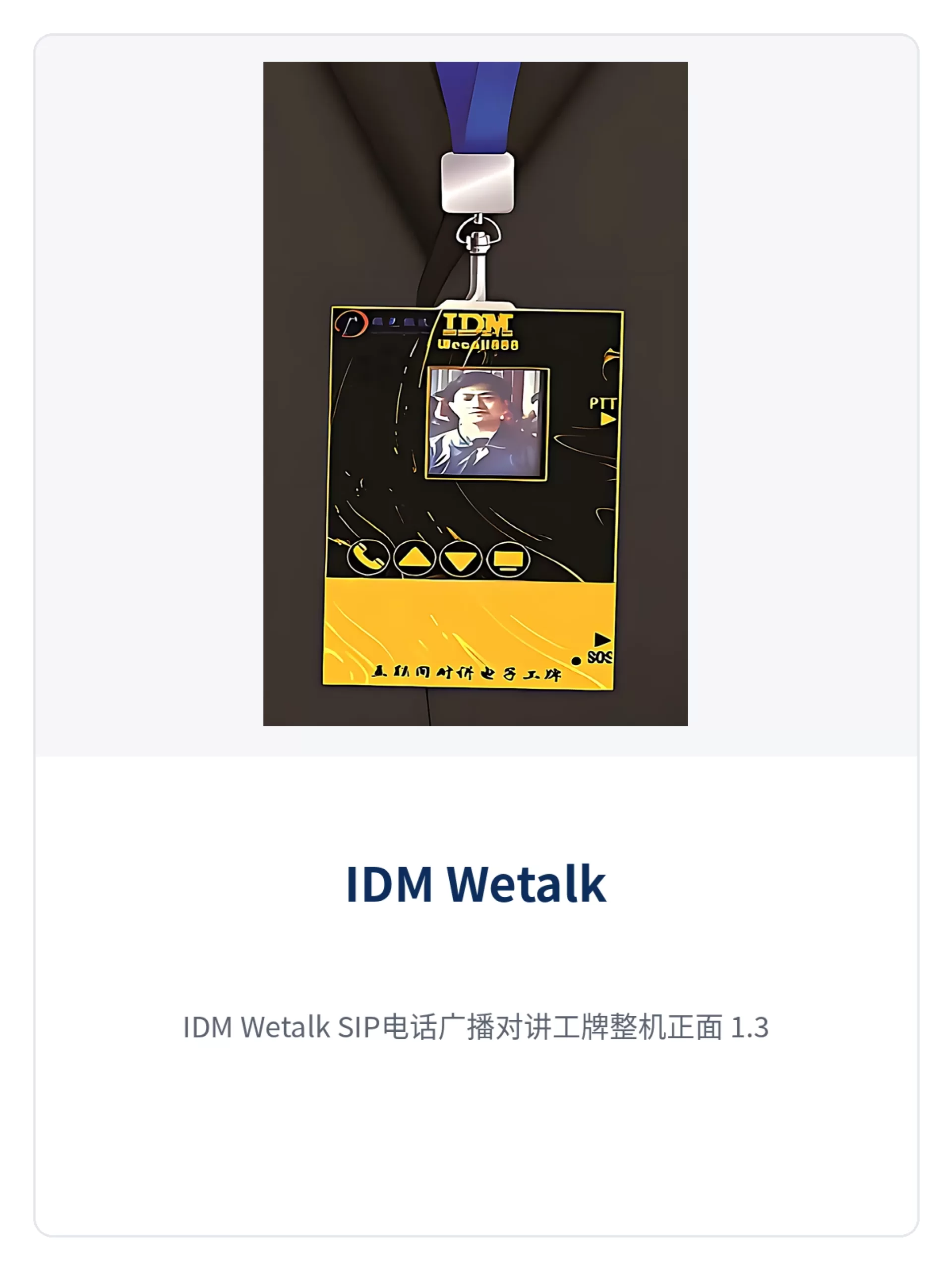
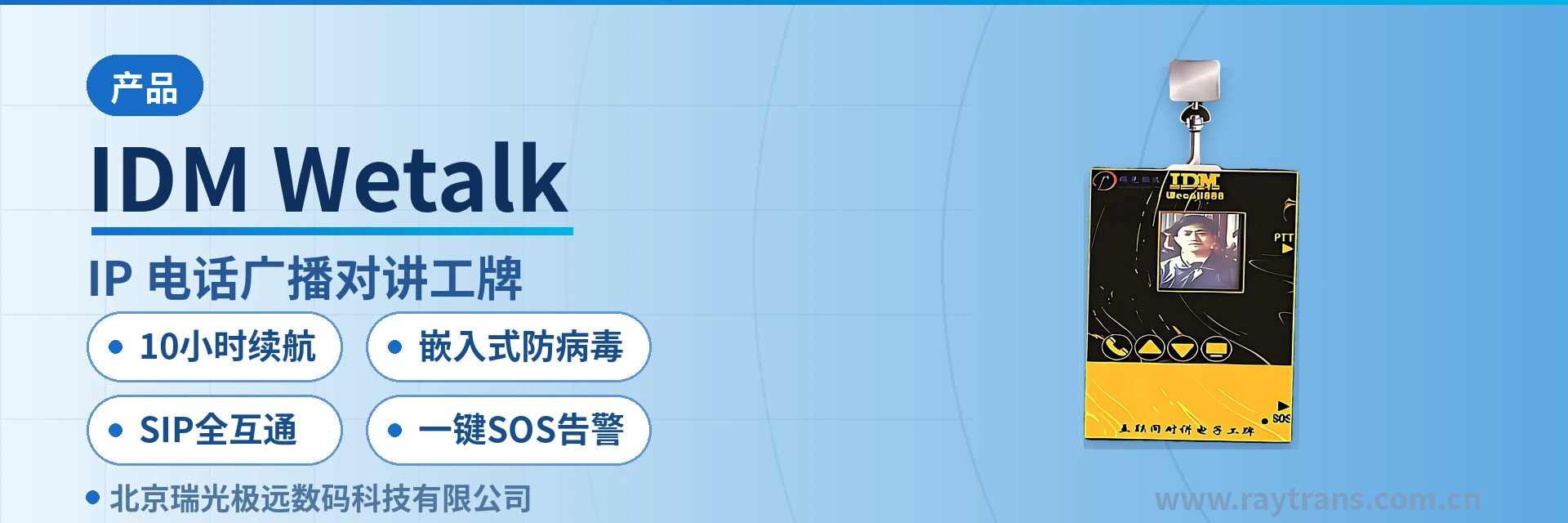
Figure 1: Front view of the IDM Wetalk SIP telephone broadcast intercom badge, with the 1.3-inch screen showing photo and name, the four touch keys, and a close-up of the side PTT and SOS keys
What Kind of Device Is the SIP Telephone Broadcast Intercom Badge?
The SIP telephone broadcast intercom badge is a SIP telephone terminal worn on the chest or clipped to clothing. Its screen shows the employee's photo and name, and it is also an internal telephone that can make and receive calls. As a typical IP access terminal, it integrates identity recognition and call capability in a single device. The 1.3-inch high-brightness LCD can alternately display the portrait photo, name, and QR code; colleagues and visitors can scan the on-screen QR code to read the identity information corresponding to the large-display badge, so face-to-face identification and badge calls are completed on the same screen.
The enclosure uses a multi-chamber design to reduce audio coupling and improve audio specifications, and it offers shock resistance. The front and rear panels of the enclosure can be customized with printed content according to user requirements; the overlay is color-printed and can be replaced with a printer. Wearing options include a lanyard and a clip, so duty managers, room attendants, and caregivers can choose according to their job role habits.
What Call and Dispatch Functions Does One Badge Provide?
The functions of this SIP telephone broadcast intercom badge fall into four groups: calls, dispatch, broadcasting, and interfaces. The function items below are listed one by one according to the capabilities of the terminal itself, making it easy for hotels, nursing homes, and security units to check them against on-site requirements without purchasing a separate device for each function.
Function | Description |
|---|---|
One-to-one voice call | After a number is preset, pressing the call key establishes a full-duplex call with the designated extension; during the call, the user can transfer the call or dial an outside line |
Group PTT intercom | After entering a preset communication group, press the side PTT key to speak and release it to listen, consistent with trunking intercom habits but without the need for frequency channels |
Full-duplex conference room intercom | Dial into an audio conference room to join a multi-party call, suitable for pre-shift meetings, shift handover, and coordinated handling across multiple job roles |
SOS one-touch alarm | Press the side SOS key to trigger an audible and visual alarm and dial the preset SOS number, with the light flashing in SOS Morse code |
SIP terminal intercommunication | Intercommunicates with SIP telephones, SIP PA systems, and SIP apps, and can also exchange voice with surveillance cameras and webRTC terminals |
Dispatch operations | The internal telephone is in a dispatchable state, and the dispatcher can perform forced release, barge-in, monitoring, transfer, and hold |
Broadcast reception and announcement | Works with the broadcast dispatch console to receive unicast, multicast, and broadcast, as well as real-time announcements, scheduled announcements, and hourly time signals |
SMS and status display | Receives text short messages delivered by the dispatch console and displays incoming and outgoing numbers, terminal status, and network configuration information |
IoT signal access | Serial port and on/off signal input and output can connect alarm buttons, access control, and sensors, and Bluetooth wristband information access is also supported |
Voice interaction | Voice chat and IoT control are implemented through the server, and a large language model can be connected for question-and-answer interaction |
What Are the Key Specifications and Interfaces?
The technical specifications are grouped into six categories: processor and system, endurance, display, audio, keys, and IoT interfaces. The table below lists verifiable specifications and their applicable conditions, so selection and quotation as well as acceptance on delivery can be checked line by line without consulting a paper manual.
Item | Parameter/Specification | Description/Applicable Conditions |
|---|---|---|
Processor and system | Embedded CPU handles protocols; does not run Windows, Android, Linux or HarmonyOS | Reduces the possibility of virus and malware infection, suitable for long-term online operation on the intranet |
Battery and endurance | 3000mAh, Type-C charging, more than 10 hours of communication | Covers a full shift; when the battery is low, the indicator LED flashes, accelerating from slow to fast until steady on |
Display | 1.3-inch high-brightness LCD display screen | Alternately displays photo, name, QR code and terminal status information |
Audio | Electret high-sensitivity microphone, 8-ohm 3W cavity speaker | When a headset is plugged into the Type-C port, the system automatically stops speaker output; the headset cable runs along the lanyard to the shoulder |
Keys | 4 capacitive touch keys + 3 physical keys | Touch keys are call, up, down and display; physical keys are power, PTT and SOS, placed in separate zones to reduce accidental touches |
Wireless access | WIFI access, coverage provided by enterprise APs | When coverage is insufficient, a phone hotspot or portable 4G router can fill the gap |
Serial port and on/off signal interface | Serial port and on/off signal input and output | Adapts to special interface requirements of unattended sites; alarm and access control signals can be connected directly |
Bluetooth interface | Bluetooth information access | Can collect information from peripherals such as wristbands for auxiliary management of personnel status |
Wearing and structure | Lanyard or pin fixing, multi-chamber enclosure | Multi-chamber design reduces audio coupling; the enclosure is shock-resistant |
Configuration method | Scan the QR code on the screen with a phone to log in to the configuration page | Preset extension number, group number, common APs and access password |
Communication and cost | SIP protocol registration, relying on enterprise WIFI and the Internet | No 4G usage fee for the badge, and no frequency filing or frequency fee required |
Four capability labels: 10-hour endurance, embedded antivirus, full SIP intercommunication, one-key SOS alarm
The four capability labels correspond to four types of demands that recur in hotels, elderly care and security sites: no power loss within a shift, a terminal that is hard to compromise with viruses, whether existing telephone and PA systems can be directly connected, and whether an elderly person or duty officer can reach someone with one press. These four are not slogans; each one can be matched to a corresponding specification and usage in the parameter table below and the scenarios that follow.
10-hour endurance: the 3000mAh battery supports more than 10 hours of communication under normal intercom use; the Type-C charging port is compatible with phone charging cables, so topping up at the end of a shift is enough.
Full SIP intercommunication: the SIP protocol enables intercommunication with SIP telephones, SIP PA systems, SIP apps and surveillance cameras, with free communication even across the Internet; it works once connected to an existing SIP softswitch environment.
Embedded antivirus: protocols are handled by the embedded CPU, with no general-purpose systems such as Windows, Android, Linux or HarmonyOS installed, reducing the possibility of virus infection.
One-key SOS alarm: pressing the SOS key on the side triggers a visual and audible alarm and dials the preset number; the light flashes in SOS Morse code so that companions and the duty room can notice at the same time.
How does the SIP telephone broadcast intercom badge work with the dispatching exchange and the PA console?
The badge itself is an endpoint device: call capability is provided by the central SIP telephone dispatching exchange and the enterprise WIFI network, and broadcast capability by the PA console. The three are connected over the SIP protocol, so there is no need to build a separate system for the badge. Before deployment, confirm that a usable SIP dispatching exchange or PA console already exists on the central side, then allocate badges according to the number of job roles.
Connecting to the dispatching exchange: after the extension number and group number are preset, the badge registers and goes online, and can make ordinary calls and emergency calls, with the central end arranging response order by priority;
Dispatch operations: the dispatcher can perform forced release, barge-in, monitoring, transfer and hold on the badge, and can also transfer outside line calls to the nearest duty post;
PA console: working with the PA console, it supports unicast, multicast and broadcast, as well as real-time announcements, scheduled announcements, time-triggered announcements and hourly time signals;
Cross-system interworking: through the voice gateway it can talk with mobile phones and fixed-line telephones, and exchange voice with surveillance cameras and webRTC terminals;
Outside line capability: it can transfer or dial outside lines, with the front desk and the duty room sharing the same number resources.
As a SIP intercom badge, the terminal side only needs the preset extension number and group number; call, broadcast and dispatch capabilities are all provided by the central platform, so there is no need to build a separate system for the badge. Numbers, groups and common WIFI networks can be modified on the page logged in to by scanning the QR code with a phone, so reconfiguration requires no disassembly and no need to return badges to the warehouse for centralized handling.
Voice calls can be established wherever there is Internet access; cross-region branch offices can register their badges to the same dispatching platform, and for field work a phone hotspot or portable 4G router can supplement coverage. Communicating with the badge requires no separate 4G usage fee to the carrier and no annual filing for wireless frequencies, which is why this type of frequency-fee-free intercom terminal is accepted in hotel, elderly care and security scenarios.
Typical application scenarios
Hotel service industry
Hotel guest room corridors are long and there are many floors; trunking intercoms often fall short of the transmission distance inside the building, and traditional analog intercoms carry no location information. Once room attendants wear WIFI intercom badges, they can call the housekeeping center over the hotel's existing network as soon as they enter a guest room, coordinating linen, maintenance and check-out progress without running between floors to relay messages.
The badge reports the received WIFI signal strength to the server, which determines the area where the person is located; this positioning capability is supported within the local area network. Attendants can conveniently confirm whether guest room WIFI is available and report the location of network failures to IT. Hotel intercom badges are preset with numbers by job role, and are charged uniformly with Type-C cables at the end of a shift; the 10-hour endurance covers a full shift.
Nursing home
Caregivers wear the badge with them, so when an elderly person presses the call button in a room, they can respond nearby; corridors, activity rooms and courtyards are kept in contact through the WIFI intercom badge, and it works both indoors and outdoors where WIFI coverage exists. In the nursing home scenario, the one-key SOS alarm trigger is on the side of the badge; after the elderly person presses it, a visual and audible alarm is triggered and the preset number is dialed.
The alarm light flashes in SOS Morse code, so the nursing station and colleagues on the same floor can notice at the same time; elderly people can also join chat groups, entertainment program groups and AI service groups, using one badge for calls, companionship and broadcast listening. For group outings, the caregiver can bring one portable 4G router to provide coverage for the accompanying badges, manage online terminals with a phone, and the backend still keeps records when personnel go offline.
Security industry
Security duty posts are scattered across gatehouses, garages and the industrial park perimeter, and coordinating by shouting is often too slow when an incident occurs. Once duty officers wear intercom badges, they can press the PTT key on the side to speak to the security center or the duty group; the center can monitor and command duty situations in multiple areas and issue instructions to a designated area.
The badge protocols are handled by the embedded CPU, with no general-purpose systems such as Windows, Android, Linux or HarmonyOS running, making it suitable for long-term online operation on the organization's intranet. The serial port and on/off signal interface can connect access control, infrared and alarm buttons; on-site signals from unattended sites return to the duty room over the same network, and duty processes can be logged by the backend for review.
Conclusion
From hotel guest rooms to nursing home corridors and security gatehouses, the SIP telephone broadcast intercom badge packs identity recognition, point-to-point telephony, group PTT and SOS alarm into a terminal the size of a chest badge, completing communication over enterprise WIFI and the SIP dispatching platform without occupying frequencies or paying 4G usage fees. When selecting, check the on-site duty mode against the three items of endurance, interfaces and system security, and you can judge whether the SIP telephone broadcast intercom badge matches the actual needs of hotels, nursing homes and security organizations.
⚠️ File-mutation verifier: 1 file edit(s) FAILED this turn despite any wording above that may suggest otherwise. Run git status or read_file to confirm what actually landed. • /home/ubuntu/rag-cms/refs/draft-channel-idm-wetalk-master-2026-10-17.md — [write_file] Refusing to overwrite /home/ubuntu/rag-cms/refs/draft-channel-idm-wetalk-master-2026-10-17.md: /home/ubuntu/rag-cms/refs/draft-channel-idm-wetalk-master-2026-10-17.md was modified…