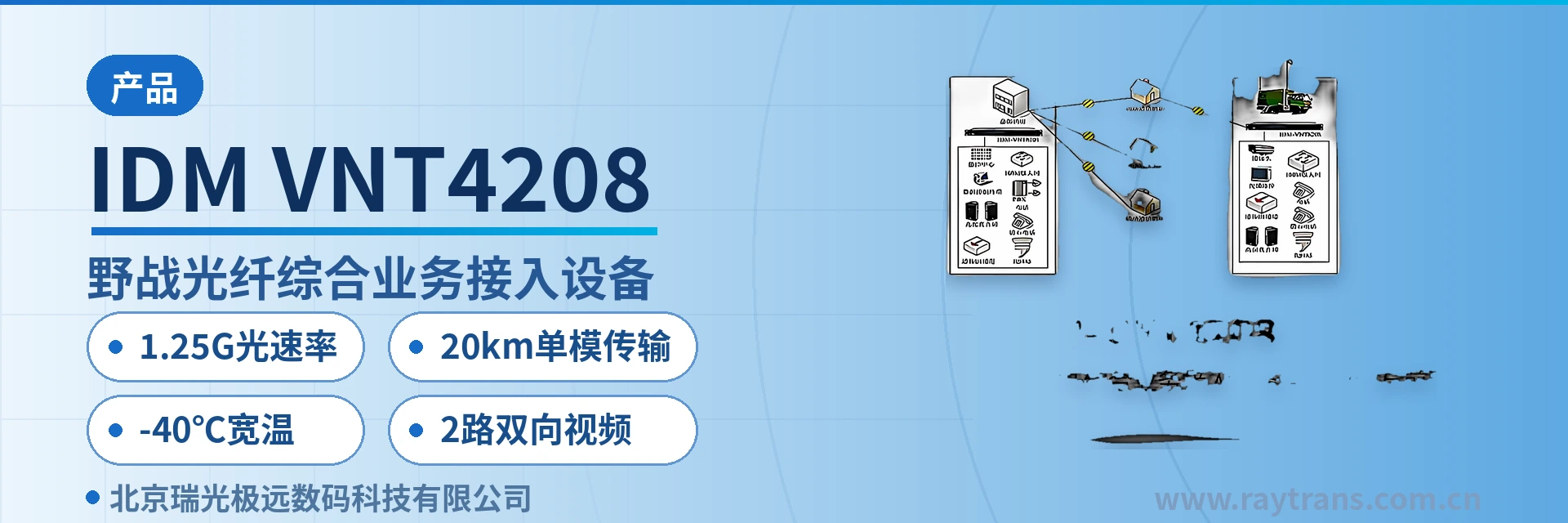
IDM-VNT4208 Field Optical Fiber Integrated Service Access Device
Video, audio, E1, and Ethernet over a single fiber; saves three devices; shock-resistant, adjustment-free, plug-and-play
The IDM-VNT4208 Field Optical Fiber Integrated Service Access Device is designed by Beijing Ruiguang Jiyuan Digital Technology Co., Ltd. specifically for military field communications. The device features an optical transmission unit and a PCM multiplexing unit, adopts a shock-resistant chassis design, and provides service interfaces suitable for military field use.
The IDM-VNT4208 field optical fiber integrated service access device is a field optical fiber integrated service access device developed by Beijing Ruiguang Jiyuan Digital Technology Co., Ltd. (Raytrans) specifically for military field communications. Composed of an optical transmission unit and a PCM multiplexing unit and featuring a shock-resistant chassis design, it carries video, audio, E1 trunk, voice, and Ethernet services simultaneously over a single optical fiber, and is a typical access device for product showcase in emergency communications scenarios.
The device's optical and electrical interfaces are designed to international standards, and its service interface forms suit the installation and operating habits of military field use, facilitating quick deployment and flexible deployment in emergency communications scenarios. The division of labor between the optical transmission unit and the PCM multiplexing unit allows the service combination to be increased or decreased as a site requires, without replacing the entire unit to add or remove a single service.
The difficulty of service aggregation in field video communications and emergency communications centers on three things: fewer devices, faster wiring, and environmental tolerance. The IDM-VNT4208 multiplexes 2 bidirectional video channels, 2 bidirectional audio channels, PCM30/31 2M channels, 10M/100M adaptive Ethernet, and serial port data into a 1.25G optical transmission channel; deployed as a pair at both ends, it can provision multiple service types over a single optical fiber.
Not having to lay a separate optical cable and configure separate equipment for each service type is the difference between field optical multiplexers and single-function video optical multiplexers in live networks. As a professional optical multiplexer manufacturer, Raytrans arranges access nodes according to this approach in military emergency communications vehicle solutions, and the same device can also be used for service bearing in government private network optical fiber communication solutions.
Key Specifications at a Glance: 1.25G optical rate · 20 km single-mode transmission · receiver sensitivity better than -21 dBm · 2 bidirectional video + 2 bidirectional audio · PCM30/31 E1 · 10M/100M adaptive Ethernet · -40℃ wide temperature · shock-resistant chassis
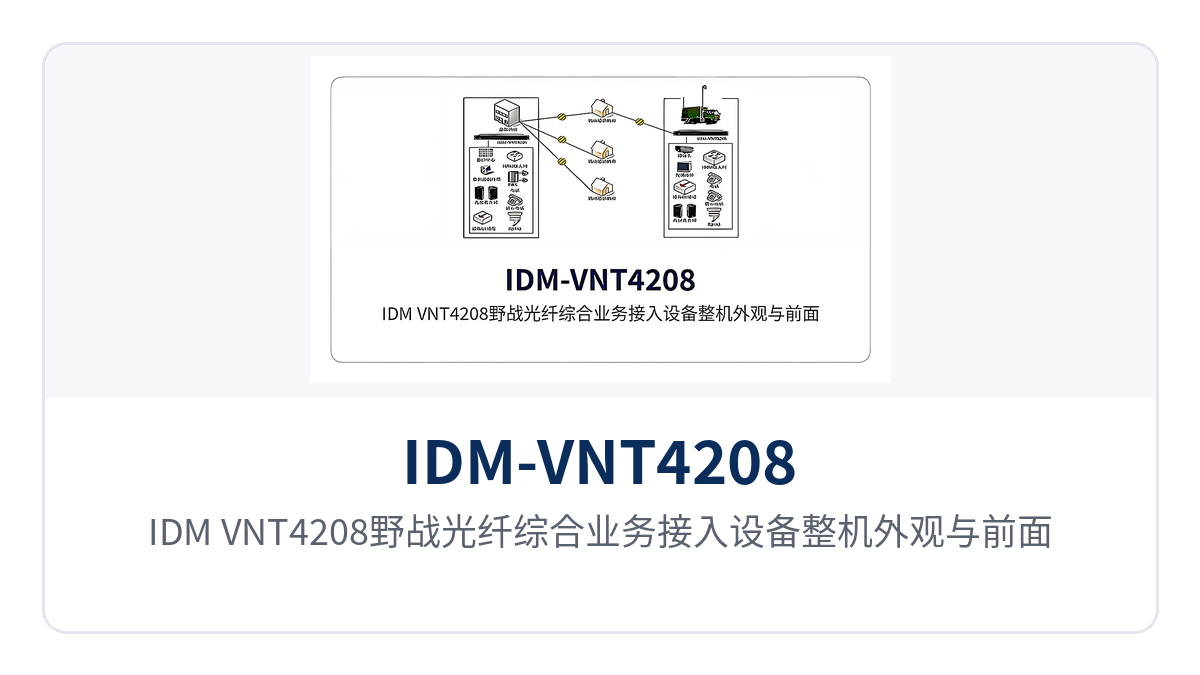
Figure 1: Overall appearance of the IDM-VNT4208 field optical fiber integrated service access device with a close-up of the front panel service interfaces
What Is a Field Optical Fiber Integrated Service Access Device
A field optical fiber integrated service access device is a field-type access device that multiplexes video, audio, voice and data, E1 trunk, and Ethernet onto a single optical fiber for transmission, and is also a commonly used multi-service access node in emergency communications scenarios. To judge whether a device belongs to this category, check whether it can simultaneously provision three service types—video, voice, and E1 trunk—over a single optical channel.
The IDM-VNT4208 accomplishes this through the cooperation of two parts: the optical transmission unit handles transmission and reception on the 1.25G optical channel and link status, while the PCM multiplexing unit aggregates signals such as voice and low-speed data onto standard 2M interfaces, which are then sent into the optical channel for transmission via time division multiplexing (TDM).
The result of this division of labor is that services can be combined as the site requires. For video backhaul, connect the BNC video port; for command calls, connect the audio port; to access an existing PCM private network, connect the G.703 E1 port; for networking, connect the RJ-45 Ethernet port; to collect device status, connect the serial port. All services share the same optical channel and can be provisioned once the service configurations at both ends correspond one-to-one—this is also the difference between a field optical fiber integrated service access device and a single video optical multiplexer.
The device features a shock-resistant chassis design, with the optical module and core circuits using standard components. The chassis dimensions are 440×230×45 (mm), and the overall power consumption is ≤50 W. It can operate under AC 220 V or DC -48 V power supply conditions. This form factor makes it easy to install in communication vehicles, shelters, or temporary command posts, and also suitable for long-term deployment at unattended sites. In military emergency communications vehicle solutions, it can serve as an optical fiber integrated service access node, providing multi-service access and product showcase capabilities for emergency communications.
What Functions Does the IDM-VNT4208 Field Optical Fiber Integrated Service Access Device Provide
The device functions are divided into groups: optical transmission, video and audio, PCM and data access, and Ethernet and device monitoring. Each function corresponds to an interface on the panel that can be wired directly. The role and on-site use of each function item are described below, facilitating configuration verification against site service volume.
| Function | Description |
|---|---|
| Optical transmission and TDM | The 1.25G optical channel performs optical transmission; the PCM multiplexing unit aggregates signals such as voice and low-speed data onto 2M interfaces, which are then sent into the optical channel via TDM |
| Bidirectional video transmission | 2 bidirectional uncompressed video channels, BNC interface, 8-bit sampling, 0 Hz~6.5 MHz video bandwidth, capable of point-to-point bidirectional backhaul |
| Bidirectional audio transmission | 2 bidirectional audio channels, 300 Hz~3400 Hz audio range, ITU-T G.711 A-law compression, for command calls and on-site monitoring |
| E1 trunk access | Supports ITU-T G.703, bit rate 2048 Kbps, HDB3 line code, PCM30/31 frame structure, channel-associated signaling (CAS) |
| Ethernet access | RJ-45 connector, 10M/100M adaptive, compliant with IEEE 802.3, full/half duplex/adaptive |
| Serial port data access | Provides RS-232, RS422 (4-wire), and RS485 (2-wire) data interfaces |
| Service card expansion | Voice cards (FXS, FXO, hotline, magneto, EM2/4) and data cards (V.24, V.35) can be added, scaled to site services |
| Device monitoring and alarms | Panel indicator LED alarms and audible alarms; the alarm sound can be muted; supports online real-time monitoring of link and device status |
| Shock resistance and adjustment-free | The shock-resistant chassis together with the plug-and-play design means the device works once powered on after the optical cable and service lines are connected, with no on-site adjustment required |
How to Configure Field Optical Multiplexer Interfaces: Video, Audio, E1, and Ethernet in One Go
Interface configuration determines what devices can be connected on site. The standard configuration of the IDM-VNT4208 field optical fiber integrated service access device covers five interface types: video, audio, E1, Ethernet, and serial port data. The number of channels and interface forms are shown in the table below; services beyond the standard configuration can be expanded with service cards.
| Service Type | Interface Form and Specification | Corresponding On-Site Device |
|---|---|---|
| Video | BNC interface, 75 Ω unbalanced, input/output voltage 1 Vp-p (typical), input overload voltage 1.5 Vp-p (typical) | Camera, peer-end monitor of the optical multiplexer, video matrix |
| Audio | 300 Hz~3400 Hz voice-channel audio, three-element complex impedance 200 Ω+560 Ω//0.1 μF, loop current 25 mA/channel | Command telephone, dispatch console, PA equipment |
| E1 trunk | ITU-T G.703, 2048 Kbps, HDB3, impedance 75 Ω/120 Ω | Existing PCM equipment, transmission device, switching equipment |
| Ethernet | RJ-45, 10M/100M adaptive, IEEE 802.3, full/half duplex/adaptive | Switch, network camera, office terminal |
| Serial port data | RS-232, RS422 (4-wire), RS485 (2-wire), RJ-45 connector form | Acquisition terminal, control unit, sensor device |
| Wideband audio | RJ45 connector, 24-bit sampling, 32 KHz sampling frequency, 20 Hz~20 KHz bandwidth, audio SNR ≥90 dB | Broadcast, sound reinforcement, and high-fidelity monitoring links |
Beyond the standard configuration, the device can also be fitted with voice interface cards and data interface cards. Voice cards can provide interfaces such as FXS, FXO, hotline phone, magneto telephone, and EM2/4, while data cards can provide interfaces such as V.24 and V.35. Field sites with many service types but a low channel count per type need not pay for ports they will not use.
All service interfaces and optical ports are arranged on the chassis panel, with interface forms corresponding one-to-one to the silkscreen markings. When wiring, simply locate the port by service type; there is no need to consult the manual item by item. Field installation emphasizes getting it right the first time and minimizing rework. Panel-direct wiring eliminates adapter boxes and patch panels—this is the practical significance of the plug-and-play design in live networks. As a professional optical multiplexer manufacturer, Raytrans adopts this type of panel-direct interface design in both field video communications and government private network optical fiber communication solutions, facilitating rapid on-site deployment.
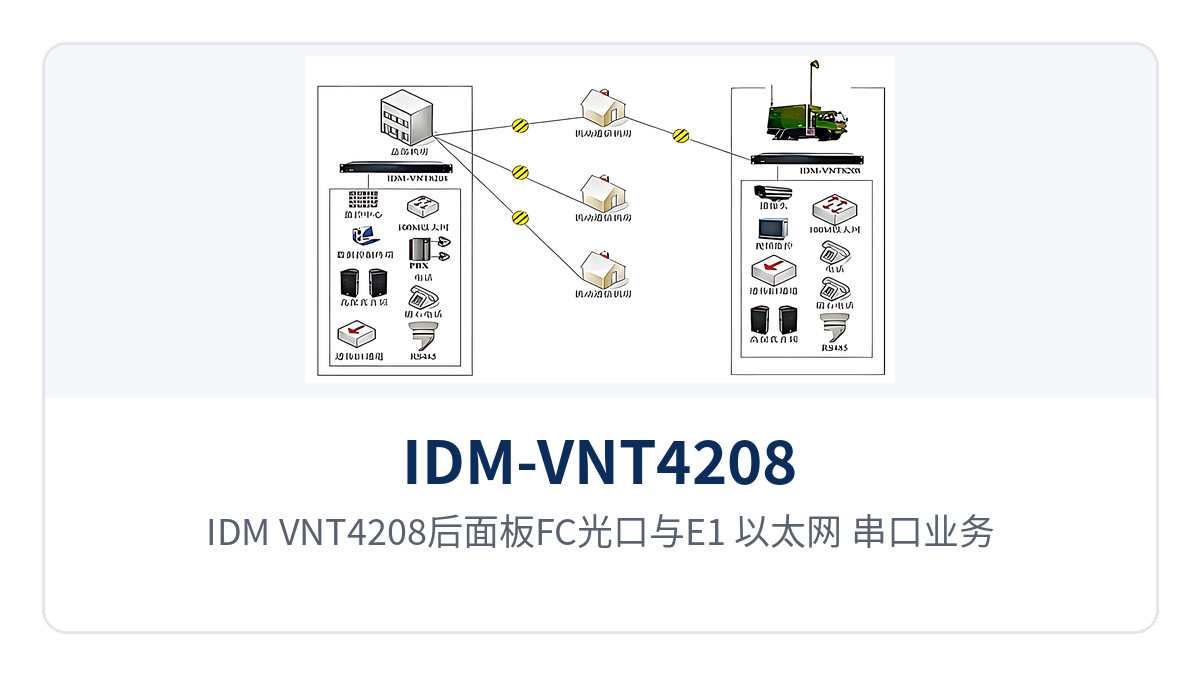
Figure 2: Layout of the FC optical port and E1, Ethernet, and serial service interfaces on the rear panel of the IDM-VNT4208
How Far Can 1.25G Optical Rate with -21 dBm Sensitivity Transmit
The optical interface of the IDM-VNT4208 is FC type, with SC and other interface forms customizable. The fiber mode is single-mode, with multimode optionally available. The receive/transmit rate is 1.25 Gbps in both directions, with an operating wavelength of 1310 nm in the receive direction and 1550 nm in the transmit direction. When deployed as a pair, the transmit and receive wavelengths at both ends are swapped, and two optical fibers complete bidirectional service transmission.
The transmit optical power is -9~-1 dBm and the receiver sensitivity is better than -21 dBm; these values determine the link margin. With a 1.25 Gbps optical rate and -21 dBm sensitivity, weak optical links still connect stably: when there are many fiber connectors on site, long patch cords, or relatively high aging loss, as long as the received optical power remains above the sensitivity threshold, video and E1 services continue to transmit normally, and there is no need to replace the entire optical cable because of relatively high link attenuation.
The transmission distance is nominally 20 km, and long-distance optical modules can be optionally installed for longer-distance optical fiber transmission. 20 km single-mode transmission covers the distance from most command posts to forward positions, from substations to dispatch centers, and from toll stations to management offices; for dispersed sites spanning more than 20 km, installing long-distance optical modules extends the reach without changing the chassis, service cards, or on-site wiring method. As an optical multiplexer manufacturer, Raytrans has deployed this series of field optical multiplexers in volume in military emergency communications vehicle solutions and government private network optical fiber communication solutions, working with field video communications and emergency communications services to achieve stable long-distance transmission.
How to Wire and Deploy a Field Optical Multiplexer On Site
The wiring principle for field optical multiplexers is one-to-one correspondence of services at both ends, connecting service lines and the optical cable before powering on. The IDM-VNT4208 is designed for plug-and-play, with the optical port and all service ports on the panel. On-site provisioning can be completed by following the sequence below; the wiring sequence and verification points are listed item by item.
- Fixing and grounding: Install the device in the shock-resistant chassis or a vehicle-mounted rack position, and connect the protective ground according to on-site regulations. Power can be AC 220 V or DC -48 V.
- Connect video: Connect the camera output to the BNC video port, input/output impedance 75 Ω unbalanced; note the direction correspondence with the monitor end.
- Connect audio: Connect the command telephone, dispatch console, or PA equipment to the audio port, loop current 25 mA/channel; verify the number of channels against on-site traffic.
- Connect E1: Match the G.703 E1 port to 75 Ω or 120 Ω impedance according to the on-site device, and connect to existing PCM equipment, transmission device, or switching equipment.
- Connect Ethernet and serial: Connect the RJ-45 Ethernet port to a switch or network camera; for serial ports, select RS-232, RS422, or RS485 wiring according to the on-site device.
- Connect the optical cable: Connect the FC or SC optical port to a single-mode pigtail, swap the transmit and receive wavelengths at both ends, and tighten after cross-connecting the transmit and receive optical ports.
- Power on and verify: After powering on both ends, check the indicator LEDs and alarm indications of each service port; the audible alarm can be muted; confirm bidirectional service continuity.
The deployment environment also needs to be verified in advance. The device operating temperature is -15℃+65℃, industrial grade -40℃+85℃, storage temperature -25℃+75℃, and relative humidity 095% (non-condensing). The chassis dimensions are 440×230×45 (mm), and the overall power consumption is ≤50 W. Reserve on-site cabinet space, power supply capacity, and heat dissipation conditions according to these items.
Post-deployment expansion and routine maintenance are also handled via the panel. When site services increase, install voice cards or data cards to expand capacity without replacing the entire unit; for routine judgment of link and service status, check the indicator LEDs and audible alarms. The alarm sound can be muted to avoid disturbing duty personnel at night, and the board fixing structure inside the shock-resistant chassis also withstands the vibration conditions of vehicle travel and temporary handling.
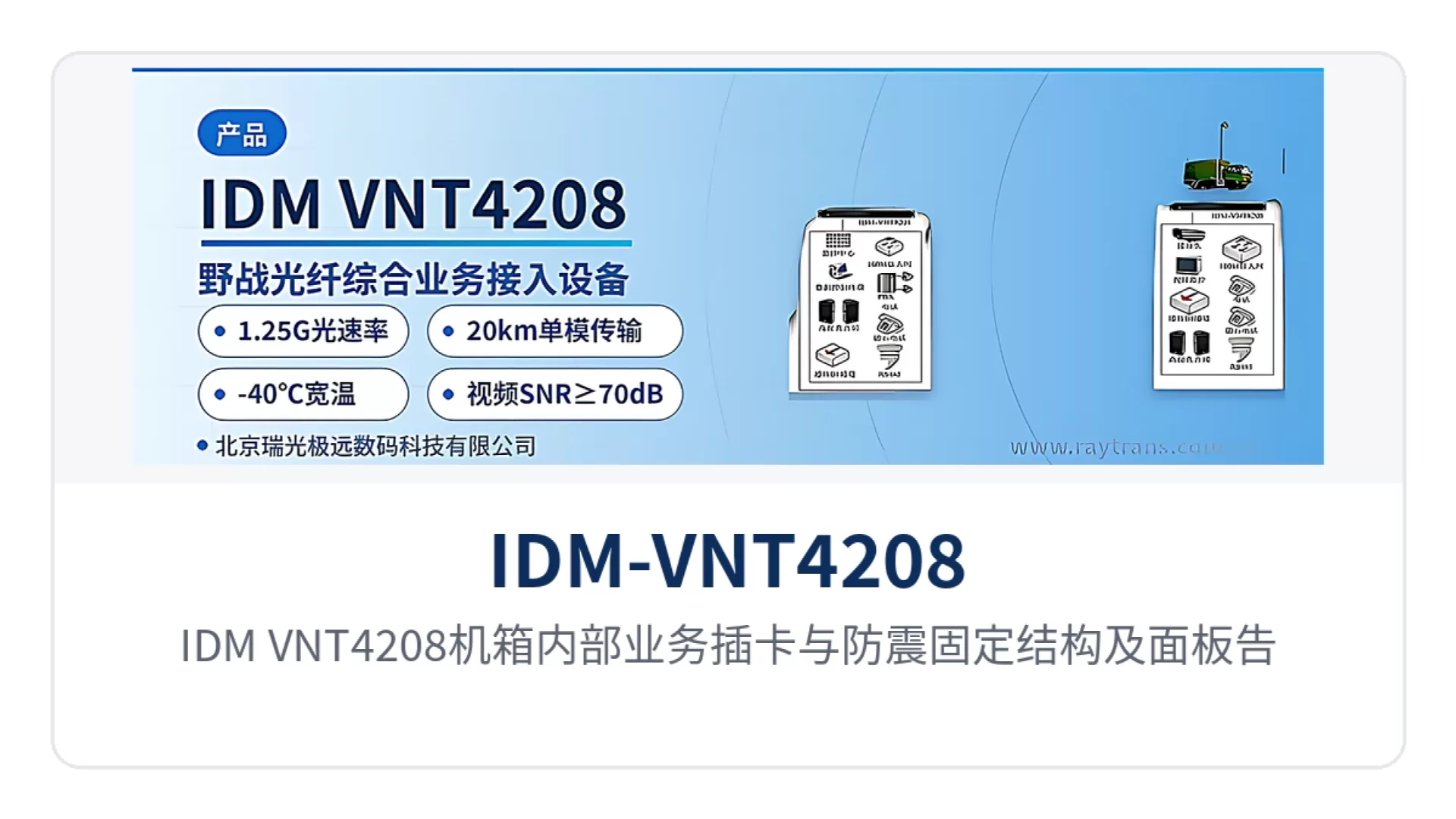
Figure 3: Service cards and shock-resistant fixing structure inside the IDM-VNT4208 chassis, and panel alarm indicator LEDs
Core Technical Specifications
The table below summarizes the optical interface, video, audio, E1, Ethernet, power supply, and environmental parameters of the IDM-VNT4208 field optical fiber integrated service access device. Each item lists the parameter value and applicable conditions for item-by-item verification in product showcase selection and procurement; parameters are subject to the manufacturer's technical documentation, and special on-site requirements are subject to commercial confirmation.
| Item | Parameter/Specification | Description/Applicable Conditions |
|---|---|---|
| Optical interface type | FC (SC and other interfaces can be customized) | Interface form must be consistent at both ends when deployed as a pair |
| Fiber mode | Single-mode (multi-mode optional) | Single-mode is the standard choice for long-distance field links |
| Receive/transmit rate | Receive 1.25 Gbps / transmit 1.25 Gbps | Video, E1, audio, Ethernet and data are multiplexed over the same channel |
| Transmit and receive wavelengths | Receive 1310 nm/1550 nm, transmit 1550 nm/1310 nm | Wavelengths are swapped at the two ends, and two fibers complete bidirectional transmission |
| Transmit optical power | -9~-1 dBm | Together with receiver sensitivity, determines the link margin |
| Receiver sensitivity | Better than -21 dBm | Stable access even on weak optical links |
| Transmission distance | 20 km single-mode transmission | Long-distance optical modules can be installed for longer transmission |
| Video interface | BNC, 75 Ω unbalanced | Input/output voltage 1 VP-P (typical) |
| Video sampling and bandwidth | 8-bit sampling, 0 Hz~6.5 MHz | Uncompressed video transmission, clear command images |
| Video SNR | Video SNR ≥70 dB (weighted) | Luminance non-linearity <3% |
| Video distortion specification | Differential gain DG <0.7%, differential phase DP <0.7o | Low luminance and chrominance distortion, no distortion |
| Video level | Input overload 1.5 VP-P (typical), input/output 1 VP-P (typical) | Check against the on-site camera output level |
| E1 bit rate and line coding | 2048 Kbps, HDB3 | Complies with ITU-T G.703 |
| E1 impedance and frame structure | Impedance 75 Ω/120 Ω, frame structure PCM30/31, channel-associated signaling | Match the existing PCM equipment on site |
| Voice channel audio | 300 Hz~3400 Hz, A-law per ITU-T G.711 | Three-element complex impedance 200 Ω+560 Ω//0.1 μF, loop current 25 mA per channel |
| Wideband audio | 24-bit sampling, 32 KHz sampling frequency, 20 Hz~20 KHz bandwidth | Input/output impedance ADC: 100 KΩ/DAC: 10 KΩ, audio SNR ≥90 dB |
| Data interface | RS-232, RS422 (4-wire), RS485 (2-wire) | RJ-45 interface form |
| Ethernet interface | RJ-45, 10M/100M adaptive | Complies with IEEE802.3, full/half duplex/adaptive |
| Power supply mode | AC220 V/DC-48 V | Selected according to on-site power conditions |
| Overall power consumption | ≤50 W | Reserve capacity accordingly for vehicle-mounted and solar-powered sites |
| Operating temperature | -15℃~+65℃ | Standard equipment rooms and indoor sites |
| Industrial-grade temperature | -40℃~+85℃ | -40℃ wide temperature suits field and unattended sites |
| Storage temperature | -25℃~+75℃ | Transportation and storage conditions |
| Relative humidity | 0~95% (non-condensing) | Prevent condensation inside field enclosures |
| Dimensions | 440×230×45 (mm) | Rack-mounted installation, easy to fit into communication vehicles and shelters |
Differentiated Value
The differentiated capabilities of the IDM-VNT4208 center on three aspects: optical link adaptation, weak-light reception and video quality. These three capabilities address different on-site problems: limited link length, optical power fluctuation and image detail interpretation. Each is listed below alongside its user value, so that trade-offs can be judged against actual site conditions.
| Differentiation Point | Value to Users |
|---|---|
| 20 km single-mode transmission, extendable with long-distance optical modules, suited to dispersed field sites | Dispersed sites such as command posts to the front line, or substations to dispatch centers, form a link directly over one fiber; spans beyond 20 km can be extended by swapping in long-distance optical modules without changing the enclosure or service configuration |
| 1.25G optical rate with -21 dBm sensitivity, stable access even on weak optical links | Attenuation from numerous field connectors, long patch cords and aging cables need not be solved by replacing cables; once video and E1 services are provisioned, they are unlikely to be interrupted by optical power fluctuation |
| Video SNR ≥70 dB, DG <0.7%, clear command images without distortion | Uncompressed video with 8-bit sampling and 0 Hz~6.5 MHz bandwidth keeps image detail and color stable for commanders, providing a basis for interpreting targets and verifying on-site conditions |
How to Select a Field Optical Multiplexer
Selection starts with how many types of service a single site needs to consolidate and how many channels of each, then the model is determined against the interface configuration table. For forward outposts with few video channels and mainly command calls and data backhaul, a 2-channel bidirectional video optical multiplexer is sufficient; with 2-channel bidirectional audio and PCM30/31 E1 channels, one device covers video, calls and private network trunking. As services grow, service cards can be added for expansion without replacing the unit.
Next, check link conditions and environmental conditions. Transmission distance, optical cable cores and connector condition on the link side determine the optical module selection: standard single-mode optical modules for spans within 20 km, and long-distance optical modules for longer spans. If the deployment position is outdoors, vehicle-mounted or an unattended site, confirm that -40℃ wide temperature, the shock-resistant enclosure and AC220 V or DC-48 V power supply match the site; these items are subject to manufacturer's technical documentation and commercial confirmation.
As an optical multiplexer manufacturer, Raytrans provides selection comparison and solution recommendations, helping users make an appropriate choice between a field optical multiplexer and a field optical fiber integrated service access device, and making it easy to convert a single-site configuration into the number of devices for the whole link. For links deployed as a pair, the number of units is calculated by site pairs; state the equipment room conditions at the opposite end during selection, so that quotation and delivery list can be aligned in one pass.
Typical Application Scenarios
Military Field Communications
Military field communications demand fast setup and fast connection, and only temporarily laid optical cables often exist between a command post and forward positions. As a mature field optical multiplexer, the IDM-VNT4208 multiplexes 2-channel bidirectional video, 2-channel bidirectional audio and PCM30/31 E1 channels onto one fiber at a 1.25G optical rate: the command post side connects video consultation, voice dispatching and private network trunking, while the forward side connects cameras, telephones and acquisition terminals. Deployed as a pair, the two ends complete a field video communication link and form the core equipment of a practical military emergency communications vehicle solution.
The shock-resistant enclosure and plug-and-play design reduce on-site commissioning. Service cards are inserted as required, and the unit works once the optical cable and service lines are connected; 20 km single-mode transmission covers common position depth, and spans beyond 20 km can be extended by swapping in long-distance optical modules. This suits rapid networking for vehicle-mounted mobility, temporary command posts and field camps, and also provides a typical deployment example of the field optical fiber integrated service access device in the product showcase.
Emergency Communications and Civil Air Defense Command
The typical contradiction at an emergency communications site is tight time, mixed services and uncertain environment. The IDM-VNT4208 simultaneously enables video backhaul, command calls, E1 trunking and Ethernet over one fiber, so video, voice and data at a rescue site need not be carried by separately installed equipment; -40℃ wide temperature and the shock-resistant enclosure let the device operate continuously outdoors, in vehicles and in temporary tents.
Links between civil air defense command posts and evacuation areas usually run along existing optical cables, with many connectors and patch cords and relatively high link attenuation. With a 1.25G optical rate and -21 dBm sensitivity, weak optical links remain stably accessible; as long as received optical power is above the threshold, command video and voice channels stay connected despite link condition fluctuation.
Unattended Sites Along Electric Power and Transportation Lines
Substations, traction stations, toll stations and tunnel portals along electric power and transportation lines are mostly unattended sites, where video, dispatch telephone and device status data need to be backhauled and existing private networks accessed. The IDM-VNT4208 consolidates these services into one device and returns them over 20 km single-mode transmission to the communications equipment room at the management center; the site side saves multiple single-function devices and duplicate cabling, and also meets the intensive access requirements of a government private network optical fiber communication solution.
Such sites are rarely inspected, so link status must be visible remotely. The device supports online real-time monitoring, with panel indicator LED alarms and audible alarms providing on-the-spot indication; operating temperature covers -15℃+65℃, industrial grade -40℃+85℃, and humidity 0~95% (non-condensing), making it suitable for long-term deployment in field cabinets without air conditioning.
Conclusion
The IDM-VNT4208 field optical fiber integrated service access device carries 2-channel bidirectional video, 2-channel bidirectional audio, PCM30/31 E1 trunking and Ethernet simultaneously over one fiber at a 1.25G optical rate, consolidating the several types of service commonly needed in field and emergency sites into one shock-resistant enclosure device, reducing the number of devices and points of failure in cabling.
For military field communications, emergency communications and civil air defense command, and unattended sites along electric power and transportation lines, 20 km single-mode transmission and -40℃ wide temperature cover most field link and environmental conditions; when longer distance is needed, long-distance optical modules can be swapped in for extension while the link and service configuration remain unchanged. As a professional optical multiplexer manufacturer, Raytrans continues to provide reliable field optical multiplexer products and technical support for military emergency communications vehicle solutions and government private network optical fiber communication solutions.