IDM USB-4G LTE Mobile Telephone Interface Terminal
One 4G SIM card replaces a fixed-line outside line; SIP trunk requires no desktop cabling; blacklist and whitelist block nuisance calls
Provides an outside line trunk interface for the enterprise through a 4G mobile number, enabling enterprise internal telephone users to call public network telephones and mobile phones; calls from the public network to the enterprise can also be routed to designated enterprise users; by configuring an outside line blacklist, nuisance calls can be reduced; by configuring a whitelist, outside line calls can be quickly transferred to designated users; outside line calls can be transferred to any place in the world with Internet access, which is suitable for companies with dispersed offices and many business travelers. It is suitable for answering external incoming calls at any time; it provides functions that ordinary telephones do not have, such as call records, speech-to-text, language translation, and AI answering
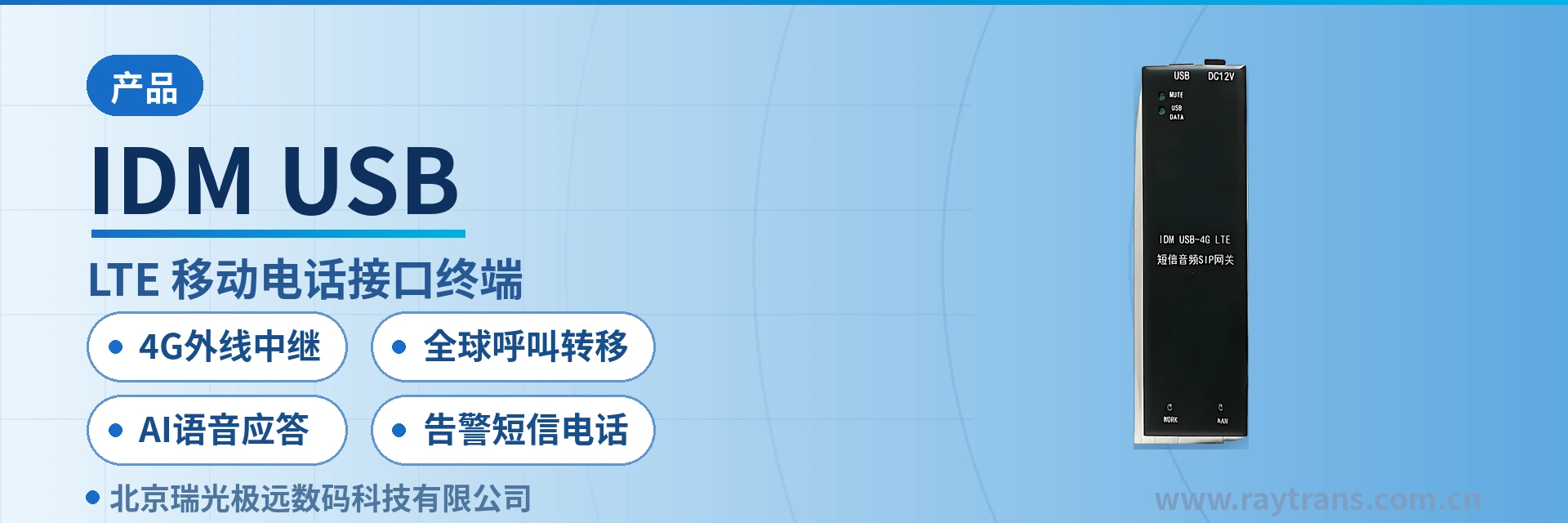
IDM USB-4G is a 4G outside-line trunk gateway, i.e., an LTE mobile telephone interface terminal (IP access terminal), developed by Beijing Ruiguang Jiyuan (Raytrans) to turn a single 4G SIM card into an outside-line trunk for an enterprise's internal telephone system. It uses the 4G mobile number to connect calls to the public network and registers with the internal telephone system over SIP, so the equipment room side no longer needs to apply for a fixed-line (PSTN) line. As a product showcase for enterprise converged communications, this terminal balances mobile network access and SIP trunk flexibility within the IP access terminal category.
In the documentation, this type of terminal is also written as USB 4G LTE SIP gateway, USB 4G SIP gateway, 4G SIP voice telephone gateway, 4G SIP trunk gateway, and 4G SIP SMS trunk gateway, all pointing to the same thing: no dedicated line, no fixed-line subscription—one 4G card lets the enterprise PBX reach the public network and traveling staff directly. For enterprises that need rapid deployment of SIP trunks, a 4G SIP trunk gateway can effectively replace traditional fixed-line outside lines and reduce cabling costs.
Key Specifications at a Glance: 4G outside-line trunk · USB host interface · SIP trunk registration · outside-line blacklist · global call forwarding · call records and speech-to-text · AI voice answer · alarm SMS and calls
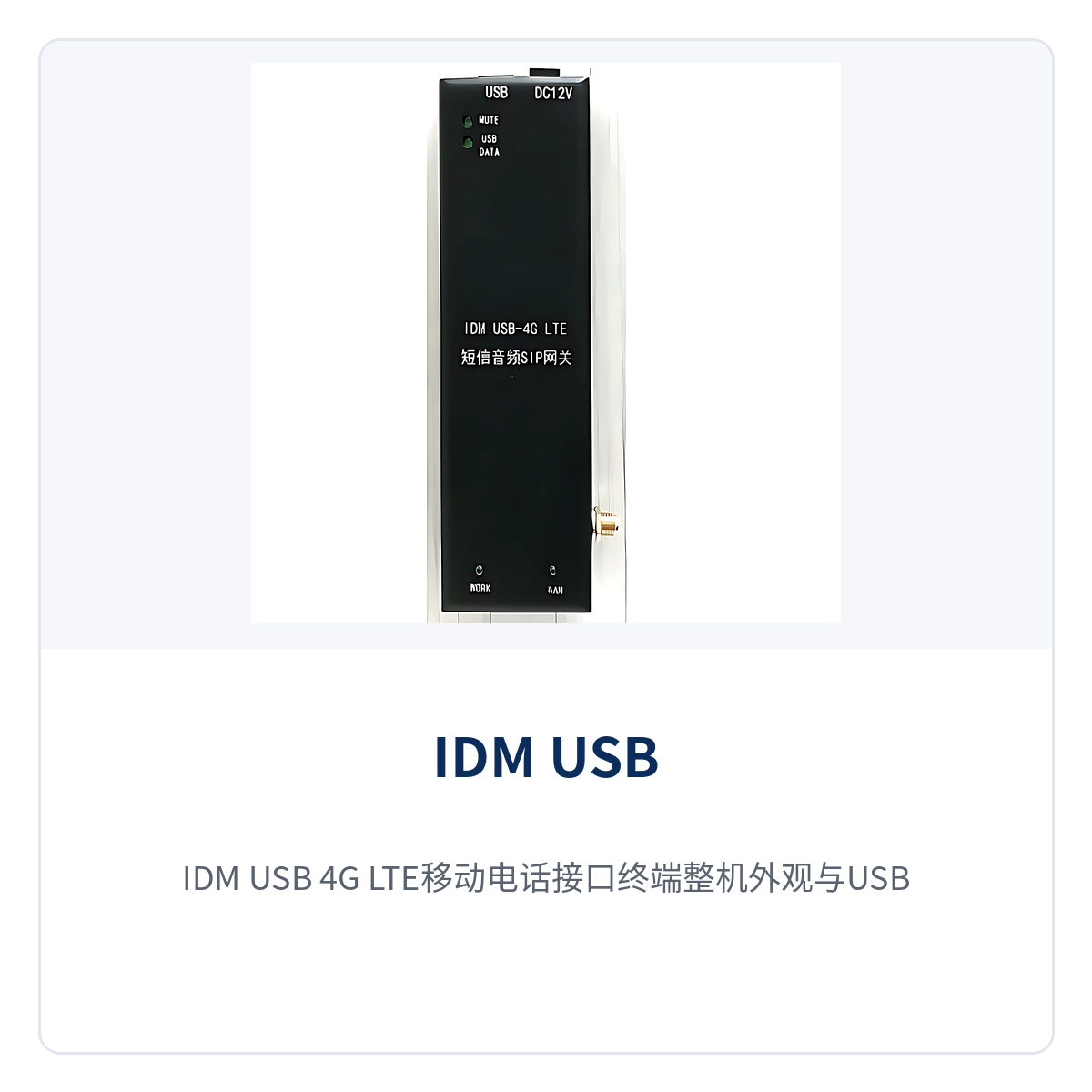
Figure 1: Overall appearance and USB interface layout of the IDM USB-4G LTE mobile telephone interface terminal
What kind of device is a 4G outside-line trunk gateway?
A 4G outside-line trunk gateway is a trunk access device that replaces fixed outside lines with a mobile network. A carrier 4G SIM card is inserted on the outside-line side, and this mobile number serves as the enterprise's external outside-line number; on the trunk side, the device registers with the enterprise's internal telephone system over SIP and presents the number as a routable, assignable trunk link, with both voice and SMS carried over this card.
What this access path eliminates is precisely the equipment room cabling segment. The enterprise does not need to apply for a separate fixed line for the outside line or deploy outside-line cables between floors; it only needs to insert the card into the IP access terminal, connect the USB cable to the main unit, and create a SIP trunk in the system to enable the service, and the device can be moved to another office while still using the same number externally. Raytrans's 4G outside-line trunk gateway is exactly the product showcase direction designed along this line of thinking, connecting mobile outside-line access with the enterprise's internal telephone system.
How a 4G mobile number becomes an enterprise outside-line trunk
For a 4G SIM card to become an enterprise outside line, three paths—outbound, inbound, and SMS—must run simultaneously between the internal telephone system and the public network. Each of the three paths is configured with its own rules, independently of the others, and the service is delivered only after each path has been tested on site. If only outbound or only inbound works, the service will have a gap, and the upgrade cannot be considered complete.
- Outbound calls: an internal user dials the outside-line prefix, the internal telephone system sends the call to the 4G outside-line trunk gateway, the gateway dials the called number over the 4G network, and the public network still sees this 4G number as the calling party number.
- Inbound calls: a call from the public network reaches the 4G number, the gateway passes the calling party number to the internal telephone system, and the system decides which enterprise user to route it to according to the blacklist and extension rules.
- SMS notifications: enterprise internal alarms are sent as SMS messages through this 4G number according to rules, and the person concerned can also be notified by outbound call.
Once the three paths run, the external number stays the same and the internal extensions stay the same; what changes is that the outside line goes from a fixed line obtained from the carrier to a trunk resource that the enterprise can configure and relocate itself. O&M personnel can then check trunk occupancy and call records in the system instead of going to the equipment room to count cables. When used as a 4G SIP trunk gateway, the device provides the internal telephone system with exactly a standard SIP trunk, so existing extensions and the numbering plan need not be rebuilt from scratch.
What functions does a 4G outside-line trunk gateway provide
The functions of a 4G outside-line trunk gateway cover outside-line access, number policies, call forwarding, call enhancement, and alarm notification, and all capabilities take effect simultaneously through the same terminal working with the internal telephone system and enterprise AI services. The function items and their purposes are listed in the table below for item-by-item verification against the enterprise's actual call handling.
| Function | Description |
|---|---|
| 4G outside-line trunk | Provides an outside-line trunk interface for the enterprise using a 4G mobile number, so internal telephone users can call public network telephones and mobile phones |
| Incoming call extension termination | Calls from the public network to the enterprise are routed to designated enterprise users according to rules, without the front desk transferring each call |
| Outside-line blacklist | Blocks nuisance and sales calls by calling party number, reducing nuisance calls, and blocked calls do not occupy extensions |
| Outside-line whitelist | Calls from numbers on the list skip the navigation step and are quickly transferred to designated users |
| Global call forwarding | Outside-line calls can be forwarded to any location with internet access, covering dispersed offices and traveling staff |
| Incoming call information display | Provides call records, incoming call number display, and related record display, replacing the single ring of an ordinary telephone |
| Speech-to-text | Converts call speech into text for retention, facilitating search, shift handover, and later verification |
| Language translation | Translates call content, so cross-language incoming calls do not require finding an interpreter first |
| AI voice answer | The enterprise's internal AI service completes answering, information collection, and transfer, so calls outside working hours are also answered |
| Phone book calling | Search and call from the phone book like a mobile phone, so frequently used numbers need not be memorized digit by digit |
| AI transfer service | Provides more telephone transfer services through the enterprise's internal AI service system, with policies adjusted as the business changes |
| Alarm SMS and calls | Notifies the person concerned of various enterprise internal alarm information in a timely manner by SMS and telephone |
How to verify access conditions and configuration items
Access conditions center on four areas—card, interface, protocol, and number rules—and the configuration is determined only after each item has been checked against on-site conditions. The table below lists the outside-line side, main unit side, trunk side, value-added services, and notification channel, where the number of interfaces and the power supply mode are subject to the documentation shipped with the product.
| Item | Description/Specification | Applicable condition |
|---|---|---|
| Outside-line side | Carrier 4G SIM card, with this number serving as the enterprise's external outside-line number | The installation position has usable 4G signal coverage |
| Main unit side interface | USB interface, connected to the main unit running SIP registration and enterprise AI services | The main unit has enterprise network or internet access |
| Trunk side protocol | SIP registration, providing trunk resources to the internal telephone system | The internal telephone system supports SIP trunks |
| Call direction | Bidirectional outbound and inbound, with outside-line call forwarding supported | Prefixes and extension rules are set according to the enterprise numbering plan |
| Number policy | Outside-line blacklist blocking and whitelist quick transfer | Lists are maintained by front desk or administrative personnel |
| Forwarding scope | Any location with internet access | Remote terminals register with the internal system over SIP |
| Notification channel | Alarm information is sent to the person concerned by SMS and telephone through this number | Notification targets and alarm severity are set by job role |
| Enhanced services | Call records, speech-to-text, language translation, AI voice answer, phone book calling | Provided by the enterprise's internal AI service system |
| Number of interfaces and power supply | Not yet recorded in the knowledge base; subject to the documentation shipped with the product | Configuration determined after on-site verification |
How the outside-line blacklist and whitelist work together
The blacklist and whitelist address two directions of the same thing: keeping unwanted calls out and delivering important calls directly to the person. The outside-line blacklist blocks nuisance and sales calls by calling party number, and blocked calls do not occupy extensions; the whitelist lets calls from numbers on the list skip the voice navigation and be transferred directly to designated users.
Maintaining the two lists is best left to front desk or administrative personnel, and adding or removing a number takes effect immediately without stopping or restarting the system. The enterprise should first decide who maintains the lists and by what criteria numbers are added or removed, and then put the rules into the system configuration. A common practice is to review the lists once a quarter, removing numbers no longer in contact and adding new key contacts to the whitelist, so the lists do not gradually become ineffective after being configured once:
- Enter the blacklist item by item: add recurring sales, collection, and irrelevant numbers to the list; they are blocked on match, with no need to hang up manually each time.
- Enter the whitelist by relationship: customers, suppliers, headquarters, and key contacts are added first, so their calls arrive in one step.
- Priority setting: when configuring, place whitelist matching before blacklist matching, so important numbers are not mistakenly blocked even if entered repeatedly.
- Scope: the lists apply only to the outside-line inbound direction; internal calls and outbound calls are unaffected.
How outside-line calls are forwarded to anywhere in the world with internet access
The destination of an outside-line call is not limited to extensions in the office. After the 4G outside-line trunk gateway turns the outside line into a SIP trunk, the destination can be any terminal registered with the enterprise's internal telephone system over SIP, including office IP telephones, softphones on traveling staff's mobile phones, and telephones at overseas offices; global call forwarding thus becomes a configurable capability rather than a one-time line upgrade.
For enterprises with dispersed offices, this path eliminates long-distance charges and layer-by-layer transfers. When overseas colleagues answer an outside-line call from headquarters, the voice travels over the internet rather than international long distance; after logging in to a softphone, traveling staff can answer and make calls with a company extension identity. There is still only this one 4G card for the outside line, number resources need not be applied for repeatedly by location, and personnel transfers do not require changing numbers.
How call records, speech-to-text, and AI voice answer are implemented
An ordinary telephone can only ring and talk, and leaves nothing behind after the call ends. After the 4G outside-line trunk gateway sends outside-line calls into the enterprise's internal AI service system, call records, speech-to-text, language translation, and AI voice answer can all be completed on the system side, with no modification to the telephone and no change to employees' usage habits.
The five enhanced capabilities each address a type of on-site problem, and which one to enable first is decided by business priority during implementation. The following describes each capability's purpose and where it is used, for item-by-item comparison with the internal telephone system's existing functions to avoid duplicate construction. All five are configured on the enterprise's internal AI service system side, with no additional equipment and no model change at the telephone:
- Call records and number display: each outside-line call leaves the calling party number, time, and call record, so follow-up calls no longer require leafing through a paper logbook.
- Speech-to-text: call speech is converted into text, facilitating search, shift handover, and later verification.
- Language translation: speech content is translated during cross-language calls, so overseas customers' calls do not depend on a temporary interpreter.
- AI voice answer: the enterprise's internal AI service completes answering, information collection, and transfer, so calls outside working hours are also answered.
- Phone book calling: search and call from the phone book like a mobile phone, so frequently used numbers are reached with one touch.
Typical application scenarios
The networking approach of a 4G outside-line trunk gateway is simple: the outside-line side is a 4G SIM card, and the trunk side connects to the main unit hosting the enterprise's internal telephone system. The following three types of scenarios have concentrated requirements for cabling conditions, personnel distribution, and alarm response, and are exactly where the value of this type of IP access terminal is most evident.
Dispersed offices and multi-branch enterprises: the outside-line number is no longer tied to a particular office
Sales companies and multi-branch enterprises often change and expand their offices, yet the outside line is tied to a fixed address, so every office move requires a number cutover. With a 4G outside-line trunk gateway, the outside-line number is placed on a 4G card, and the terminal moves together with the main unit of the internal telephone system, so the number follows and no re-application or cabling is needed.
For such enterprises, the more practical value is that incoming calls reach the person rather than the workstation. Outside-line calls go directly to the corresponding sales or project lead according to the whitelist and extension rules, and traveling staff can answer with a company extension on high-speed rail or at a customer site, while the customer still hears the same enterprise number.
Unattended sites in the field: external contact without fixed-line (PSTN) lines
Sites such as oil pipeline valve chambers, hydrological monitoring stations, and photovoltaic booster stations usually have no fixed-line (PSTN) lines, and the cost and lead time of laying an outside-line cable are hard to accept. At these locations, the 4G outside-line trunk gateway provides a ready-made external voice outlet: telephones on site can call the public network, and on-duty personnel and inspection personnel can also be called directly.
What these sites need more is for alarms to get out. Various alarm information from on-site equipment is sent to on-duty personnel and area leaders by SMS and telephone through this one 4G card; voice and SMS use the same channel, so there is no need to build a separate wireless notification device for alarms.
Industrial private network plant: 4G outside line as public network outlet and backup channel
The internal telephone system of a plant is often a self-contained private network, with external contact concentrated on one or two outside-line access devices. The 4G outside-line trunk gateway turns the public network outlet into a single card, and the access position is not limited by the distance from the equipment room to the carrier patch panel; temporary command posts, newly built workshops, and maintenance sites can all be deployed on the spot.
Availability requirements on the plant floor come down to continuous operation. Outside line access does not depend on outdoor cables: when ground works cut a cable, the public network outlet remains available. If the device fails or is relocated, a spare unit with the same card inserted restores the outside numbers, and the service side does not need to re-plan numbering.
Deployment and Activation: Six Steps from Card Insertion to Extensions
Activating a 4G outside line trunk gateway requires no changes to carrier lines and no replacement of existing telephones; the work centers on three things: card insertion, registration, and rule configuration. Complete the steps below in order, and the site is usually activated in a single visit, with the upgrade window measured in hours:
- Check the card and number: confirm that the 4G card has voice and SMS services enabled, record the number, and test the signal strength at the installation position.
- Insert the card and power on: insert the card into the terminal, connect the USB main unit side, and confirm that the device registers on the network normally.
- Register the trunk: configure the SIP trunk account on the internal telephone system side, confirm successful registration, and then test outside line off-hook, dialing, and hang-up.
- Configure number rules: set the outside line prefix, calling party number display, and extension assignment rules, test with a few extensions first, and then open up to all extensions.
- Enter lists and forwarding: maintain the outside line blacklist and whitelist, set global call forwarding rules for remote terminals and business travelers, and check whitelist priority.
- Trial run: run consecutive test calls for outbound, inbound, and transfer calls, confirm that call records, speech-to-text, and alarm SMS are all stored normally, and then hand over for use.
When 4G Outside Line Access Fits
Whether to adopt 4G outside line access depends mainly on three conditions: outside line conditions, personnel distribution, and alarm requirements. The four criteria below are common; if two or more apply, the project can move to solution design. Signal coverage is a prerequisite: if it does not check out, there is no need to evaluate further.
- Limited outside line conditions: the site has no fixed-line (PSTN) lines, or the cost and lead time of cabling are clearly higher than expected.
- Dispersed personnel: the headquarters, branch offices, and business travelers need to reach the same set of numbers, which must be assigned by rule.
- Small upgrade scope: there is no wish to replace telephones, re-cable, or endure a long cutover outage; the available window is only a few hours.
- Clear value-added requirements: there is a wish to bring call records, speech-to-text, language translation, AI voice response, and alarm SMS onto the telephone service.
Conclusion
As a 4G outside line trunk gateway, the Raytrans IDM USB-4G uses a single 4G mobile card to open an outside line trunk for the enterprise. Internal telephones can call public network telephones and mobile phones, and public network incoming calls reach the designated users according to the blacklist, whitelist, and forwarding rules. The equipment room does not need to re-cable for outside lines or apply for fixed-line (PSTN) lines again.
For the three call handling patterns of dispersed offices, unattended sites in the field, and industrial private network plants, the 4G SIP trunk gateway brings outside lines, call records, speech-to-text, AI voice response, and alarm SMS telephony into one system, with the upgrade confined to three points: the card, the USB connection, and SIP registration. For the number of interfaces, power supply mode, and compatible internal telephone system versions, confirm with the manufacturer according to on-site conditions before finalizing the configuration.